DESIGN OF A NOVEL SINGLE-
ENDED, ROBUST 8T SRAM CELL
FOR ULTRA LOW-VOLTAGE,
APPLICATIONS
Presented By:
Rajesh Yadav
12ECP01P- M.Tech.(VLSI Design)
rajeshyadav@itmindia.edu
Thesis Phase - I
7th December 2013
Contents
• Objective
• Literature Survey
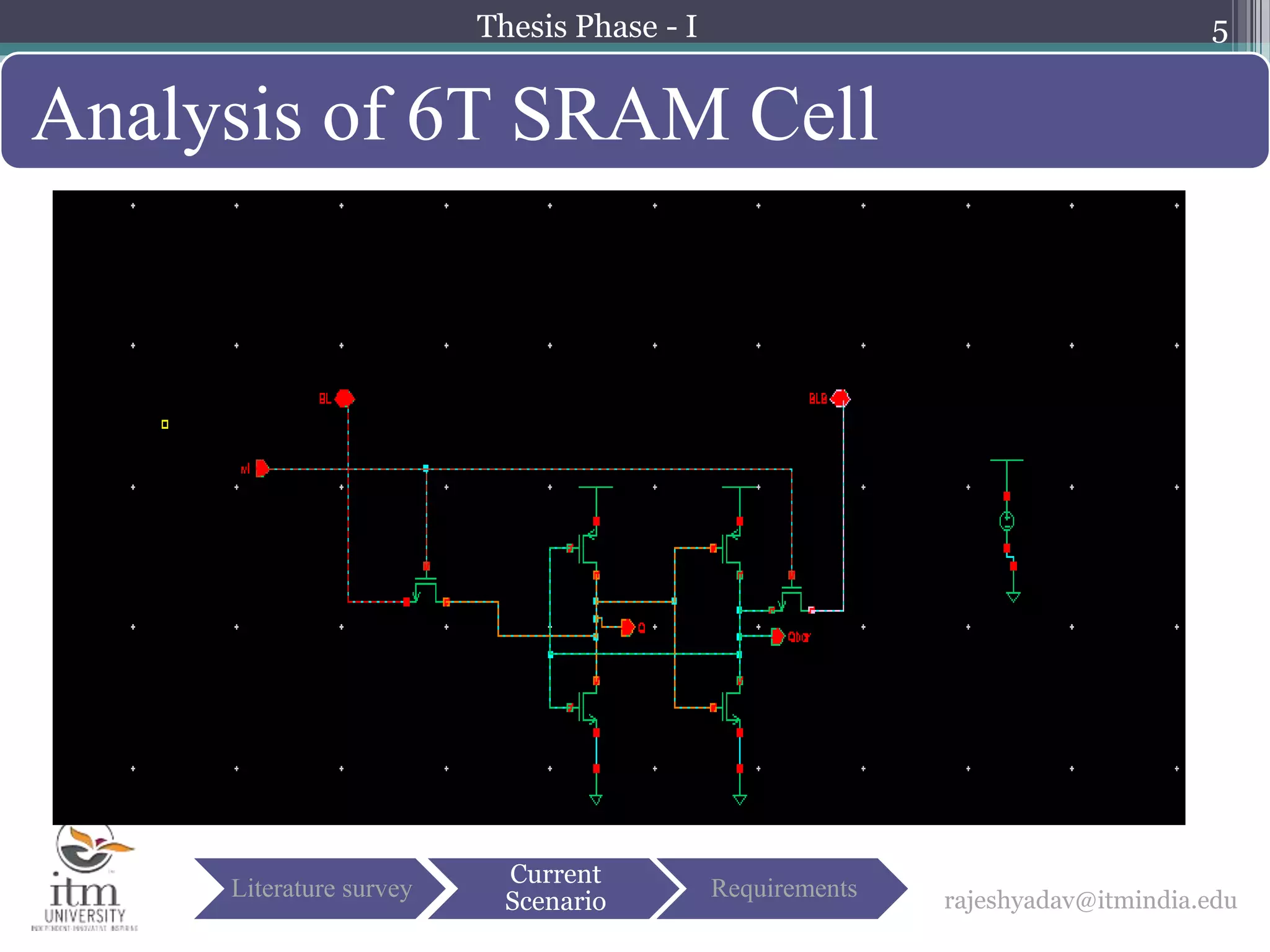
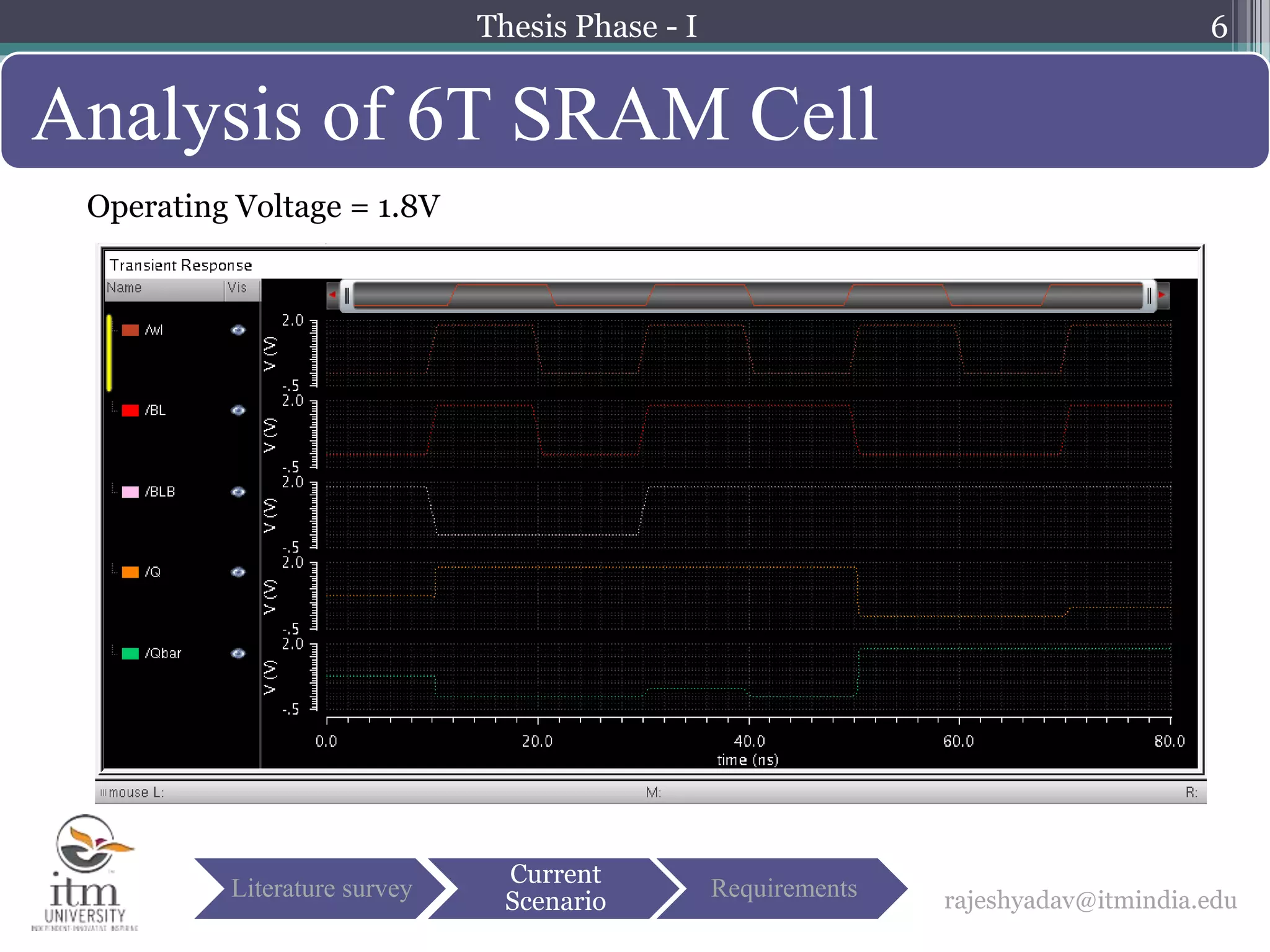
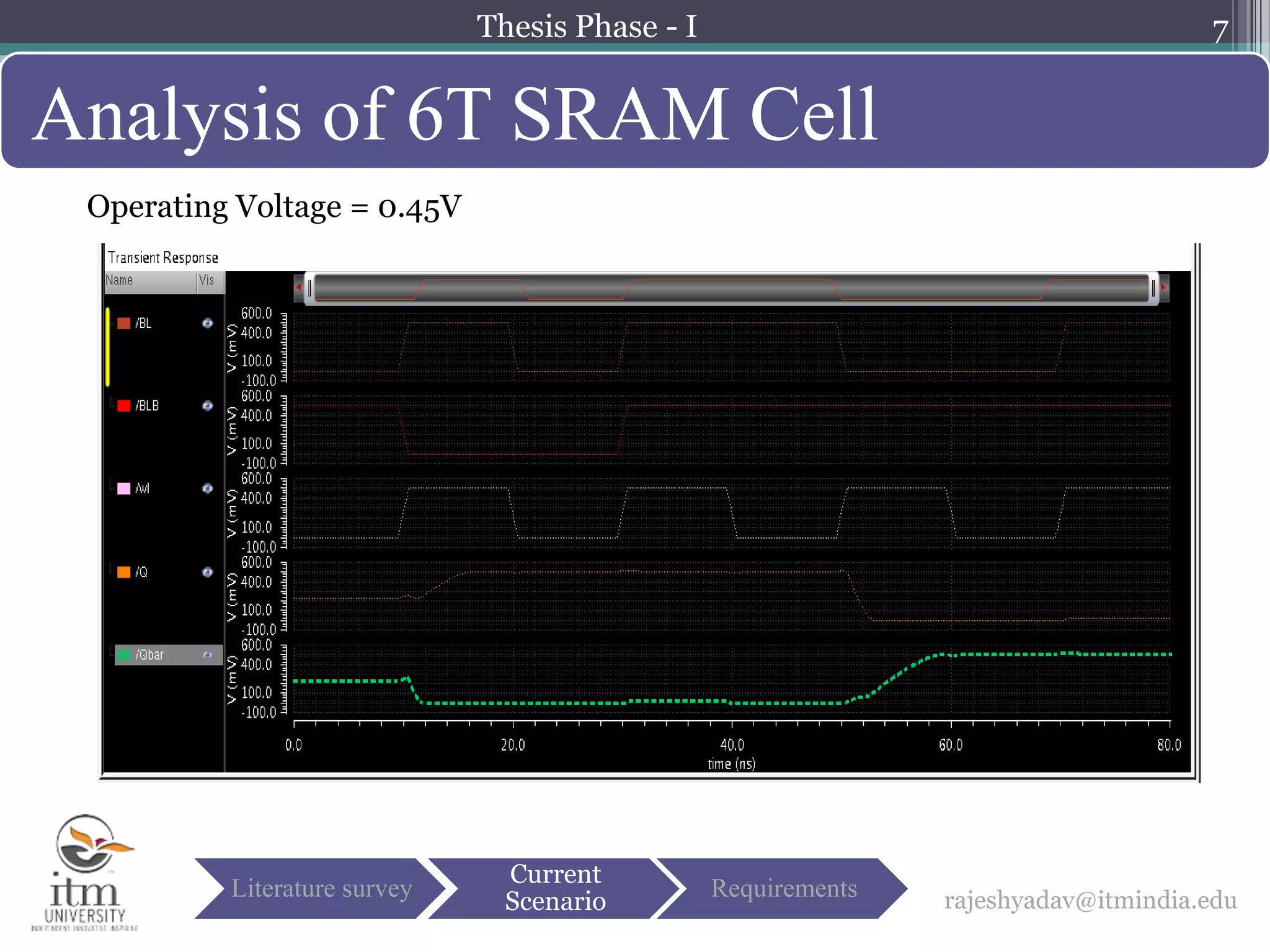
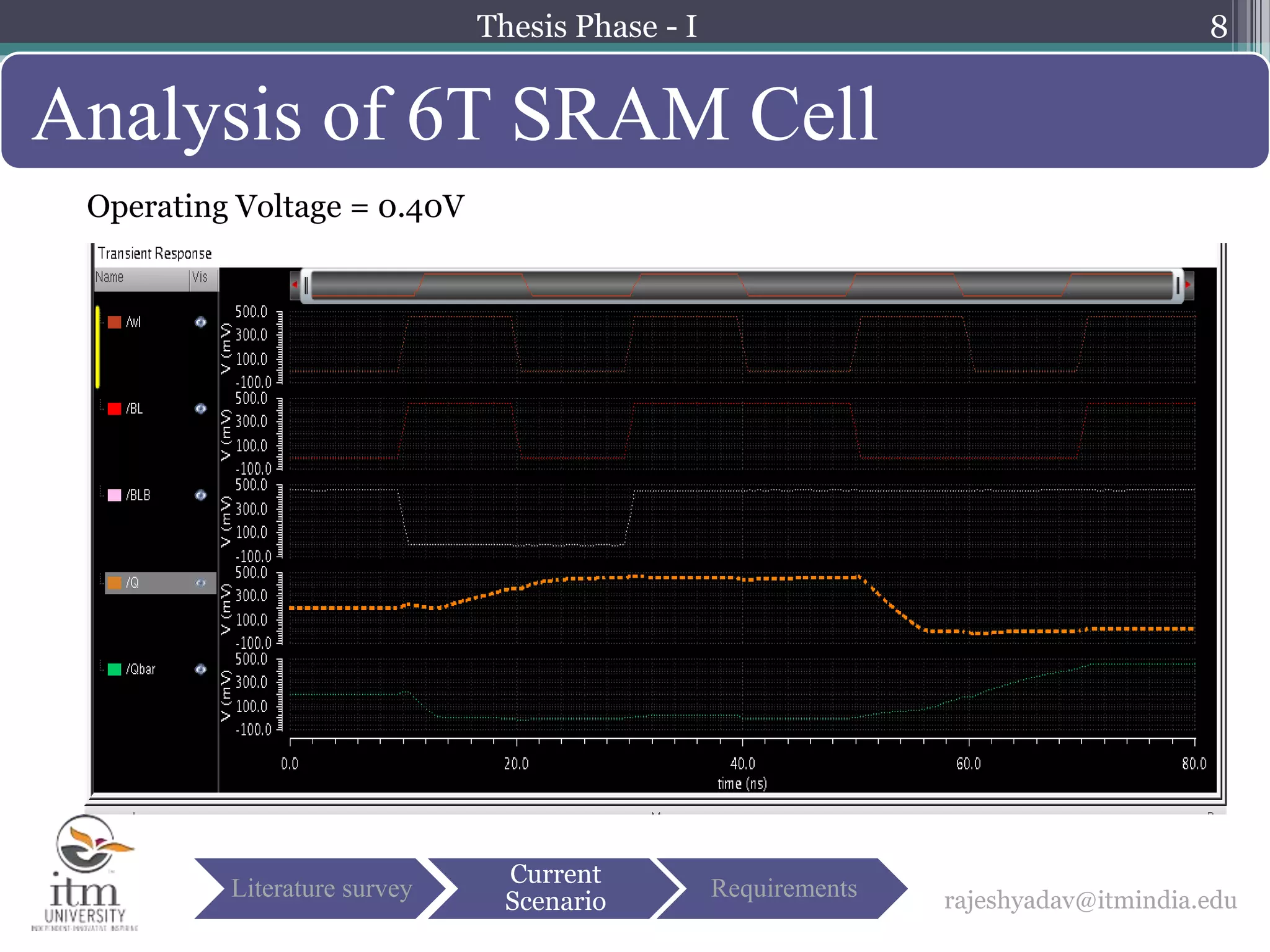
• Analysis of conventional 6T SRAM Cell
• Analysis of proposed 8T SRAM Cell
• References
2
rajeshyadav@itmindia.edu
Thesis Phase - I
• To overcome the bottleneck of 6T SRAM cell in
terms of low voltage operation.
• Design a single ended 8T SRAM cell with following
characteristics:
 Ultra Low Voltage operation
 Low power consumption
 Increased Write and Read Margin
3
Objective
rajeshyadav@itmindia.eduObjective Literature
Survey
6T SRAM Cell
Thesis Phase - I
• Most of the area of any SoC is consumed by memory.
• Minimum operating voltage of SRAM cell is 0.45V
reported till now as per my best Knowledge.
• Power dissipation will reduce, if we reduce its
operating voltage.
• As scale down the device (technology lower down)
leakage current is the major issue which causes great
power dissipation
4
Literature Survey
rajeshyadav@itmindia.eduObjective Literature
Survey
6T SRAM Cell
Thesis Phase - I
5
Analysis of 6T SRAM Cell
rajeshyadav@itmindia.eduLiterature survey
Current
Scenario
Requirements
Thesis Phase - I
6
Analysis of 6T SRAM Cell
rajeshyadav@itmindia.eduLiterature survey
Current
Scenario
Requirements
Operating Voltage = 1.8V
Thesis Phase - I
7
Analysis of 6T SRAM Cell
rajeshyadav@itmindia.eduLiterature survey
Current
Scenario
Requirements
Operating Voltage = 0.45V
Thesis Phase - I
8
Analysis of 6T SRAM Cell
rajeshyadav@itmindia.eduLiterature survey
Current
Scenario
Requirements
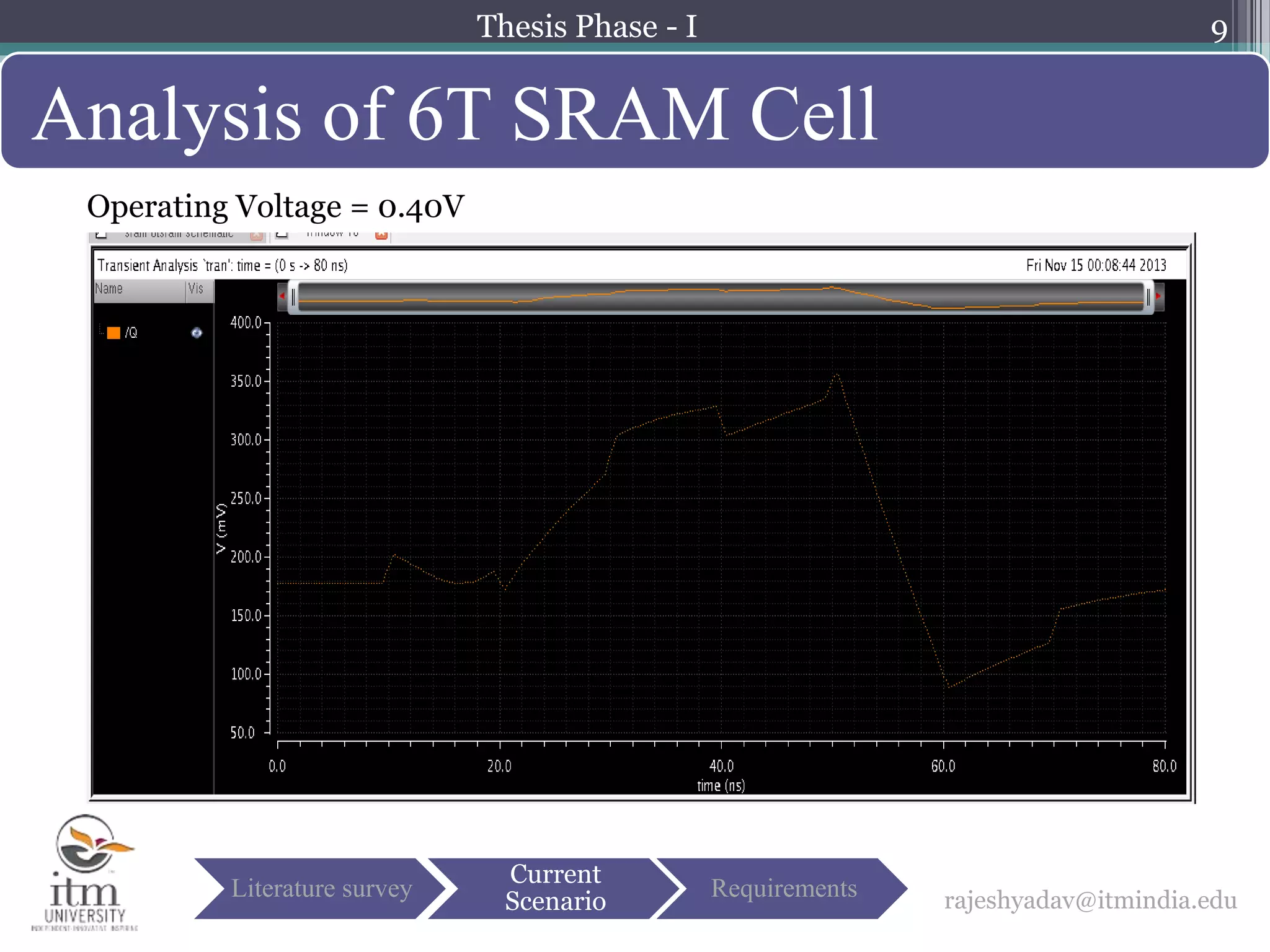
Operating Voltage = 0.40V
Thesis Phase - I
9
Analysis of 6T SRAM Cell
rajeshyadav@itmindia.eduLiterature survey
Current
Scenario
Requirements
Operating Voltage = 0.40V
Thesis Phase - I
10
Analysis of Proposed 8T SRAM Cell
rajeshyadav@itmindia.eduLiterature survey
Current
Scenario
Requirements
Thesis Phase - I
11
Analysis of Proposed 8T SRAM Cell
rajeshyadav@itmindia.eduLiterature survey
Current
Scenario
Requirements
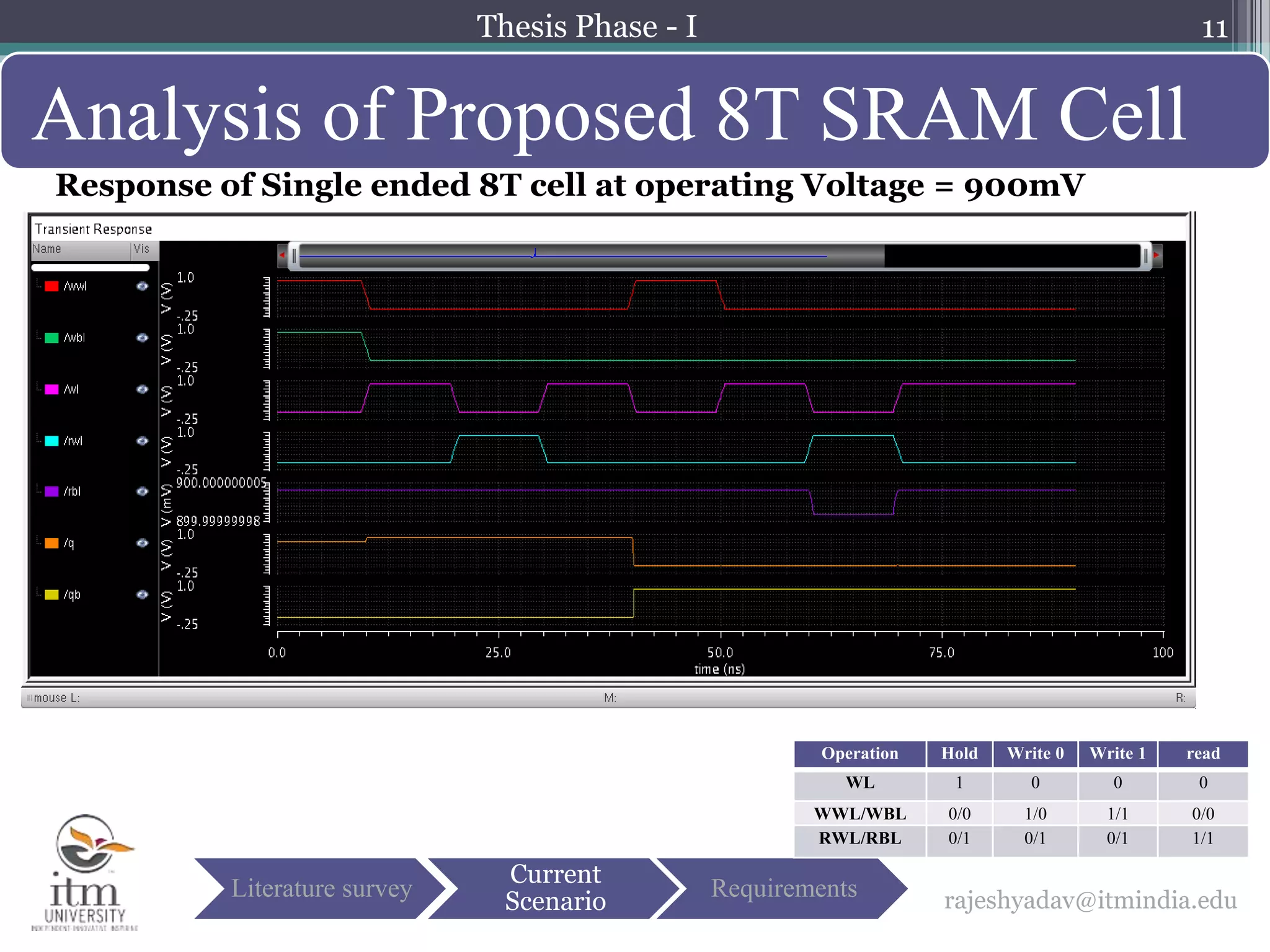
Response of Single ended 8T cell at operating Voltage = 900mV
Operation Hold Write 0 Write 1 read
WL 1 0 0 0
WWL/WBL 0/0 1/0 1/1 0/0
RWL/RBL 0/1 0/1 0/1 1/1
Thesis Phase - I
12
Analysis of Proposed 8T SRAM Cell
rajeshyadav@itmindia.eduLiterature survey
Current
Scenario
Requirements
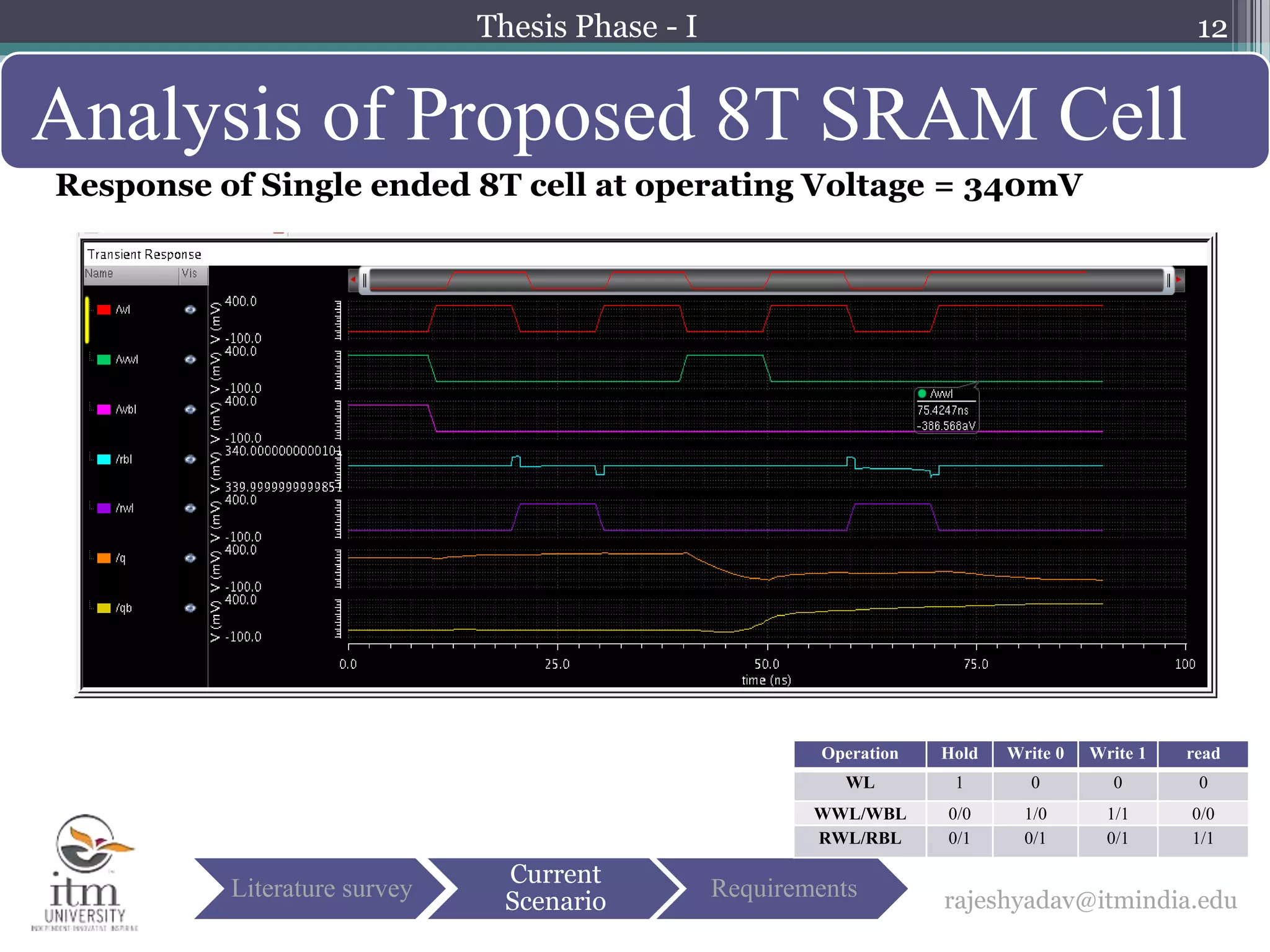
Response of Single ended 8T cell at operating Voltage = 340mV
Operation Hold Write 0 Write 1 read
WL 1 0 0 0
WWL/WBL 0/0 1/0 1/1 0/0
RWL/RBL 0/1 0/1 0/1 1/1
Thesis Phase - I
13
Analysis of Proposed 8T SRAM Cell
rajeshyadav@itmindia.eduLiterature survey
Current
Scenario
Requirements
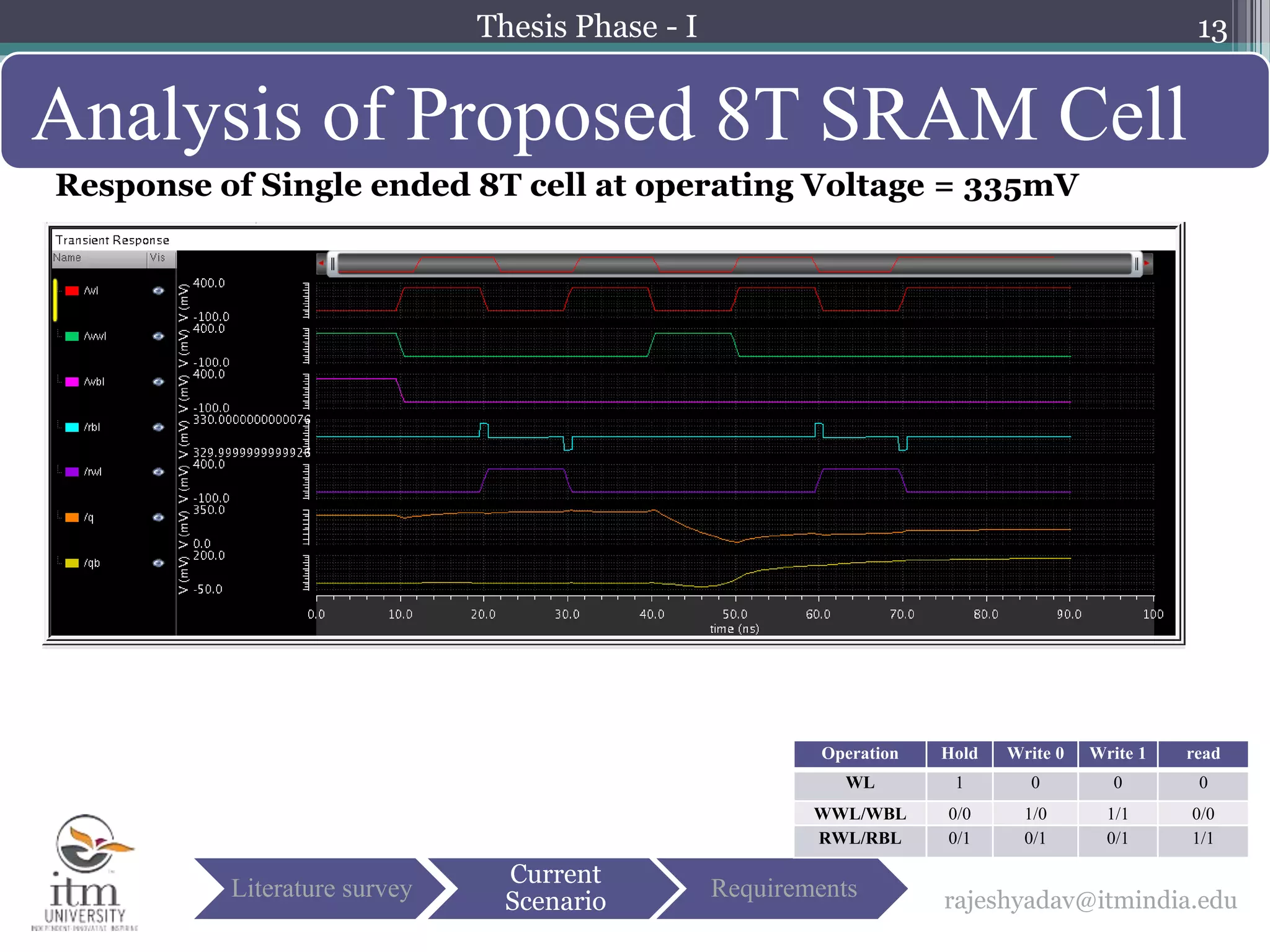
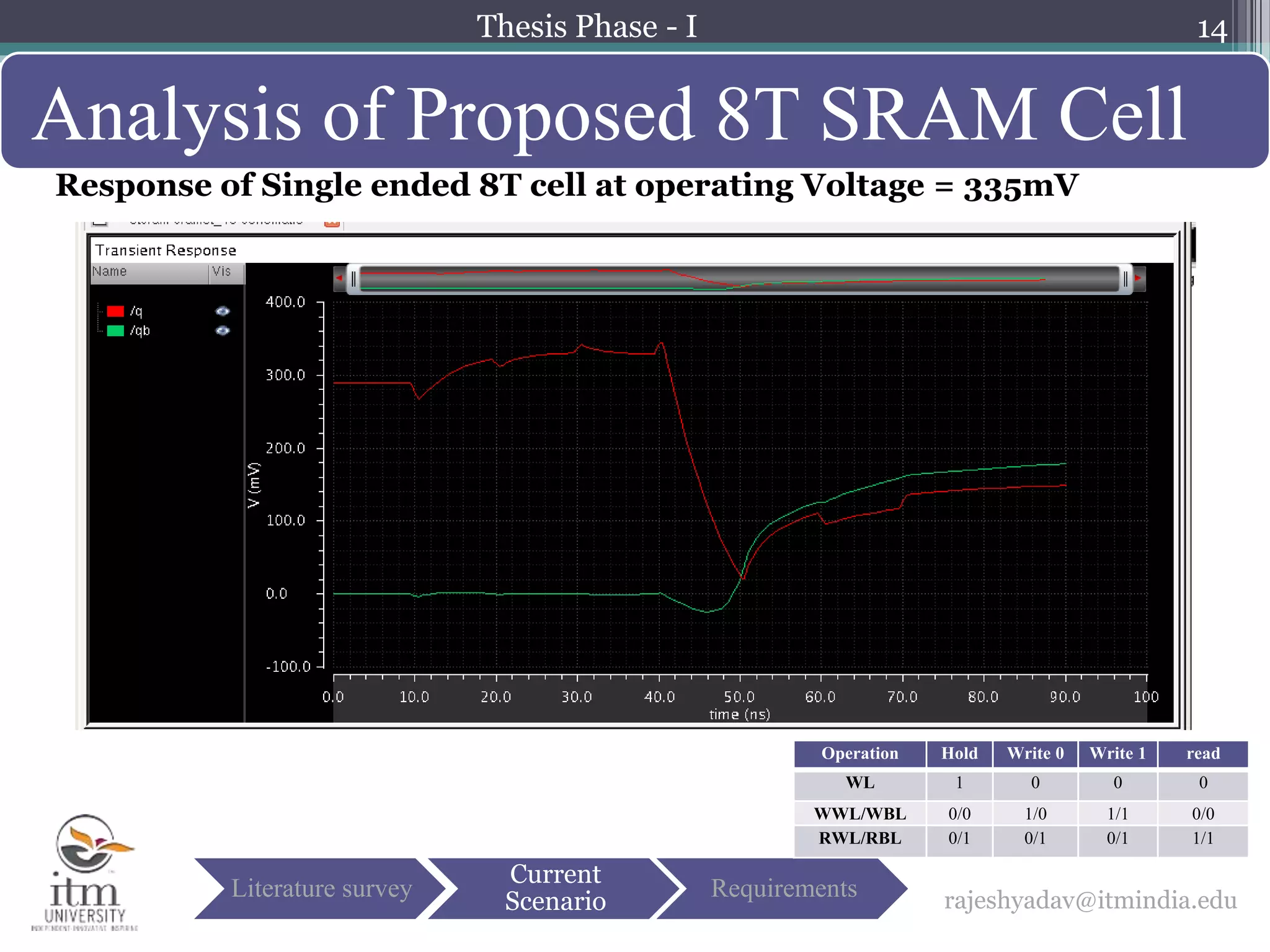
Response of Single ended 8T cell at operating Voltage = 335mV
Operation Hold Write 0 Write 1 read
WL 1 0 0 0
WWL/WBL 0/0 1/0 1/1 0/0
RWL/RBL 0/1 0/1 0/1 1/1
Thesis Phase - I
14
Analysis of Proposed 8T SRAM Cell
rajeshyadav@itmindia.eduLiterature survey
Current
Scenario
Requirements
Response of Single ended 8T cell at operating Voltage = 335mV
Operation Hold Write 0 Write 1 read
WL 1 0 0 0
WWL/WBL 0/0 1/0 1/1 0/0
RWL/RBL 0/1 0/1 0/1 1/1
Thesis Phase - I
15
Analysis of Proposed 8T SRAM Cell
rajeshyadav@itmindia.eduLiterature survey
Current
Scenario
Requirements
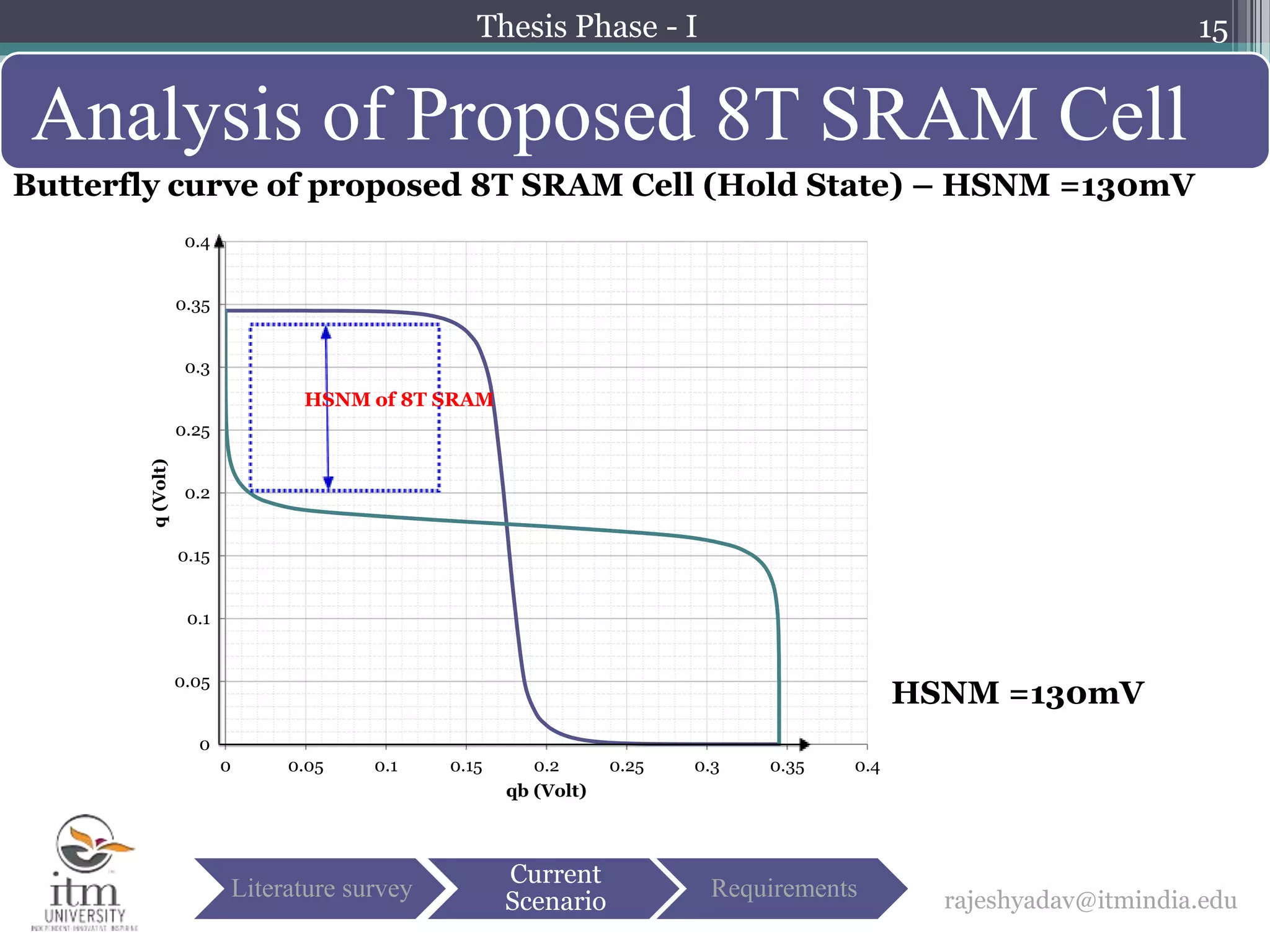
Butterfly curve of proposed 8T SRAM Cell (Hold State) – HSNM =130mV
0
0.05
0.1
0.15
0.2
0.25
0.3
0.35
0.4
0 0.05 0.1 0.15 0.2 0.25 0.3 0.35 0.4
q(Volt)
qb (Volt)
HSNM of 8T SRAM
HSNM =130mV
Thesis Phase - I
16
Analysis of Proposed 8T SRAM Cell
rajeshyadav@itmindia.eduLiterature survey
Current
Scenario
Requirements
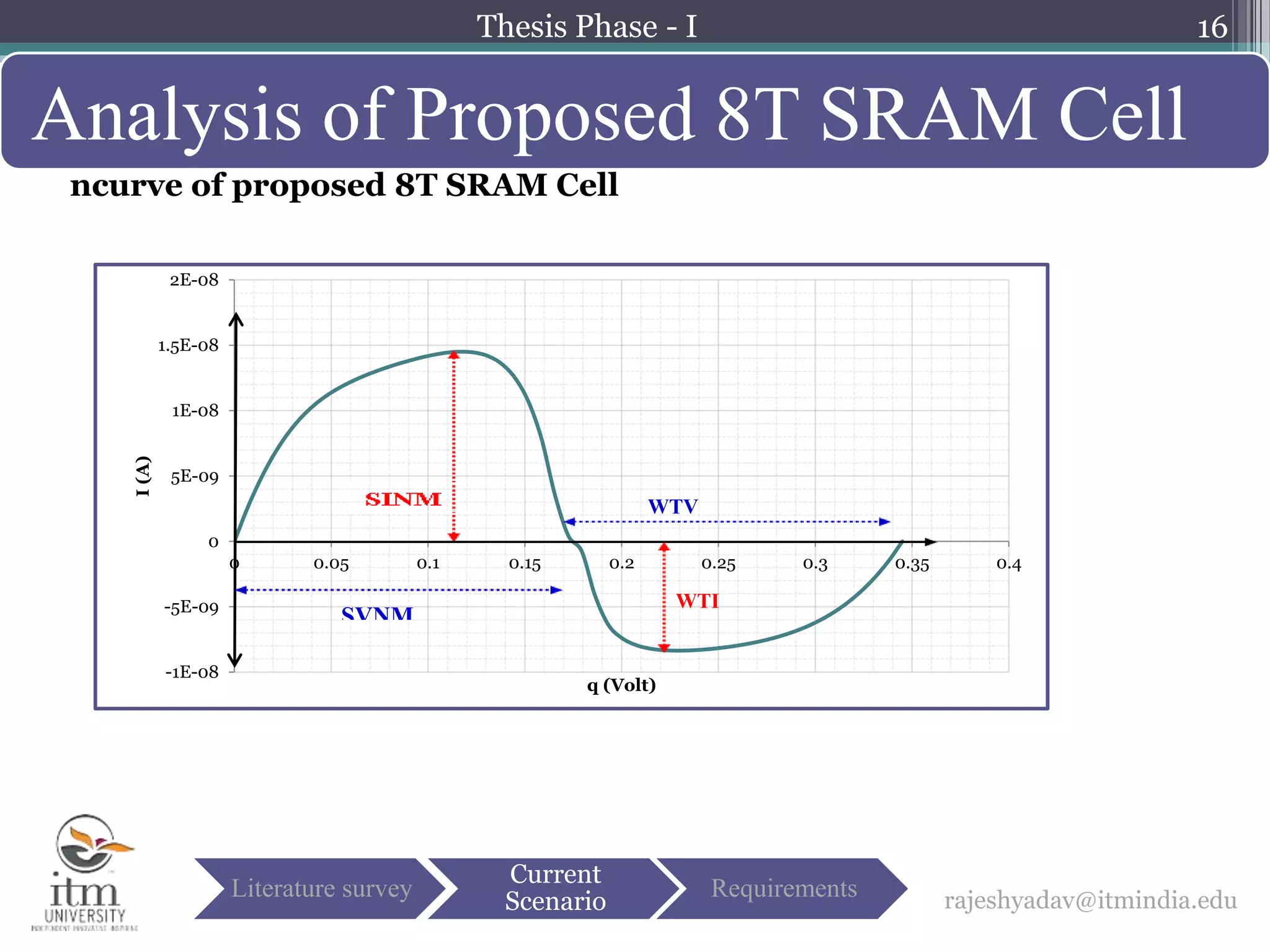
ncurve of proposed 8T SRAM Cell
-1E-08
-5E-09
0
5E-09
1E-08
1.5E-08
2E-08
0 0.05 0.1 0.15 0.2 0.25 0.3 0.35 0.4
I(A)
q (Volt)
SVNM
WTI
WTV
Thesis Phase - I
[1] Koichi Takeda et al, “A Read Static Noise Margin Free SRAM cell for Low Vdd and High Speed Applications”, Solid-
State Circuits, IEEE Journal vol. 41, Jan.2006, Issue 1 , pp.113-121
[2] M.F. Chang et al., A Differential Data Aware Power-supplied (D2AP) 8T SRAM Cell with Expanded Write / Read
Stabilities for Lower VDDmin Applications. Symposium on VLSI Circuits Digest of Technical Papers, pp. 156–157
(2009a)
[3] M. Yabuuchi et al., A 45 nm 0.6 V Cross-Point 8T SRAM with Negative Biased Read/Write Assist, Symposium on
VLSI Circuits Digest of Technical Papers, pp. 158–159 (2009) 30 2 SRAM Bit Cell Optimization
[4] L. Chang et al., An 8T-SRAM for variability tolerance and low-voltage operation in high performances caches. IEEE
J. Solid-State Circuits, 43, 4, April (2008)
[5] B.H. Calhoun et al., A 256 k Sub threshold SRAM Using 65 nm CMOS. Proceedings of IEEE International Solid-
State Circuits Conference (ISSCC), pp. 628–629, Feb 2006
[6] T.H. Kim et al., A High-Density Sub threshold SRAM with Data–Independent Bitline Leakage and Virtual Ground
Replica Scheme. Proceedings of IEEE International Solid-State Circuits Conference (ISSCC), pp. 330–331, Feb
2007
[7] I.J. Chang et al., A 32 kb 10T sub-threshold SRAM array with bit-interleaving and differential Read scheme in 90
nm CMOS. IEEE J. Solid-State Circuits 44(2), 650–658 (2009b)
[8] J. Wu et al., A Large rVTH/VDD Tolerant Zigzag 8T SRAM with Area-Efficient Decoupled Differential
Technical Papers, pp. 101–102 (2010)
[9] T. Suzuki et al., 0.5 V, 150 MHz, Bulk-CMOS SRAM with Suspended Bit-Line Read Scheme, Proceedings of Sensing
and Fast Write-Back Scheme. Symposium on VLSI Circuits Digest of IEEE European Solid-State Circuits
Conference (ESSCIRC), pp. 354–357, Sept 2010
[10] V. Sharma et al., A 4.4 pJ/Access 80 MHz, 128 kbit variability resilient SRAM with multi-sized sense amplifier
redundancy. IEEE J. Solid-State Circuits, 46, 10 (2011a)
[11] H.Pilo,J.Barwin,G.Braceras,etal.,AnSRAMdesignin65-nmand45-nm technology nodes featuring read and write-
assist circuits to expand operating voltage, Symposiumon VLSI Circuits, Digest of Technical Papers, 2006, pp.15-16.
[12] A. Bhavn agarwala, S. Kosonocky, C. Radens, etal., Fluctuation limits and scaling opportunities for CMOS SRAM
cells, in: Proceedings of International Electron Devices Meeting (IEDM) Technical Digest, 2005, pp.659-662.
17
References
rajeshyadav@itmindia.eduTrade off
Expected
Outcomes References
Thesis Phase - I
[13] A. Bhavn agarwala, S. Kosonocky, Y. Chan, etal., Asub-600mV fluctuation tolerant 65nm CMOS SRAM array with
dynamic cell biasing, Symposium on VLSI Circuits Digest of Technical Papers, 2007, pp. 78–79.
[14] M. Yamaoka, N. Maeda, Y. Shinozaki, etal., Low-power embedded SRAM modules with expanded margins
forwriting, IEEE International Solid-State Circuits Conference, Digest of Technical Papers, 2005, pp. 480–611.
[15] K. Zhang, U. Bhattacharya, Z. Chen, etal. A 3-GHz 70-MBSR AM in 65-nm CMOS technology with integrated
column-based dynamic power supply, IEEE J. Solid-State Circuits 41(1)(2006)146–151.
[16] S. Ohbayashi ,M. Yabuuchi, K.Nii ,etal., A 65-nm SoC embedded 6T-SRAM designed for manufactur ability with
read and write operation stabilizing circuits, IEEE J.Solid-State Circuits 42 (4) (2007) 820–829.
[17] K.Sohn,Y.H.Suh,Y.J.Son,etal.,A100-nmdouble-stacked500-MHz72-MB separate I/O synchronous SRAM with
automatic cell-bias scheme and adaptive block redundancy, IEEE International Solid-State Circuits Conference,
Digest of Technical Papers, 2008, pp.386–622.
[18] O .Hirabayashi ,A. Katayama, A. Suzuki, etal., Aprocess-variation-tolerant dual-power-supply SRAM with 0.179-
mm 2 cell in 40-nm CMOS using level-programmable wordline driver, IEEE International Solid-State Circuits
Conference, Digest of Technical Papers, 2009, pp. 458–459.
[19] Y.H.Chen, W.M.Chan, S.Y.Chou, etal., A 0.6-V 45-nm adaptive dual-rail SRAM compiler circuit design for lower
VDDmin VLSIs, Symposiumon VLSI Circuits Digest of Technical Papers, 2008, pp. 210–211.
[20] M. Khellah, N. S. Kim, J. Howard, etal., A 4.2-GHz 0.3-mm 2 256 KB dual-Vcc SRAM building blockin65-
nmCMOS,IEEEInternationalSolid-StateCircuits Conference, DigestofTechnicalPapers,2006,pp.2572–2581.
[21] [13]J.Davis,D.Plass,P.Bunce,etal.,A5.6GHz64-KBdual-readdatacacheforthe POWER6TM
processor,IEEEInternationalSolid-StateCircuitsConference, Digest ofTechnicalPapers,2006,pp.2564–2571.
[22] [14]J.Pille,C.Adams,T.Christensen,etal.,ImplementationoftheCELLbroadband engine ina65-
nmSOItechnologyfeaturingdual-supplySRAMarrays supporting 6GHzat1.3V,IEEEInternationalSolid-
StateCircuitsConference, Digest ofTechnicalPapers,2007,pp.322–606.
[23] [15] M. Yamaoka,K.Osada,K.Ishibashi,0.4-Vlogic–library-friendlySRAMarray using rectangular-
diffusioncellanddelta-boosted-arrayvoltagescheme,IEEE J. Solid-StateCircuits39(6)(2004)934–940.
[24] [16] F.S.Lai,C.F.Lee,On-chipvoltagedownconvertertoimproveSRAMread/write margin andstaticpowerforsub-
nanoCMOStechnology,IEEEJ.Solid-State Circuits 42(9)(2007)2061–2070.
18
References
rajeshyadav@itmindia.eduTrade off
Expected
Outcomes References
Thesis Phase - I
Thank You For Your
Kind Attention
19Thesis Phase - I
Open For Discussion
20
???
Pre-Thesis Presentation , Phase - I

SRAM- Ultra low voltage operation

  • 1.
    DESIGN OF ANOVEL SINGLE- ENDED, ROBUST 8T SRAM CELL FOR ULTRA LOW-VOLTAGE, APPLICATIONS Presented By: Rajesh Yadav 12ECP01P- M.Tech.(VLSI Design) rajeshyadav@itmindia.edu Thesis Phase - I 7th December 2013
  • 2.
    Contents • Objective • LiteratureSurvey • Analysis of conventional 6T SRAM Cell • Analysis of proposed 8T SRAM Cell • References 2 rajeshyadav@itmindia.edu Thesis Phase - I
  • 3.
    • To overcomethe bottleneck of 6T SRAM cell in terms of low voltage operation. • Design a single ended 8T SRAM cell with following characteristics:  Ultra Low Voltage operation  Low power consumption  Increased Write and Read Margin 3 Objective rajeshyadav@itmindia.eduObjective Literature Survey 6T SRAM Cell Thesis Phase - I
  • 4.
    • Most ofthe area of any SoC is consumed by memory. • Minimum operating voltage of SRAM cell is 0.45V reported till now as per my best Knowledge. • Power dissipation will reduce, if we reduce its operating voltage. • As scale down the device (technology lower down) leakage current is the major issue which causes great power dissipation 4 Literature Survey rajeshyadav@itmindia.eduObjective Literature Survey 6T SRAM Cell Thesis Phase - I
  • 5.
    5 Analysis of 6TSRAM Cell rajeshyadav@itmindia.eduLiterature survey Current Scenario Requirements Thesis Phase - I
  • 6.
    6 Analysis of 6TSRAM Cell rajeshyadav@itmindia.eduLiterature survey Current Scenario Requirements Operating Voltage = 1.8V Thesis Phase - I
  • 7.
    7 Analysis of 6TSRAM Cell rajeshyadav@itmindia.eduLiterature survey Current Scenario Requirements Operating Voltage = 0.45V Thesis Phase - I
  • 8.
    8 Analysis of 6TSRAM Cell rajeshyadav@itmindia.eduLiterature survey Current Scenario Requirements Operating Voltage = 0.40V Thesis Phase - I
  • 9.
    9 Analysis of 6TSRAM Cell rajeshyadav@itmindia.eduLiterature survey Current Scenario Requirements Operating Voltage = 0.40V Thesis Phase - I
  • 10.
    10 Analysis of Proposed8T SRAM Cell rajeshyadav@itmindia.eduLiterature survey Current Scenario Requirements Thesis Phase - I
  • 11.
    11 Analysis of Proposed8T SRAM Cell rajeshyadav@itmindia.eduLiterature survey Current Scenario Requirements Response of Single ended 8T cell at operating Voltage = 900mV Operation Hold Write 0 Write 1 read WL 1 0 0 0 WWL/WBL 0/0 1/0 1/1 0/0 RWL/RBL 0/1 0/1 0/1 1/1 Thesis Phase - I
  • 12.
    12 Analysis of Proposed8T SRAM Cell rajeshyadav@itmindia.eduLiterature survey Current Scenario Requirements Response of Single ended 8T cell at operating Voltage = 340mV Operation Hold Write 0 Write 1 read WL 1 0 0 0 WWL/WBL 0/0 1/0 1/1 0/0 RWL/RBL 0/1 0/1 0/1 1/1 Thesis Phase - I
  • 13.
    13 Analysis of Proposed8T SRAM Cell rajeshyadav@itmindia.eduLiterature survey Current Scenario Requirements Response of Single ended 8T cell at operating Voltage = 335mV Operation Hold Write 0 Write 1 read WL 1 0 0 0 WWL/WBL 0/0 1/0 1/1 0/0 RWL/RBL 0/1 0/1 0/1 1/1 Thesis Phase - I
  • 14.
    14 Analysis of Proposed8T SRAM Cell rajeshyadav@itmindia.eduLiterature survey Current Scenario Requirements Response of Single ended 8T cell at operating Voltage = 335mV Operation Hold Write 0 Write 1 read WL 1 0 0 0 WWL/WBL 0/0 1/0 1/1 0/0 RWL/RBL 0/1 0/1 0/1 1/1 Thesis Phase - I
  • 15.
    15 Analysis of Proposed8T SRAM Cell rajeshyadav@itmindia.eduLiterature survey Current Scenario Requirements Butterfly curve of proposed 8T SRAM Cell (Hold State) – HSNM =130mV 0 0.05 0.1 0.15 0.2 0.25 0.3 0.35 0.4 0 0.05 0.1 0.15 0.2 0.25 0.3 0.35 0.4 q(Volt) qb (Volt) HSNM of 8T SRAM HSNM =130mV Thesis Phase - I
  • 16.
    16 Analysis of Proposed8T SRAM Cell rajeshyadav@itmindia.eduLiterature survey Current Scenario Requirements ncurve of proposed 8T SRAM Cell -1E-08 -5E-09 0 5E-09 1E-08 1.5E-08 2E-08 0 0.05 0.1 0.15 0.2 0.25 0.3 0.35 0.4 I(A) q (Volt) SVNM WTI WTV Thesis Phase - I
  • 17.
    [1] Koichi Takedaet al, “A Read Static Noise Margin Free SRAM cell for Low Vdd and High Speed Applications”, Solid- State Circuits, IEEE Journal vol. 41, Jan.2006, Issue 1 , pp.113-121 [2] M.F. Chang et al., A Differential Data Aware Power-supplied (D2AP) 8T SRAM Cell with Expanded Write / Read Stabilities for Lower VDDmin Applications. Symposium on VLSI Circuits Digest of Technical Papers, pp. 156–157 (2009a) [3] M. Yabuuchi et al., A 45 nm 0.6 V Cross-Point 8T SRAM with Negative Biased Read/Write Assist, Symposium on VLSI Circuits Digest of Technical Papers, pp. 158–159 (2009) 30 2 SRAM Bit Cell Optimization [4] L. Chang et al., An 8T-SRAM for variability tolerance and low-voltage operation in high performances caches. IEEE J. Solid-State Circuits, 43, 4, April (2008) [5] B.H. Calhoun et al., A 256 k Sub threshold SRAM Using 65 nm CMOS. Proceedings of IEEE International Solid- State Circuits Conference (ISSCC), pp. 628–629, Feb 2006 [6] T.H. Kim et al., A High-Density Sub threshold SRAM with Data–Independent Bitline Leakage and Virtual Ground Replica Scheme. Proceedings of IEEE International Solid-State Circuits Conference (ISSCC), pp. 330–331, Feb 2007 [7] I.J. Chang et al., A 32 kb 10T sub-threshold SRAM array with bit-interleaving and differential Read scheme in 90 nm CMOS. IEEE J. Solid-State Circuits 44(2), 650–658 (2009b) [8] J. Wu et al., A Large rVTH/VDD Tolerant Zigzag 8T SRAM with Area-Efficient Decoupled Differential Technical Papers, pp. 101–102 (2010) [9] T. Suzuki et al., 0.5 V, 150 MHz, Bulk-CMOS SRAM with Suspended Bit-Line Read Scheme, Proceedings of Sensing and Fast Write-Back Scheme. Symposium on VLSI Circuits Digest of IEEE European Solid-State Circuits Conference (ESSCIRC), pp. 354–357, Sept 2010 [10] V. Sharma et al., A 4.4 pJ/Access 80 MHz, 128 kbit variability resilient SRAM with multi-sized sense amplifier redundancy. IEEE J. Solid-State Circuits, 46, 10 (2011a) [11] H.Pilo,J.Barwin,G.Braceras,etal.,AnSRAMdesignin65-nmand45-nm technology nodes featuring read and write- assist circuits to expand operating voltage, Symposiumon VLSI Circuits, Digest of Technical Papers, 2006, pp.15-16. [12] A. Bhavn agarwala, S. Kosonocky, C. Radens, etal., Fluctuation limits and scaling opportunities for CMOS SRAM cells, in: Proceedings of International Electron Devices Meeting (IEDM) Technical Digest, 2005, pp.659-662. 17 References rajeshyadav@itmindia.eduTrade off Expected Outcomes References Thesis Phase - I
  • 18.
    [13] A. Bhavnagarwala, S. Kosonocky, Y. Chan, etal., Asub-600mV fluctuation tolerant 65nm CMOS SRAM array with dynamic cell biasing, Symposium on VLSI Circuits Digest of Technical Papers, 2007, pp. 78–79. [14] M. Yamaoka, N. Maeda, Y. Shinozaki, etal., Low-power embedded SRAM modules with expanded margins forwriting, IEEE International Solid-State Circuits Conference, Digest of Technical Papers, 2005, pp. 480–611. [15] K. Zhang, U. Bhattacharya, Z. Chen, etal. A 3-GHz 70-MBSR AM in 65-nm CMOS technology with integrated column-based dynamic power supply, IEEE J. Solid-State Circuits 41(1)(2006)146–151. [16] S. Ohbayashi ,M. Yabuuchi, K.Nii ,etal., A 65-nm SoC embedded 6T-SRAM designed for manufactur ability with read and write operation stabilizing circuits, IEEE J.Solid-State Circuits 42 (4) (2007) 820–829. [17] K.Sohn,Y.H.Suh,Y.J.Son,etal.,A100-nmdouble-stacked500-MHz72-MB separate I/O synchronous SRAM with automatic cell-bias scheme and adaptive block redundancy, IEEE International Solid-State Circuits Conference, Digest of Technical Papers, 2008, pp.386–622. [18] O .Hirabayashi ,A. Katayama, A. Suzuki, etal., Aprocess-variation-tolerant dual-power-supply SRAM with 0.179- mm 2 cell in 40-nm CMOS using level-programmable wordline driver, IEEE International Solid-State Circuits Conference, Digest of Technical Papers, 2009, pp. 458–459. [19] Y.H.Chen, W.M.Chan, S.Y.Chou, etal., A 0.6-V 45-nm adaptive dual-rail SRAM compiler circuit design for lower VDDmin VLSIs, Symposiumon VLSI Circuits Digest of Technical Papers, 2008, pp. 210–211. [20] M. Khellah, N. S. Kim, J. Howard, etal., A 4.2-GHz 0.3-mm 2 256 KB dual-Vcc SRAM building blockin65- nmCMOS,IEEEInternationalSolid-StateCircuits Conference, DigestofTechnicalPapers,2006,pp.2572–2581. [21] [13]J.Davis,D.Plass,P.Bunce,etal.,A5.6GHz64-KBdual-readdatacacheforthe POWER6TM processor,IEEEInternationalSolid-StateCircuitsConference, Digest ofTechnicalPapers,2006,pp.2564–2571. [22] [14]J.Pille,C.Adams,T.Christensen,etal.,ImplementationoftheCELLbroadband engine ina65- nmSOItechnologyfeaturingdual-supplySRAMarrays supporting 6GHzat1.3V,IEEEInternationalSolid- StateCircuitsConference, Digest ofTechnicalPapers,2007,pp.322–606. [23] [15] M. Yamaoka,K.Osada,K.Ishibashi,0.4-Vlogic–library-friendlySRAMarray using rectangular- diffusioncellanddelta-boosted-arrayvoltagescheme,IEEE J. Solid-StateCircuits39(6)(2004)934–940. [24] [16] F.S.Lai,C.F.Lee,On-chipvoltagedownconvertertoimproveSRAMread/write margin andstaticpowerforsub- nanoCMOStechnology,IEEEJ.Solid-State Circuits 42(9)(2007)2061–2070. 18 References rajeshyadav@itmindia.eduTrade off Expected Outcomes References Thesis Phase - I
  • 19.
    Thank You ForYour Kind Attention 19Thesis Phase - I
  • 20.
    Open For Discussion 20 ??? Pre-ThesisPresentation , Phase - I