BY:
RAJESH YADAV
M.TECH VLSI
12ECP01P
Floorplanning is the first major step in
physical design; it is particularly important
because the resulting floorplan affects all the
subsequent steps in physical design, such as
placement and routing.
Floorplanning provides early feedback that:
 evaluates architectural decisions,
 estimates chip areas, and
 estimates delay and congestion caused by
wiring.
Two popular approaches to floorplanning are:
 simulated annealing: simulated annealing-
based floorplanning relies on the
representation of the geometric relationship
among modules and
 analytical formulation: an analytical approach
usually captures the absolute relationship
directly.
The representation of geometric relationship
is done using three popular floorplan
representations:
 normalized Polish expression
 B*-tree
 Sequence Pair
These representations are efficient, flexible,
and effective in modeling geometric
relationships (e.g., left, right, above, and
below relationships) among modules for
floorplan designs.
Let B = {b1, b2, ..., bm} be a set of m rectangular
modules whose respective width, height, and area are
denoted by wi, hi, and ai, 1<= i <= m. Each module is
free to rotate.
Let (xi , yi) denote the coordinate of the bottom-left
corner of module bi such that no two modules
overlap with each other.
The goal of floorplanning is to optimize a predefined
cost metric such as a combination of the area (i.e.,
the minimum bounding rectangle of F ) and wire
length (i.e., the sum of all interconnection lengths)
induced by a floorplan.
For modern floorplan designs, other costs such as
routability, power, and thermal might also need to be
considered.
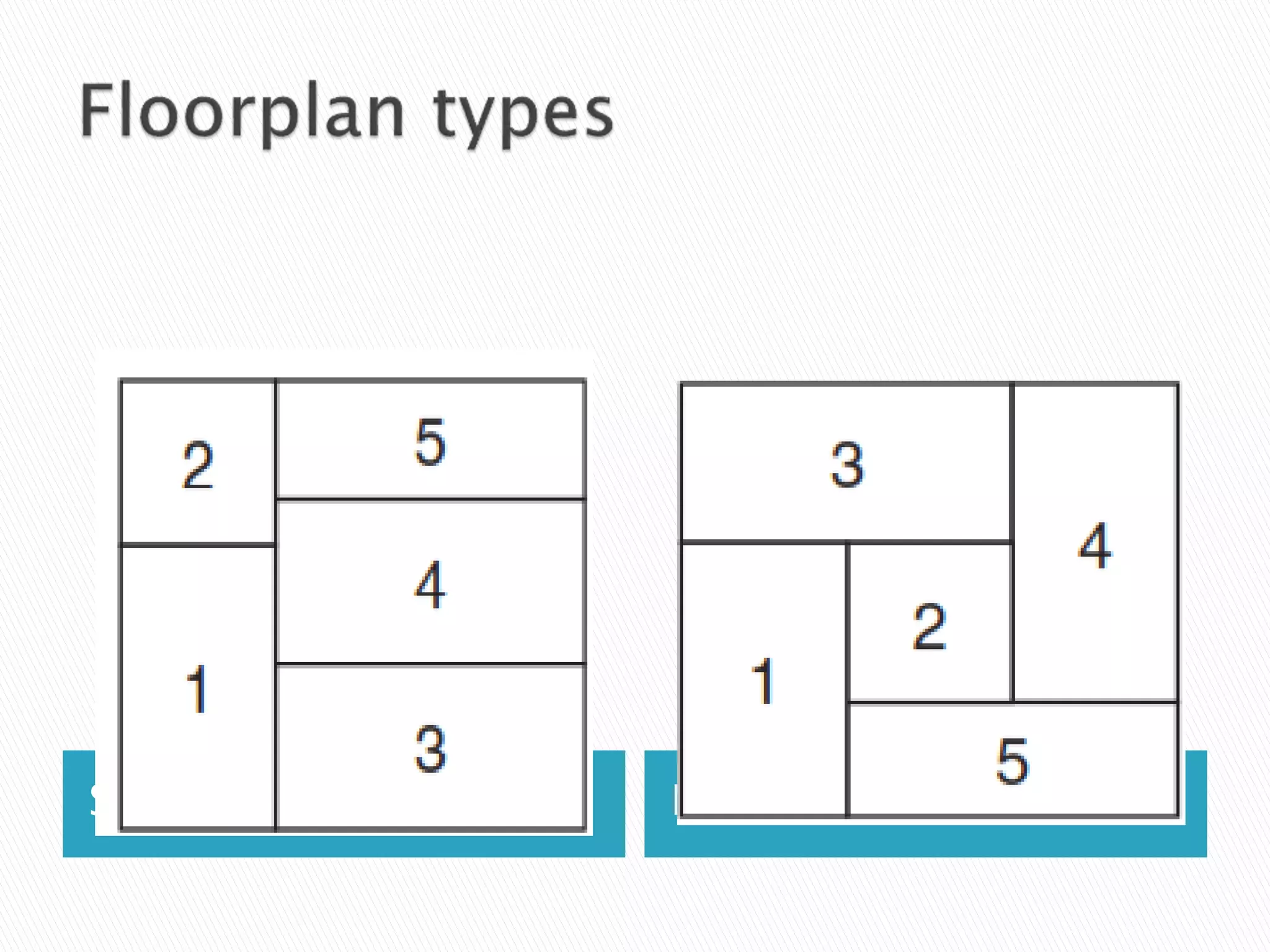
two categories for discussions:
 Slicing floorplans: A slicing floorplan can be
obtained by repetitively cutting the floorplan
horizontally or vertically
 Non-slicing floorplans: it is not so in this
case.
We can use a binary tree to represent a slicing
floorplan.
A slicing tree is a binary tree with modules at
the leaves and cut types at the internal nodes.
There are two cut types, H and V. The H cut
divides the floorplan horizontally. Similarly,
the V cut divides the floorplan vertically.
Slicing floorplan may correspond to more
than one slicing tree, because the order of
the cut-line selections may be different.
Slicing floorplan Non-slicing floorplan
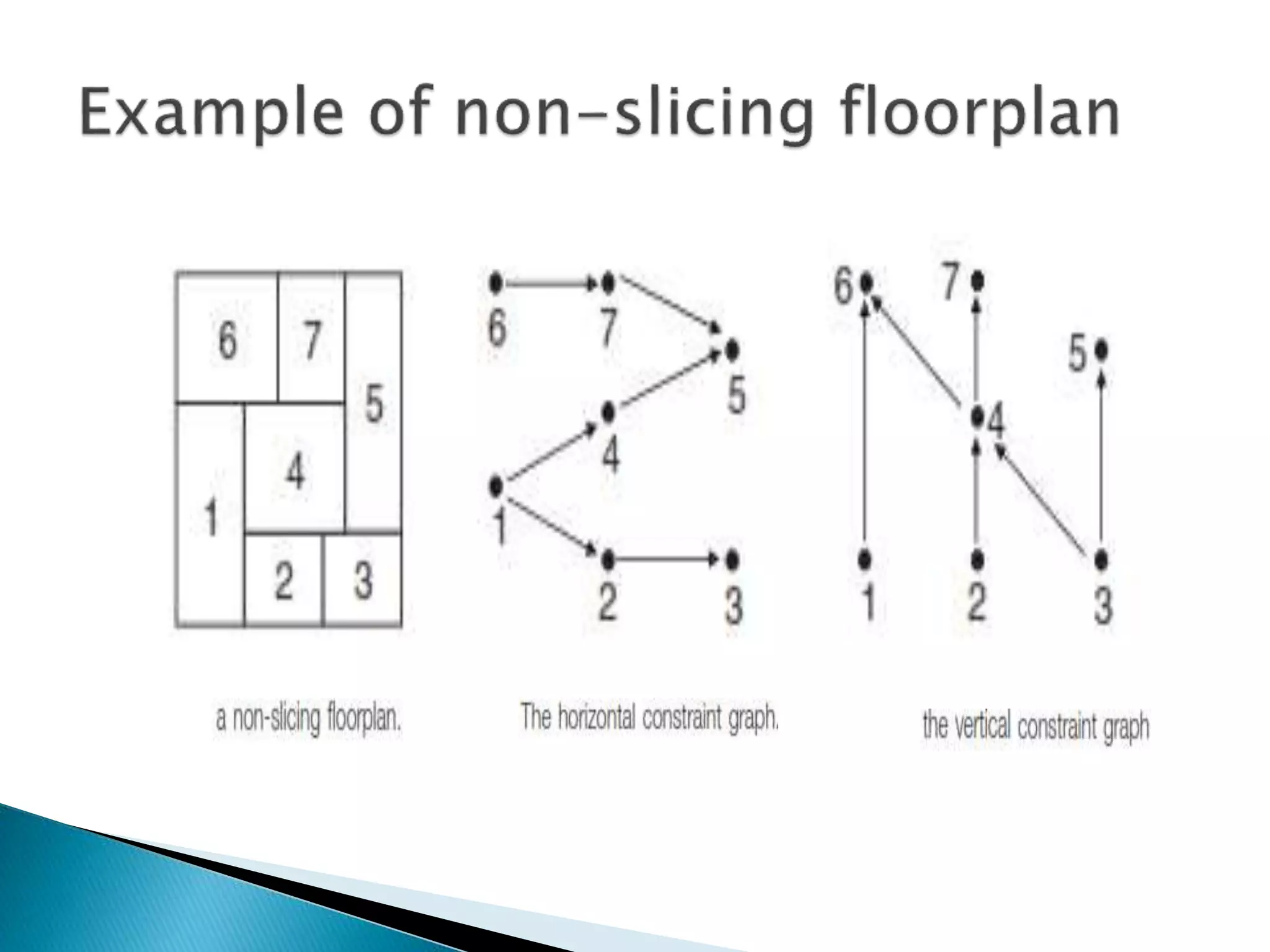
We use a horizontal constraint graph ( HCG)
and a vertical constraint graph ( VCG) to
model a non-slicing floorplan.
The horizontal constraint graph defines the
horizontal relations of modules, and the
vertical constraint graph defines the vertical
ones.
In a constraint graph, a node represents a
module. If there is an edge from node A to
node B in the HCG ( VCG), then module A is at
the left (bottom) of module B.
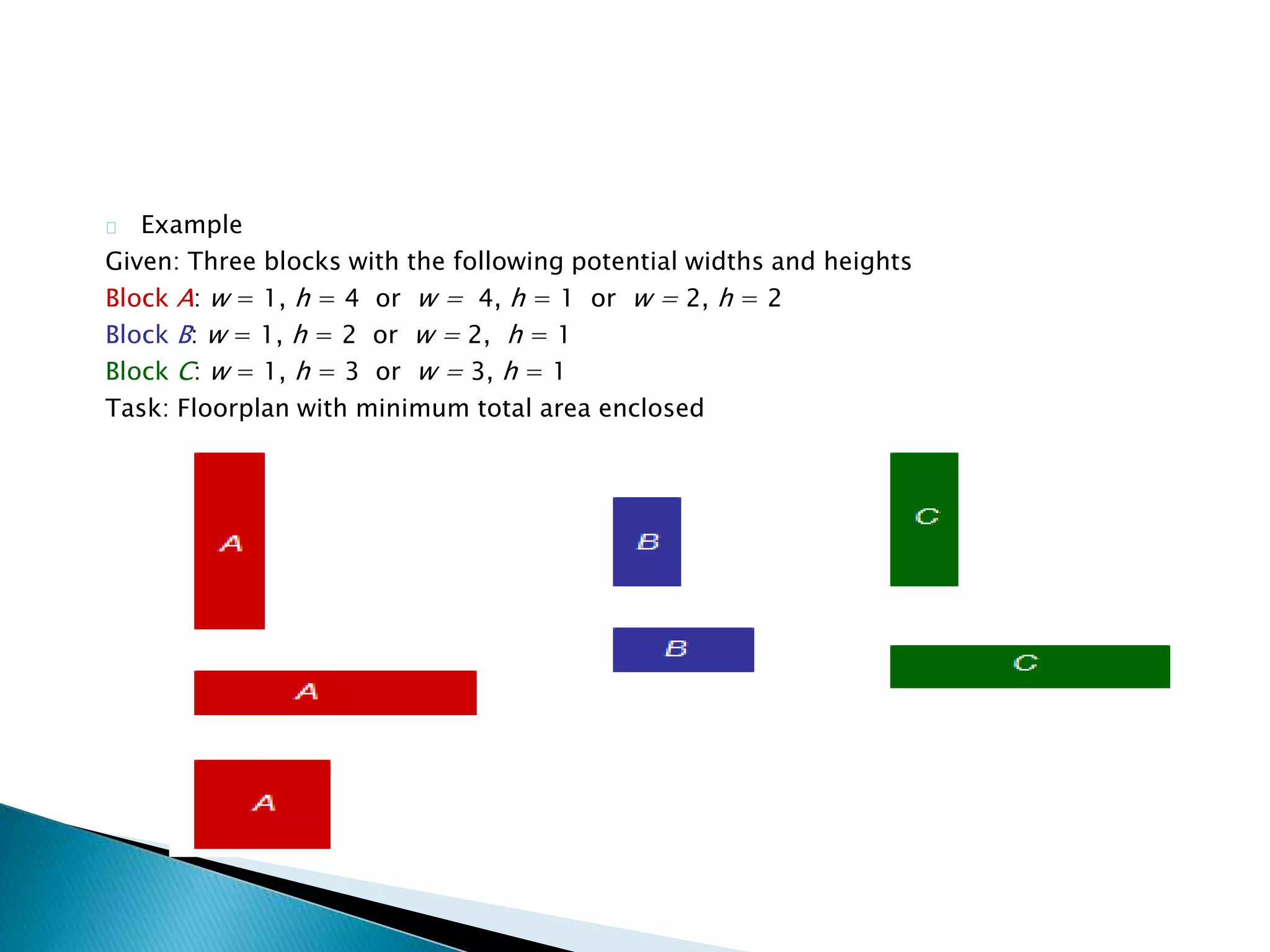
Example
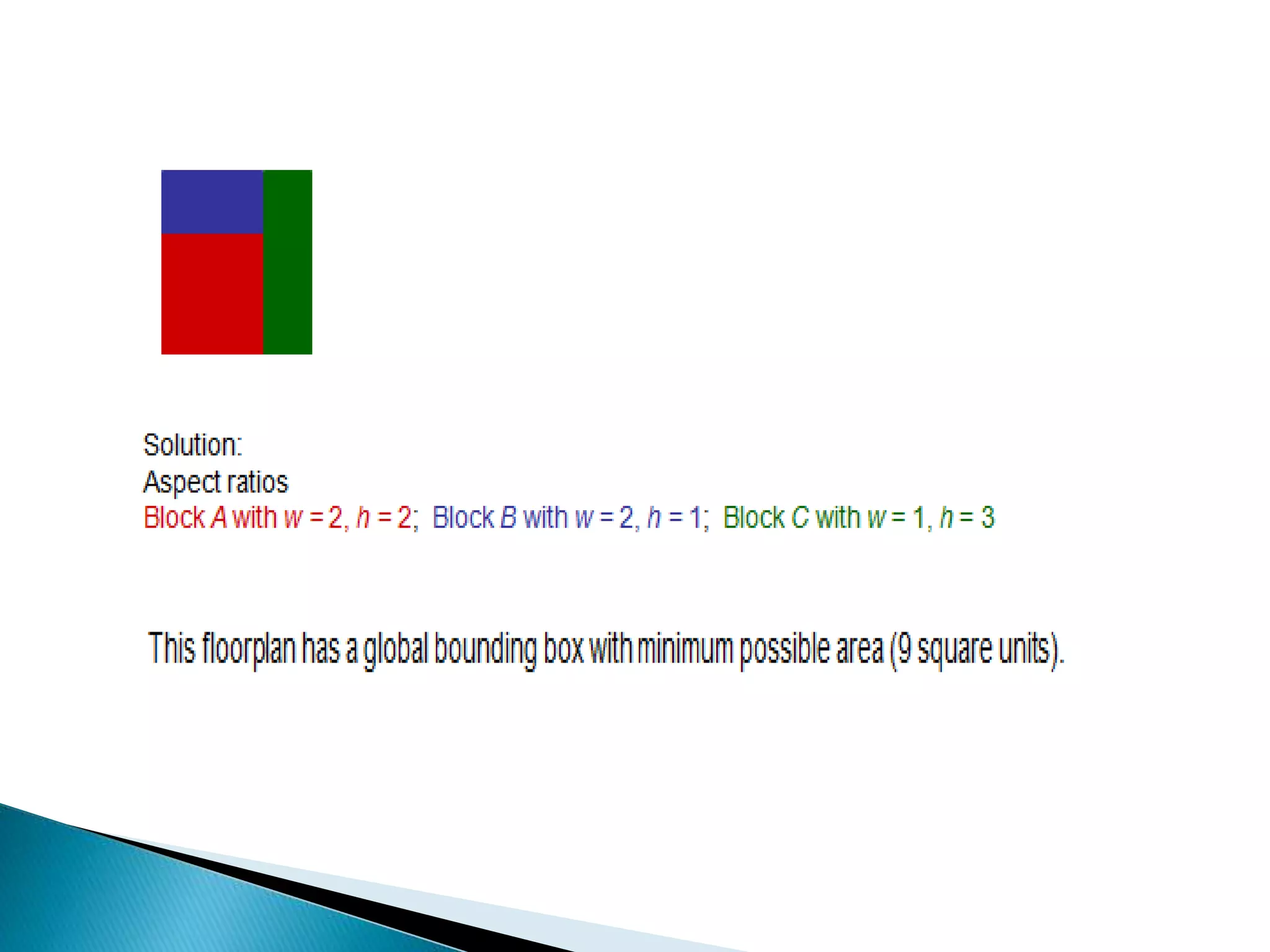
Given: Three blocks with the following potential widths and heights
Block A: w = 1, h = 4 or w = 4, h = 1 or w = 2, h = 2
Block B: w = 1, h = 2 or w = 2, h = 1
Block C: w = 1, h = 3 or w = 3, h = 1
Task: Floorplan with minimum total area enclosed
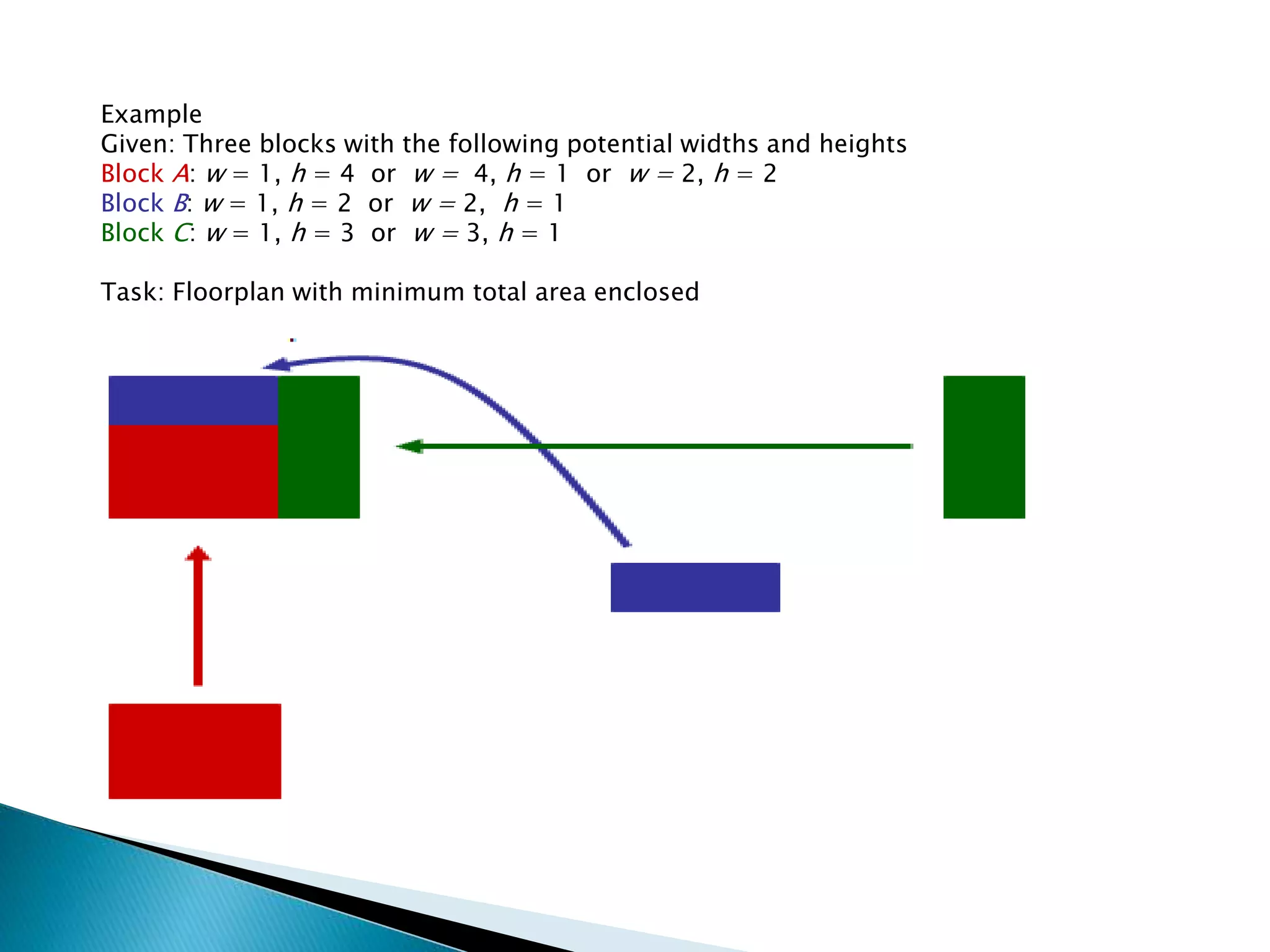
Example
Given: Three blocks with the following potential widths and heights
Block A: w = 1, h = 4 or w = 4, h = 1 or w = 2, h = 2
Block B: w = 1, h = 2 or w = 2, h = 1
Block C: w = 1, h = 3 or w = 3, h = 1
Task: Floorplan with minimum total area enclosed
The goal of floorplanning is to optimize a
predefined cost function, such as the area of
a resulting floorplan given by the minimum
bounding rectangle of the floorplan region.
The floorplan area directly correlates to the
chip silicon cost. The larger the area, the
higher the silicon cost. The space in the
floorplan bounding rectangle uncovered by
any module is called white space or dead
space.
CAD:  introduction to floorplanning

CAD: introduction to floorplanning

  • 1.
  • 2.
    Floorplanning is thefirst major step in physical design; it is particularly important because the resulting floorplan affects all the subsequent steps in physical design, such as placement and routing. Floorplanning provides early feedback that:  evaluates architectural decisions,  estimates chip areas, and  estimates delay and congestion caused by wiring.
  • 3.
    Two popular approachesto floorplanning are:  simulated annealing: simulated annealing- based floorplanning relies on the representation of the geometric relationship among modules and  analytical formulation: an analytical approach usually captures the absolute relationship directly.
  • 4.
    The representation ofgeometric relationship is done using three popular floorplan representations:  normalized Polish expression  B*-tree  Sequence Pair These representations are efficient, flexible, and effective in modeling geometric relationships (e.g., left, right, above, and below relationships) among modules for floorplan designs.
  • 5.
    Let B ={b1, b2, ..., bm} be a set of m rectangular modules whose respective width, height, and area are denoted by wi, hi, and ai, 1<= i <= m. Each module is free to rotate. Let (xi , yi) denote the coordinate of the bottom-left corner of module bi such that no two modules overlap with each other. The goal of floorplanning is to optimize a predefined cost metric such as a combination of the area (i.e., the minimum bounding rectangle of F ) and wire length (i.e., the sum of all interconnection lengths) induced by a floorplan. For modern floorplan designs, other costs such as routability, power, and thermal might also need to be considered.
  • 6.
    two categories fordiscussions:  Slicing floorplans: A slicing floorplan can be obtained by repetitively cutting the floorplan horizontally or vertically  Non-slicing floorplans: it is not so in this case.
  • 7.
    We can usea binary tree to represent a slicing floorplan. A slicing tree is a binary tree with modules at the leaves and cut types at the internal nodes. There are two cut types, H and V. The H cut divides the floorplan horizontally. Similarly, the V cut divides the floorplan vertically. Slicing floorplan may correspond to more than one slicing tree, because the order of the cut-line selections may be different.
  • 8.
  • 10.
    We use ahorizontal constraint graph ( HCG) and a vertical constraint graph ( VCG) to model a non-slicing floorplan. The horizontal constraint graph defines the horizontal relations of modules, and the vertical constraint graph defines the vertical ones. In a constraint graph, a node represents a module. If there is an edge from node A to node B in the HCG ( VCG), then module A is at the left (bottom) of module B.
  • 12.
    Example Given: Three blockswith the following potential widths and heights Block A: w = 1, h = 4 or w = 4, h = 1 or w = 2, h = 2 Block B: w = 1, h = 2 or w = 2, h = 1 Block C: w = 1, h = 3 or w = 3, h = 1 Task: Floorplan with minimum total area enclosed
  • 13.
    Example Given: Three blockswith the following potential widths and heights Block A: w = 1, h = 4 or w = 4, h = 1 or w = 2, h = 2 Block B: w = 1, h = 2 or w = 2, h = 1 Block C: w = 1, h = 3 or w = 3, h = 1 Task: Floorplan with minimum total area enclosed
  • 15.
    The goal offloorplanning is to optimize a predefined cost function, such as the area of a resulting floorplan given by the minimum bounding rectangle of the floorplan region. The floorplan area directly correlates to the chip silicon cost. The larger the area, the higher the silicon cost. The space in the floorplan bounding rectangle uncovered by any module is called white space or dead space.

Editor's Notes

  • #5 The analytical approach applies mathematical programming that is composed of an objective function and a set of constraints.