Implementing Useful Skew
Using Skew Groups
Matthew Mei
Cisco Systems
2
Matthew Mei
• Overview of skew
• Example design affected by skew
• What is useful skew
• Using skew groups to achieve useful skew
• Experimental results of trials on example design
• Inserting clock buffers to achieve useful skew
• Comparing skew groups and buffer insertion
• Conclusions
Outline
3
Matthew Mei
Skew
Capture
Flip
Flop
Clock
Port
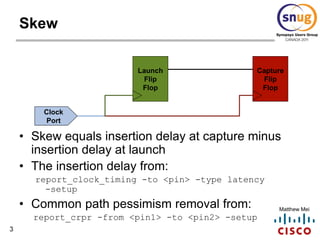
• Skew equals insertion delay at capture minus
insertion delay at launch
• The insertion delay from:
report_clock_timing -to <pin> -type latency
-setup
• Common path pessimism removal from:
report_crpr -from <pin1> -to <pin2> -setup
Launch
Flip
Flop
4
Matthew Mei
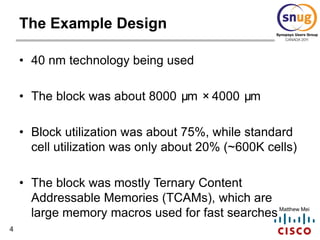
• 40 nm technology being used
• The block was about 8000 µm ×4000 µm
• Block utilization was about 75%, while standard
cell utilization was only about 20% (~600K cells)
• The block was mostly Ternary Content
Addressable Memories (TCAMs), which are
large memory macros used for fast searches
The Example Design
5
Matthew Mei
Example Failing Path
(Diagram)
Memory
Capture
Flip
Flops
clk_core
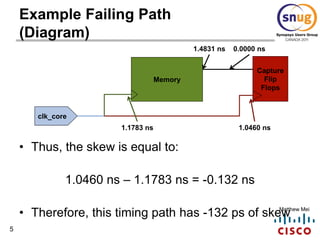
• Thus, the skew is equal to:
1.0460 ns – 1.1783 ns = -0.132 ns
• Therefore, this timing path has -132 ps of skew
1.4831 ns 0.0000 ns
1.0460 ns1.1783 ns
6
Matthew Mei
Example Failing Path
(Timing Report)
Path Type: max
Point Incr Path
----------------------------------------------------------
clock clk_core (rise edge) 0.0000 0.0000
clock network delay (propagated) 1.1783 1.1783
w/m_36x1/CLK 0.0000 1.1783 r
w/m_36x1/QXY[13] 1.4831 2.6614 f
w/r0_data_read1_s_36x1_13_ (net) 0.0000 2.6614 f
w/r1_data_read1_s_36x1_reg_13_/D 0.0000 & 2.6614 f
data arrival time 2.6614
clock clk_core (rise edge) 1.6670 1.6670
clock network delay (propagated) 1.0460 2.7130
clock uncertainty -0.0580 2.6550
w/r1_data_read1_s_36x1_reg_13_/CK 0.0000 2.6550 r
library setup time -0.1197 2.5353
data required time 2.5353
----------------------------------------------------------
data required time 2.5353
data arrival time -2.6614
----------------------------------------------------------
slack (VIOLATED) -0.1261
7
Matthew Mei
Example Failing Path
(Layout)
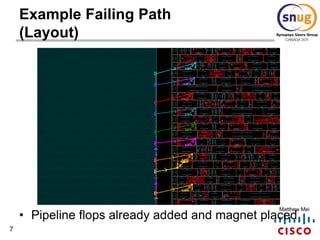
• Pipeline flops already added and magnet placed
8
Matthew Mei
Using Skew Groups to Achieve
Useful Skew
TCAMs
Pipeline
Flip
Flops
clk_core
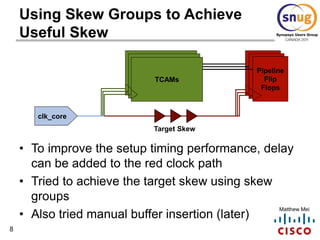
• To improve the setup timing performance, delay
can be added to the red clock path
• Tried to achieve the target skew using skew
groups
• Also tried manual buffer insertion (later)
Target Skew
9
Matthew Mei
Skew Groups
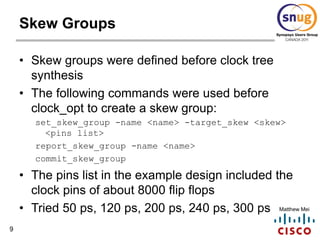
• Skew groups were defined before clock tree
synthesis
• The following commands were used before
clock_opt to create a skew group:
set_skew_group -name <name> -target_skew <skew>
<pins list>
report_skew_group -name <name>
commit_skew_group
• The pins list in the example design included the
clock pins of about 8000 flip flops
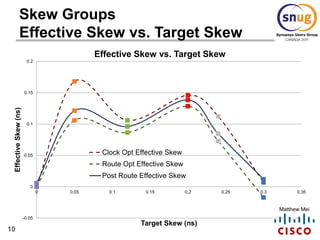
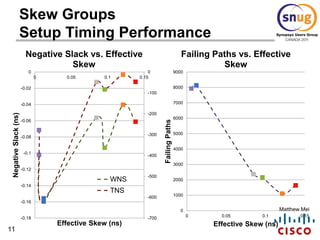
• Tried 50 ps, 120 ps, 200 ps, 240 ps, 300 ps
10
Matthew Mei
Skew Groups
Effective Skew vs. Target Skew
-0.05
0
0.05
0.1
0.15
0.2
0 0.05 0.1 0.15 0.2 0.25 0.3 0.35
EffectiveSkew(ns)
Target Skew (ns)
Effective Skew vs. Target Skew
Clock Opt Effective Skew
Route Opt Effective Skew
Post Route Effective Skew
11
Matthew Mei
Skew Groups
Setup Timing Performance
-700
-600
-500
-400
-300
-200
-100
0
-0.18
-0.16
-0.14
-0.12
-0.1
-0.08
-0.06
-0.04
-0.02
0
0 0.05 0.1 0.15
NegativeSlack(ns)
Effective Skew (ns)
Negative Slack vs. Effective
Skew
WNS
TNS
0
1000
2000
3000
4000
5000
6000
7000
8000
9000
0 0.05 0.1 0.15
FailingPaths
Effective Skew (ns)
Failing Paths vs. Effective
Skew
12
Matthew Mei
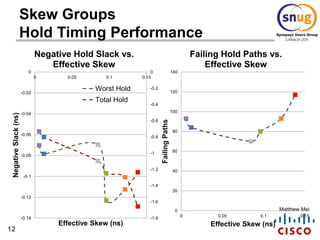
Skew Groups
Hold Timing Performance
0
20
40
60
80
100
120
140
0 0.05 0.1 0.15
FailingPaths
Effective Skew (ns)
Failing Hold Paths vs.
Effective Skew
-1.8
-1.6
-1.4
-1.2
-1
-0.8
-0.6
-0.4
-0.2
0
-0.14
-0.12
-0.1
-0.08
-0.06
-0.04
-0.02
0
0 0.05 0.1 0.15
NegativeSlack(ns)
Effective Skew (ns)
Negative Hold Slack vs.
Effective Skew
Worst Hold
Total Hold
13
Matthew Mei
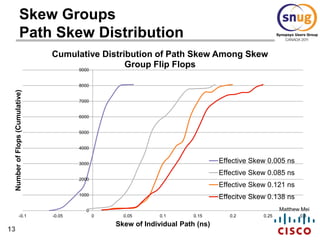
Skew Groups
Path Skew Distribution
0
1000
2000
3000
4000
5000
6000
7000
8000
9000
-0.1 -0.05 0 0.05 0.1 0.15 0.2 0.25 0.3
NumberofFlops(Cumulative)
Skew of Individual Path (ns)
Cumulative Distribution of Path Skew Among Skew
Group Flip Flops
Effective Skew 0.005 ns
Effective Skew 0.085 ns
Effective Skew 0.121 ns
Effecitve Skew 0.138 ns
14
Matthew Mei
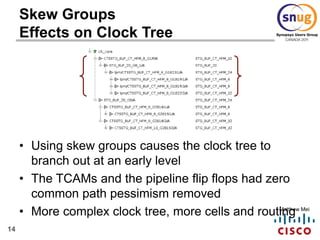
• Using skew groups causes the clock tree to
branch out at an early level
• The TCAMs and the pipeline flip flops had zero
common path pessimism removed
• More complex clock tree, more cells and routing
Skew Groups
Effects on Clock Tree
15
Matthew Mei
Skew Groups
Clock Tree Cells and Buffer Area
23000
24000
25000
26000
27000
28000
29000
5950
6000
6050
6100
6150
6200
6250
6300
6350
6400
6450
Control 0.05 0.12 0.2 0.24 0.3
BufferArea(µm2)
NumberofClockCells
Target Skew (ns)
Clock Tree vs. Target Skew
Buffer Area
Clock Cells
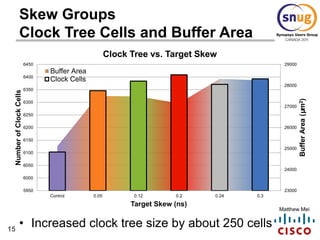
• Increased clock tree size by about 250 cells
16
Matthew Mei
Skew Groups
Power Consumption
0
0.2
0.4
0.6
0.8
1
1.2
0
1
2
3
4
5
6
7
8
0.05 0.12 0.2 0.24 0.3
IncreaseinTotalPower(%)
IncreaseinClockTreePower(%)
Target Skew (ns)
Power Increase vs. Target Skew
Percent Total Power Increase
Percent Clock Tree Power Increase
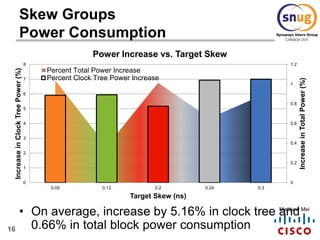
• On average, increase by 5.16% in clock tree and
0.66% in total block power consumption
17
Matthew Mei
Manual Buffer Insertion to Achieve
Useful Skew
TCAMs
Pipeline
Flip
Flops
clk_core
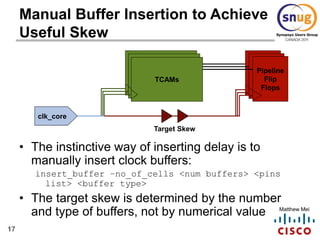
• The instinctive way of inserting delay is to
manually insert clock buffers:
insert_buffer –no_of_cells <num buffers> <pins
list> <buffer type>
• The target skew is determined by the number
and type of buffers, not by numerical value
Target Skew
18
Matthew Mei
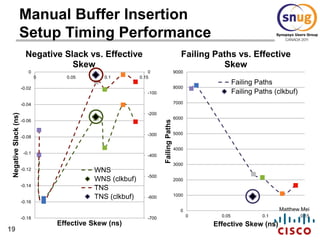
Manual Buffer Insertion
• Clock buffers were inserted right before clock
tree routing
• Two buffers of low drive strength were used.
Each buffer added about 40 ps of delay
• The pins list in the example design included the
clock pins of the same ~8000 flip flops
• The clock buffer insertion resulted in a “Post
Route Effective Skew” of about 0.084 ns
• The TCAMs and the flip flops had on average 38
ps of common path pessimism removed
19
Matthew Mei
Manual Buffer Insertion
Setup Timing Performance
-700
-600
-500
-400
-300
-200
-100
0
-0.18
-0.16
-0.14
-0.12
-0.1
-0.08
-0.06
-0.04
-0.02
0
0 0.05 0.1 0.15
NegativeSlack(ns)
Effective Skew (ns)
Negative Slack vs. Effective
Skew
WNS
WNS (clkbuf)
TNS
TNS (clkbuf)
0
1000
2000
3000
4000
5000
6000
7000
8000
9000
0 0.05 0.1 0.15
FailingPaths
Effective Skew (ns)
Failing Paths vs. Effective
Skew
Failing Paths
Failing Paths (clkbuf)
20
Matthew Mei
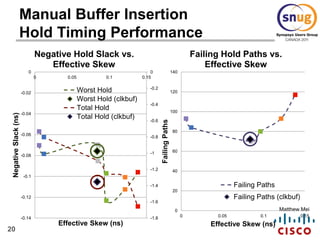
Manual Buffer Insertion
Hold Timing Performance
0
20
40
60
80
100
120
140
0 0.05 0.1 0.15
FailingPaths
Effective Skew (ns)
Failing Hold Paths vs.
Effective Skew
Failing Paths
Failing Paths (clkbuf)
-1.8
-1.6
-1.4
-1.2
-1
-0.8
-0.6
-0.4
-0.2
0
-0.14
-0.12
-0.1
-0.08
-0.06
-0.04
-0.02
0
0 0.05 0.1 0.15
NegativeSlack(ns)
Effective Skew (ns)
Negative Hold Slack vs.
Effective Skew
Worst Hold
Worst Hold (clkbuf)
Total Hold
Total Hold (clkbuf)
21
Matthew Mei
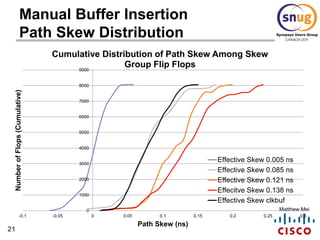
Manual Buffer Insertion
Path Skew Distribution
0
1000
2000
3000
4000
5000
6000
7000
8000
9000
-0.1 -0.05 0 0.05 0.1 0.15 0.2 0.25 0.3
NumberofFlops(Cumulative)
Path Skew (ns)
Cumulative Distribution of Path Skew Among Skew
Group Flip Flops
Effective Skew 0.005 ns
Effective Skew 0.085 ns
Effective Skew 0.121 ns
Effecitve Skew 0.138 ns
Effective Skew clkbuf
22
Matthew Mei
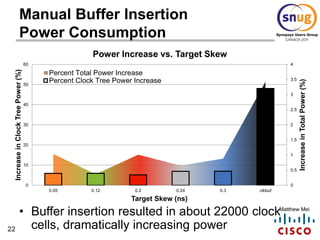
Manual Buffer Insertion
Power Consumption
• Buffer insertion resulted in about 22000 clock
cells, dramatically increasing power
0
0.5
1
1.5
2
2.5
3
3.5
4
0
10
20
30
40
50
60
0.05 0.12 0.2 0.24 0.3 clkbuf
IncreaseinTotalPower(%)
IncreaseinClockTreePower(%)
Target Skew (ns)
Power Increase vs. Target Skew
Percent Total Power Increase
Percent Clock Tree Power Increase
23
Matthew Mei
Conclusions
• Both methods are easy to setup in IC Compiler
• Skew groups:
– Easy to specify target skew
– Results in smaller increase in cells, power, and area
• Manual buffer insertion:
– Relies on past experience for buffer selection
– Results in larger increase in cells, power, and area
Questions?

Implementing Useful Clock Skew Using Skew Groups

  • 1.
    Implementing Useful Skew UsingSkew Groups Matthew Mei Cisco Systems
  • 2.
    2 Matthew Mei • Overviewof skew • Example design affected by skew • What is useful skew • Using skew groups to achieve useful skew • Experimental results of trials on example design • Inserting clock buffers to achieve useful skew • Comparing skew groups and buffer insertion • Conclusions Outline
  • 3.
    3 Matthew Mei Skew Capture Flip Flop Clock Port • Skewequals insertion delay at capture minus insertion delay at launch • The insertion delay from: report_clock_timing -to <pin> -type latency -setup • Common path pessimism removal from: report_crpr -from <pin1> -to <pin2> -setup Launch Flip Flop
  • 4.
    4 Matthew Mei • 40nm technology being used • The block was about 8000 µm ×4000 µm • Block utilization was about 75%, while standard cell utilization was only about 20% (~600K cells) • The block was mostly Ternary Content Addressable Memories (TCAMs), which are large memory macros used for fast searches The Example Design
  • 5.
    5 Matthew Mei Example FailingPath (Diagram) Memory Capture Flip Flops clk_core • Thus, the skew is equal to: 1.0460 ns – 1.1783 ns = -0.132 ns • Therefore, this timing path has -132 ps of skew 1.4831 ns 0.0000 ns 1.0460 ns1.1783 ns
  • 6.
    6 Matthew Mei Example FailingPath (Timing Report) Path Type: max Point Incr Path ---------------------------------------------------------- clock clk_core (rise edge) 0.0000 0.0000 clock network delay (propagated) 1.1783 1.1783 w/m_36x1/CLK 0.0000 1.1783 r w/m_36x1/QXY[13] 1.4831 2.6614 f w/r0_data_read1_s_36x1_13_ (net) 0.0000 2.6614 f w/r1_data_read1_s_36x1_reg_13_/D 0.0000 & 2.6614 f data arrival time 2.6614 clock clk_core (rise edge) 1.6670 1.6670 clock network delay (propagated) 1.0460 2.7130 clock uncertainty -0.0580 2.6550 w/r1_data_read1_s_36x1_reg_13_/CK 0.0000 2.6550 r library setup time -0.1197 2.5353 data required time 2.5353 ---------------------------------------------------------- data required time 2.5353 data arrival time -2.6614 ---------------------------------------------------------- slack (VIOLATED) -0.1261
  • 7.
    7 Matthew Mei Example FailingPath (Layout) • Pipeline flops already added and magnet placed
  • 8.
    8 Matthew Mei Using SkewGroups to Achieve Useful Skew TCAMs Pipeline Flip Flops clk_core • To improve the setup timing performance, delay can be added to the red clock path • Tried to achieve the target skew using skew groups • Also tried manual buffer insertion (later) Target Skew
  • 9.
    9 Matthew Mei Skew Groups •Skew groups were defined before clock tree synthesis • The following commands were used before clock_opt to create a skew group: set_skew_group -name <name> -target_skew <skew> <pins list> report_skew_group -name <name> commit_skew_group • The pins list in the example design included the clock pins of about 8000 flip flops • Tried 50 ps, 120 ps, 200 ps, 240 ps, 300 ps
  • 10.
    10 Matthew Mei Skew Groups EffectiveSkew vs. Target Skew -0.05 0 0.05 0.1 0.15 0.2 0 0.05 0.1 0.15 0.2 0.25 0.3 0.35 EffectiveSkew(ns) Target Skew (ns) Effective Skew vs. Target Skew Clock Opt Effective Skew Route Opt Effective Skew Post Route Effective Skew
  • 11.
    11 Matthew Mei Skew Groups SetupTiming Performance -700 -600 -500 -400 -300 -200 -100 0 -0.18 -0.16 -0.14 -0.12 -0.1 -0.08 -0.06 -0.04 -0.02 0 0 0.05 0.1 0.15 NegativeSlack(ns) Effective Skew (ns) Negative Slack vs. Effective Skew WNS TNS 0 1000 2000 3000 4000 5000 6000 7000 8000 9000 0 0.05 0.1 0.15 FailingPaths Effective Skew (ns) Failing Paths vs. Effective Skew
  • 12.
    12 Matthew Mei Skew Groups HoldTiming Performance 0 20 40 60 80 100 120 140 0 0.05 0.1 0.15 FailingPaths Effective Skew (ns) Failing Hold Paths vs. Effective Skew -1.8 -1.6 -1.4 -1.2 -1 -0.8 -0.6 -0.4 -0.2 0 -0.14 -0.12 -0.1 -0.08 -0.06 -0.04 -0.02 0 0 0.05 0.1 0.15 NegativeSlack(ns) Effective Skew (ns) Negative Hold Slack vs. Effective Skew Worst Hold Total Hold
  • 13.
    13 Matthew Mei Skew Groups PathSkew Distribution 0 1000 2000 3000 4000 5000 6000 7000 8000 9000 -0.1 -0.05 0 0.05 0.1 0.15 0.2 0.25 0.3 NumberofFlops(Cumulative) Skew of Individual Path (ns) Cumulative Distribution of Path Skew Among Skew Group Flip Flops Effective Skew 0.005 ns Effective Skew 0.085 ns Effective Skew 0.121 ns Effecitve Skew 0.138 ns
  • 14.
    14 Matthew Mei • Usingskew groups causes the clock tree to branch out at an early level • The TCAMs and the pipeline flip flops had zero common path pessimism removed • More complex clock tree, more cells and routing Skew Groups Effects on Clock Tree
  • 15.
    15 Matthew Mei Skew Groups ClockTree Cells and Buffer Area 23000 24000 25000 26000 27000 28000 29000 5950 6000 6050 6100 6150 6200 6250 6300 6350 6400 6450 Control 0.05 0.12 0.2 0.24 0.3 BufferArea(µm2) NumberofClockCells Target Skew (ns) Clock Tree vs. Target Skew Buffer Area Clock Cells • Increased clock tree size by about 250 cells
  • 16.
    16 Matthew Mei Skew Groups PowerConsumption 0 0.2 0.4 0.6 0.8 1 1.2 0 1 2 3 4 5 6 7 8 0.05 0.12 0.2 0.24 0.3 IncreaseinTotalPower(%) IncreaseinClockTreePower(%) Target Skew (ns) Power Increase vs. Target Skew Percent Total Power Increase Percent Clock Tree Power Increase • On average, increase by 5.16% in clock tree and 0.66% in total block power consumption
  • 17.
    17 Matthew Mei Manual BufferInsertion to Achieve Useful Skew TCAMs Pipeline Flip Flops clk_core • The instinctive way of inserting delay is to manually insert clock buffers: insert_buffer –no_of_cells <num buffers> <pins list> <buffer type> • The target skew is determined by the number and type of buffers, not by numerical value Target Skew
  • 18.
    18 Matthew Mei Manual BufferInsertion • Clock buffers were inserted right before clock tree routing • Two buffers of low drive strength were used. Each buffer added about 40 ps of delay • The pins list in the example design included the clock pins of the same ~8000 flip flops • The clock buffer insertion resulted in a “Post Route Effective Skew” of about 0.084 ns • The TCAMs and the flip flops had on average 38 ps of common path pessimism removed
  • 19.
    19 Matthew Mei Manual BufferInsertion Setup Timing Performance -700 -600 -500 -400 -300 -200 -100 0 -0.18 -0.16 -0.14 -0.12 -0.1 -0.08 -0.06 -0.04 -0.02 0 0 0.05 0.1 0.15 NegativeSlack(ns) Effective Skew (ns) Negative Slack vs. Effective Skew WNS WNS (clkbuf) TNS TNS (clkbuf) 0 1000 2000 3000 4000 5000 6000 7000 8000 9000 0 0.05 0.1 0.15 FailingPaths Effective Skew (ns) Failing Paths vs. Effective Skew Failing Paths Failing Paths (clkbuf)
  • 20.
    20 Matthew Mei Manual BufferInsertion Hold Timing Performance 0 20 40 60 80 100 120 140 0 0.05 0.1 0.15 FailingPaths Effective Skew (ns) Failing Hold Paths vs. Effective Skew Failing Paths Failing Paths (clkbuf) -1.8 -1.6 -1.4 -1.2 -1 -0.8 -0.6 -0.4 -0.2 0 -0.14 -0.12 -0.1 -0.08 -0.06 -0.04 -0.02 0 0 0.05 0.1 0.15 NegativeSlack(ns) Effective Skew (ns) Negative Hold Slack vs. Effective Skew Worst Hold Worst Hold (clkbuf) Total Hold Total Hold (clkbuf)
  • 21.
    21 Matthew Mei Manual BufferInsertion Path Skew Distribution 0 1000 2000 3000 4000 5000 6000 7000 8000 9000 -0.1 -0.05 0 0.05 0.1 0.15 0.2 0.25 0.3 NumberofFlops(Cumulative) Path Skew (ns) Cumulative Distribution of Path Skew Among Skew Group Flip Flops Effective Skew 0.005 ns Effective Skew 0.085 ns Effective Skew 0.121 ns Effecitve Skew 0.138 ns Effective Skew clkbuf
  • 22.
    22 Matthew Mei Manual BufferInsertion Power Consumption • Buffer insertion resulted in about 22000 clock cells, dramatically increasing power 0 0.5 1 1.5 2 2.5 3 3.5 4 0 10 20 30 40 50 60 0.05 0.12 0.2 0.24 0.3 clkbuf IncreaseinTotalPower(%) IncreaseinClockTreePower(%) Target Skew (ns) Power Increase vs. Target Skew Percent Total Power Increase Percent Clock Tree Power Increase
  • 23.
    23 Matthew Mei Conclusions • Bothmethods are easy to setup in IC Compiler • Skew groups: – Easy to specify target skew – Results in smaller increase in cells, power, and area • Manual buffer insertion: – Relies on past experience for buffer selection – Results in larger increase in cells, power, and area
  • 24.