F. Maloberti - Layout of Analog CMOS IC
1
F. Maloberti
Layout of Analog
CMOS
Integrated Circuit
Part 2
Transistors and Basic Cells Layout
F. Maloberti - Layout of Analog CMOS IC
2
Outline
 Introduction
 Process and Overview Topics
 Transistors and Basic Cells Layout
 Passive components: Resistors, Capacitors
 System level Mixed-signal Layout
F. Maloberti - Layout of Analog CMOS IC
3
Part II: Transistor and Basic Cell Layout
 Transistors and Matched Transistors
 Layout of a single transistor
 Use of multiple fingers
 Interdigitated devices
 Common Centroid
 Dummy devices on ends
 Matched interconnect (metal, vias, contacts)
 Surrounded by guard ring
 Design for Layout
 Stacked layout of analog cells
 Stick diagram of analog cells
 Example 1: two stages op-amp
 Example 2: folded cascode
F. Maloberti - Layout of Analog CMOS IC
4
Single Transistor Layout
 A CMOS transistor is the crossing of two rectangles,
polysilicon and active area
 but, … we need the drain and source connections and we
need to bias the substrate or the well
diffusion
Polysilicon gate
F. Maloberti - Layout of Analog CMOS IC
5
Source and Drain Connections
 Ensure good connections
 Multiple contacts or one big contact?
F. Maloberti - Layout of Analog CMOS IC
6
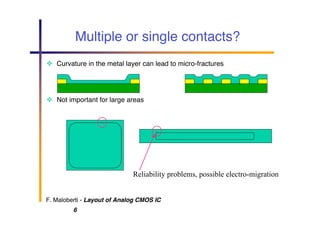
Multiple or single contacts?
 Curvature in the metal layer can lead to micro-fractures
 Not important for large areas
Reliability problems, possible electro-migration
F. Maloberti - Layout of Analog CMOS IC
7
Multiple contacts: Exercise
 Consider the following design rules:
 minimum contact 0.5 µ
 spacing contact-contact 0.4 µ
 minimum grid strep 0.1 µ
 spacing contact diffusion 0.6 µ
 Estimate the number of contacts and their spacing for
 W=50 µ
 W=52 µ
 W=60 µ
F. Maloberti - Layout of Analog CMOS IC
8
Matching single Transistors
 Regular (rectangular shape)
 the W and L matter!!
 Parallel elements
 silicon is unisotropic
 Possibly, the current flowing
in the same direction
F. Maloberti - Layout of Analog CMOS IC
9
Asymmetry due to Fabrication
Shadowed region
7°
An MOS transistor is not a symmetrical device. To avoid channeling of
implanted ions the wafer is tilted by about 7 °.
Source and drain are not equivalent
F. Maloberti - Layout of Analog CMOS IC
10
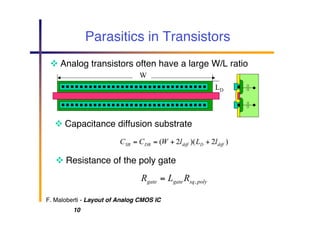
Parasitics in Transistors
)2)(2( diffDdiffDBSB lLlWCC ++==
 Analog transistors often have a large W/L ratio
 Capacitance diffusion substrate
W
LD
 Resistance of the poly gate
polysqgategate RLR ,=
F. Maloberti - Layout of Analog CMOS IC
11
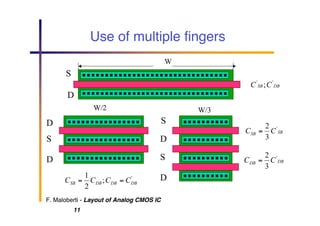
Use of multiple fingers
W
S
S
S
S
D
D
D
D
D
W/2 W/3
'
;
2
1
DBDBDBSB CCCC ==
SBSB CC '
3
2
=
DBDB CC '
3
2
=
DBSB CC ''
;
F. Maloberti - Layout of Analog CMOS IC
12
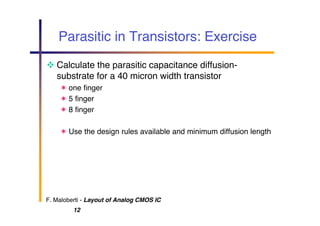
Parasitic in Transistors: Exercise
 Calculate the parasitic capacitance diffusion-
substrate for a 40 micron width transistor
 one finger
 5 finger
 8 finger
 Use the design rules available and minimum diffusion length
F. Maloberti - Layout of Analog CMOS IC
13
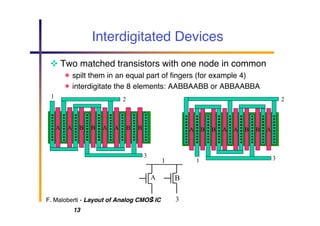
Interdigitated Devices
 Two matched transistors with one node in common
 spilt them in an equal part of fingers (for example 4)
 interdigitate the 8 elements: AABBAABB or ABBAABBA
B
2
A
3
1
A A B B A A B B
21
3
A B B A A B B A
2
1 3
F. Maloberti - Layout of Analog CMOS IC
14
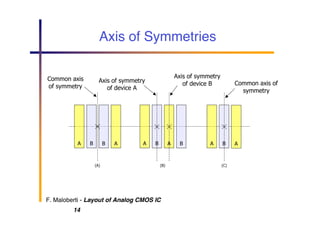
Axis of Symmetries
A B B A A B A B A B A
(A) (B) (C)
Common axis
of symmetry
Axis of symmetry
of device A
Axis of symmetry
of device B Common axis of
symmetry
F. Maloberti - Layout of Analog CMOS IC
15
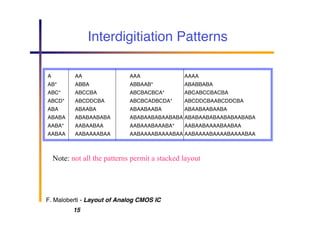
Interdigitiation Patterns
A AA AAA AAAA
AB* ABBA ABBAAB* ABABBABA
ABC* ABCCBA ABCBACBCA* ABCABCCBACBA
ABCD* ABCDDCBA ABCBCADBCDA* ABCDDCBAABCDDCBA
ABA ABAABA ABAABAABA ABAABAABAABA
ABABA ABABAABABA ABABAABABAABABA ABABAABABAABABAABABA
AABA* AABAABAA AABAAABAAABA* AABAABAAAABAABAA
AABAA AABAAAABAA AABAAAABAAAABAA AABAAAABAAAABAAAABAA
Note: not all the patterns permit a stacked layout
F. Maloberti - Layout of Analog CMOS IC
16
Interdigitated Transistors: Exercises
 Sketch the layout of two interdigitated transistors
having W1=3W2 and split W2 into 4 fingers. M1 and M2
have their source in common.
 Sketch the layout of three interdigitized transistors
having the same width. Use the optimum number of
fingers. The three transistors have the source in
common.
F. Maloberti - Layout of Analog CMOS IC
17
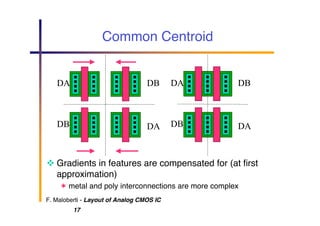
Common Centroid
DB
DA
DA
DB
DB
DA
DA
DB
 Gradients in features are compensated for (at first
approximation)
 metal and poly interconnections are more complex
F. Maloberti - Layout of Analog CMOS IC
18
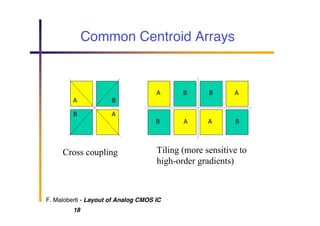
Common Centroid Arrays
A B
B A
B
B A
A AB
BA
Cross coupling Tiling (more sensitive to
high-order gradients)
F. Maloberti - Layout of Analog CMOS IC
19
Common Centroid Patterns
ABBA ABBAABBA ABBAABBA ABBAABBA
BAAB BAABBAAB BAABBAAB BAABBAAB
ABBAABBA BAABBAAB
ABBAABBA
ABA ABAABA ABAABA ABAABAABA
BAB BABBAB BABBAB BABBABBAB
ABAABA BABBABBAB
ABAABAABA
ABCCBA ABCCBAABC ABCCBAABC ABCCBAABC
CBAABC CBAABCCBA CBAABCCBA CBAABCCBA
ABCCBAABC CBAABCCBA
ABCCBAABC
AAB AABBAA AABBAA AABBAA
BAA BAAAAB BAAAAB BAAAAB
AABBAA BAAAAB
AABBAA
F. Maloberti - Layout of Analog CMOS IC
20
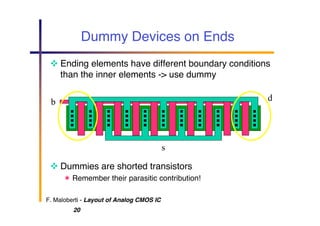
Dummy Devices on Ends
 Ending elements have different boundary conditions
than the inner elements -> use dummy
 Dummies are shorted transistors
 Remember their parasitic contribution!
s
b d
F. Maloberti - Layout of Analog CMOS IC
21
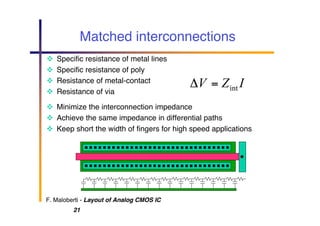
Matched interconnections
 Specific resistance of metal lines
 Specific resistance of poly
 Resistance of metal-contact
 Resistance of via
IZV int=Δ
 Minimize the interconnection impedance
 Achieve the same impedance in differential paths
 Keep short the width of fingers for high speed applications
F. Maloberti - Layout of Analog CMOS IC
22
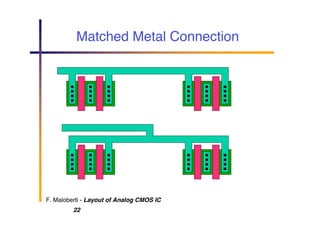
Matched Metal Connection
F. Maloberti - Layout of Analog CMOS IC
23
Waffle Transistor
S
D
Minimum capacitance
drain-substrate and
source-substrate
W not accurate
L not well defined
To be used in wide transistors
whose aspect ratio is not
relevant
F. Maloberti - Layout of Analog CMOS IC
24
Part II: Transistor and Basic Cell Layout
 Transistors and Matched Transistors
 Layout of a single transistor
 Use of multiple fingers
 Interdigitated devices
 Common Centroid
 Dummy devices on ends
 Matched interconnect (metal, vias, contacts)
 Surrounded by guard ring
 Design for Layout
 Stacked layout of analog cells
 Stick diagram of analog cells
 Example 1: two stages op-amp
 Example 2: folded cascode
F. Maloberti - Layout of Analog CMOS IC
25
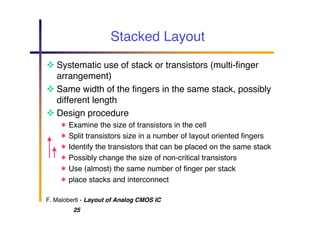
Stacked Layout
 Systematic use of stack or transistors (multi-finger
arrangement)
 Same width of the fingers in the same stack, possibly
different length
 Design procedure
 Examine the size of transistors in the cell
 Split transistors size in a number of layout oriented fingers
 Identify the transistors that can be placed on the same stack
 Possibly change the size of non-critical transistors
 Use (almost) the same number of finger per stack
 place stacks and interconnect
F. Maloberti - Layout of Analog CMOS IC
26
Stick Representation (one transistor)
s d s d s
s d s dd
s d sd
s d s d
Ending drain
Ending source D/S ending
S/D ending
s
d
EVEN ODD
F. Maloberti - Layout of Analog CMOS IC
27
Multi-transistor Stick Diagram
1
2
3
1 2 3
4
4 1 2 3 42
Same width
M1 M2
M3
M1 double
1 2 1 2 3 2 3 4 3 4
M1 M2 M3
3 4 3 2 1 2 3 4 3
M3 M2 M1 M2 M3
3 4 3 2 2 3 4 3
M3 M2 M1 M2 M3
2 11
3
2
4
1
F. Maloberti - Layout of Analog CMOS IC
28
Example 1 (2 stages OTA)
M1 M2
M3 M4
M5
M6
M7
60 60
40
3030
72
108
Assume to layout a two stages OTA
Width only are shown;
Compensation network and bias are missing (!)
F. Maloberti - Layout of Analog CMOS IC
29
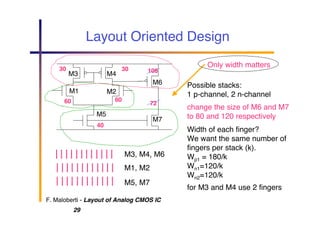
Layout Oriented Design
M1 M2
M3 M4
M5
M6
M7
60 60
40
3030
72
108
Possible stacks:
1 p-channel, 2 n-channel
change the size of M6 and M7
to 80 and 120 respectively
Width of each finger?
We want the same number of
fingers per stack (k).
Wp1 = 180/k
Wn1=120/k
Wn2=120/k
for M3 and M4 use 2 fingers
M3, M4, M6
M1, M2
M5, M7
Only width matters
F. Maloberti - Layout of Analog CMOS IC
30
Stack Design and Interconnections
M1 M2
M3 M4
M5
M6
M7
6 6
4
22
8
8M6 M6M3 M4
M7 M7M5
First attempt of
interconnections
(not completed)
GND
OUTCS
O1
VDD
D3
M1 M2
D3 O1
F. Maloberti - Layout of Analog CMOS IC
31
Use of one Metal Layer
M1 M2
M3 M4
M5
M6
M7
GND
OUTCS
O1
VDD
D3
GND
VDD
M1
CS
O1
OUT
M2
M4M3
Use metal for carrying
current!
Poly connections are
not a problem (usually)
M5 M5
F. Maloberti - Layout of Analog CMOS IC
32
Stick Layout: Exercise
Draw the stick diagram of the two stages OTA in
the following three cases:
• fingers of M6 and M7 all together
• M6 =90 M7=60
• M1 and M2 in a common centroid arrangement
F. Maloberti - Layout of Analog CMOS IC
33
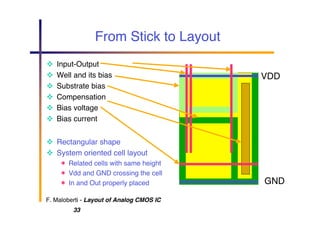
From Stick to Layout
 Input-Output
 Well and its bias
 Substrate bias
 Compensation
 Bias voltage
 Bias current
VDD
GND
 Rectangular shape
 System oriented cell layout
 Related cells with same height
 Vdd and GND crossing the cell
 In and Out properly placed
F. Maloberti - Layout of Analog CMOS IC
34
Example 2 (Folded Cascode)
M1 M2
M3
M4
M11
M5
M7
M9
M6
M8
M10
30 30
80 80
MN
60 60
16
16
38 38
25 25
Only Ws are shown20
MP
F. Maloberti - Layout of Analog CMOS IC
35
Split of Transistors
M1 M2
M3 M4
M11
M5
M7
M9
M6
M8
M10
30 30
80 80
MN
60 60
16
16
40 40
24 24
20
2
3
3
6
6
25
38
5
2
5
3 3
2
MP
F. Maloberti - Layout of Analog CMOS IC
36
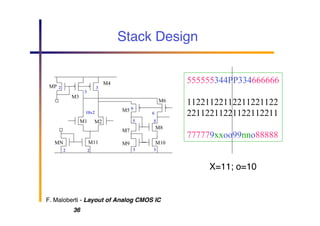
Stack Design
M1 M2
M3
M4
M11
M5
M7
M9
M6
M8
M10MN
2
3
3
6
6
5
2
5
3 32
MP
10x2
555555344PP334666666
11221122112211221122
22112211221122112211
777779xxoo99nno88888
X=11; o=10
F. Maloberti - Layout of Analog CMOS IC
37
Interconnection: Exercise
Sketch the source-drain interconnections of the folded-cascode
F. Maloberti - Layout of Analog CMOS IC
38
Basic Cell Design: check-list
 Draw a well readable transistor
diagram
 Identify critical elements and
nodes
 Absolute and relative accuracy
 Minimum parasitic capacitance
 Minimum interference
 Mark transistors that must
match
 Mark symmetry axes
 Analyze transistor sizing (W’s)
 Possibly, change transistor size
for a layout oriented strategy
 Group transistors in stacks
 Define the expected height
(or width) of the cell
 Sketch the stick diagram
 transistors of the same type in
the same region
 Foresee room for substrate
and well biasing
 substrate bias around the cell
 well-bias surrounding the well
 Define the connection layer
for input-output (horizontal,
vertical connections)
 Begin the layout now!!

Layout02 (1)

  • 1.
    F. Maloberti -Layout of Analog CMOS IC 1 F. Maloberti Layout of Analog CMOS Integrated Circuit Part 2 Transistors and Basic Cells Layout
  • 2.
    F. Maloberti -Layout of Analog CMOS IC 2 Outline  Introduction  Process and Overview Topics  Transistors and Basic Cells Layout  Passive components: Resistors, Capacitors  System level Mixed-signal Layout
  • 3.
    F. Maloberti -Layout of Analog CMOS IC 3 Part II: Transistor and Basic Cell Layout  Transistors and Matched Transistors  Layout of a single transistor  Use of multiple fingers  Interdigitated devices  Common Centroid  Dummy devices on ends  Matched interconnect (metal, vias, contacts)  Surrounded by guard ring  Design for Layout  Stacked layout of analog cells  Stick diagram of analog cells  Example 1: two stages op-amp  Example 2: folded cascode
  • 4.
    F. Maloberti -Layout of Analog CMOS IC 4 Single Transistor Layout  A CMOS transistor is the crossing of two rectangles, polysilicon and active area  but, … we need the drain and source connections and we need to bias the substrate or the well diffusion Polysilicon gate
  • 5.
    F. Maloberti -Layout of Analog CMOS IC 5 Source and Drain Connections  Ensure good connections  Multiple contacts or one big contact?
  • 6.
    F. Maloberti -Layout of Analog CMOS IC 6 Multiple or single contacts?  Curvature in the metal layer can lead to micro-fractures  Not important for large areas Reliability problems, possible electro-migration
  • 7.
    F. Maloberti -Layout of Analog CMOS IC 7 Multiple contacts: Exercise  Consider the following design rules:  minimum contact 0.5 µ  spacing contact-contact 0.4 µ  minimum grid strep 0.1 µ  spacing contact diffusion 0.6 µ  Estimate the number of contacts and their spacing for  W=50 µ  W=52 µ  W=60 µ
  • 8.
    F. Maloberti -Layout of Analog CMOS IC 8 Matching single Transistors  Regular (rectangular shape)  the W and L matter!!  Parallel elements  silicon is unisotropic  Possibly, the current flowing in the same direction
  • 9.
    F. Maloberti -Layout of Analog CMOS IC 9 Asymmetry due to Fabrication Shadowed region 7° An MOS transistor is not a symmetrical device. To avoid channeling of implanted ions the wafer is tilted by about 7 °. Source and drain are not equivalent
  • 10.
    F. Maloberti -Layout of Analog CMOS IC 10 Parasitics in Transistors )2)(2( diffDdiffDBSB lLlWCC ++==  Analog transistors often have a large W/L ratio  Capacitance diffusion substrate W LD  Resistance of the poly gate polysqgategate RLR ,=
  • 11.
    F. Maloberti -Layout of Analog CMOS IC 11 Use of multiple fingers W S S S S D D D D D W/2 W/3 ' ; 2 1 DBDBDBSB CCCC == SBSB CC ' 3 2 = DBDB CC ' 3 2 = DBSB CC '' ;
  • 12.
    F. Maloberti -Layout of Analog CMOS IC 12 Parasitic in Transistors: Exercise  Calculate the parasitic capacitance diffusion- substrate for a 40 micron width transistor  one finger  5 finger  8 finger  Use the design rules available and minimum diffusion length
  • 13.
    F. Maloberti -Layout of Analog CMOS IC 13 Interdigitated Devices  Two matched transistors with one node in common  spilt them in an equal part of fingers (for example 4)  interdigitate the 8 elements: AABBAABB or ABBAABBA B 2 A 3 1 A A B B A A B B 21 3 A B B A A B B A 2 1 3
  • 14.
    F. Maloberti -Layout of Analog CMOS IC 14 Axis of Symmetries A B B A A B A B A B A (A) (B) (C) Common axis of symmetry Axis of symmetry of device A Axis of symmetry of device B Common axis of symmetry
  • 15.
    F. Maloberti -Layout of Analog CMOS IC 15 Interdigitiation Patterns A AA AAA AAAA AB* ABBA ABBAAB* ABABBABA ABC* ABCCBA ABCBACBCA* ABCABCCBACBA ABCD* ABCDDCBA ABCBCADBCDA* ABCDDCBAABCDDCBA ABA ABAABA ABAABAABA ABAABAABAABA ABABA ABABAABABA ABABAABABAABABA ABABAABABAABABAABABA AABA* AABAABAA AABAAABAAABA* AABAABAAAABAABAA AABAA AABAAAABAA AABAAAABAAAABAA AABAAAABAAAABAAAABAA Note: not all the patterns permit a stacked layout
  • 16.
    F. Maloberti -Layout of Analog CMOS IC 16 Interdigitated Transistors: Exercises  Sketch the layout of two interdigitated transistors having W1=3W2 and split W2 into 4 fingers. M1 and M2 have their source in common.  Sketch the layout of three interdigitized transistors having the same width. Use the optimum number of fingers. The three transistors have the source in common.
  • 17.
    F. Maloberti -Layout of Analog CMOS IC 17 Common Centroid DB DA DA DB DB DA DA DB  Gradients in features are compensated for (at first approximation)  metal and poly interconnections are more complex
  • 18.
    F. Maloberti -Layout of Analog CMOS IC 18 Common Centroid Arrays A B B A B B A A AB BA Cross coupling Tiling (more sensitive to high-order gradients)
  • 19.
    F. Maloberti -Layout of Analog CMOS IC 19 Common Centroid Patterns ABBA ABBAABBA ABBAABBA ABBAABBA BAAB BAABBAAB BAABBAAB BAABBAAB ABBAABBA BAABBAAB ABBAABBA ABA ABAABA ABAABA ABAABAABA BAB BABBAB BABBAB BABBABBAB ABAABA BABBABBAB ABAABAABA ABCCBA ABCCBAABC ABCCBAABC ABCCBAABC CBAABC CBAABCCBA CBAABCCBA CBAABCCBA ABCCBAABC CBAABCCBA ABCCBAABC AAB AABBAA AABBAA AABBAA BAA BAAAAB BAAAAB BAAAAB AABBAA BAAAAB AABBAA
  • 20.
    F. Maloberti -Layout of Analog CMOS IC 20 Dummy Devices on Ends  Ending elements have different boundary conditions than the inner elements -> use dummy  Dummies are shorted transistors  Remember their parasitic contribution! s b d
  • 21.
    F. Maloberti -Layout of Analog CMOS IC 21 Matched interconnections  Specific resistance of metal lines  Specific resistance of poly  Resistance of metal-contact  Resistance of via IZV int=Δ  Minimize the interconnection impedance  Achieve the same impedance in differential paths  Keep short the width of fingers for high speed applications
  • 22.
    F. Maloberti -Layout of Analog CMOS IC 22 Matched Metal Connection
  • 23.
    F. Maloberti -Layout of Analog CMOS IC 23 Waffle Transistor S D Minimum capacitance drain-substrate and source-substrate W not accurate L not well defined To be used in wide transistors whose aspect ratio is not relevant
  • 24.
    F. Maloberti -Layout of Analog CMOS IC 24 Part II: Transistor and Basic Cell Layout  Transistors and Matched Transistors  Layout of a single transistor  Use of multiple fingers  Interdigitated devices  Common Centroid  Dummy devices on ends  Matched interconnect (metal, vias, contacts)  Surrounded by guard ring  Design for Layout  Stacked layout of analog cells  Stick diagram of analog cells  Example 1: two stages op-amp  Example 2: folded cascode
  • 25.
    F. Maloberti -Layout of Analog CMOS IC 25 Stacked Layout  Systematic use of stack or transistors (multi-finger arrangement)  Same width of the fingers in the same stack, possibly different length  Design procedure  Examine the size of transistors in the cell  Split transistors size in a number of layout oriented fingers  Identify the transistors that can be placed on the same stack  Possibly change the size of non-critical transistors  Use (almost) the same number of finger per stack  place stacks and interconnect
  • 26.
    F. Maloberti -Layout of Analog CMOS IC 26 Stick Representation (one transistor) s d s d s s d s dd s d sd s d s d Ending drain Ending source D/S ending S/D ending s d EVEN ODD
  • 27.
    F. Maloberti -Layout of Analog CMOS IC 27 Multi-transistor Stick Diagram 1 2 3 1 2 3 4 4 1 2 3 42 Same width M1 M2 M3 M1 double 1 2 1 2 3 2 3 4 3 4 M1 M2 M3 3 4 3 2 1 2 3 4 3 M3 M2 M1 M2 M3 3 4 3 2 2 3 4 3 M3 M2 M1 M2 M3 2 11 3 2 4 1
  • 28.
    F. Maloberti -Layout of Analog CMOS IC 28 Example 1 (2 stages OTA) M1 M2 M3 M4 M5 M6 M7 60 60 40 3030 72 108 Assume to layout a two stages OTA Width only are shown; Compensation network and bias are missing (!)
  • 29.
    F. Maloberti -Layout of Analog CMOS IC 29 Layout Oriented Design M1 M2 M3 M4 M5 M6 M7 60 60 40 3030 72 108 Possible stacks: 1 p-channel, 2 n-channel change the size of M6 and M7 to 80 and 120 respectively Width of each finger? We want the same number of fingers per stack (k). Wp1 = 180/k Wn1=120/k Wn2=120/k for M3 and M4 use 2 fingers M3, M4, M6 M1, M2 M5, M7 Only width matters
  • 30.
    F. Maloberti -Layout of Analog CMOS IC 30 Stack Design and Interconnections M1 M2 M3 M4 M5 M6 M7 6 6 4 22 8 8M6 M6M3 M4 M7 M7M5 First attempt of interconnections (not completed) GND OUTCS O1 VDD D3 M1 M2 D3 O1
  • 31.
    F. Maloberti -Layout of Analog CMOS IC 31 Use of one Metal Layer M1 M2 M3 M4 M5 M6 M7 GND OUTCS O1 VDD D3 GND VDD M1 CS O1 OUT M2 M4M3 Use metal for carrying current! Poly connections are not a problem (usually) M5 M5
  • 32.
    F. Maloberti -Layout of Analog CMOS IC 32 Stick Layout: Exercise Draw the stick diagram of the two stages OTA in the following three cases: • fingers of M6 and M7 all together • M6 =90 M7=60 • M1 and M2 in a common centroid arrangement
  • 33.
    F. Maloberti -Layout of Analog CMOS IC 33 From Stick to Layout  Input-Output  Well and its bias  Substrate bias  Compensation  Bias voltage  Bias current VDD GND  Rectangular shape  System oriented cell layout  Related cells with same height  Vdd and GND crossing the cell  In and Out properly placed
  • 34.
    F. Maloberti -Layout of Analog CMOS IC 34 Example 2 (Folded Cascode) M1 M2 M3 M4 M11 M5 M7 M9 M6 M8 M10 30 30 80 80 MN 60 60 16 16 38 38 25 25 Only Ws are shown20 MP
  • 35.
    F. Maloberti -Layout of Analog CMOS IC 35 Split of Transistors M1 M2 M3 M4 M11 M5 M7 M9 M6 M8 M10 30 30 80 80 MN 60 60 16 16 40 40 24 24 20 2 3 3 6 6 25 38 5 2 5 3 3 2 MP
  • 36.
    F. Maloberti -Layout of Analog CMOS IC 36 Stack Design M1 M2 M3 M4 M11 M5 M7 M9 M6 M8 M10MN 2 3 3 6 6 5 2 5 3 32 MP 10x2 555555344PP334666666 11221122112211221122 22112211221122112211 777779xxoo99nno88888 X=11; o=10
  • 37.
    F. Maloberti -Layout of Analog CMOS IC 37 Interconnection: Exercise Sketch the source-drain interconnections of the folded-cascode
  • 38.
    F. Maloberti -Layout of Analog CMOS IC 38 Basic Cell Design: check-list  Draw a well readable transistor diagram  Identify critical elements and nodes  Absolute and relative accuracy  Minimum parasitic capacitance  Minimum interference  Mark transistors that must match  Mark symmetry axes  Analyze transistor sizing (W’s)  Possibly, change transistor size for a layout oriented strategy  Group transistors in stacks  Define the expected height (or width) of the cell  Sketch the stick diagram  transistors of the same type in the same region  Foresee room for substrate and well biasing  substrate bias around the cell  well-bias surrounding the well  Define the connection layer for input-output (horizontal, vertical connections)  Begin the layout now!!