Download to read offline


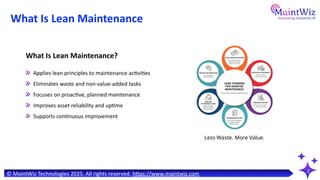
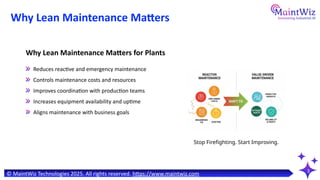
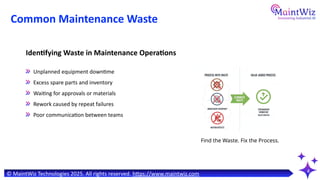
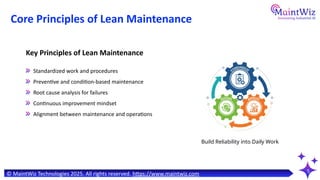
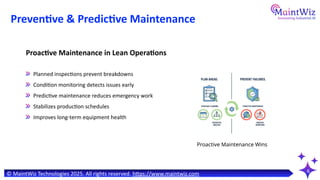
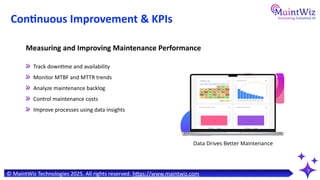
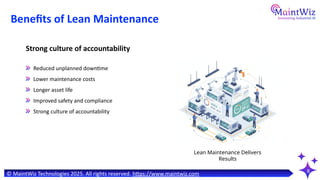
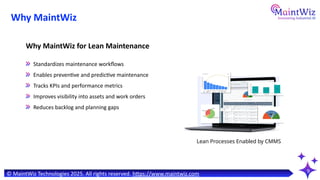
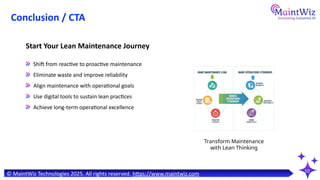

Lean maintenance is a strategic approach that applies lean principles to maintenance operations to eliminate waste, reduce downtime, and improve overall reliability and efficiency. In today’s competitive industrial environments, maintenance teams can no longer function purely reactively — they need structured, data-driven practices that align maintenance with business goals. This SlideShare, “Lean Maintenance: Streamlining Operations for Efficiency & Reliability,” explores what lean maintenance is, why it matters, and how it helps organizations transform traditional maintenance into a proactive, performance-driven function. The presentation begins by defining lean maintenance as the application of lean thinking — originally from manufacturing — to maintenance processes. It emphasizes identifying and eliminating waste in maintenance workflows, such as excessive downtime, unnecessary spare parts, inefficient procedures, redundant inspections, and delays caused by reactive work or poor communication. By focusing only on value-added activities, maintenance teams can improve reliability, reduce costs, and increase uptime. You will learn the key principles of lean maintenance including standard work, preventive and predictive maintenance, root cause analysis, and continuous improvement. The SlideShare highlights the importance of cross-functional collaboration between maintenance, operations, and planning teams to ensure that maintenance strategies are synchronized with production needs and business priorities. A critical part of lean maintenance is the shift from reactive to proactive strategies. Preventive maintenance scheduling, regular condition monitoring, and real-time performance tracking help teams anticipate failures before they occur. Measuring maintenance performance using key performance indicators (KPIs) such as mean time between failures (MTBF), mean time to repair (MTTR), backlog trends, and downtime rates enables organizations to make data-driven decisions and drive continuous improvement. The presentation also describes common maintenance waste — such as unnecessary inspections, delays waiting for parts or approvals, rework due to improper procedures, and excess inventory — and how lean maintenance tools and practices can address these inefficiencies. Lean maintenance leads to more reliable operations, safer workplaces, optimized resource allocation, and improved overall equipment effectiveness (OEE). The SlideShare concludes by demonstrating how modern maintenance practices, supported by digital tools like CMMS (Computerized Maintenance Management System), empower teams to standardize processes, enforce workflows, capture real-time data, and track asset performance. Whether managing a single plant or a network of facilities, this guide provides actionable insights for implementing lean maintenance to enhance operational performance, reduce waste, and strengthen your maintenance function.


