SoC Design

Vinchip Systems
(a Design and Verification Company)

         Chennai.
Agenda

 1.Introduction

 2.SoC   Fundamentals
 3.SoC   Design flow
 4.Query   session
Introduction
    A system on chip (SoC) is an integrated circuit (IC) that integrates all
     components of a computer or other electronic system into a single chip.
    It may contain digital, analog, mixed-signal, and often radio-frequency functions
     all on a single chip substrate.
    A SoC design is a “product creation process” Which
    Starts at identifying the end-user needs (or system)
        Hardware
        Software
    Ends at delivering a product with enough functional satisfaction to overcome
     the payment from the end-user
SoC Fundamentals
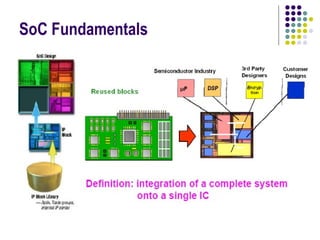
   SoC is a collection of IP’s
   IP stands for Intellectual Property.
   That may be
       Soft IP
       Hard IP
   The design starts from the specification to fabrication through the integration of
    various IP’s
SoC Fundamentals
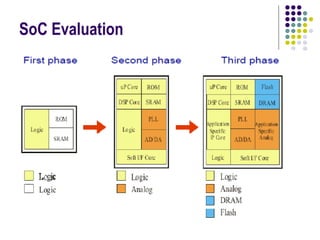
SoC Evaluation
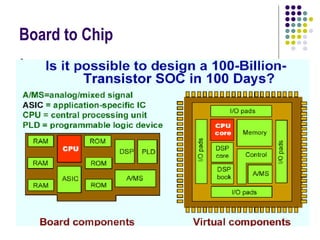
Board to Chip
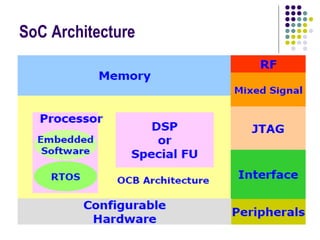
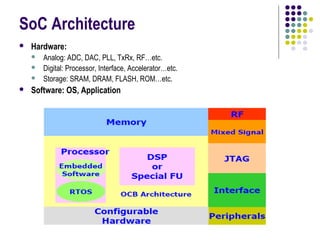
SoC Architecture
SoC Architecture
   Hardware:
       Analog: ADC, DAC, PLL, TxRx, RF…etc.
       Digital: Processor, Interface, Accelerator…etc.
       Storage: SRAM, DRAM, FLASH, ROM…etc.
   Software: OS, Application
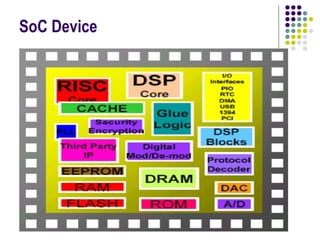
SoC Device
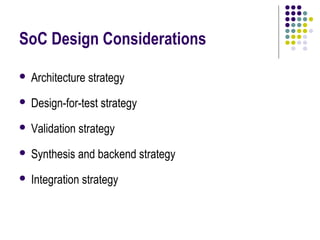
SoC Design Considerations

   Architecture strategy
   Design-for-test strategy
   Validation strategy
   Synthesis and backend strategy
   Integration strategy
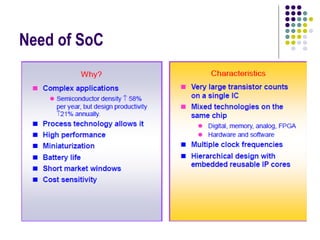
Need of SoC
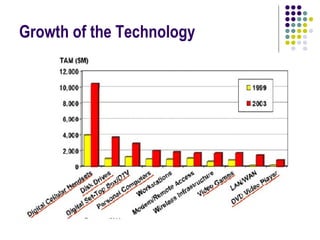
Growth of the Technology
Architecture Strategy
   Central processing core
   DSP cores
   On chip bus
   Easy plug-and-play IPs
   I/O, peripherals
   Platform-based design methodology
       Parameterization
       Function partition
Alternative Computing Subsystem
Control-dominated subsystem.
    controls & coordinates

       system tasks
    performs reactive tasks

      (e.g. user interface)
Data-dominated Subsystem
    regular & predictable

    transformational tasks
    well-defined DSP kernels

   with high parallelism
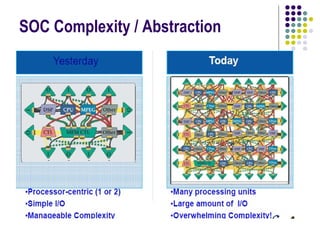
SOC Complexity / Abstraction
Conquer the SoC Complexity
   Use a known real entity
       A pre-designed component (IP, VC reuse)
       A platform (architecture reuse)
   Partition
       Based on functionality
       Hardware and software
   Modeling
       At different level
       Consistent and accurate
What is IP?
   Intellectual Property (IP)
       Intellectual Property means products, technology, software, etc. that have
        been protected through patents, copyrights, or trade secrets.
   Virtual Component (VC)
       A block that meets the Virtual Socket Interface Specification and is used as a
        component in the Virtual Socket design environment. Virtual Components can
        be of three forms Soft, Firm, or Hard.
   Also named mega function, macro block, reusable component
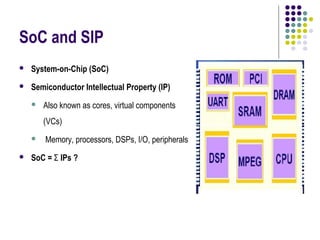
SoC and SIP
   System-on-Chip (SoC)
   Semiconductor Intellectual Property (IP)
       Also known as cores, virtual components
        (VCs)
       Memory, processors, DSPs, I/O, peripherals
   SoC = Σ IPs ?
Core (IP)-Based Design
IP, VC, PE, FU, …
   Memory controller
   Interrupt controller
   Power management controller
   Internal memories
   Bridges
   Caches
   Other functions
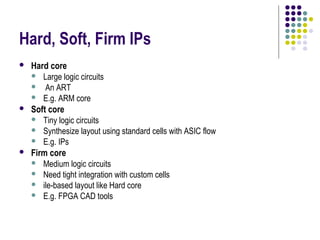
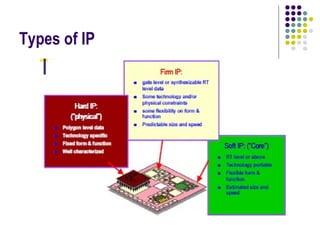
Hard, Soft, Firm IPs
   Hard core
     Large logic circuits
     An ART
     E.g. ARM core
   Soft core
     Tiny logic circuits
     Synthesize layout using standard cells with ASIC flow
     E.g. IPs
   Firm core
     Medium logic circuits
     Need tight integration with custom cells
     ile-based layout like Hard core
     E.g. FPGA CAD tools
Types of IP
Differences in Design Between
IC and IP
   Limitation of IC design
     Number of I/O pin

     Design and Implement all the functionality in the silicon

   Soft IP
     No limitation on number of I/O pin

     Parameterized IP Design: design all the functionality in HDL code

     but implement desired parts in the silicon

     IP compiler/Generator: select what you want !!

     More high level auxiliary tools to verify design

     More difficult in chip-level verification

   Hard IP
     No limitation on number of I/O pin

     Provide multiple level abstract model

     Design and Implement all the functionality in the layout
IP Value

 Foundation    IP – Cell, MegaCell
 Star   IP – ARM ( low power )
 Niche   IP – JPEG, MPEGII, TV, Filter
 Standard    IP – USB, IEEE1394, ADC, DAC
IP Sources
   Legacy IP
       from previous IC
   New IP
       specifically designed for reuse
   Licensed IP
       from IP vendors
Why IP ?
   Don’t know how to do it
   Cannot wait for new in-house development
   Standard/Compatibility calls for it
       PCI, USB, IEEE1394, Bluetooth
       Software compatibility
   Configurable
SoC: A Finer View
   SoC = ∫ (IPs + Platform)
   Platform, or Semiconductor Infrastructure IP
   Interconnect/Inter-block communication
   Performance optimization
   Test
   Diagnosis
   Repair
   Power management
On-Chip-Bus, OCB
   Requirements
       Have to connect many local IPs
       Heterogeneous traffic
       Scalable capability
       QoS
   Types
       Wire (zero hop)
       Bus (single hop)
       Switch, router (multi-hop)
       Circuit-switched
       Packet-switched
Example: ARM OCB - AMBA
   Advanced Microcontroller Bus Architecture (AMBA)
   AMBA 2.0 specifies
       The Advanced High-performance Bus (AHB)
       The Advanced System Bus (ASB)
       The Advanced Peripheral Bus (APB)
       Test methodology
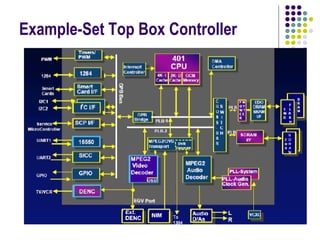
Example-Set Top Box Controller
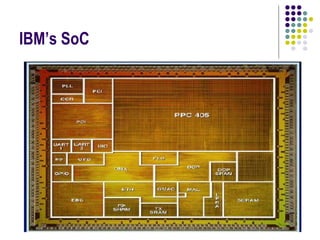
IBM’s SoC
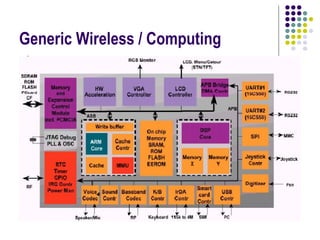
Generic Wireless / Computing
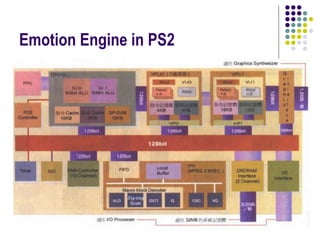
Emotion Engine in PS2

SOC design

  • 1.
    SoC Design Vinchip Systems (aDesign and Verification Company) Chennai.
  • 2.
    Agenda  1.Introduction  2.SoC Fundamentals  3.SoC Design flow  4.Query session
  • 3.
    Introduction  A system on chip (SoC) is an integrated circuit (IC) that integrates all components of a computer or other electronic system into a single chip.  It may contain digital, analog, mixed-signal, and often radio-frequency functions all on a single chip substrate.  A SoC design is a “product creation process” Which  Starts at identifying the end-user needs (or system)  Hardware  Software  Ends at delivering a product with enough functional satisfaction to overcome the payment from the end-user
  • 4.
    SoC Fundamentals  SoC is a collection of IP’s  IP stands for Intellectual Property.  That may be  Soft IP  Hard IP  The design starts from the specification to fabrication through the integration of various IP’s
  • 5.
  • 6.
  • 7.
  • 8.
  • 9.
    SoC Architecture  Hardware:  Analog: ADC, DAC, PLL, TxRx, RF…etc.  Digital: Processor, Interface, Accelerator…etc.  Storage: SRAM, DRAM, FLASH, ROM…etc.  Software: OS, Application
  • 10.
  • 11.
    SoC Design Considerations  Architecture strategy  Design-for-test strategy  Validation strategy  Synthesis and backend strategy  Integration strategy
  • 12.
  • 13.
    Growth of theTechnology
  • 14.
    Architecture Strategy  Central processing core  DSP cores  On chip bus  Easy plug-and-play IPs  I/O, peripherals  Platform-based design methodology  Parameterization  Function partition
  • 15.
    Alternative Computing Subsystem Control-dominatedsubsystem.  controls & coordinates system tasks  performs reactive tasks (e.g. user interface) Data-dominated Subsystem  regular & predictable transformational tasks  well-defined DSP kernels with high parallelism
  • 16.
    SOC Complexity /Abstraction
  • 17.
    Conquer the SoCComplexity  Use a known real entity  A pre-designed component (IP, VC reuse)  A platform (architecture reuse)  Partition  Based on functionality  Hardware and software  Modeling  At different level  Consistent and accurate
  • 18.
    What is IP?  Intellectual Property (IP)  Intellectual Property means products, technology, software, etc. that have been protected through patents, copyrights, or trade secrets.  Virtual Component (VC)  A block that meets the Virtual Socket Interface Specification and is used as a component in the Virtual Socket design environment. Virtual Components can be of three forms Soft, Firm, or Hard.  Also named mega function, macro block, reusable component
  • 19.
    SoC and SIP  System-on-Chip (SoC)  Semiconductor Intellectual Property (IP)  Also known as cores, virtual components (VCs)  Memory, processors, DSPs, I/O, peripherals  SoC = Σ IPs ?
  • 20.
  • 21.
    IP, VC, PE,FU, …  Memory controller  Interrupt controller  Power management controller  Internal memories  Bridges  Caches  Other functions
  • 22.
    Hard, Soft, FirmIPs  Hard core  Large logic circuits  An ART  E.g. ARM core  Soft core  Tiny logic circuits  Synthesize layout using standard cells with ASIC flow  E.g. IPs  Firm core  Medium logic circuits  Need tight integration with custom cells  ile-based layout like Hard core  E.g. FPGA CAD tools
  • 23.
  • 24.
    Differences in DesignBetween IC and IP  Limitation of IC design  Number of I/O pin  Design and Implement all the functionality in the silicon  Soft IP  No limitation on number of I/O pin  Parameterized IP Design: design all the functionality in HDL code  but implement desired parts in the silicon  IP compiler/Generator: select what you want !!  More high level auxiliary tools to verify design  More difficult in chip-level verification  Hard IP  No limitation on number of I/O pin  Provide multiple level abstract model  Design and Implement all the functionality in the layout
  • 25.
    IP Value  Foundation IP – Cell, MegaCell  Star IP – ARM ( low power )  Niche IP – JPEG, MPEGII, TV, Filter  Standard IP – USB, IEEE1394, ADC, DAC
  • 26.
    IP Sources  Legacy IP  from previous IC  New IP  specifically designed for reuse  Licensed IP  from IP vendors
  • 27.
    Why IP ?  Don’t know how to do it  Cannot wait for new in-house development  Standard/Compatibility calls for it  PCI, USB, IEEE1394, Bluetooth  Software compatibility  Configurable
  • 28.
    SoC: A FinerView  SoC = ∫ (IPs + Platform)  Platform, or Semiconductor Infrastructure IP  Interconnect/Inter-block communication  Performance optimization  Test  Diagnosis  Repair  Power management
  • 29.
    On-Chip-Bus, OCB  Requirements  Have to connect many local IPs  Heterogeneous traffic  Scalable capability  QoS  Types  Wire (zero hop)  Bus (single hop)  Switch, router (multi-hop)  Circuit-switched  Packet-switched
  • 30.
    Example: ARM OCB- AMBA  Advanced Microcontroller Bus Architecture (AMBA)  AMBA 2.0 specifies  The Advanced High-performance Bus (AHB)  The Advanced System Bus (ASB)  The Advanced Peripheral Bus (APB)  Test methodology
  • 31.
  • 32.
  • 33.
  • 34.