
Multi mode multi corner …(mmmc)
Presented By
sharief . shaik
MMMC:-
Mode:-
A mode is defined by a set of clocks, supply voltages, timing constraints,
and libraries. It can also have annotation data, such as SDF or parasitic files.
Many chip have multiple modes such as functional modes, test mode, sleep mode, and
Corner:-
A corner is defined as a set of libraries characterized for process, voltage, and
variations.
Corners are not dependent on functional settings; they are meant to capture variations in
manufacturing process, along with expected variations in the voltage and temperature of
environment in which the chip will operate
PVT CONDITIONS (CORNERS)
•Temperature: Best case, worst case, typical = 3 corners
• Process for cells: Fast-fast, slow-slow, fast-slow, slow-fast, typical = 5 corners
•Voltage: Best case, worst case, typical = 3 corners
•Process for interconnect: Max C, Min C, Max RC, Min RC, typical = 5 corners
EXAMPLE:-
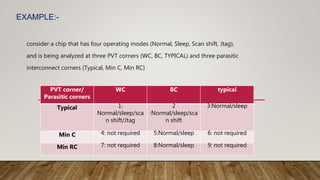
consider a chip that has four operating modes (Normal, Sleep, Scan shift, Jtag),
and is being analyzed at three PVT corners (WC, BC, TYPICAL) and three parasitic
interconnect corners (Typical, Min C, Min RC)
PVT corner/
Parasitic corners
WC BC typical
Typical 1:
Normal/sleep/sca
n shift/Jtag
2
:Normal/sleep/sca
n shift
3:Normal/sleep
Min C 4: not required 5:Normal/sleep 6: not required
Min RC 7: not required 8:Normal/sleep 9: not required
THANK YOU

Multi mode multi corner (mmmc)

  • 1.
    Multi mode multicorner …(mmmc) Presented By sharief . shaik
  • 2.
    MMMC:- Mode:- A mode isdefined by a set of clocks, supply voltages, timing constraints, and libraries. It can also have annotation data, such as SDF or parasitic files. Many chip have multiple modes such as functional modes, test mode, sleep mode, and Corner:- A corner is defined as a set of libraries characterized for process, voltage, and variations. Corners are not dependent on functional settings; they are meant to capture variations in manufacturing process, along with expected variations in the voltage and temperature of environment in which the chip will operate
  • 3.
    PVT CONDITIONS (CORNERS) •Temperature:Best case, worst case, typical = 3 corners • Process for cells: Fast-fast, slow-slow, fast-slow, slow-fast, typical = 5 corners •Voltage: Best case, worst case, typical = 3 corners •Process for interconnect: Max C, Min C, Max RC, Min RC, typical = 5 corners
  • 4.
    EXAMPLE:- consider a chipthat has four operating modes (Normal, Sleep, Scan shift, Jtag), and is being analyzed at three PVT corners (WC, BC, TYPICAL) and three parasitic interconnect corners (Typical, Min C, Min RC) PVT corner/ Parasitic corners WC BC typical Typical 1: Normal/sleep/sca n shift/Jtag 2 :Normal/sleep/sca n shift 3:Normal/sleep Min C 4: not required 5:Normal/sleep 6: not required Min RC 7: not required 8:Normal/sleep 9: not required
  • 6.