Power Dissipation 
CMOS
Outline 
• Motivation to estimate power dissipation 
• Sources of power dissipation 
• Dynamic power dissipation 
• Static power dissipation 
• Metrics 
• Conclusion
Need to estimate power dissipation 
Power dissipation affects 
• Performance 
• Reliability 
• Packaging 
• Cost 
• Portability
Where Does Power Go in CMOS? 
• Dynamic Power Consumption 
Charging and Discharging Capacitors 
• Short Circuit Currents 
Short Circuit Path between Supply Rails during Switching 
• Leakage 
Leaking diodes and transistors
Node Transition Activity and Power 
•Due to charging and discharging of capacitance 
Consider switching a CMOS gate for N clock cycles 
E 
N 
=  2  nN 
C 
L 
V 
dd 
EN : the energy consumed for N clock cycles 
n(N): the number o f 0->1 transition in N clock cycles 
P 
avg 
lim 
N  
E 
N 
N 
-------- f 
clk 
=  
nN 
N 
 lim 
------------ 
  C 
  
N  
L 
V 
dd 
 
2 
f 
clk 
=  
= lim 
 
0  1 
nN 
------------ 
N 
N   
P 
avg 
=  
 C 
0  1 
L 
 2 f 
V 
dd 
clk 

Activity factors of basic gates 
• AND 
• OR 
• XOR 
A B A B   (1 p p ) p p 
(1 )(1 )[1 (1 )(1 )] A B A B    p  p   p  p 
[1 ( 2 )]( 2 ) A B A B A B A B    p  p  p p p  p  p p
Dynamic Power dissipation 
• Power reduced by reducing Vdd, f, C and also activity 
• A signal transition can be classified into two categories 
 a functional transition and 
 a glitch
Glitch Power Dissipation 
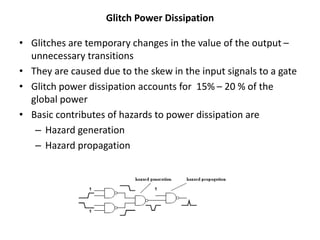
• Glitches are temporary changes in the value of the output – 
unnecessary transitions 
• They are caused due to the skew in the input signals to a gate 
• Glitch power dissipation accounts for 15% – 20 % of the 
global power 
• Basic contributes of hazards to power dissipation are 
– Hazard generation 
– Hazard propagation
Glitch Power Dissipation 
• P = 1/2 .CL.Vdd . (Vdd – Vmin) ; 
Vmin : min voltage swing at the output 
• Glitch power dissipation is dependent on 
– Output load 
– Input pattern 
– Input slope
Glitch Power Dissipation 
• Hazard generation can be reduced by gate sizing and path 
balancing techniques 
• Hazard propagation can be reduced by using less number of 
inverters which tend to amplify and propagate glitches
Short Circuit Power Dissipation 
• Short circuit current occurs during signal transitions when 
both the NMOS and PMOS are ON and there is a direct path 
between Vdd and GND 
• Also called crowbar current 
• Accounts for more than 20% of total power dissipation 
• As clock frequency increases transitions increase 
consequently short circuit power dissipation increases 
• Can be reduced : 
– faster input and slower output 
– Vdd <= Vtn + |Vtp| 
• So both NMOS and PMOS are not on at the same time
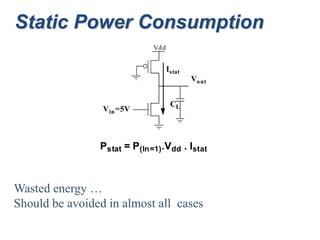
Static Power Consumption 
Vin=5V 
Vout 
CL 
Vdd 
Istat 
Pstat = P(In=1).Vdd . Istat 
• Dominates over dynamic consumption 
Wasted energy … 
Should be avoided in almost all cases 
• Not a function of switching frequency
Static Power Dissipation 
• Power dissipation occurring when device is in standby mode 
• As technology scales this becomes significant 
• Leakage power dissipation 
• Components: 
– Reverse biased p-n junction 
– Sub threshold leakage 
– DIBL leakage 
– Channel punch through 
– GIDL Leakage 
– Narrow width effect 
– Oxide leakage 
– Hot carrier tunneling effect
Leakage Current
New Problem: Gate Leakage 
„Now about 20-30% of all leakage, and growing 
„Gate oxide is so thin, electrons tunnel thru it… 
„NMOS is much worse than PMOS
Principles for Power Reduction 
• Prime choice: Reduce voltage! 
– Recent years have seen an acceleration in 
supply voltage reduction 
– Design at very low voltages still open question 
(0.6 … 0.9 V by 2010!) 
• Reduce switching activity 
Logic synthesis 
Clock gating 
• Reduce physical capacitance 
– Proper Device Sizing 
– Good layout
Factors affecting leakage power 
• Temperature 
– Sub-threshold current increases exponentially 
• Reduction in Vt 
• Increase in thermal voltage 
– BTBT increases due to band gap narrowing 
– Gate leakage is insensitive to temperature change
Factors affecting leakage power 
• Gate oxide thickness 
– Sub-threshold current decreases in long channel transistors and 
increases in short channel 
– BTBT is insensitive 
– Gate leakage increases as thickness reduces
Solutions 
• MTCMOS 
• Dual Vt 
• Dual Vt domino logic 
• Adaptive Body Bias 
• Transistor stacking
Metrics 
• Power Delay product 
• Energy Delay Product 
– Average energy per instruction x average inter instruction 
delay 
• Cunit_area 
– Capacitance per unit area
Summary 
„Power Dissipation is already a prime design constraint 
„Low-power design requires operation at lowest possible 
voltage and clock speed 
„Low-power design requires optimization at
Conclusion 
• Power dissipation is unavoidable especially as technology 
scales down 
• Techniques must be devised to reduce power dissipation 
• Techniques must be devised to accurately estimate the power 
dissipation 
• Estimation and modeling of the sources of power dissipation 
for simulation purposes

Power dissipation cmos

  • 1.
  • 2.
    Outline • Motivationto estimate power dissipation • Sources of power dissipation • Dynamic power dissipation • Static power dissipation • Metrics • Conclusion
  • 3.
    Need to estimatepower dissipation Power dissipation affects • Performance • Reliability • Packaging • Cost • Portability
  • 4.
    Where Does PowerGo in CMOS? • Dynamic Power Consumption Charging and Discharging Capacitors • Short Circuit Currents Short Circuit Path between Supply Rails during Switching • Leakage Leaking diodes and transistors
  • 5.
    Node Transition Activityand Power •Due to charging and discharging of capacitance Consider switching a CMOS gate for N clock cycles E N =  2  nN C L V dd EN : the energy consumed for N clock cycles n(N): the number o f 0->1 transition in N clock cycles P avg lim N  E N N -------- f clk =  nN N  lim ------------   C   N  L V dd  2 f clk =  = lim  0  1 nN ------------ N N   P avg =   C 0  1 L  2 f V dd clk 
  • 6.
    Activity factors ofbasic gates • AND • OR • XOR A B A B   (1 p p ) p p (1 )(1 )[1 (1 )(1 )] A B A B    p  p   p  p [1 ( 2 )]( 2 ) A B A B A B A B    p  p  p p p  p  p p
  • 7.
    Dynamic Power dissipation • Power reduced by reducing Vdd, f, C and also activity • A signal transition can be classified into two categories  a functional transition and  a glitch
  • 8.
    Glitch Power Dissipation • Glitches are temporary changes in the value of the output – unnecessary transitions • They are caused due to the skew in the input signals to a gate • Glitch power dissipation accounts for 15% – 20 % of the global power • Basic contributes of hazards to power dissipation are – Hazard generation – Hazard propagation
  • 9.
    Glitch Power Dissipation • P = 1/2 .CL.Vdd . (Vdd – Vmin) ; Vmin : min voltage swing at the output • Glitch power dissipation is dependent on – Output load – Input pattern – Input slope
  • 11.
    Glitch Power Dissipation • Hazard generation can be reduced by gate sizing and path balancing techniques • Hazard propagation can be reduced by using less number of inverters which tend to amplify and propagate glitches
  • 12.
    Short Circuit PowerDissipation • Short circuit current occurs during signal transitions when both the NMOS and PMOS are ON and there is a direct path between Vdd and GND • Also called crowbar current • Accounts for more than 20% of total power dissipation • As clock frequency increases transitions increase consequently short circuit power dissipation increases • Can be reduced : – faster input and slower output – Vdd <= Vtn + |Vtp| • So both NMOS and PMOS are not on at the same time
  • 14.
    Static Power Consumption Vin=5V Vout CL Vdd Istat Pstat = P(In=1).Vdd . Istat • Dominates over dynamic consumption Wasted energy … Should be avoided in almost all cases • Not a function of switching frequency
  • 15.
    Static Power Dissipation • Power dissipation occurring when device is in standby mode • As technology scales this becomes significant • Leakage power dissipation • Components: – Reverse biased p-n junction – Sub threshold leakage – DIBL leakage – Channel punch through – GIDL Leakage – Narrow width effect – Oxide leakage – Hot carrier tunneling effect
  • 16.
  • 19.
    New Problem: GateLeakage „Now about 20-30% of all leakage, and growing „Gate oxide is so thin, electrons tunnel thru it… „NMOS is much worse than PMOS
  • 20.
    Principles for PowerReduction • Prime choice: Reduce voltage! – Recent years have seen an acceleration in supply voltage reduction – Design at very low voltages still open question (0.6 … 0.9 V by 2010!) • Reduce switching activity Logic synthesis Clock gating • Reduce physical capacitance – Proper Device Sizing – Good layout
  • 21.
    Factors affecting leakagepower • Temperature – Sub-threshold current increases exponentially • Reduction in Vt • Increase in thermal voltage – BTBT increases due to band gap narrowing – Gate leakage is insensitive to temperature change
  • 22.
    Factors affecting leakagepower • Gate oxide thickness – Sub-threshold current decreases in long channel transistors and increases in short channel – BTBT is insensitive – Gate leakage increases as thickness reduces
  • 23.
    Solutions • MTCMOS • Dual Vt • Dual Vt domino logic • Adaptive Body Bias • Transistor stacking
  • 24.
    Metrics • PowerDelay product • Energy Delay Product – Average energy per instruction x average inter instruction delay • Cunit_area – Capacitance per unit area
  • 25.
    Summary „Power Dissipationis already a prime design constraint „Low-power design requires operation at lowest possible voltage and clock speed „Low-power design requires optimization at
  • 26.
    Conclusion • Powerdissipation is unavoidable especially as technology scales down • Techniques must be devised to reduce power dissipation • Techniques must be devised to accurately estimate the power dissipation • Estimation and modeling of the sources of power dissipation for simulation purposes