Low Power Techniques Rajesh k Navandar IC Physical Layout Training Manager (VLSI)
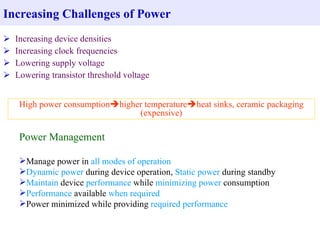
Increasing device densities Increasing clock frequencies Lowering supply voltage Lowering transistor threshold voltage Increasing Challenges of Power High power consumption  higher temperature  heat sinks, ceramic packaging (expensive) Power Management Manage power in  all modes of operation Dynamic power  during device operation,  Static power  during standby Maintain  device  performance  while  minimizing power  consumption Performance  available  when required Power minimized while providing  required performance
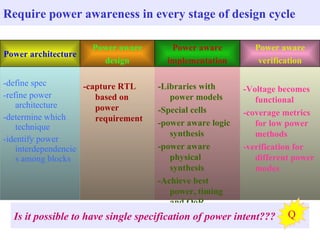
-define spec -refine power architecture -determine which technique -identify power interdependencies among blocks Require power awareness in every stage of design cycle -capture RTL based on power requirement -Libraries with power models -Special cells -power aware logic synthesis -power aware physical synthesis -Achieve best power, timing and QoR -Voltage becomes functional -coverage metrics for low power methods -verification for different power modes Power architecture Power aware design Power aware implementation Power aware verification Is it possible to have single specification of power intent???   Q
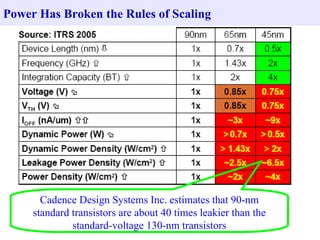
Power Has Broken the Rules of Scaling Cadence Design Systems Inc. estimates that 90-nm standard transistors are about 40 times leakier than the standard-voltage 130-nm transistors
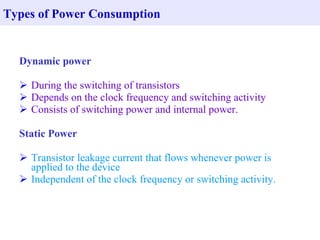
Dynamic power During the switching of transistors Depends on the clock frequency and switching activity Consists of switching power and internal power. Static Power Transistor leakage current that flows whenever power is applied to the device Independent of the clock frequency or switching activity. Types of Power Consumption
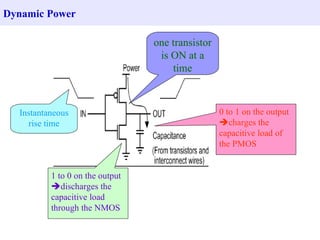
Dynamic Power 0 to 1 on the output   charges the capacitive load of the PMOS 1 to 0 on the output   discharges the capacitive load through the NMOS Instantaneous rise time one transistor is ON at a time
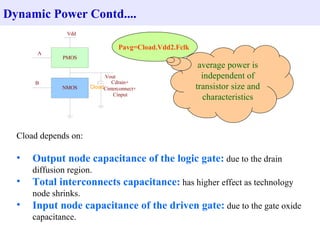
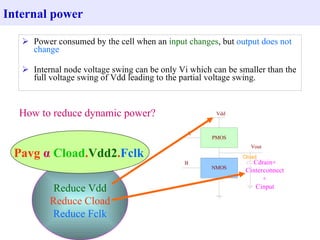
Dynamic Power Contd.... Pavg=Cload.Vdd2.Fclk  Cload depends on: Output node capacitance of the logic gate:  due to the drain diffusion region. Total interconnects capacitance:  has higher effect as technology node shrinks. Input node capacitance of the driven gate:  due to the gate oxide capacitance.  average power is independent of transistor size and characteristics
Power consumed by the cell when an  input changes , but  output does not change   Internal node voltage swing can be only Vi which can be smaller than the full voltage swing of Vdd leading to the partial voltage swing. Internal power How to reduce dynamic power? Reduce Vdd Reduce Cload Reduce Fclk Pavg  α   Cload . Vdd2 . Fclk
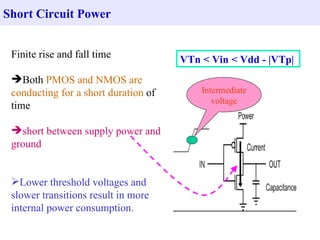
Finite rise and fall time Both  PMOS and NMOS are conducting for a short duration  of time short between supply power and ground Lower threshold voltages and slower transitions result in more internal power consumption. Intermediate voltage VTn < Vin < Vdd - |VTp|   Short Circuit Power
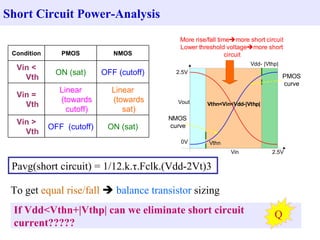
To get  equal rise/fall      balance transistor  sizing Pavg(short circuit) = 1/12.k.τ.Fclk.(Vdd-2Vt)3  Short Circuit Power-Analysis If Vdd<Vthn+|Vthp| can we eliminate short circuit current????? Q Condition PMOS NMOS Vin < Vth ON (sat) OFF (cutoff) Vin = Vth Linear (towards cutoff) Linear (towards sat) Vin > Vth OFF  (cutoff) ON (sat)
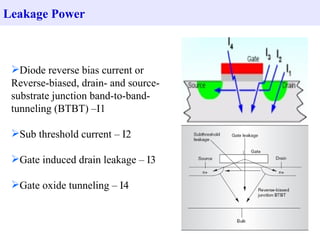
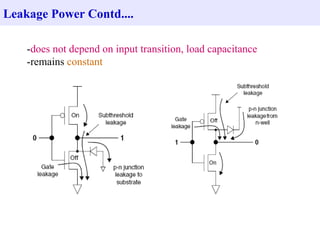
Diode reverse bias current or Reverse-biased, drain- and source-substrate junction band-to-band-tunneling (BTBT) –I1 Sub threshold current – I2 Gate induced drain leakage – I3 Gate oxide tunneling – I4 Leakage Power
- does not depend on input transition, load capacitance   -remains  constant   Leakage Power Contd....
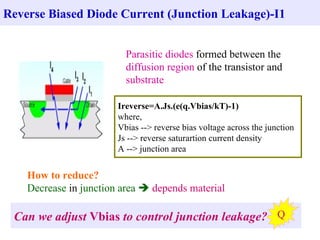
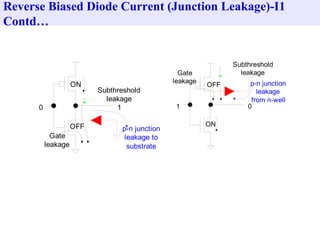
Ireverse=A.Js.(e(q.Vbias/kT)-1) where, Vbias --> reverse bias voltage across the junction Js --> reverse saturartion current density A --> junction area  How to reduce? Decrease  in  junction area     depends material   Parasitic diodes   formed between the   diffusion region  of the transistor and  substrate   Reverse Biased Diode Current (Junction Leakage)-I1 Can we adjust  Vbias  to control junction leakage?   Q
Reverse Biased Diode Current (Junction Leakage)-I1 Contd…
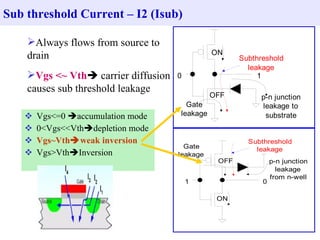
Vgs<=0   accumulation mode 0<Vgs<<Vth  depletion mode Vgs~Vth  weak inversion Vgs>Vth  Inversion Always flows from source to drain  Vgs <~ Vth   carrier diffusion causes sub threshold leakage  Sub threshold Current – I2 (Isub)
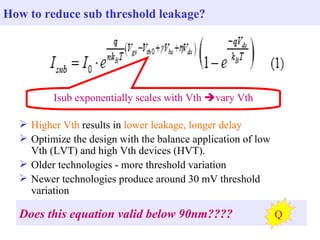
How to reduce sub threshold leakage? Higher Vth  results in  lower leakage, longer delay Optimize the design with the balance application of low Vth (LVT) and high Vth devices (HVT).  Older technologies - more threshold variation  Newer technologies produce around 30 mV threshold variation  Isub exponentially scales with Vth   vary Vth Does this equation valid below 90nm????   Q
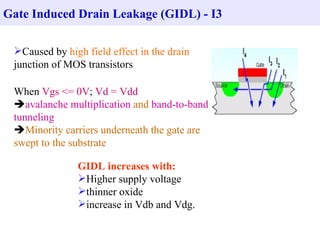
Caused by  high field effect in the drain  junction of MOS transistors  GIDL increases with: Higher supply voltage thinner oxide increase in Vdb and Vdg. When  Vgs <= 0V ;  Vd = Vdd  avalanche multiplication  and  band-to-band tunneling  Minority carriers underneath the gate are swept to the substrate   Gate Induced Drain Leakage (GIDL) - I3
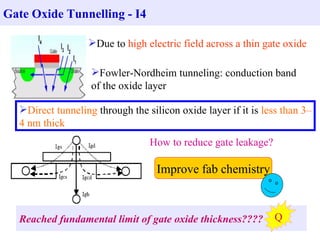
How to reduce gate leakage? Due to  high electric field across a thin gate oxide  Fowler-Nordheim tunneling: conduction band of the oxide layer  Direct tunneling  through the silicon oxide layer if it is  less than 3–4 nm thick  Gate Oxide Tunnelling - I4 Improve fab chemistry Reached fundamental limit of gate oxide thickness???? Q
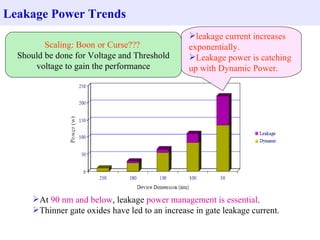
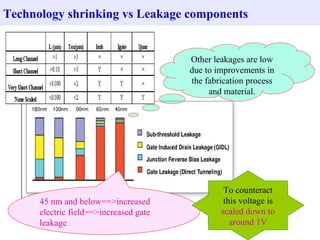
Leakage Power Trends At  90 nm and below , leakage  power management is essential . Thinner gate oxides have led to an increase in gate leakage current. leakage current increases exponentially.  Leakage power is catching up with Dynamic Power. Scaling: Boon or Curse???   Should be done for Voltage and Threshold voltage to gain the performance
Technology shrinking vs Leakage components 45 nm and below==>increased electric field==>increased gate leakage To counteract this voltage is  scaled down to around 1V Other leakages are low due to improvements in the fabrication process and material.
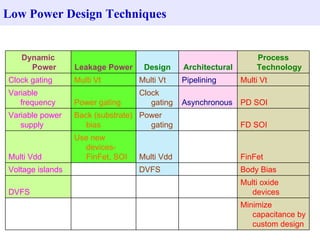
Low Power Design Techniques Dynamic Power Leakage Power Design Architectural Process Technology Clock gating Multi Vt Multi Vt Pipelining Multi Vt Variable frequency Power gating Clock gating Asynchronous PD SOI Variable power supply Back (substrate) bias Power gating   FD SOI Multi Vdd Use new devices-FinFet, SOI Multi Vdd   FinFet Voltage islands   DVFS   Body Bias DVFS       Multi oxide devices         Minimize capacitance by custom design
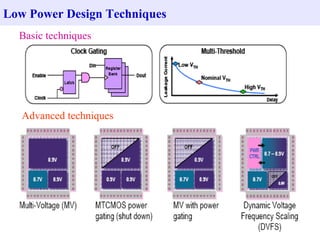
Low Power Design Techniques Advanced techniques Basic techniques
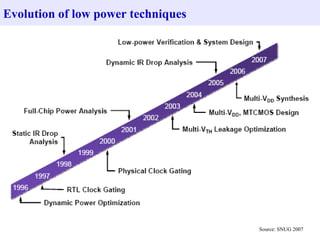
Evolution of low power techniques Source: SNUG 2007
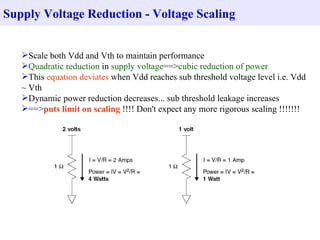
Scale both Vdd and Vth to maintain performance Quadratic reduction  in  supply voltage ==> cubic reduction of power This  equation deviates  when Vdd reaches sub threshold voltage level i.e. Vdd ~ Vth  Dynamic power reduction decreases... sub threshold leakage increases ==> puts limit on scaling  !!!! Don't expect any more rigorous scaling !!!!!!! Supply Voltage Reduction - Voltage Scaling
There are  two types of clock gating styles  available. They are: 1)  Latch-based clock gating 2)  Latch-free clock gating. Clock tree consume  more than 50 % of dynamic power Turn off the clock when it is not needed Gate the clocks of flops which have common enable signal The components of this power are:   Power consumed by combinatorial logic whose values are changing on each clock edge Power consumed by flip-flops and The power consumed by the clock buffer tree in the design. Clock Gating
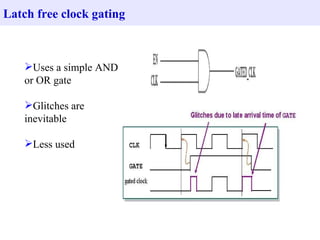
Uses a simple AND or OR gate Glitches are inevitable Less used Latch free clock gating
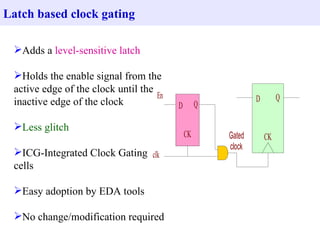
Adds a  level-sensitive latch Holds the enable signal from the active edge of the clock until the inactive edge of the clock Less glitch ICG-Integrated Clock Gating cells Easy adoption by EDA tools No change/modification required Latch based clock gating
Use both  LVT  and  HVT  cells. LVT gates on critical path while HVT gates off the critical path. Footprint and area of low Vt and high Vt cells are same as that of nominal Vt cells. Multi Vt optimization is placement non disturbing.  This enables swapping of cells. Increase fabrication complexity Multi Threshold (MVT) technique
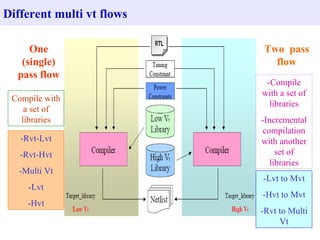
Different multi vt flows One (single) pass flow Two  pass flow Compile with a set of libraries -Compile with a set of libraries -Incremental compilation with another set of libraries -Rvt-Lvt -Rvt-Hvt -Multi Vt -Lvt -Hvt -Lvt to Mvt -Hvt to Mvt -Rvt to Multi Vt
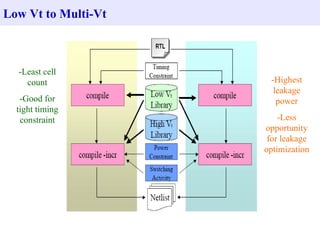
Low Vt to Multi-Vt -Least cell count -Good for tight timing constraint -Highest leakage power -Less opportunity for leakage optimization
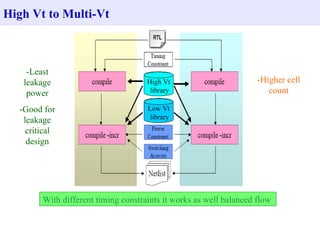
High Vt to Multi-Vt -Least leakage power -Good for leakage critical design -Higher cell count With different timing constraints it works as well balanced flow   High Vt library Low Vt library
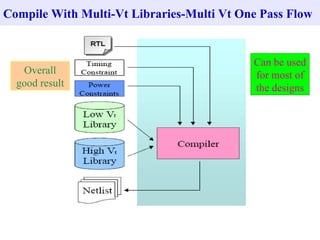
Compile With Multi-Vt Libraries-Multi Vt One Pass Flow Overall good result Can be used for most of the designs
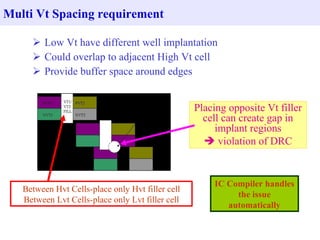
Low Vt have different well implantation Could overlap to adjacent High Vt cell Provide buffer space around edges Multi Vt Spacing requirement Between Hvt Cells-place only Hvt filler cell Between Lvt Cells-place only Lvt filler cell Placing opposite Vt filler cell can create gap in implant regions    violation of DRC IC Compiler handles the issue automatically
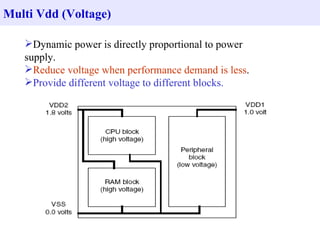
Multi Vdd (Voltage) Dynamic power is directly proportional to power supply. Reduce voltage when performance demand is less . Provide different voltage to different blocks.
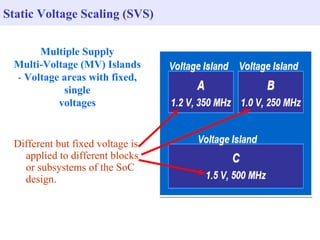
Different but fixed voltage is applied to different blocks or subsystems of the SoC design. Static Voltage Scaling (SVS) Multiple Supply Multi-Voltage (MV) Islands -  Voltage areas with fixed, single voltages
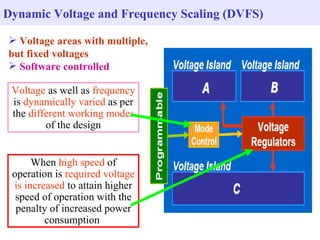
Voltage areas with multiple, but fixed voltages Software controlled Dynamic Voltage and Frequency Scaling (DVFS) When  high speed  of operation is  required voltage is increased  to attain higher speed of operation with the penalty of increased power consumption  Voltage  as well as  frequency  is  dynamically varied  as per the  different working modes  of the design
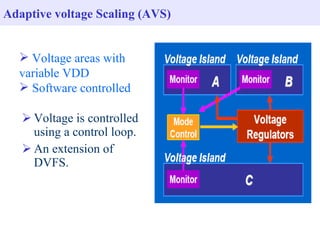
Voltage is controlled using a control loop.  An extension of DVFS. Voltage areas with variable VDD Software controlled Adaptive voltage Scaling (AVS)
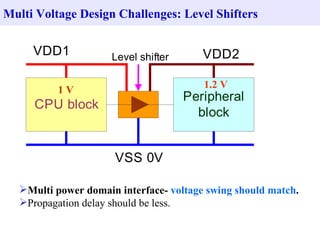
Multi power domain interface-  voltage swing should match . Propagation delay should be less. Multi Voltage Design Challenges: Level Shifters 1 V 1.2 V
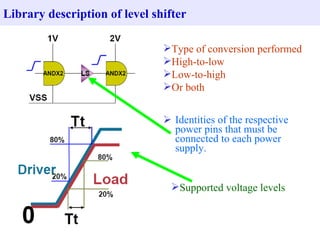
Identities of the respective power pins that must be connected to each power supply. Library description of level shifter Type of conversion performed High-to-low Low-to-high Or both Supported voltage levels
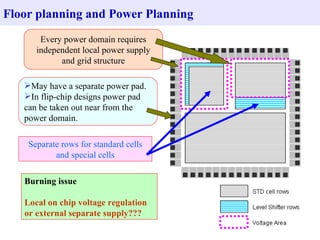
Floor planning and Power Planning Burning issue Local on chip voltage regulation or external separate supply??? Every power domain requires independent local power supply and grid structure May have a separate power pad. In flip-chip designs power pad can be taken out near from the power domain. Separate rows for standard cells and special cells
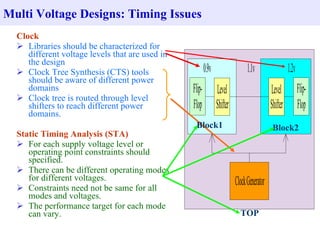
Clock Libraries should be characterized for different voltage levels that are used in the design Clock Tree Synthesis (CTS) tools should be aware of different power domains Clock tree is routed through level shifters to reach different power domains. Static Timing Analysis (STA) For each supply voltage level or operating point constraints should specified. There can be different operating modes for different voltages.  Constraints need not be same for all modes and voltages.  The performance target for each mode can vary.   Multi Voltage Designs: Timing Issues TOP Block1 Block2
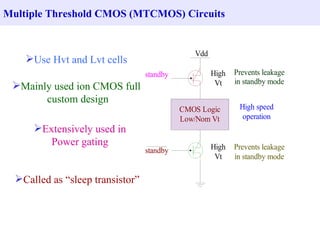
Multiple Threshold CMOS (MTCMOS) Circuits Use Hvt and Lvt cells Mainly used ion CMOS full custom design Extensively used in Power gating Called as “sleep transistor”
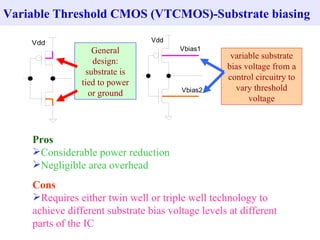
Variable Threshold CMOS (VTCMOS)-Substrate biasing variable substrate bias voltage from a control circuitry to vary threshold voltage General design: substrate is tied to power or ground Pros Considerable power reduction Negligible area overhead Cons Requires either twin well or triple well technology to achieve different substrate bias voltage levels at different parts of the IC
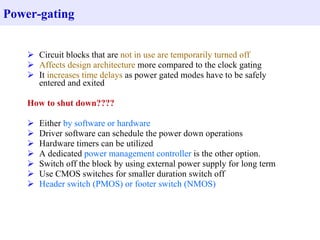
Circuit blocks that are  not in use are temporarily turned off Affects design architecture  more compared to the clock gating It  increases time delays  as power gated modes have to be safely entered and exited How to shut down???? Either  by software or hardware Driver software can schedule the power down operations Hardware timers can be utilized A dedicated  power management controller  is the other option. Switch off the block by using external power supply for long term Use CMOS switches for smaller duration switch off Header switch (PMOS) or footer switch (NMOS) Power-gating
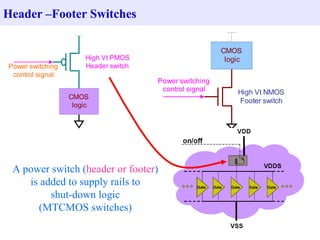
Header –Footer Switches A power switch ( header or footer ) is added to supply rails to shut-down logic (MTCMOS switches)
Power gate size   Should handle the  switching (rush) current   Big enough not to have IR drop Footer gates are smaller for the same amount of current (NMOS has twice mobility of PMOS) Gate control slew rate Larger the slew larger the time taken to switch off or switch on Simultaneous switching capacitance Refers to the amount of circuit that can be switched simultaneously without affecting the power network integrity Rush current may damage the circuitry Switch the block step by step Power gate leakage Should have less leakage  Use High Vt transistors ==> slower switching Power-gating parameters
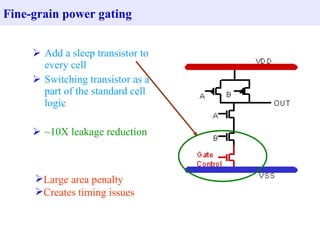
Add a sleep transistor to every cell Switching transistor as a part of the standard cell logic ~10X leakage reduction   Large area penalty Creates timing issues Fine-grain power gating
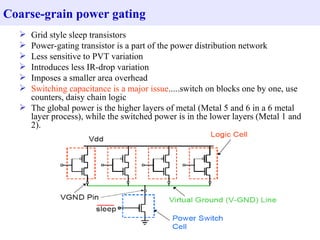
Grid style sleep transistors Power-gating transistor is a part of the power distribution network Less sensitive to PVT variation Introduces less IR-drop variation Imposes a smaller area overhead Switching capacitance is a major issue .....switch on blocks one by one, use counters, daisy chain logic The global power is the higher layers of metal (Metal 5 and 6 in a 6 metal layer process), while the switched power is in the lower layers (Metal 1 and 2). Coarse-grain power gating
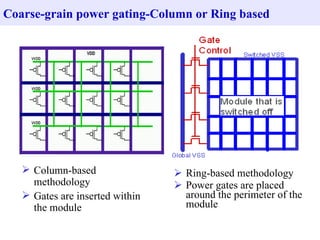
Ring-based methodology Power gates are placed around the perimeter of the module  Column-based methodology Gates are inserted within the module  Coarse-grain power gating-Column or Ring based
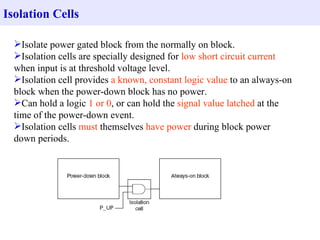
Isolate power gated block from the normally on block. Isolation cells are specially designed for  low short circuit current  when input is at threshold voltage level. Isolation cell provides  a known, constant logic value  to an always-on block when the power-down block has no power. Can hold a logic  1 or 0 , or can hold the  signal value latched  at the time of the power-down event. Isolation cells  must  themselves  have power  during block power down periods.  Isolation Cells
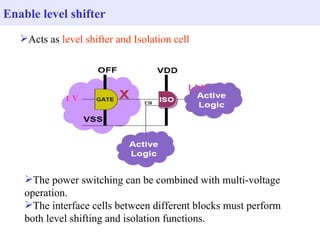
The power switching can be combined with multi-voltage operation. The interface cells between different blocks must perform both level shifting and isolation functions. Enable level shifter Acts as  level shifter and Isolation cell 1 V 1.2 V
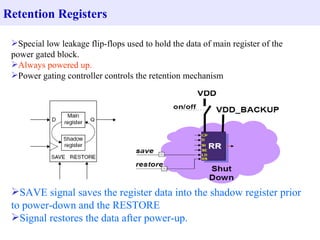
Special low leakage flip-flops used to hold the data of main register of the power gated block. Always powered up.   Power gating controller controls the retention mechanism  SAVE signal   saves the register data into the shadow register prior to power-down and the RESTORE Signal restores the data after power-up. Retention Registers
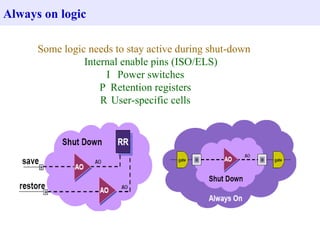
Some logic needs to stay active during shut-down   􀂃  Internal enable pins (ISO/ELS) 􀂃  Power switches 􀂃  Retention registers 􀂃  User-specific cells Always on logic
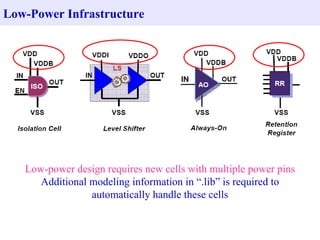
Low-Power Infrastructure Low-power design requires new cells with multiple power pins Additional modeling information in “.lib” is required to automatically handle these cells
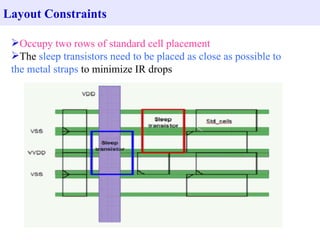
Occupy two rows of standard cell placement The  sleep transistors need to be placed as close as possible   to the metal straps  to minimize IR drops Layout Constraints
Library syntax of special cells
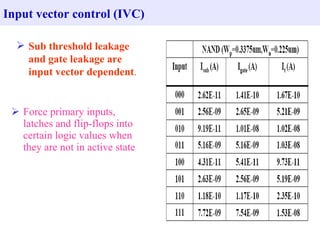
Force primary inputs, latches and flip-flops into certain logic values when they are not in active state Input vector control (IVC) Sub threshold leakage and gate leakage are input vector dependent .
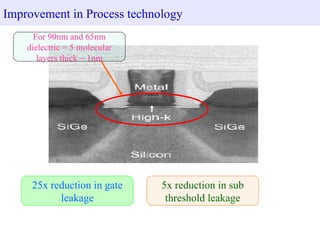
Improvement in Process technology For 90nm and 65nm dielectric = 5 molecular layers thick ~ 1nm 25x reduction in gate leakage 5x reduction in sub threshold leakage
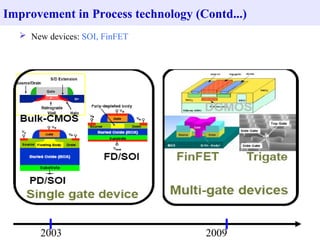
New devices:  SOI, FinFET   2003 2009 Improvement in Process technology (Contd...)
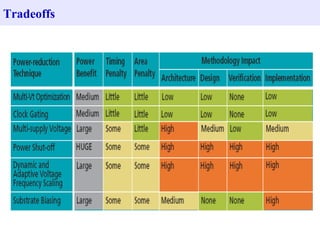
Tradeoffs
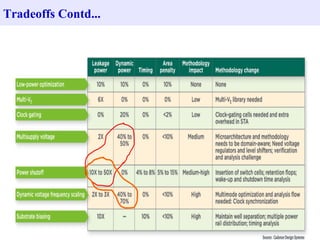
Tradeoffs Contd...
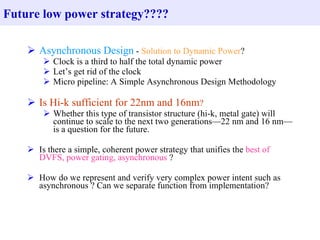
Asynchronous Design  -  Solution to Dynamic Power ? Clock is a third to half the total dynamic power Let’s get rid of the clock Micro pipeline: A Simple Asynchronous Design Methodology Is Hi-k sufficient for 22nm and 16nm ? Whether this type of transistor structure (hi-k, metal gate) will continue to scale to the next two generations—22 nm and 16 nm—is a question for the future. Is there a simple, coherent power strategy that unifies the  best of DVFS, power gating, asynchronous  ? How do we represent and verify very complex power intent such as asynchronous ? Can we separate function from implementation? Future low power strategy????
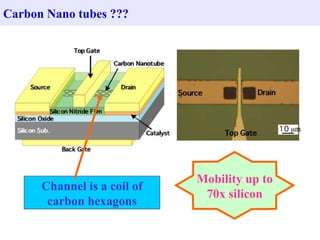
Carbon Nano tubes ??? Channel is a coil of carbon hexagons Mobility up to 70x silicon
Spintronics ??? Information is stored (written) into spins as a particular spin orientation (up or down) The spins, being attached to mobile electrons, carry the information along a wire The information is read at a terminal.
http://asic-soc.blogspot.com www.cadence.com www.synopsys.com SNUG 2007 and 2008 presentations on low power References

Low Power Design Techniques for ASIC / SOC Design

  • 1.
    Low Power TechniquesRajesh k Navandar IC Physical Layout Training Manager (VLSI)
  • 2.
    Increasing device densitiesIncreasing clock frequencies Lowering supply voltage Lowering transistor threshold voltage Increasing Challenges of Power High power consumption  higher temperature  heat sinks, ceramic packaging (expensive) Power Management Manage power in all modes of operation Dynamic power during device operation, Static power during standby Maintain device performance while minimizing power consumption Performance available when required Power minimized while providing required performance
  • 3.
    -define spec -refinepower architecture -determine which technique -identify power interdependencies among blocks Require power awareness in every stage of design cycle -capture RTL based on power requirement -Libraries with power models -Special cells -power aware logic synthesis -power aware physical synthesis -Achieve best power, timing and QoR -Voltage becomes functional -coverage metrics for low power methods -verification for different power modes Power architecture Power aware design Power aware implementation Power aware verification Is it possible to have single specification of power intent??? Q
  • 4.
    Power Has Brokenthe Rules of Scaling Cadence Design Systems Inc. estimates that 90-nm standard transistors are about 40 times leakier than the standard-voltage 130-nm transistors
  • 5.
    Dynamic power Duringthe switching of transistors Depends on the clock frequency and switching activity Consists of switching power and internal power. Static Power Transistor leakage current that flows whenever power is applied to the device Independent of the clock frequency or switching activity. Types of Power Consumption
  • 6.
    Dynamic Power 0to 1 on the output  charges the capacitive load of the PMOS 1 to 0 on the output  discharges the capacitive load through the NMOS Instantaneous rise time one transistor is ON at a time
  • 7.
    Dynamic Power Contd....Pavg=Cload.Vdd2.Fclk Cload depends on: Output node capacitance of the logic gate: due to the drain diffusion region. Total interconnects capacitance: has higher effect as technology node shrinks. Input node capacitance of the driven gate: due to the gate oxide capacitance. average power is independent of transistor size and characteristics
  • 8.
    Power consumed bythe cell when an input changes , but output does not change Internal node voltage swing can be only Vi which can be smaller than the full voltage swing of Vdd leading to the partial voltage swing. Internal power How to reduce dynamic power? Reduce Vdd Reduce Cload Reduce Fclk Pavg α Cload . Vdd2 . Fclk
  • 9.
    Finite rise andfall time Both PMOS and NMOS are conducting for a short duration of time short between supply power and ground Lower threshold voltages and slower transitions result in more internal power consumption. Intermediate voltage VTn < Vin < Vdd - |VTp| Short Circuit Power
  • 10.
    To get equal rise/fall  balance transistor sizing Pavg(short circuit) = 1/12.k.τ.Fclk.(Vdd-2Vt)3 Short Circuit Power-Analysis If Vdd<Vthn+|Vthp| can we eliminate short circuit current????? Q Condition PMOS NMOS Vin < Vth ON (sat) OFF (cutoff) Vin = Vth Linear (towards cutoff) Linear (towards sat) Vin > Vth OFF (cutoff) ON (sat)
  • 11.
    Diode reverse biascurrent or Reverse-biased, drain- and source-substrate junction band-to-band-tunneling (BTBT) –I1 Sub threshold current – I2 Gate induced drain leakage – I3 Gate oxide tunneling – I4 Leakage Power
  • 12.
    - does notdepend on input transition, load capacitance -remains constant Leakage Power Contd....
  • 13.
    Ireverse=A.Js.(e(q.Vbias/kT)-1) where, Vbias--> reverse bias voltage across the junction Js --> reverse saturartion current density A --> junction area How to reduce? Decrease in junction area  depends material Parasitic diodes formed between the diffusion region of the transistor and substrate Reverse Biased Diode Current (Junction Leakage)-I1 Can we adjust Vbias to control junction leakage? Q
  • 14.
    Reverse Biased DiodeCurrent (Junction Leakage)-I1 Contd…
  • 15.
    Vgs<=0 accumulation mode 0<Vgs<<Vth  depletion mode Vgs~Vth  weak inversion Vgs>Vth  Inversion Always flows from source to drain Vgs <~ Vth  carrier diffusion causes sub threshold leakage Sub threshold Current – I2 (Isub)
  • 16.
    How to reducesub threshold leakage? Higher Vth results in lower leakage, longer delay Optimize the design with the balance application of low Vth (LVT) and high Vth devices (HVT). Older technologies - more threshold variation Newer technologies produce around 30 mV threshold variation Isub exponentially scales with Vth  vary Vth Does this equation valid below 90nm???? Q
  • 17.
    Caused by high field effect in the drain junction of MOS transistors GIDL increases with: Higher supply voltage thinner oxide increase in Vdb and Vdg. When Vgs <= 0V ; Vd = Vdd  avalanche multiplication and band-to-band tunneling  Minority carriers underneath the gate are swept to the substrate Gate Induced Drain Leakage (GIDL) - I3
  • 18.
    How to reducegate leakage? Due to high electric field across a thin gate oxide Fowler-Nordheim tunneling: conduction band of the oxide layer Direct tunneling through the silicon oxide layer if it is less than 3–4 nm thick Gate Oxide Tunnelling - I4 Improve fab chemistry Reached fundamental limit of gate oxide thickness???? Q
  • 19.
    Leakage Power TrendsAt 90 nm and below , leakage power management is essential . Thinner gate oxides have led to an increase in gate leakage current. leakage current increases exponentially. Leakage power is catching up with Dynamic Power. Scaling: Boon or Curse??? Should be done for Voltage and Threshold voltage to gain the performance
  • 20.
    Technology shrinking vsLeakage components 45 nm and below==>increased electric field==>increased gate leakage To counteract this voltage is scaled down to around 1V Other leakages are low due to improvements in the fabrication process and material.
  • 21.
    Low Power DesignTechniques Dynamic Power Leakage Power Design Architectural Process Technology Clock gating Multi Vt Multi Vt Pipelining Multi Vt Variable frequency Power gating Clock gating Asynchronous PD SOI Variable power supply Back (substrate) bias Power gating   FD SOI Multi Vdd Use new devices-FinFet, SOI Multi Vdd   FinFet Voltage islands   DVFS   Body Bias DVFS       Multi oxide devices         Minimize capacitance by custom design
  • 22.
    Low Power DesignTechniques Advanced techniques Basic techniques
  • 23.
    Evolution of lowpower techniques Source: SNUG 2007
  • 24.
    Scale both Vddand Vth to maintain performance Quadratic reduction in supply voltage ==> cubic reduction of power This equation deviates when Vdd reaches sub threshold voltage level i.e. Vdd ~ Vth Dynamic power reduction decreases... sub threshold leakage increases ==> puts limit on scaling !!!! Don't expect any more rigorous scaling !!!!!!! Supply Voltage Reduction - Voltage Scaling
  • 25.
    There are two types of clock gating styles available. They are: 1) Latch-based clock gating 2) Latch-free clock gating. Clock tree consume more than 50 % of dynamic power Turn off the clock when it is not needed Gate the clocks of flops which have common enable signal The components of this power are: Power consumed by combinatorial logic whose values are changing on each clock edge Power consumed by flip-flops and The power consumed by the clock buffer tree in the design. Clock Gating
  • 26.
    Uses a simpleAND or OR gate Glitches are inevitable Less used Latch free clock gating
  • 27.
    Adds a level-sensitive latch Holds the enable signal from the active edge of the clock until the inactive edge of the clock Less glitch ICG-Integrated Clock Gating cells Easy adoption by EDA tools No change/modification required Latch based clock gating
  • 28.
    Use both LVT and HVT cells. LVT gates on critical path while HVT gates off the critical path. Footprint and area of low Vt and high Vt cells are same as that of nominal Vt cells. Multi Vt optimization is placement non disturbing. This enables swapping of cells. Increase fabrication complexity Multi Threshold (MVT) technique
  • 29.
    Different multi vtflows One (single) pass flow Two pass flow Compile with a set of libraries -Compile with a set of libraries -Incremental compilation with another set of libraries -Rvt-Lvt -Rvt-Hvt -Multi Vt -Lvt -Hvt -Lvt to Mvt -Hvt to Mvt -Rvt to Multi Vt
  • 30.
    Low Vt toMulti-Vt -Least cell count -Good for tight timing constraint -Highest leakage power -Less opportunity for leakage optimization
  • 31.
    High Vt toMulti-Vt -Least leakage power -Good for leakage critical design -Higher cell count With different timing constraints it works as well balanced flow High Vt library Low Vt library
  • 32.
    Compile With Multi-VtLibraries-Multi Vt One Pass Flow Overall good result Can be used for most of the designs
  • 33.
    Low Vt havedifferent well implantation Could overlap to adjacent High Vt cell Provide buffer space around edges Multi Vt Spacing requirement Between Hvt Cells-place only Hvt filler cell Between Lvt Cells-place only Lvt filler cell Placing opposite Vt filler cell can create gap in implant regions  violation of DRC IC Compiler handles the issue automatically
  • 34.
    Multi Vdd (Voltage)Dynamic power is directly proportional to power supply. Reduce voltage when performance demand is less . Provide different voltage to different blocks.
  • 35.
    Different but fixedvoltage is applied to different blocks or subsystems of the SoC design. Static Voltage Scaling (SVS) Multiple Supply Multi-Voltage (MV) Islands - Voltage areas with fixed, single voltages
  • 36.
    Voltage areas withmultiple, but fixed voltages Software controlled Dynamic Voltage and Frequency Scaling (DVFS) When high speed of operation is required voltage is increased to attain higher speed of operation with the penalty of increased power consumption Voltage as well as frequency is dynamically varied as per the different working modes of the design
  • 37.
    Voltage is controlledusing a control loop. An extension of DVFS. Voltage areas with variable VDD Software controlled Adaptive voltage Scaling (AVS)
  • 38.
    Multi power domaininterface- voltage swing should match . Propagation delay should be less. Multi Voltage Design Challenges: Level Shifters 1 V 1.2 V
  • 39.
    Identities of therespective power pins that must be connected to each power supply. Library description of level shifter Type of conversion performed High-to-low Low-to-high Or both Supported voltage levels
  • 40.
    Floor planning andPower Planning Burning issue Local on chip voltage regulation or external separate supply??? Every power domain requires independent local power supply and grid structure May have a separate power pad. In flip-chip designs power pad can be taken out near from the power domain. Separate rows for standard cells and special cells
  • 41.
    Clock Libraries shouldbe characterized for different voltage levels that are used in the design Clock Tree Synthesis (CTS) tools should be aware of different power domains Clock tree is routed through level shifters to reach different power domains. Static Timing Analysis (STA) For each supply voltage level or operating point constraints should specified. There can be different operating modes for different voltages. Constraints need not be same for all modes and voltages. The performance target for each mode can vary. Multi Voltage Designs: Timing Issues TOP Block1 Block2
  • 42.
    Multiple Threshold CMOS(MTCMOS) Circuits Use Hvt and Lvt cells Mainly used ion CMOS full custom design Extensively used in Power gating Called as “sleep transistor”
  • 43.
    Variable Threshold CMOS(VTCMOS)-Substrate biasing variable substrate bias voltage from a control circuitry to vary threshold voltage General design: substrate is tied to power or ground Pros Considerable power reduction Negligible area overhead Cons Requires either twin well or triple well technology to achieve different substrate bias voltage levels at different parts of the IC
  • 44.
    Circuit blocks thatare not in use are temporarily turned off Affects design architecture more compared to the clock gating It increases time delays as power gated modes have to be safely entered and exited How to shut down???? Either by software or hardware Driver software can schedule the power down operations Hardware timers can be utilized A dedicated power management controller is the other option. Switch off the block by using external power supply for long term Use CMOS switches for smaller duration switch off Header switch (PMOS) or footer switch (NMOS) Power-gating
  • 45.
    Header –Footer SwitchesA power switch ( header or footer ) is added to supply rails to shut-down logic (MTCMOS switches)
  • 46.
    Power gate size Should handle the switching (rush) current Big enough not to have IR drop Footer gates are smaller for the same amount of current (NMOS has twice mobility of PMOS) Gate control slew rate Larger the slew larger the time taken to switch off or switch on Simultaneous switching capacitance Refers to the amount of circuit that can be switched simultaneously without affecting the power network integrity Rush current may damage the circuitry Switch the block step by step Power gate leakage Should have less leakage Use High Vt transistors ==> slower switching Power-gating parameters
  • 47.
    Add a sleeptransistor to every cell Switching transistor as a part of the standard cell logic ~10X leakage reduction Large area penalty Creates timing issues Fine-grain power gating
  • 48.
    Grid style sleeptransistors Power-gating transistor is a part of the power distribution network Less sensitive to PVT variation Introduces less IR-drop variation Imposes a smaller area overhead Switching capacitance is a major issue .....switch on blocks one by one, use counters, daisy chain logic The global power is the higher layers of metal (Metal 5 and 6 in a 6 metal layer process), while the switched power is in the lower layers (Metal 1 and 2). Coarse-grain power gating
  • 49.
    Ring-based methodology Powergates are placed around the perimeter of the module Column-based methodology Gates are inserted within the module Coarse-grain power gating-Column or Ring based
  • 50.
    Isolate power gatedblock from the normally on block. Isolation cells are specially designed for low short circuit current when input is at threshold voltage level. Isolation cell provides a known, constant logic value to an always-on block when the power-down block has no power. Can hold a logic 1 or 0 , or can hold the signal value latched at the time of the power-down event. Isolation cells must themselves have power during block power down periods. Isolation Cells
  • 51.
    The power switchingcan be combined with multi-voltage operation. The interface cells between different blocks must perform both level shifting and isolation functions. Enable level shifter Acts as level shifter and Isolation cell 1 V 1.2 V
  • 52.
    Special low leakageflip-flops used to hold the data of main register of the power gated block. Always powered up. Power gating controller controls the retention mechanism SAVE signal saves the register data into the shadow register prior to power-down and the RESTORE Signal restores the data after power-up. Retention Registers
  • 53.
    Some logic needsto stay active during shut-down 􀂃 Internal enable pins (ISO/ELS) 􀂃 Power switches 􀂃 Retention registers 􀂃 User-specific cells Always on logic
  • 54.
    Low-Power Infrastructure Low-powerdesign requires new cells with multiple power pins Additional modeling information in “.lib” is required to automatically handle these cells
  • 55.
    Occupy two rowsof standard cell placement The sleep transistors need to be placed as close as possible to the metal straps to minimize IR drops Layout Constraints
  • 56.
    Library syntax ofspecial cells
  • 57.
    Force primary inputs,latches and flip-flops into certain logic values when they are not in active state Input vector control (IVC) Sub threshold leakage and gate leakage are input vector dependent .
  • 58.
    Improvement in Processtechnology For 90nm and 65nm dielectric = 5 molecular layers thick ~ 1nm 25x reduction in gate leakage 5x reduction in sub threshold leakage
  • 59.
    New devices: SOI, FinFET 2003 2009 Improvement in Process technology (Contd...)
  • 60.
  • 61.
  • 62.
    Asynchronous Design - Solution to Dynamic Power ? Clock is a third to half the total dynamic power Let’s get rid of the clock Micro pipeline: A Simple Asynchronous Design Methodology Is Hi-k sufficient for 22nm and 16nm ? Whether this type of transistor structure (hi-k, metal gate) will continue to scale to the next two generations—22 nm and 16 nm—is a question for the future. Is there a simple, coherent power strategy that unifies the best of DVFS, power gating, asynchronous ? How do we represent and verify very complex power intent such as asynchronous ? Can we separate function from implementation? Future low power strategy????
  • 63.
    Carbon Nano tubes??? Channel is a coil of carbon hexagons Mobility up to 70x silicon
  • 64.
    Spintronics ??? Informationis stored (written) into spins as a particular spin orientation (up or down) The spins, being attached to mobile electrons, carry the information along a wire The information is read at a terminal.
  • 65.
    http://asic-soc.blogspot.com www.cadence.com www.synopsys.comSNUG 2007 and 2008 presentations on low power References