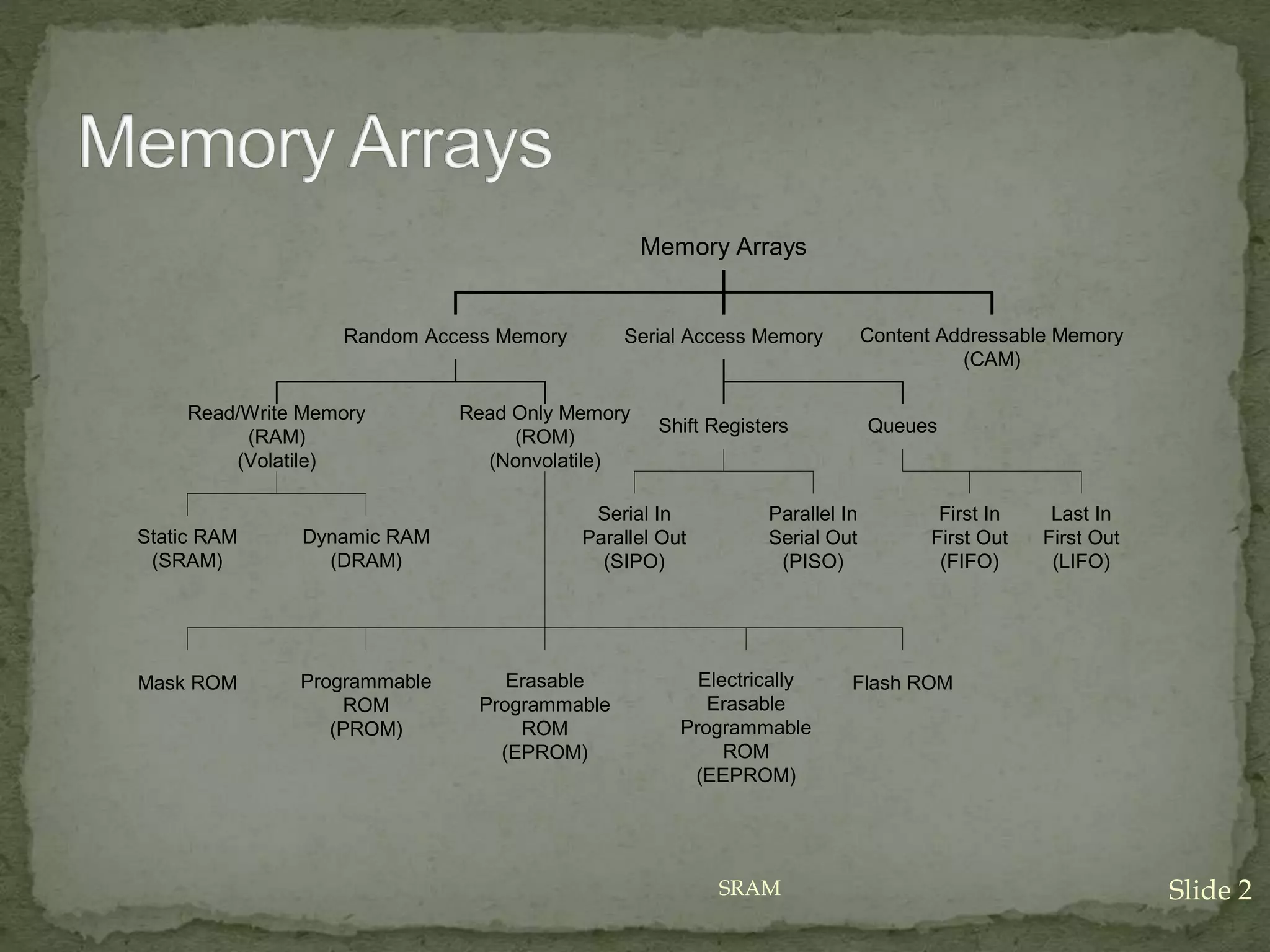
Memory Arrays 
Random Access Memory Serial Access Memory Content Addressable Memory 
(CAM) 
SRAM Slide 2 
Read/Write Memory 
(RAM) 
(Volatile) 
Read Only Memory 
(ROM) 
(Nonvolatile) 
Static RAM 
(SRAM) 
Dynamic RAM 
(DRAM) 
Shift Registers Queues 
First In 
First Out 
(FIFO) 
Last In 
First Out 
(LIFO) 
Serial In 
Parallel Out 
(SIPO) 
Parallel In 
Serial Out 
(PISO) 
Mask ROM Programmable 
ROM 
(PROM) 
Erasable 
Programmable 
ROM 
(EPROM) 
Electrically 
Erasable 
Programmable 
ROM 
(EEPROM) 
Flash ROM
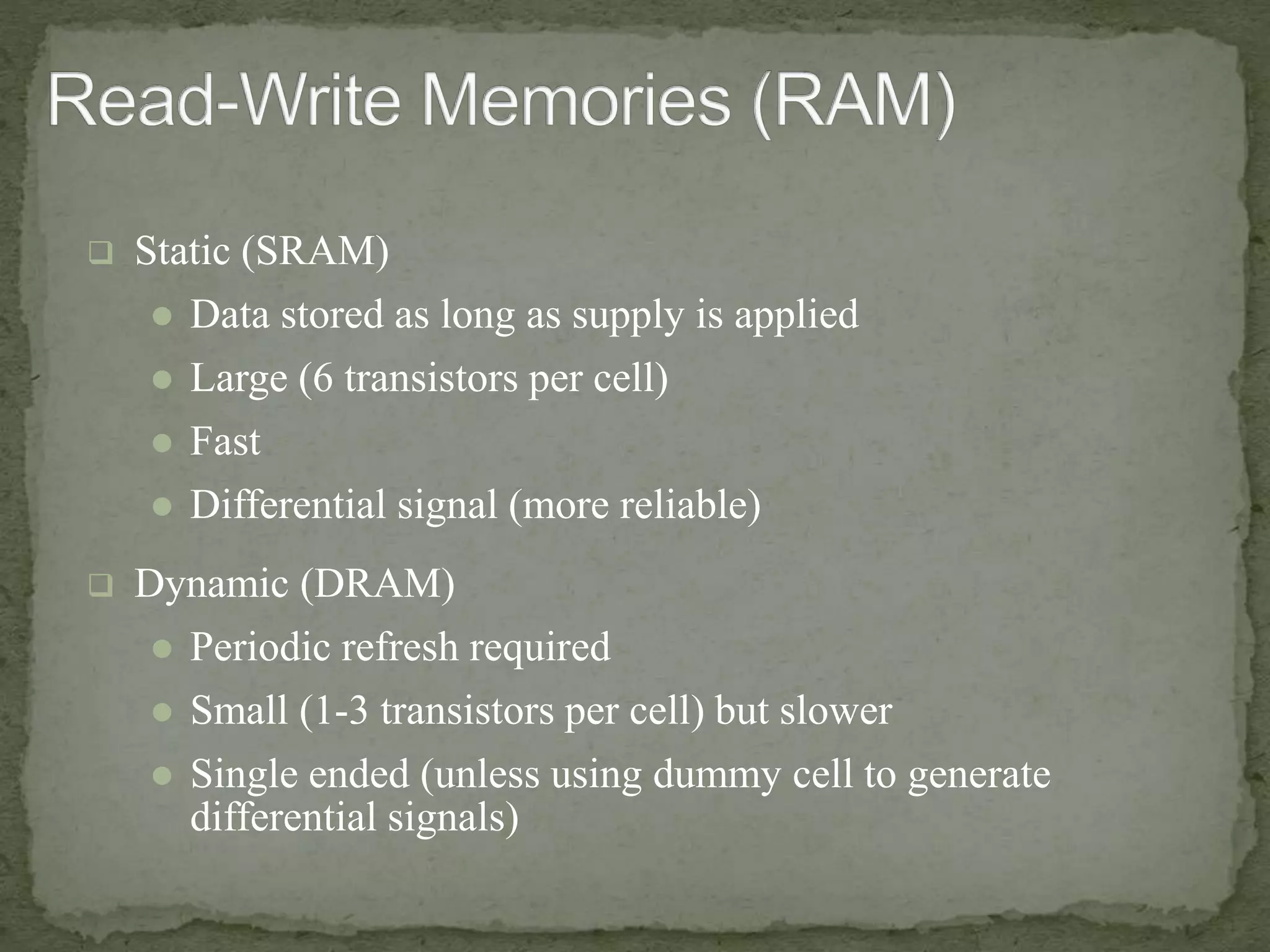
 Static (SRAM) 
 Data stored as long as supply is applied 
 Large (6 transistors per cell) 
 Fast 
 Differential signal (more reliable) 
 Dynamic (DRAM) 
 Periodic refresh required 
 Small (1-3 transistors per cell) but slower 
 Single ended (unless using dummy cell to generate 
differential signals)
 SRAM :- 
 Is static memory. 
 The term static is derived from the fact that it 
doesn't need to be refreshed like dynamic 
RAM. 
 Has cycle time is much shorter than that of 
DRAM because it does not need to pause 
between accesses. 
 Is often used only as a memory cache
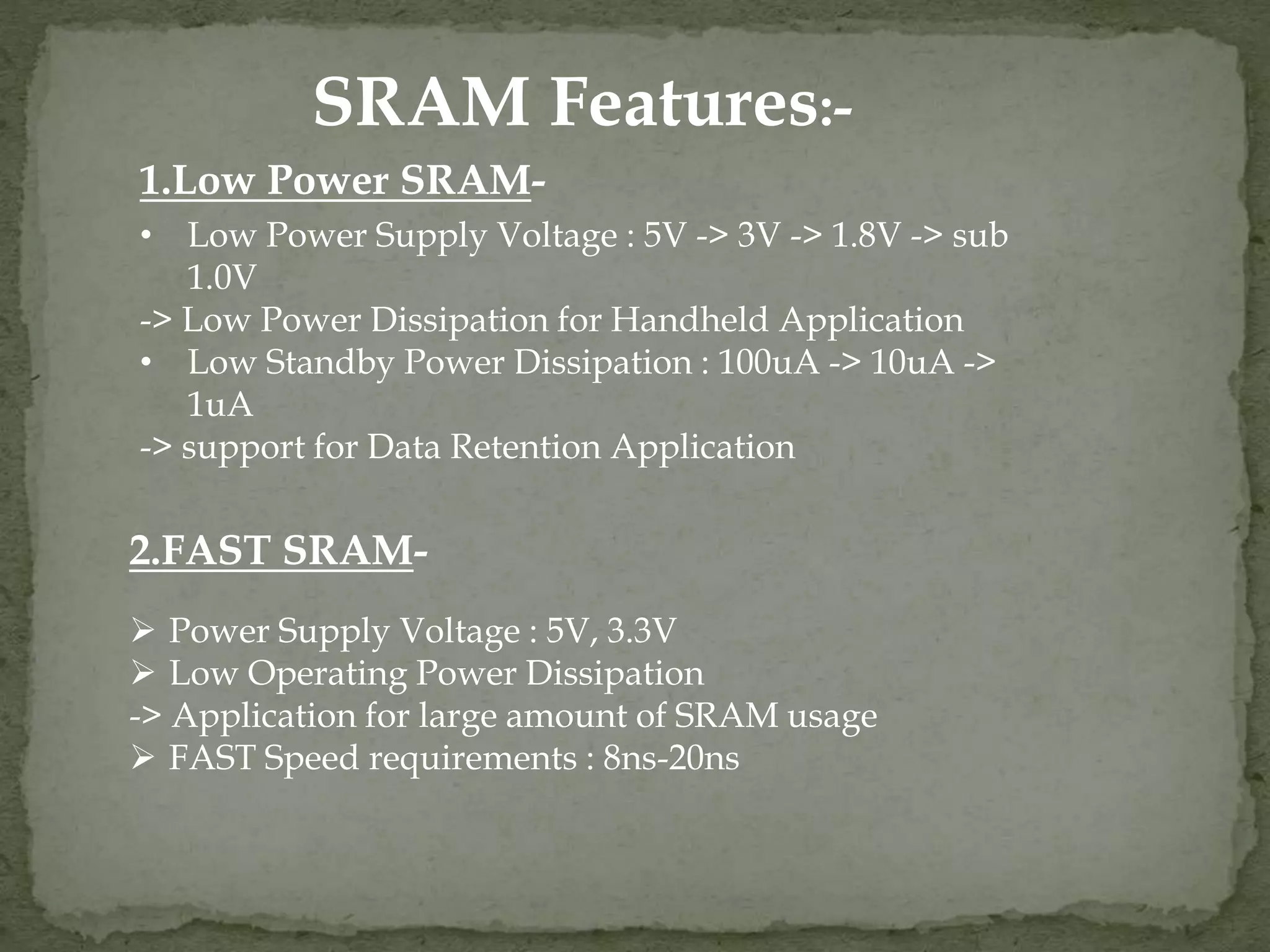
SRAM Features:- 
1.Low Power SRAM- 
• Low Power Supply Voltage : 5V -> 3V -> 1.8V -> sub 
1.0V 
-> Low Power Dissipation for Handheld Application 
• Low Standby Power Dissipation : 100uA -> 10uA -> 
1uA 
-> support for Data Retention Application 
2.FAST SRAM- 
 Power Supply Voltage : 5V, 3.3V 
 Low Operating Power Dissipation 
-> Application for large amount of SRAM usage 
 FAST Speed requirements : 8ns-20ns
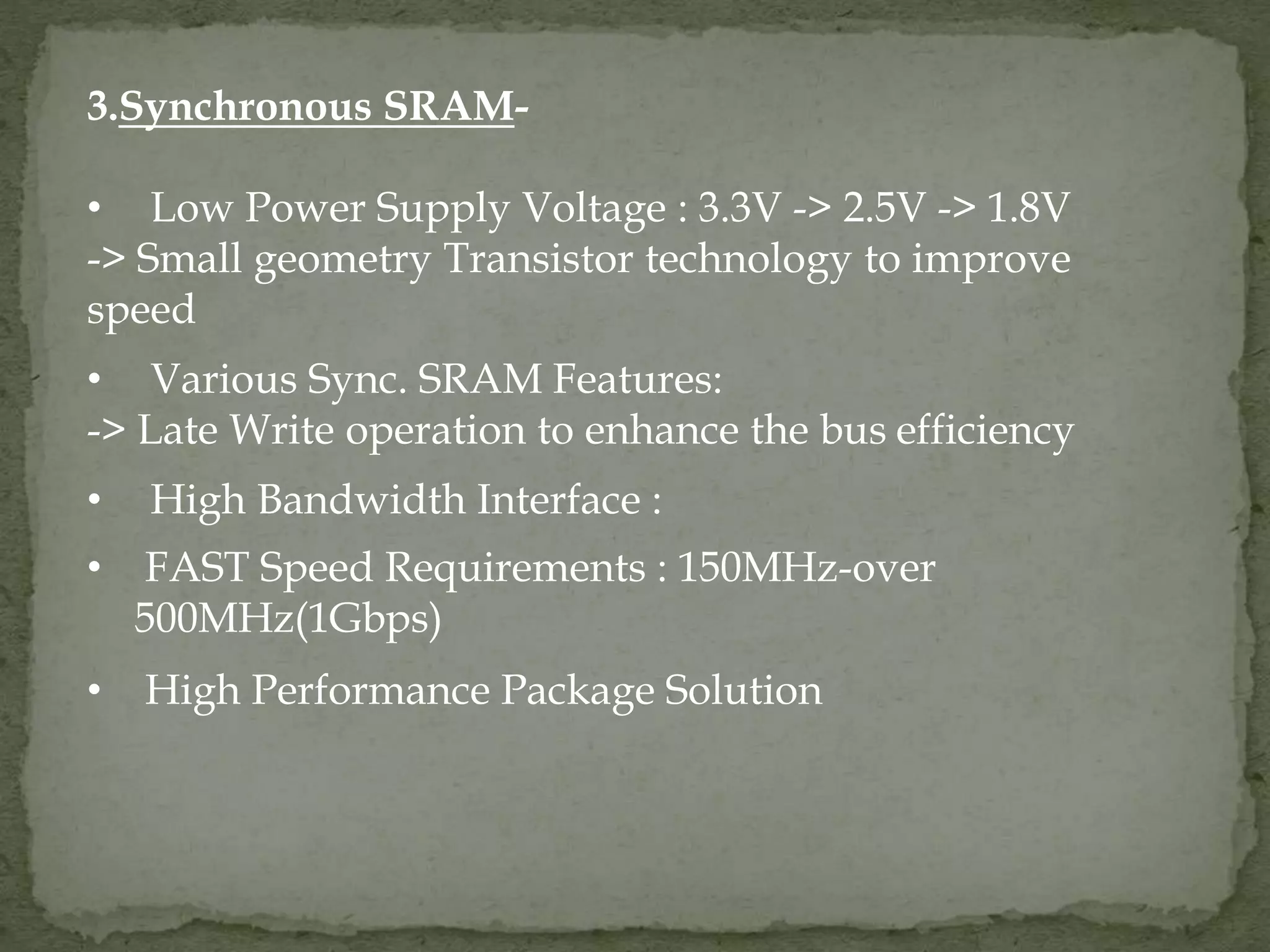
3.Synchronous SRAM- 
• Low Power Supply Voltage : 3.3V -> 2.5V -> 1.8V 
-> Small geometry Transistor technology to improve 
speed 
• Various Sync. SRAM Features: 
-> Late Write operation to enhance the bus efficiency 
• High Bandwidth Interface : 
• FAST Speed Requirements : 150MHz-over 
500MHz(1Gbps) 
• High Performance Package Solution
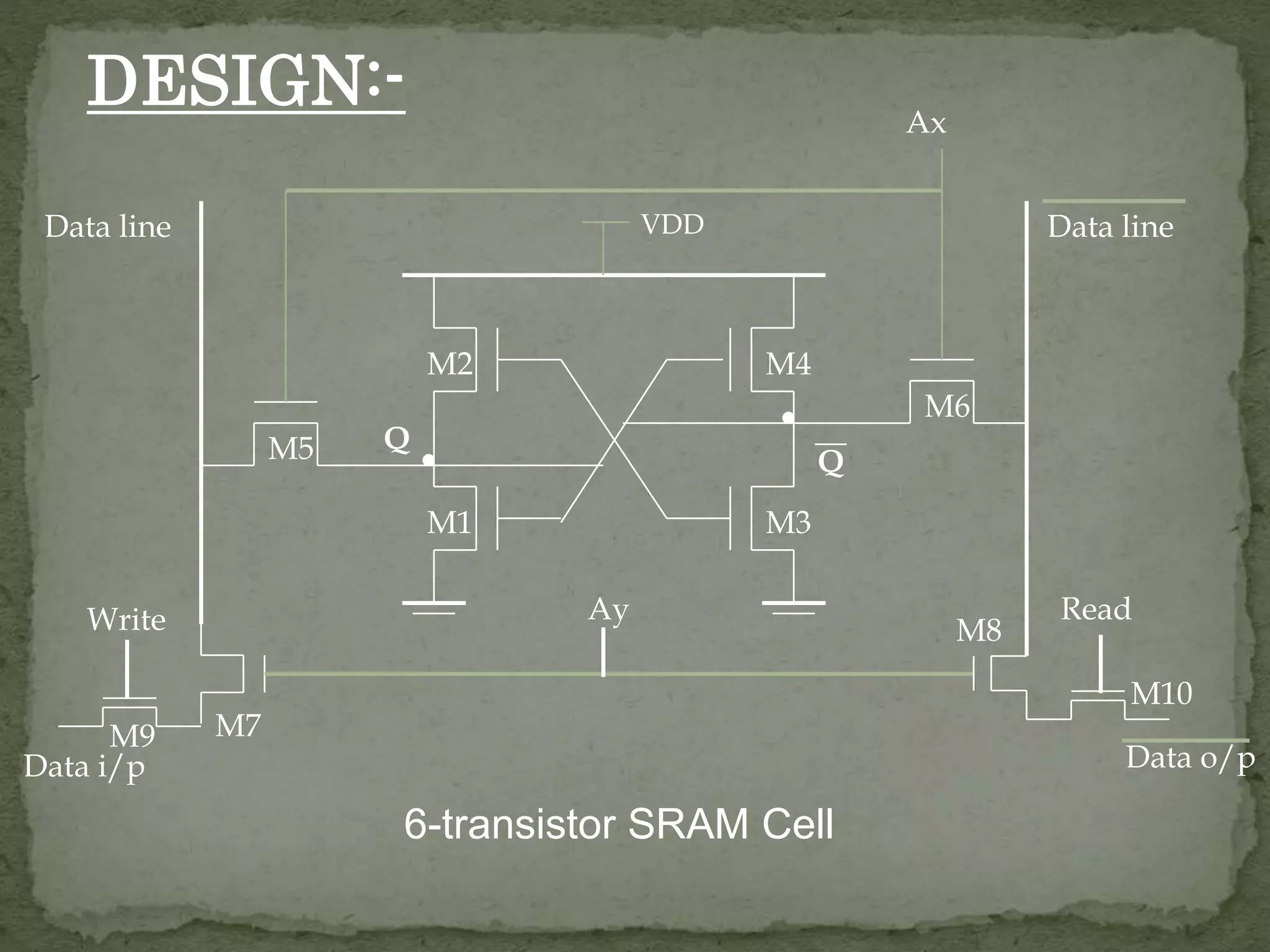
Ax 
Data line Data line 
M2 
M1 
M4 
M3 
DESIGN:- 
M5 
M6 
Q 
Q 
VDD 
Write Read 
Data i/p Data o/p 
6-transistor SRAM Cell 
M9 M7 
M8 
M10 
Ay
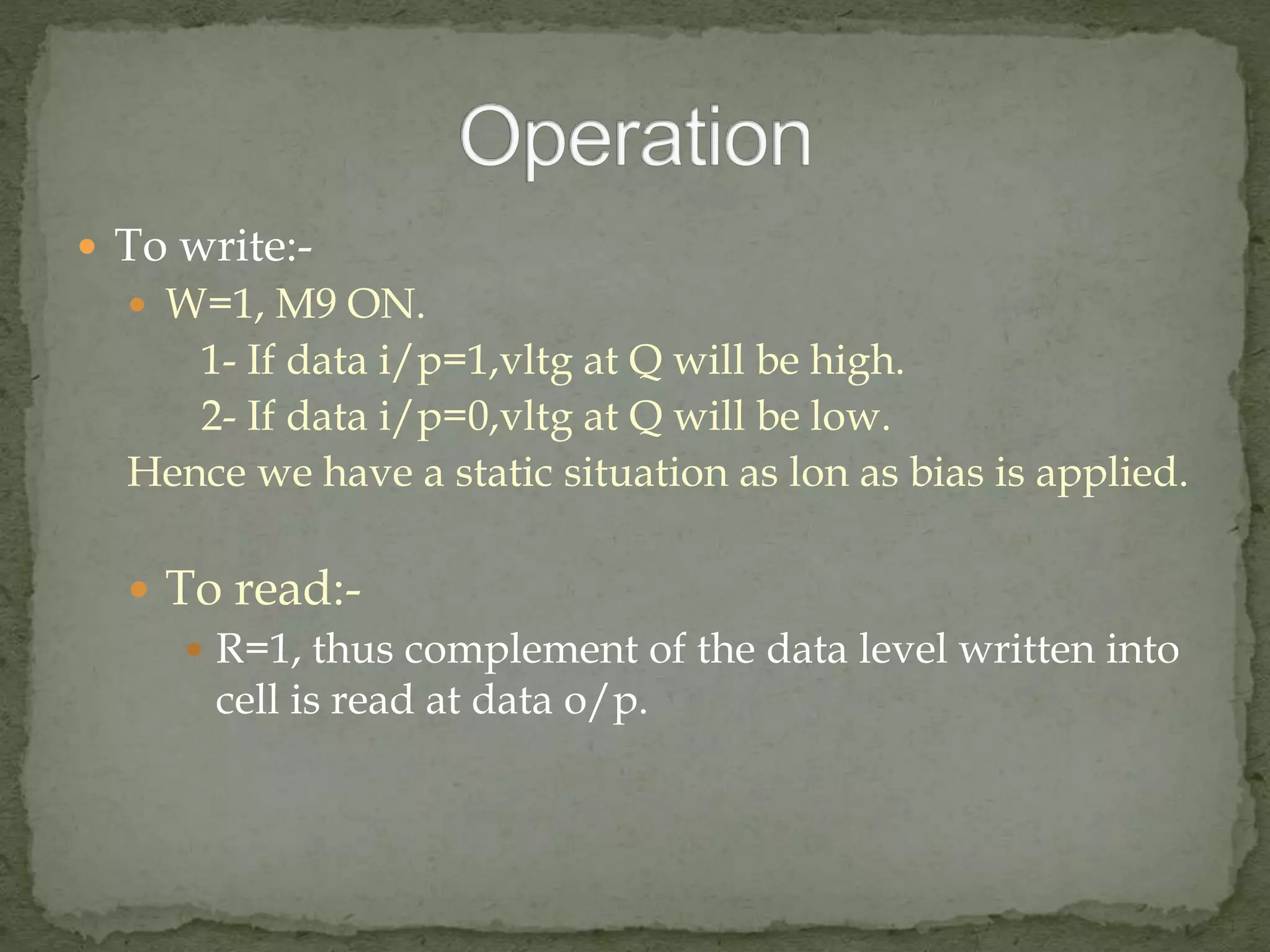
 To write:- 
 W=1, M9 ON. 
1- If data i/p=1,vltg at Q will be high. 
2- If data i/p=0,vltg at Q will be low. 
Hence we have a static situation as lon as bias is applied. 
 To read:- 
 R=1, thus complement of the data level written into 
cell is read at data o/p.
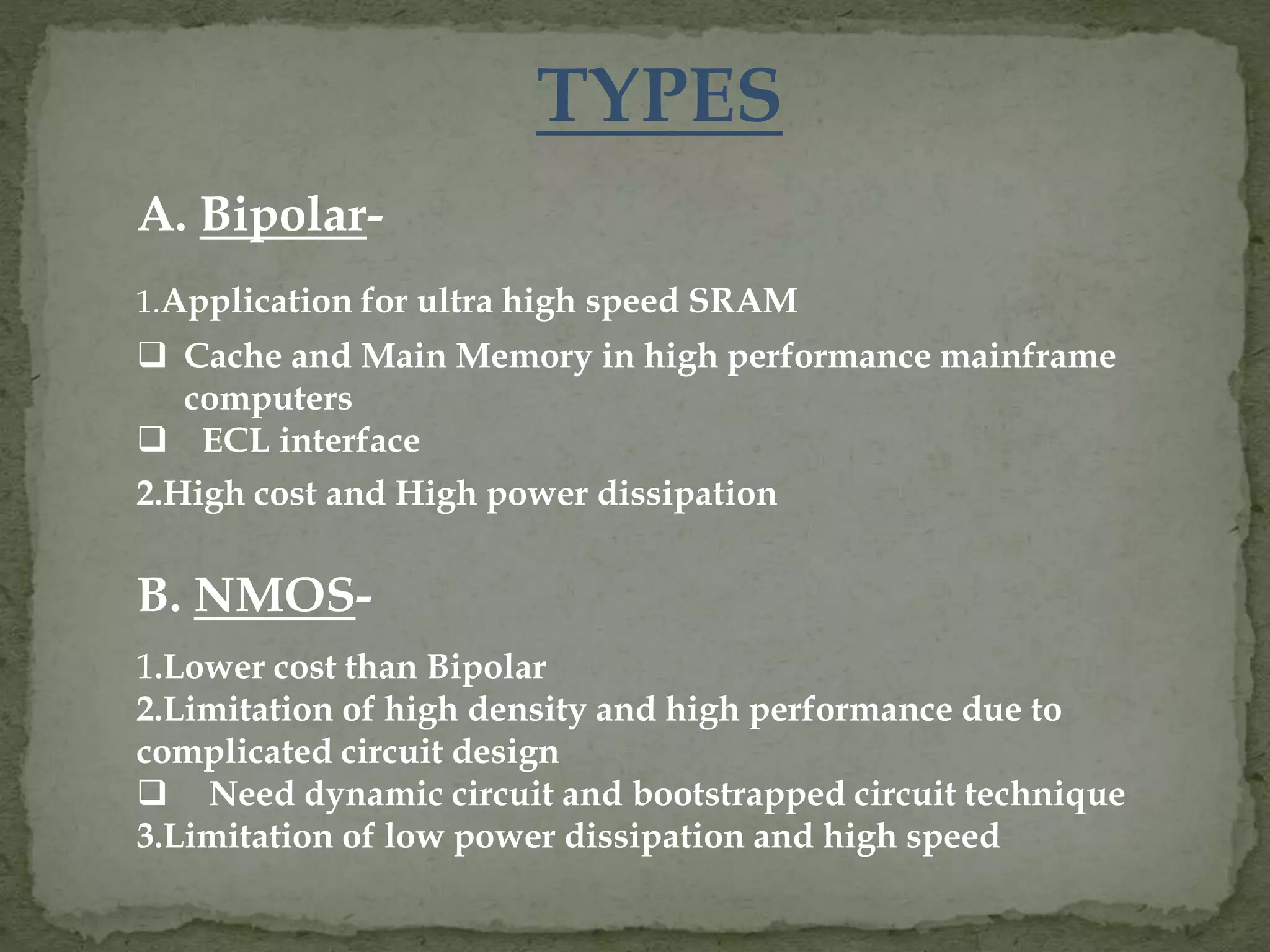
TYPES 
A. Bipolar- 
1.Application for ultra high speed SRAM 
 Cache and Main Memory in high performance mainframe 
computers 
 ECL interface 
2.High cost and High power dissipation 
B. NMOS- 
1.Lower cost than Bipolar 
2.Limitation of high density and high performance due to 
complicated circuit design 
 Need dynamic circuit and bootstrapped circuit technique 
3.Limitation of low power dissipation and high speed
C. Bi-CMOS- 
- High speed 
. application for small volume/high performance 
- Complicated process [7][8] 
. use triple diffused BiCMOS process 
- Limitation of low power supply voltage [9] 
. improve the MOS Transistor (Lower Vth) 
. use BiNMOS or NBiCMOS 
. Base boost technique 
D. CMOS- 
1. Low cost and low power dissipation 
2. Easy to make high density SRAM 
3.Limitation of high speed 
 Improve the MOS Transistor 
 Use Dynamic Gate Logic
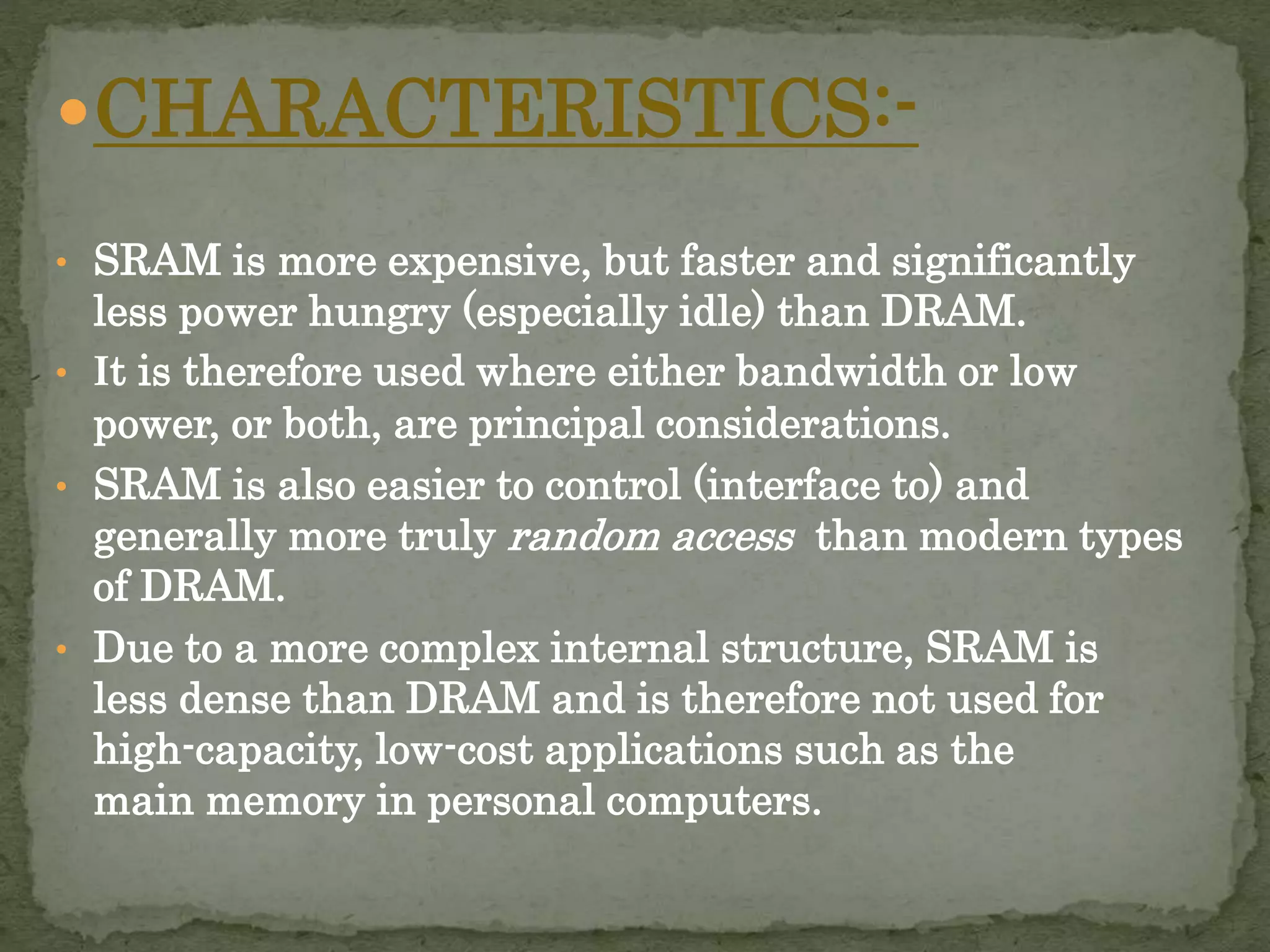
CHARACTERISTICS:- 
• SRAM is more expensive, but faster and significantly 
less power hungry (especially idle) than DRAM. 
• It is therefore used where either bandwidth or low 
power, or both, are principal considerations. 
• SRAM is also easier to control (interface to) and 
generally more truly random access than modern types 
of DRAM. 
• Due to a more complex internal structure, SRAM is 
less dense than DRAM and is therefore not used for 
high-capacity, low-cost applications such as the 
main memory in personal computers.
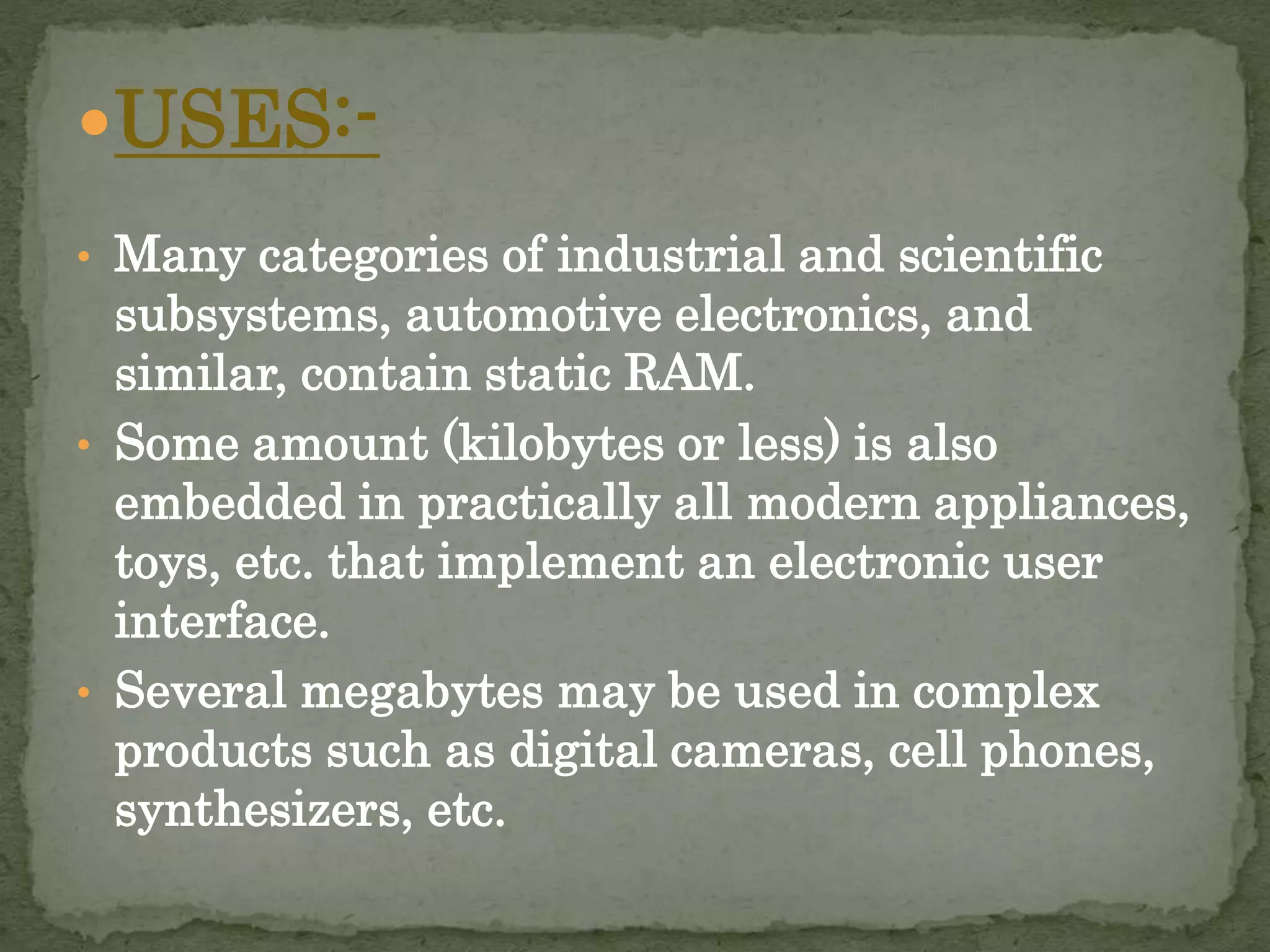
USES:- 
• Many categories of industrial and scientific 
subsystems, automotive electronics, and 
similar, contain static RAM. 
• Some amount (kilobytes or less) is also 
embedded in practically all modern appliances, 
toys, etc. that implement an electronic user 
interface. 
• Several megabytes may be used in complex 
products such as digital cameras, cell phones, 
synthesizers, etc.
SRAM

SRAM

  • 2.
    Memory Arrays RandomAccess Memory Serial Access Memory Content Addressable Memory (CAM) SRAM Slide 2 Read/Write Memory (RAM) (Volatile) Read Only Memory (ROM) (Nonvolatile) Static RAM (SRAM) Dynamic RAM (DRAM) Shift Registers Queues First In First Out (FIFO) Last In First Out (LIFO) Serial In Parallel Out (SIPO) Parallel In Serial Out (PISO) Mask ROM Programmable ROM (PROM) Erasable Programmable ROM (EPROM) Electrically Erasable Programmable ROM (EEPROM) Flash ROM
  • 3.
     Static (SRAM)  Data stored as long as supply is applied  Large (6 transistors per cell)  Fast  Differential signal (more reliable)  Dynamic (DRAM)  Periodic refresh required  Small (1-3 transistors per cell) but slower  Single ended (unless using dummy cell to generate differential signals)
  • 4.
     SRAM :-  Is static memory.  The term static is derived from the fact that it doesn't need to be refreshed like dynamic RAM.  Has cycle time is much shorter than that of DRAM because it does not need to pause between accesses.  Is often used only as a memory cache
  • 5.
    SRAM Features:- 1.LowPower SRAM- • Low Power Supply Voltage : 5V -> 3V -> 1.8V -> sub 1.0V -> Low Power Dissipation for Handheld Application • Low Standby Power Dissipation : 100uA -> 10uA -> 1uA -> support for Data Retention Application 2.FAST SRAM-  Power Supply Voltage : 5V, 3.3V  Low Operating Power Dissipation -> Application for large amount of SRAM usage  FAST Speed requirements : 8ns-20ns
  • 6.
    3.Synchronous SRAM- •Low Power Supply Voltage : 3.3V -> 2.5V -> 1.8V -> Small geometry Transistor technology to improve speed • Various Sync. SRAM Features: -> Late Write operation to enhance the bus efficiency • High Bandwidth Interface : • FAST Speed Requirements : 150MHz-over 500MHz(1Gbps) • High Performance Package Solution
  • 7.
    Ax Data lineData line M2 M1 M4 M3 DESIGN:- M5 M6 Q Q VDD Write Read Data i/p Data o/p 6-transistor SRAM Cell M9 M7 M8 M10 Ay
  • 8.
     To write:-  W=1, M9 ON. 1- If data i/p=1,vltg at Q will be high. 2- If data i/p=0,vltg at Q will be low. Hence we have a static situation as lon as bias is applied.  To read:-  R=1, thus complement of the data level written into cell is read at data o/p.
  • 9.
    TYPES A. Bipolar- 1.Application for ultra high speed SRAM  Cache and Main Memory in high performance mainframe computers  ECL interface 2.High cost and High power dissipation B. NMOS- 1.Lower cost than Bipolar 2.Limitation of high density and high performance due to complicated circuit design  Need dynamic circuit and bootstrapped circuit technique 3.Limitation of low power dissipation and high speed
  • 10.
    C. Bi-CMOS- -High speed . application for small volume/high performance - Complicated process [7][8] . use triple diffused BiCMOS process - Limitation of low power supply voltage [9] . improve the MOS Transistor (Lower Vth) . use BiNMOS or NBiCMOS . Base boost technique D. CMOS- 1. Low cost and low power dissipation 2. Easy to make high density SRAM 3.Limitation of high speed  Improve the MOS Transistor  Use Dynamic Gate Logic
  • 11.
    CHARACTERISTICS:- • SRAMis more expensive, but faster and significantly less power hungry (especially idle) than DRAM. • It is therefore used where either bandwidth or low power, or both, are principal considerations. • SRAM is also easier to control (interface to) and generally more truly random access than modern types of DRAM. • Due to a more complex internal structure, SRAM is less dense than DRAM and is therefore not used for high-capacity, low-cost applications such as the main memory in personal computers.
  • 12.
    USES:- • Manycategories of industrial and scientific subsystems, automotive electronics, and similar, contain static RAM. • Some amount (kilobytes or less) is also embedded in practically all modern appliances, toys, etc. that implement an electronic user interface. • Several megabytes may be used in complex products such as digital cameras, cell phones, synthesizers, etc.