International Journal of Engineering Research and Development
e-ISSN: 2278-067X, p-ISSN: 2278-800X, www.ijerd.com
Volume 8, Issue 2 (August 2013), PP. 19-22
19
Design and Analysis of Low Power Sub-Threshold Sram
K.V.Ganesh., B.D.Charan, K.Venkata Siva
1
Assistant Professor,Department of Ece,Vitam
2
Dept of Ece,Vitam.
3
Department of Ece,Vitam .
Abstract:- Increasing area overhead is a major design concern in low-power sub-threshold SRAM designs, due
to stability considerations. The extensive growth of battery operated devices has made low-power design
important in recent years. As electronics are being integrated into portable devices, the demand grows for
increased functionality, with reduced size and long battery life. This implies a need to balance ultra-low power
with area-efficient design. An obvious way to minimize energy per operation is to decrease VDD. This decreases
active power, as well as leakage power, which is affected by DIB. If VDD is decreased too sharply, however,
increased delay time causes the power-delay product (PDP) to rise, can be kept minimum if operated in Sub-
threshold region. In this paper the advantages of the sub-threshold inverter compared to the conventional strong
inversion inverter with 90 nm technology in Cadence is presented. A one-Bit 6T SRAM, sense amplifier, and
precharge circuit is designed using HSPICE 45nm technology.
Keywords:- Sub-threshold region, Power-Delay Product, DIBL, Temperature, SRAM.
I. INTRODUCTION
In the past few years a tremendous rise in VLSI fabrication has led to increase the densities of
integrated circuits by decreasing the device geometries. Such high density circuits support high design
complexities and very high speed but susceptible to power consumption. Circuits with excessive power
dissipation are more susceptible to run time failures and give rise to reliability problems. The other factors
behind the low power design is growing class of personal computing devices, e.g., as portable desktops, digital
pens, audio and video based multimedia products and wireless communications such as PDA’s and smart cards,
etc. These devices and systems demand high speed and complex design functionalities. The performance of
these devices is
Limited by the size, weight and lifetime of portable batteries. Memory design is an integral part in
these devices and so reducing the power dissipation in
these can improve the system power efficiency, performance, reliability.
II. CONVENTIONAL 6T SRAM CELL
SRAM have experienced a very rapid development of low power,low voltage memory design during
recent years due to an increase demand for notebooks,laptops,hand held communication devices and IC memory
cards.Due to these concerns limiting power consumption is a must andhence new techniques are being realised
to improve energy efficiency at all levels of the design.In this paper an overall analysis has been carried-out for
the different SRAM cells at various technologies in respect to stability and leakage power consumption.
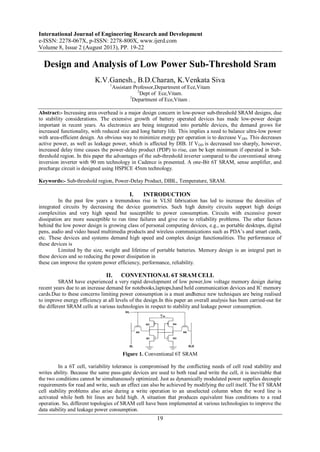
Figure 1. Conventional 6T SRAM
In a 6T cell, variability tolerance is compromised by the conflicting needs of cell read stability and
writes ability. Because the same pass-gate devices are used to both read and write the cell, it is inevitable that
the two conditions cannot be simultaneously optimized. Just as dynamically modulated power supplies decouple
requirements for read and write, such an effect can also be achieved by modifying the cell itself. The 6T SRAM
cell stability problems also arise during a write operation to an unselected column when the word line is
activated while both bit lines are held high. A situation that produces equivalent bias conditions to a read
operation. So, different topologies of SRAM cell have been implemented at various technologies to improve the
data stability and leakage power consumption.
DESIGN AND ANALYSIS OF LOW POWER SUB-THRESHOLD SRAM
20
III. 8T SRAM CELL
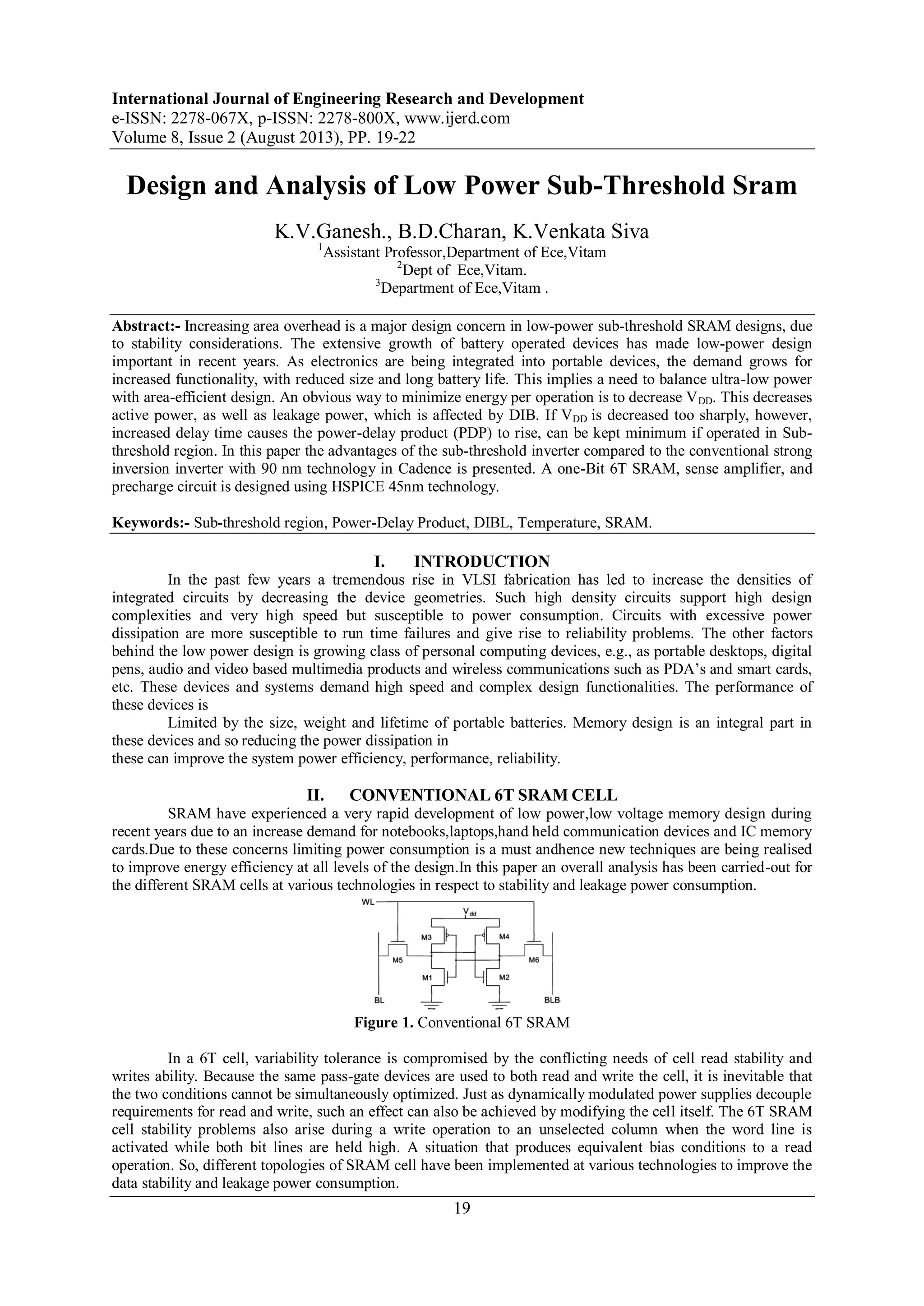
To address the reduced read SNM problem, the read and writeoperations are separated by adding read
access structures to the original 6T cell, thus increasing the transistor count to 8. As the read current does not
significantly affect the cell value, then the read stability of the 8T cell is dramatically increased compared with
the original 6T SRAM cell. The transistor configuration (i.e. M1 through M6) is identical to a conventional 6T
SRAM cell. Write access to the cell occurs through the write access transistors and from the write bitlines, BL
and BLB. Read access to the cell is through the read access transistor and controlled by the read wordline,
RWL. Figure 3.1 shows that the proposed 8T cell has a higher read SNM, comparing to the 6T SRAM cell.
Moreover, the write margin of these two cells (defined as the least bitline voltage required to change the state of
SRAM cell) is the same due to the unchanged write configuration. However, for the 8T structure, the read
bitline leakage is quite significant especially in the deep submicron/Nano ranges. Since it is not possible to
design a high-density SRAM using 8T cells, this conclusion leads to an investigation of other cells.
Figure 2. 8T SRAM Cell
IV. 9TSRAM
A 9T structure is proposed in this paper to reduce the powerconsumption of the SRAM cell and the
bitline leakage. Figure shows the proposed 9T SRAM cell. Similarly to the 8T cell of, the configuration from
M1 to M6 is unchanged (same as in the 6T SRAM cell). The read SNM margin is maintained by retaining the
write access circuit and adding a NMOS transistor (M9) between M7 and M8. As shown in, the leakage current
through M7, M8, and M9 can be reduced significantly by the so-called stack effect when M7 and M9 are off.
Figure 3. 9T SRAM Cell
V. 10T SRAM
The following figure Shows the schematic of a l0T bitcell that addresses theseproblems and provides
sub-threshold functionality. Transistors M1 through M6 are identical to a 6T bitcell except that the source of
M3and M6 tie to a virtual supply voltage rail, VVDD. Write access to the bitcell occurs through the write
access transistors, M2 and M5, from the write bitlines, BL and BLB. Transistors M7 through M10implement a
buffer used for reading. Read access is single-ended and occurs on a separate bitline, RBL, which is
precharged prior to read access. The wordline for read also is distinct from the write wordline. One key
advantage to separating the read and write wordlines and bitlines is that a memory using this bitcell can have
distinct read and write ports. Since a 6T bitcell does not have this feature, the l0T bitcell is in some ways more
fairly compared to an 8T dual-port bitcell (6T bitcell with two pairs of access transistors and bitlines).
Figure 4. 10T SRAM cell
DESIGN AND ANALYSIS OF LOW POWER SUB-THRESHOLD SRAM
21
VI. RESULTS
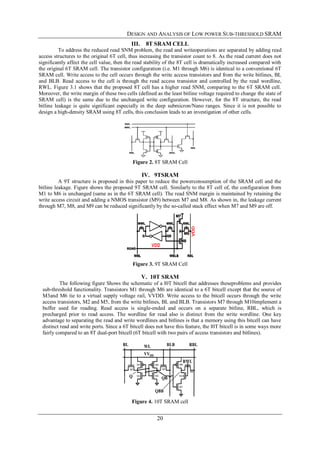
Figure 5. 8T SRAM Write operation
Figure 6. 8T SRAM Read operation
Figure 7. 9T SRAM Write operation
Figure 8 9T SRAM Read operation
Figure 6.5: 10T SRAM Write operation
Figure 6.6: 10T SRAM Read operation
DESIGN AND ANALYSIS OF LOW POWER SUB-THRESHOLD SRAM
22
VII. CONCLUSION
In this, I made comparisons between different configurations of SRAMs. In all configurations 4T, 6T,
8T, 9T SRAMs SNM is the problem when scaling the voltages. In 10T SRAM we can find optimum power and
optimum delay as well as good SNM. 10 T SRAM achieves best stability and low power compared to remaining
configurations in 45nm. Read and write operations done for all configurations.
REFERENCES
[1] M.E. Sinangil, N. Verma, and A.P. Chandrakasan, ‘‘A Reconfigurable 8T Ultra-Dynamic Voltage
Scalable (U-DVS) SRAM in 65 nm CMOS,’’ IEEE J. Solid-State Circuits, vol. 44, no. 11, 2009, pp.
3163-3173.
[2] K. Takeda et al., ‘‘A Read-Static-Noise-Margin-Free SRAM Cell for Low-VDD and High-Speed
Applications,’’ IEEE J. Solid-State Circuits, vol. 41, no. 1, 2006, pp. 113-121.
[3] B.H. Calhoun and A.P. Chandrakasan, ‘‘A 256-kb 65-nm Sub-threshold SRAM Design for Ultra-Low-
Voltage Operation,’’ IEEE J. Solid-State Circuits, vol. 42, no. 3, 2007, pp. 680-688
[4] I.J. Chang et al., ‘‘A 32 kb 10T Sub-threshold SRAM Array with Bit-Interleaving and Differential
Read Scheme in 90 nm CMOS,’’ IEEE J. Solid-State Circuits, vol. 44, no. 2, 2009, pp. 650-658.
[5] H. Pilo et al., ‘‘An SRAM Design in 65-nm Technology Node Featuring Read and Write-Assist
Circuits to Expand Operating Voltage,’’ IEEE J. Solid-State Circuits, vol. 42, no. 4, 2007, pp. 813-819.
[6] M. Qazi et al., ‘‘A 512kb 8T SRAM Macro Operating down to 0.57V with an AC-Coupled Sense
Amplifier and Embedded Data-Retention-Voltage Sensor in 45nm SOI CMOS,’’ Proc. IEEE Int’l
Solid-State Circuits Conf. (ISSCC 10), 2010, pp. 350-351.
[7] H. Qin et al., ‘‘SRAM Leakage Suppression by Minimizing Standby Supply Voltage,’’ Proc. 5th Int’l
Symp. Quality Electronic Design (ISQED 04), IEEE Press, 2004,pp. 55-60.
[8] S. Ohbayashi et al., ‘‘A 65-nm SoC Embedded 6T-SRAM Designed for Manufacturability with Read
and Write Operation Stabilizing Circuits,’’ IEEE J. Solid-State Circuits, vol. 42, no. 4, 2007, pp. 820-
829.
[9] Y. Morita et al., ‘‘An Area-Conscious Low-Voltage- Oriented 8T-SRAM Design under DVS
Environment,’’ Proc. IEEE Symp. VLSI Circuits, IEEE Press, 2007, pp. 256-257.

International Journal of Engineering Research and Development (IJERD)

  • 1.
    International Journal ofEngineering Research and Development e-ISSN: 2278-067X, p-ISSN: 2278-800X, www.ijerd.com Volume 8, Issue 2 (August 2013), PP. 19-22 19 Design and Analysis of Low Power Sub-Threshold Sram K.V.Ganesh., B.D.Charan, K.Venkata Siva 1 Assistant Professor,Department of Ece,Vitam 2 Dept of Ece,Vitam. 3 Department of Ece,Vitam . Abstract:- Increasing area overhead is a major design concern in low-power sub-threshold SRAM designs, due to stability considerations. The extensive growth of battery operated devices has made low-power design important in recent years. As electronics are being integrated into portable devices, the demand grows for increased functionality, with reduced size and long battery life. This implies a need to balance ultra-low power with area-efficient design. An obvious way to minimize energy per operation is to decrease VDD. This decreases active power, as well as leakage power, which is affected by DIB. If VDD is decreased too sharply, however, increased delay time causes the power-delay product (PDP) to rise, can be kept minimum if operated in Sub- threshold region. In this paper the advantages of the sub-threshold inverter compared to the conventional strong inversion inverter with 90 nm technology in Cadence is presented. A one-Bit 6T SRAM, sense amplifier, and precharge circuit is designed using HSPICE 45nm technology. Keywords:- Sub-threshold region, Power-Delay Product, DIBL, Temperature, SRAM. I. INTRODUCTION In the past few years a tremendous rise in VLSI fabrication has led to increase the densities of integrated circuits by decreasing the device geometries. Such high density circuits support high design complexities and very high speed but susceptible to power consumption. Circuits with excessive power dissipation are more susceptible to run time failures and give rise to reliability problems. The other factors behind the low power design is growing class of personal computing devices, e.g., as portable desktops, digital pens, audio and video based multimedia products and wireless communications such as PDA’s and smart cards, etc. These devices and systems demand high speed and complex design functionalities. The performance of these devices is Limited by the size, weight and lifetime of portable batteries. Memory design is an integral part in these devices and so reducing the power dissipation in these can improve the system power efficiency, performance, reliability. II. CONVENTIONAL 6T SRAM CELL SRAM have experienced a very rapid development of low power,low voltage memory design during recent years due to an increase demand for notebooks,laptops,hand held communication devices and IC memory cards.Due to these concerns limiting power consumption is a must andhence new techniques are being realised to improve energy efficiency at all levels of the design.In this paper an overall analysis has been carried-out for the different SRAM cells at various technologies in respect to stability and leakage power consumption. Figure 1. Conventional 6T SRAM In a 6T cell, variability tolerance is compromised by the conflicting needs of cell read stability and writes ability. Because the same pass-gate devices are used to both read and write the cell, it is inevitable that the two conditions cannot be simultaneously optimized. Just as dynamically modulated power supplies decouple requirements for read and write, such an effect can also be achieved by modifying the cell itself. The 6T SRAM cell stability problems also arise during a write operation to an unselected column when the word line is activated while both bit lines are held high. A situation that produces equivalent bias conditions to a read operation. So, different topologies of SRAM cell have been implemented at various technologies to improve the data stability and leakage power consumption.
  • 2.
    DESIGN AND ANALYSISOF LOW POWER SUB-THRESHOLD SRAM 20 III. 8T SRAM CELL To address the reduced read SNM problem, the read and writeoperations are separated by adding read access structures to the original 6T cell, thus increasing the transistor count to 8. As the read current does not significantly affect the cell value, then the read stability of the 8T cell is dramatically increased compared with the original 6T SRAM cell. The transistor configuration (i.e. M1 through M6) is identical to a conventional 6T SRAM cell. Write access to the cell occurs through the write access transistors and from the write bitlines, BL and BLB. Read access to the cell is through the read access transistor and controlled by the read wordline, RWL. Figure 3.1 shows that the proposed 8T cell has a higher read SNM, comparing to the 6T SRAM cell. Moreover, the write margin of these two cells (defined as the least bitline voltage required to change the state of SRAM cell) is the same due to the unchanged write configuration. However, for the 8T structure, the read bitline leakage is quite significant especially in the deep submicron/Nano ranges. Since it is not possible to design a high-density SRAM using 8T cells, this conclusion leads to an investigation of other cells. Figure 2. 8T SRAM Cell IV. 9TSRAM A 9T structure is proposed in this paper to reduce the powerconsumption of the SRAM cell and the bitline leakage. Figure shows the proposed 9T SRAM cell. Similarly to the 8T cell of, the configuration from M1 to M6 is unchanged (same as in the 6T SRAM cell). The read SNM margin is maintained by retaining the write access circuit and adding a NMOS transistor (M9) between M7 and M8. As shown in, the leakage current through M7, M8, and M9 can be reduced significantly by the so-called stack effect when M7 and M9 are off. Figure 3. 9T SRAM Cell V. 10T SRAM The following figure Shows the schematic of a l0T bitcell that addresses theseproblems and provides sub-threshold functionality. Transistors M1 through M6 are identical to a 6T bitcell except that the source of M3and M6 tie to a virtual supply voltage rail, VVDD. Write access to the bitcell occurs through the write access transistors, M2 and M5, from the write bitlines, BL and BLB. Transistors M7 through M10implement a buffer used for reading. Read access is single-ended and occurs on a separate bitline, RBL, which is precharged prior to read access. The wordline for read also is distinct from the write wordline. One key advantage to separating the read and write wordlines and bitlines is that a memory using this bitcell can have distinct read and write ports. Since a 6T bitcell does not have this feature, the l0T bitcell is in some ways more fairly compared to an 8T dual-port bitcell (6T bitcell with two pairs of access transistors and bitlines). Figure 4. 10T SRAM cell
  • 3.
    DESIGN AND ANALYSISOF LOW POWER SUB-THRESHOLD SRAM 21 VI. RESULTS Figure 5. 8T SRAM Write operation Figure 6. 8T SRAM Read operation Figure 7. 9T SRAM Write operation Figure 8 9T SRAM Read operation Figure 6.5: 10T SRAM Write operation Figure 6.6: 10T SRAM Read operation
  • 4.
    DESIGN AND ANALYSISOF LOW POWER SUB-THRESHOLD SRAM 22 VII. CONCLUSION In this, I made comparisons between different configurations of SRAMs. In all configurations 4T, 6T, 8T, 9T SRAMs SNM is the problem when scaling the voltages. In 10T SRAM we can find optimum power and optimum delay as well as good SNM. 10 T SRAM achieves best stability and low power compared to remaining configurations in 45nm. Read and write operations done for all configurations. REFERENCES [1] M.E. Sinangil, N. Verma, and A.P. Chandrakasan, ‘‘A Reconfigurable 8T Ultra-Dynamic Voltage Scalable (U-DVS) SRAM in 65 nm CMOS,’’ IEEE J. Solid-State Circuits, vol. 44, no. 11, 2009, pp. 3163-3173. [2] K. Takeda et al., ‘‘A Read-Static-Noise-Margin-Free SRAM Cell for Low-VDD and High-Speed Applications,’’ IEEE J. Solid-State Circuits, vol. 41, no. 1, 2006, pp. 113-121. [3] B.H. Calhoun and A.P. Chandrakasan, ‘‘A 256-kb 65-nm Sub-threshold SRAM Design for Ultra-Low- Voltage Operation,’’ IEEE J. Solid-State Circuits, vol. 42, no. 3, 2007, pp. 680-688 [4] I.J. Chang et al., ‘‘A 32 kb 10T Sub-threshold SRAM Array with Bit-Interleaving and Differential Read Scheme in 90 nm CMOS,’’ IEEE J. Solid-State Circuits, vol. 44, no. 2, 2009, pp. 650-658. [5] H. Pilo et al., ‘‘An SRAM Design in 65-nm Technology Node Featuring Read and Write-Assist Circuits to Expand Operating Voltage,’’ IEEE J. Solid-State Circuits, vol. 42, no. 4, 2007, pp. 813-819. [6] M. Qazi et al., ‘‘A 512kb 8T SRAM Macro Operating down to 0.57V with an AC-Coupled Sense Amplifier and Embedded Data-Retention-Voltage Sensor in 45nm SOI CMOS,’’ Proc. IEEE Int’l Solid-State Circuits Conf. (ISSCC 10), 2010, pp. 350-351. [7] H. Qin et al., ‘‘SRAM Leakage Suppression by Minimizing Standby Supply Voltage,’’ Proc. 5th Int’l Symp. Quality Electronic Design (ISQED 04), IEEE Press, 2004,pp. 55-60. [8] S. Ohbayashi et al., ‘‘A 65-nm SoC Embedded 6T-SRAM Designed for Manufacturability with Read and Write Operation Stabilizing Circuits,’’ IEEE J. Solid-State Circuits, vol. 42, no. 4, 2007, pp. 820- 829. [9] Y. Morita et al., ‘‘An Area-Conscious Low-Voltage- Oriented 8T-SRAM Design under DVS Environment,’’ Proc. IEEE Symp. VLSI Circuits, IEEE Press, 2007, pp. 256-257.