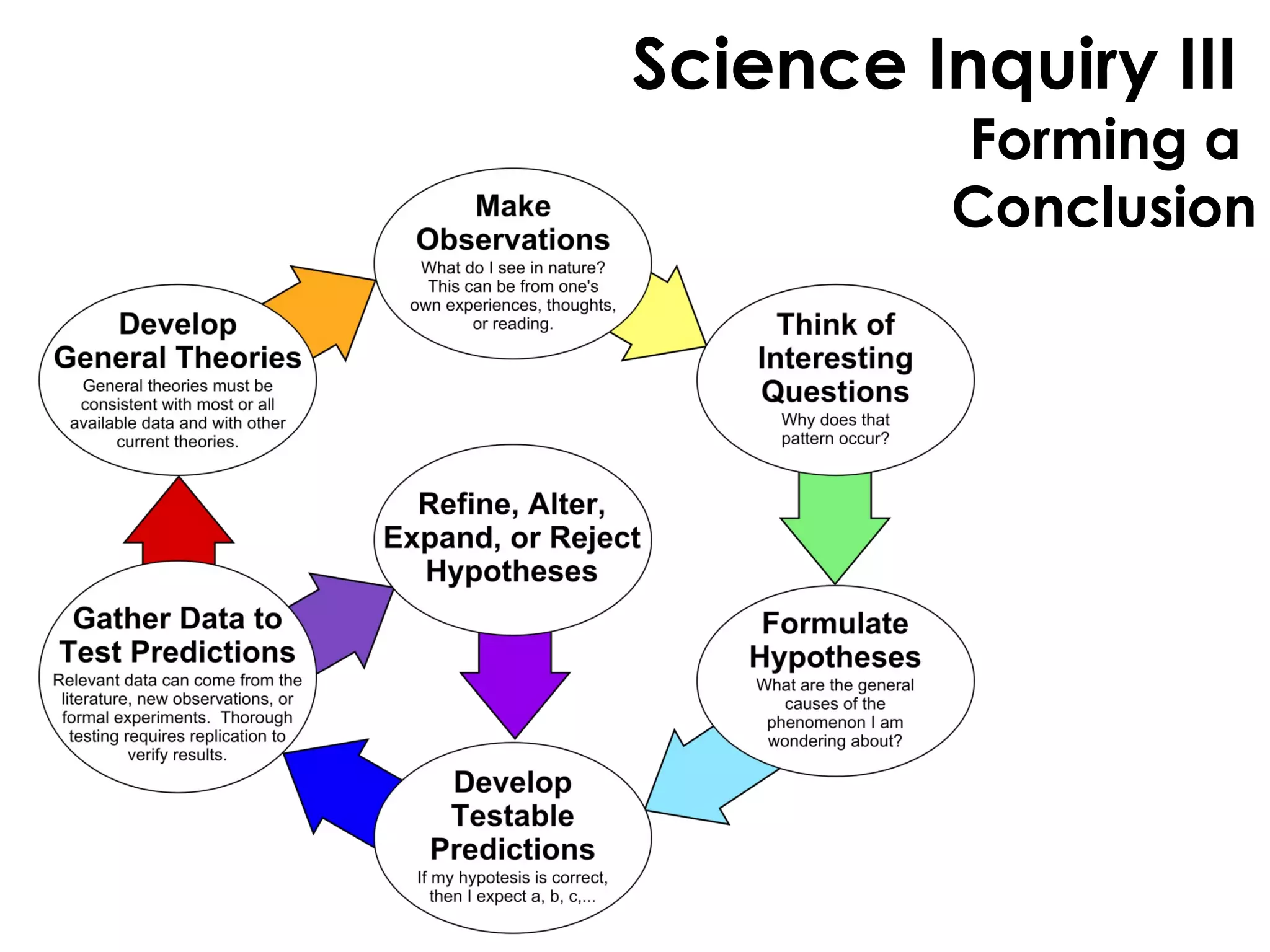
Science Inquiry III
Forming a
Conclusion
In your lab notebook, please answer as best you can:
1. What are the four MAIN steps of the Scientific Method?
• Observation, Hypothesis, Experiment, Conclusion
2. What is BIAS in science?
• An assumed belief that affects the way you see or understand things.
3. Give two reasons specific procedures should be written down.
• So it can be performed by YOU (as stated, in multiple trials)
• So it can be performed by OTHERS
• So your results can be evaluated
4. What is the outcome (the “effect”) of the experiment called?
• Dependent Variable
4. Which data should be graphed on the X axis?
• IV = Independent Variable, the thing you choose to test/change (cause)
Bonus Q: What is a qualitative description (compared to quantitative)?
Review
Quiz 13
State the
Problem (as a ?)
Do Background
Research
"Best Guess"
Solution
Design (Materials
& Procedures)
Perform (Collect
& Analyze Data)
Report Results
Hypothesis is
False or Partly True
Hypothesis is
True
Revise!
Try Again
Conclusion
Experiment
Hypothesis
Observation
Experiment Data Collection
• As you perform the experiment, observations and
data must be recorded.
– measurements listed in a chart
– written observations
– drawings
– photos
Magnet Type
(Independent Variable)
Distance to Paper Clip (cm)
(Dependent Variable)
N Pole
Trial 1 Trial 2
S Pole
Trial 1 Trial 2
Midway
between N & S
Ceramic bar
Neodymium disc
Oval hematite
Data Analysis
• Next, analyze the data to show cause/effect
– Numbers, observations, and measurements are
broken down, organized, and studied
– Graphing the data allows patterns to emerge,
showing cause-and-effect relationships
• Independent Variable on the X-axis
• Dependent Variable on the Y-axis
– Label each axis
– Include units and a title
Sample Line Graph
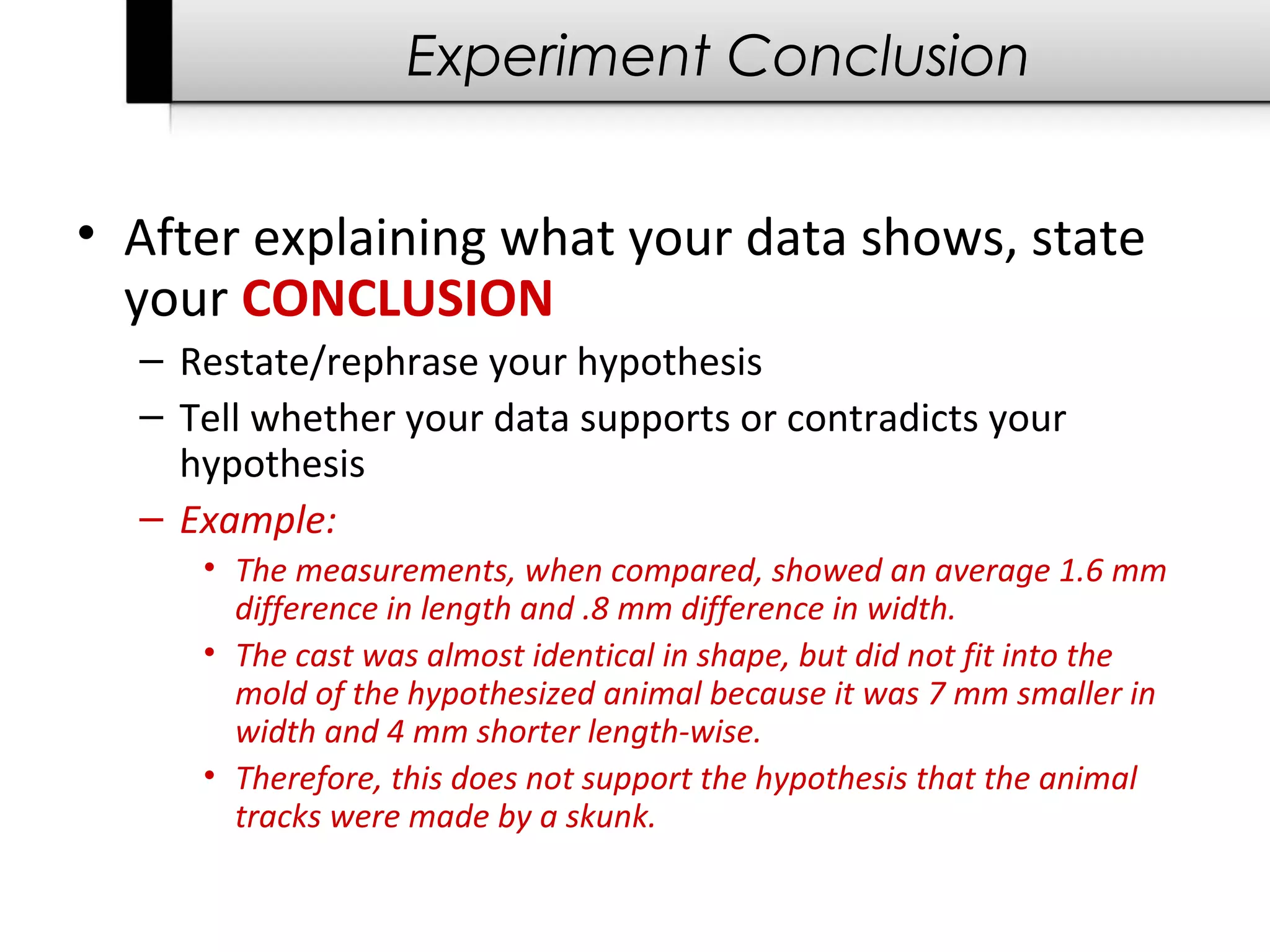
Experiment Conclusion
• After explaining what your data shows, state
your CONCLUSION
– Restate/rephrase your hypothesis
– Tell whether your data supports or contradicts your
hypothesis
– Example:
• The measurements, when compared, showed an average 1.6 mm
difference in length and .8 mm difference in width.
• The cast was almost identical in shape, but did not fit into the
mold of the hypothesized animal because it was 7 mm smaller in
width and 4 mm shorter length-wise.
• Therefore, this does not support the hypothesis that the animal
tracks were made by a skunk.
The Scientific Method
• If hypothesis is rejected
– share findings and let others perform the experiment
– modify your hypothesis and perform another experiment
• If hypothesis is supported
– share findings and let others perform the experiment
– repeat to verify results
• Either way, something was learned!
– NEVER make up results simply because you
think it was “supposed” to go differently
– NEVER change your hypothesis before forming
a conclusion
Evaluating Error
• EVERY experiment has errors
– Uncontrolled variables
• Weather, animal behavior, unexpected interruptions
– Data collection errors
• Inconsistent methods, accidents, contamination
• Sloppy recording (can’t read writing, mixed numbers)
• Be sure to record and note in your conclusion
all errors and ways they could be corrected in
future experiments.
What’s Next?
• Include plans for further experimentation
– Revisions: what would you do different next time?
– New questions: revised hypothesis or different
(but related) questions to investigate.
• Include WHY you want to
change things for your next
experiment!
State the
Problem (as a ?)
Do Background
Research
"Best Guess"
Solution
Design (Materials
& Procedures)
Perform (Collect
& Analyze Data)
Report Results
Hypothesis is
False or Partly True
Hypothesis is
True
Revise!
Try Again
Conclusion
Experiment
Hypothesis
Observation
F = Gm1m2
r2
Fact - Theory - Law
• Fact:
– an objective, verifiable observation of
something that occurs in our natural world
– i.e. gravity, natural selection, heat exchange
• Theory:
– an explanation of how natural occurrences work
• it can be repeated, and tested with predictable results
• a hypothesis that is proven correct often explains part of theory
– i.e. Theory of Gravity, Theory of Evolution, Kinetic Theory of Matter
• Law:
– a mathematical description of observable phenomenon
– i.e. Newton's First Law of Universal Gravitation

Science Inquiry: Conclusion

  • 1.
  • 2.
    In your labnotebook, please answer as best you can: 1. What are the four MAIN steps of the Scientific Method? • Observation, Hypothesis, Experiment, Conclusion 2. What is BIAS in science? • An assumed belief that affects the way you see or understand things. 3. Give two reasons specific procedures should be written down. • So it can be performed by YOU (as stated, in multiple trials) • So it can be performed by OTHERS • So your results can be evaluated 4. What is the outcome (the “effect”) of the experiment called? • Dependent Variable 4. Which data should be graphed on the X axis? • IV = Independent Variable, the thing you choose to test/change (cause) Bonus Q: What is a qualitative description (compared to quantitative)? Review Quiz 13
  • 3.
    State the Problem (asa ?) Do Background Research "Best Guess" Solution Design (Materials & Procedures) Perform (Collect & Analyze Data) Report Results Hypothesis is False or Partly True Hypothesis is True Revise! Try Again Conclusion Experiment Hypothesis Observation
  • 4.
    Experiment Data Collection •As you perform the experiment, observations and data must be recorded. – measurements listed in a chart – written observations – drawings – photos Magnet Type (Independent Variable) Distance to Paper Clip (cm) (Dependent Variable) N Pole Trial 1 Trial 2 S Pole Trial 1 Trial 2 Midway between N & S Ceramic bar Neodymium disc Oval hematite
  • 5.
    Data Analysis • Next,analyze the data to show cause/effect – Numbers, observations, and measurements are broken down, organized, and studied – Graphing the data allows patterns to emerge, showing cause-and-effect relationships • Independent Variable on the X-axis • Dependent Variable on the Y-axis – Label each axis – Include units and a title
  • 6.
  • 7.
    Experiment Conclusion • Afterexplaining what your data shows, state your CONCLUSION – Restate/rephrase your hypothesis – Tell whether your data supports or contradicts your hypothesis – Example: • The measurements, when compared, showed an average 1.6 mm difference in length and .8 mm difference in width. • The cast was almost identical in shape, but did not fit into the mold of the hypothesized animal because it was 7 mm smaller in width and 4 mm shorter length-wise. • Therefore, this does not support the hypothesis that the animal tracks were made by a skunk.
  • 8.
    The Scientific Method •If hypothesis is rejected – share findings and let others perform the experiment – modify your hypothesis and perform another experiment • If hypothesis is supported – share findings and let others perform the experiment – repeat to verify results • Either way, something was learned! – NEVER make up results simply because you think it was “supposed” to go differently – NEVER change your hypothesis before forming a conclusion
  • 9.
    Evaluating Error • EVERYexperiment has errors – Uncontrolled variables • Weather, animal behavior, unexpected interruptions – Data collection errors • Inconsistent methods, accidents, contamination • Sloppy recording (can’t read writing, mixed numbers) • Be sure to record and note in your conclusion all errors and ways they could be corrected in future experiments.
  • 10.
    What’s Next? • Includeplans for further experimentation – Revisions: what would you do different next time? – New questions: revised hypothesis or different (but related) questions to investigate. • Include WHY you want to change things for your next experiment!
  • 11.
    State the Problem (asa ?) Do Background Research "Best Guess" Solution Design (Materials & Procedures) Perform (Collect & Analyze Data) Report Results Hypothesis is False or Partly True Hypothesis is True Revise! Try Again Conclusion Experiment Hypothesis Observation
  • 12.
    F = Gm1m2 r2 Fact- Theory - Law • Fact: – an objective, verifiable observation of something that occurs in our natural world – i.e. gravity, natural selection, heat exchange • Theory: – an explanation of how natural occurrences work • it can be repeated, and tested with predictable results • a hypothesis that is proven correct often explains part of theory – i.e. Theory of Gravity, Theory of Evolution, Kinetic Theory of Matter • Law: – a mathematical description of observable phenomenon – i.e. Newton's First Law of Universal Gravitation

Editor's Notes

  • #3 Bonus ?: qualitative describes a quality such as color, name, individual type, brand, etc. while quantitative gives a numerical measurment
  • #9 ...or unrecognized variable (maybe two different animals made tracks on top of each other - they'd be hard to distinguish)? ...or no control (you couldn't tell what's causing a change)
  • #13 NOT theory becomes law becomes fact! Gravitational Force (pull) = gravitational constant (6.67 x 10 -11) x mass of object 1 x mass of object 2 divided by the square of the distance between their centers (r).