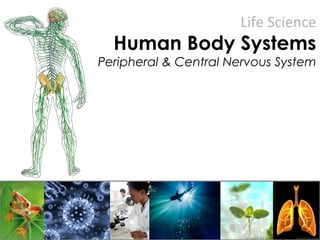
Life Science
Human Body Systems
Peripheral & Central Nervous System
Bonus: Name as many innate immune defenses as you can.
- Skin barrier, mucus membranes, coughing/sneezing, phagocytes,
inflammation (histamines/mast cells), fever, vomiting, anti-microbial
saliva & tears, stomach acid, competing beneficial microbes
1. What do endocrine glands produce?
• Hormones
1. Name at least 3 endocrine glands.
• pituitary, hypothalamus, pineal, ovaries, adrenal, thyroid, pancreas, testes, placenta
1. A clear, watery fluid that comes from plasma which has seeped into the
spaces between cells near capillaries is called
• Lymph
1. True or False? Lymph nodes contain immune cells which filter pathogens
from blood before returning the fluid back to the circulatory system.
• True (lymph nodes filter interstitial plasma)
1. Which type of white blood cell (WBC) makes antibodies that fight off
infection?
• B cells
In your lab notebook, please answer as best you can:
Week 24
Review Quiz
The Nervous System
• Central Nervous System (CNS)
– Brain
– Spinal Cord
• Peripheral Nervous System (PNS)
– Nerves that connect all your body
parts to the spinal cord
• Somatic nerves (voluntary)
– Motor (muscle) & sensory (senses)
• Autonomic nerves
– heart, respiration, digestion (involuntary)
Central Nervous System (CNS)
• Cerebrum (Cerebral Cortex)
– divided into 4 lobes
– thinking, movement, memories, sensory processing, vision, speech
• Cerebellum
– posture, balance, muscle coordination, muscle memory
• Brain stem
– basic body functions (breathing, heart rate, consciousness, sleep)
Mr. Egghead Demo
Meninges surrounding the Brain
Cerebrospinal
fluid provides:
•Protection
•Buoyancy
•Nourishment
Meningitis =
infection or
inflammation
of the
meninges
Does Brain Size Matter?
pig dolphin human
• Men have bigger
brains than women
– Does brain size/volume
indicate intelligence?
Wk 24 Experiment
Hemisphere Dominance
Brain Dominance Quiz
• Right hemisphere
– controls left side of body
– art, writing
– creativity, intuition,
emotion, imagination
• Left hemisphere
– controls right side of body
– math, science
– organization, sense of
time, logic
Inside the Brain
• Thalamus
– directs incoming
sensory messages to
proper area of brain
• Hypothalamus
– regulates hunger, thirst,
and body temperature
• Corpus Callosum
– connection between
hemispheres of the
cerebrum that allows
signals to go between
CNS - Spinal Cord
• Information Superhighway
– Carries brain messages out to
body
• muscles, glands, organs, etc.
– Takes sensory information
from body up to brain
• touch, heat, pain
• blood oxygen & sugar levels
• stomach contents, taste
Peripheral Nervous System
• Afferent Nerves (arrives in the brain)
– Sensory neurons conduct messages from
skin & sense organs to the brain
– Visceral sensory neurons bring info from
visceral organs (muscle stretch, blood O2 &
sugar levels, arterial pressure and what's
in the stomach) up to the brain
• Efferent (exits the brain)
– Somatic motor nerves take commands
from spinal cord to muscles
– Autonomic nerves convey signals from the
brainstem & hypothalamus to the heart,
diaphragm/ribs, digestive tract, glands,
blood vessels, etc.
CNS
PNS
PNS & CNS Work Together
Carotid body
senses low
blood O2 levels
& sends
message
Brain stem
receives/interprets
message, sends
new message out
spinal cord
spinalcord
Ribs & Diaphragm
receive message
and breathing rate
speeds up
O2
levelsgo
up
 Is this SOMATIC or AUTONOMIC?
 Which are sensory nerves? Motor nerves?
Reflex Arc
• Sometimes quick action is needed
– No time to "think" about moving
– CNS is bypassed, so reaction time quickened
– Realization of pain reaches brain after movement occurs
Animation
Test Your Reflexes
- The nervous system’s main job is:
1. collecting SENSORY INPUT
2. taking sensory info to the brain for INTEGRATION
3. sending instructions that result in MOTOR OUTPUT
- The central nervous system (CNS) =
the BRAIN & SPINAL CORD
- The peripheral nervous system (PNS) =
SENSORY & MOTOR neurons
- A REFLEX ARC is when a sensory nerve triggers a
motor nerve to react before the brain has a chance to
process information.
What is a Nerve?
• There are over 100 billion neurons in the brain alone.
– This doesn't even count "helper" nerve cells (neuroglia)
• Bundles of neurons form each nerve in your body
• Neurons can only send info one way
Info IN
Info
OUT
Synapses - where neurons meet
 Neurons
never touch!
 Chemicals
(neuro-
transmitters)
are released
 Triggers an
electrical
current to run
length of the
next cell
Animation
Neural Pathway
Brain  Spinal Cord  Peripheral Motor Nerve(s)  Muscle
Synapse
Synaptic transmission
Neuron Relay
Let’s make a neural pathway!
• Left hand = the dendrites of a neuron
• Your body is the cell body (soma)
• Right arm = an axon (R hand holds neurotransmitters)
• Your right hand is the terminal button which releases
neurotransmitters into the synapse.
• Your “neurotransmitters” should be unique. (Different neurons
use many different types of neurotransmitters.)
Drugs & Alcohol on the Brain
• Illegal drugs have many harmful
affects on the brain:
– Distortion of reality
– Worsening of existing mental or medical
conditions
– Damaged brain cells
– Addiction
• Alcohol slows the transmission of
nerve signals, resulting in:
– Uncoordinated muscle control (slurred
speech is caused by inability to correctly
control the muscles used in forming
words.)
– Sedation (slowed neural response, loss of
self-control & reasoning)
– False sense of confidence
– Addiction