Current Electricity
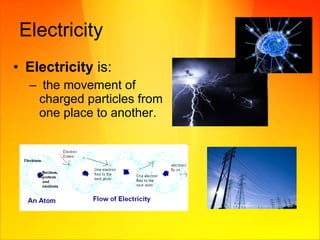
Electricity Electricity  is: the movement of charged particles from one place to another.
Static vs. Current How is static electricity different than current electricity? Static electricity  involves a build-up of electric charge with a singular, momentary discharge. Current electricity  pertains to a continuous flow of electricity through a conductor. Name two examples of each. Static :  lightning, static shock Current :  wall outlet, battery
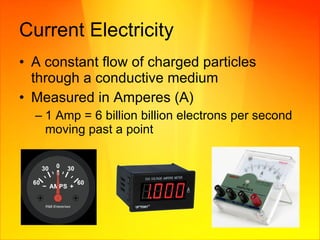
Current Electricity A constant flow of charged particles through a conductive medium  Measured in Amperes (A) 1 Amp = 6 billion billion electrons per second moving past a point
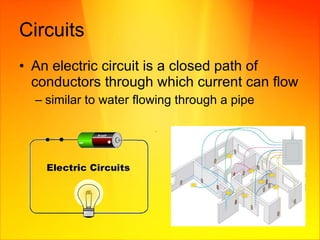
Circuits An electric circuit is a closed path of conductors through which current can flow similar to water flowing through a pipe
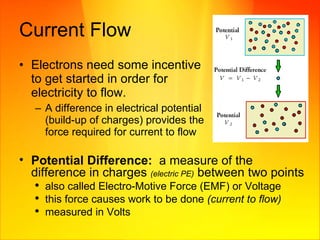
Current Flow Electrons need some incentive to get started in order for electricity to flow. A difference in electrical potential (build-up of charges) provides the force required for current to flow Potential Difference:   a measure of the difference in charges  (electric PE)  between two points also called Electro-Motive Force (EMF) or Voltage this force causes work to be done  (current to flow) measured in Volts
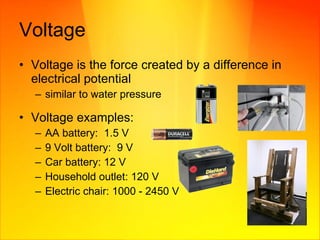
Voltage Voltage is the force created by a difference in electrical potential similar to water pressure Voltage examples: AA battery:  1.5 V 9 Volt battery:  9 V Car battery: 12 V Household outlet: 120 V Electric chair: 1000 - 2450 V
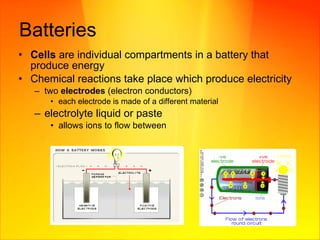
Batteries  Cells  are individual compartments in a battery that produce energy Chemical reactions take place which produce electricity  two  electrodes  (electron conductors) each electrode is made of a different material electrolyte liquid or paste allows ions to flow between
Inside Batteries  Electrodes: one material donates electrons negative electrode (anode)  connects to -  terminal  (outside) other material accepts electrons positive electrode (cathode)  connects to + terminal Electrolyte: paste in  dry cell i.e. alkaline (basic pH) liquid in  wet cell i.e. sulfuric acid Dry Cell Wet Cell
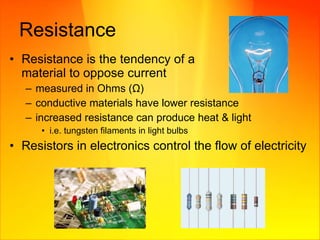
Resistance Resistance is the tendency of a  material to oppose current  measured in Ohms ( Ω ) conductive materials have lower resistance increased resistance can produce heat & light i.e. tungsten filaments in light bulbs Resistors in electronics control the flow of electricity
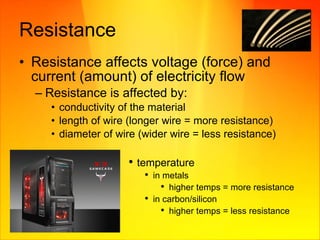
Resistance Resistance affects voltage (force) and current (amount) of electricity flow Resistance is affected by: conductivity of the material length of wire (longer wire = more resistance) diameter of wire (wider wire = less resistance) temperature in metals higher temps = more resistance in carbon/silicon higher temps = less resistance
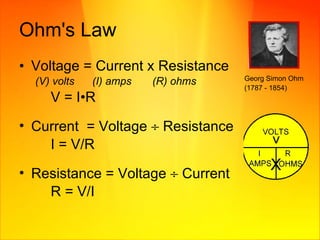
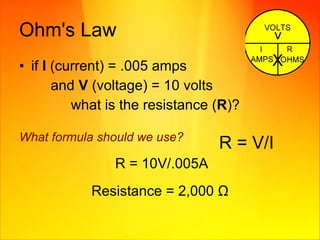
Ohm's Law Voltage = Current x Resistance (V) volts  (I) amps  (R) ohms V = I • R Current  = Voltage    Resistance I = V/R  Resistance = Voltage    Current  R = V/I Georg Simon Ohm (1787 - 1854)
Ohm's Law if  I  (current) = .005 amps and  V  (voltage) = 10 volts   what is the resistance ( R )? What formula should we use?   R = 10V/.005A Resistance = 2,000  Ω R = V/I
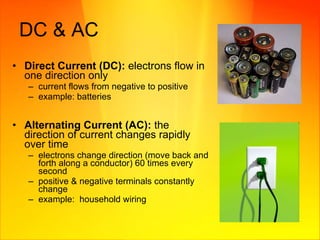
DC & AC Direct Current (DC):  electrons flow in one direction only current flows from negative to positive example: batteries Alternating Current (AC):  the direction of current changes rapidly over time electrons change direction (move back and forth along a conductor) 60 times every second positive & negative terminals constantly change example:  household wiring

Current Electricity

  • 1.
  • 2.
    Electricity Electricity is: the movement of charged particles from one place to another.
  • 3.
    Static vs. CurrentHow is static electricity different than current electricity? Static electricity involves a build-up of electric charge with a singular, momentary discharge. Current electricity pertains to a continuous flow of electricity through a conductor. Name two examples of each. Static : lightning, static shock Current : wall outlet, battery
  • 4.
    Current Electricity Aconstant flow of charged particles through a conductive medium Measured in Amperes (A) 1 Amp = 6 billion billion electrons per second moving past a point
  • 5.
    Circuits An electriccircuit is a closed path of conductors through which current can flow similar to water flowing through a pipe
  • 6.
    Current Flow Electronsneed some incentive to get started in order for electricity to flow. A difference in electrical potential (build-up of charges) provides the force required for current to flow Potential Difference: a measure of the difference in charges (electric PE) between two points also called Electro-Motive Force (EMF) or Voltage this force causes work to be done (current to flow) measured in Volts
  • 7.
    Voltage Voltage isthe force created by a difference in electrical potential similar to water pressure Voltage examples: AA battery: 1.5 V 9 Volt battery: 9 V Car battery: 12 V Household outlet: 120 V Electric chair: 1000 - 2450 V
  • 8.
    Batteries Cells are individual compartments in a battery that produce energy Chemical reactions take place which produce electricity two electrodes (electron conductors) each electrode is made of a different material electrolyte liquid or paste allows ions to flow between
  • 9.
    Inside Batteries Electrodes: one material donates electrons negative electrode (anode) connects to - terminal (outside) other material accepts electrons positive electrode (cathode) connects to + terminal Electrolyte: paste in dry cell i.e. alkaline (basic pH) liquid in wet cell i.e. sulfuric acid Dry Cell Wet Cell
  • 10.
    Resistance Resistance isthe tendency of a material to oppose current measured in Ohms ( Ω ) conductive materials have lower resistance increased resistance can produce heat & light i.e. tungsten filaments in light bulbs Resistors in electronics control the flow of electricity
  • 11.
    Resistance Resistance affectsvoltage (force) and current (amount) of electricity flow Resistance is affected by: conductivity of the material length of wire (longer wire = more resistance) diameter of wire (wider wire = less resistance) temperature in metals higher temps = more resistance in carbon/silicon higher temps = less resistance
  • 12.
    Ohm's Law Voltage= Current x Resistance (V) volts (I) amps (R) ohms V = I • R Current = Voltage  Resistance I = V/R Resistance = Voltage  Current R = V/I Georg Simon Ohm (1787 - 1854)
  • 13.
    Ohm's Law if I (current) = .005 amps and V (voltage) = 10 volts what is the resistance ( R )? What formula should we use? R = 10V/.005A Resistance = 2,000 Ω R = V/I
  • 14.
    DC & ACDirect Current (DC): electrons flow in one direction only current flows from negative to positive example: batteries Alternating Current (AC): the direction of current changes rapidly over time electrons change direction (move back and forth along a conductor) 60 times every second positive & negative terminals constantly change example: household wiring

Editor's Notes

  • #6 *but instead of water flowing through the interior of a pipe, electricity is a flow of electrons across the surface of a metal (or other conductive material)
  • #8 Like water, voltage (electrical force through potential difference) has the ability to do more work (or damage) with greater flow. (Wind causing a wave vs. earthquake causing a tsunami) If VOLTAGE is the FORCE pushing the water/electricity, CURRENT is how MUCH is flowing past per second
  • #9 Lithium cobalt oxide and carbon (Li ion battery) manganese dioxide and zinc (Alkaline battery) lead dioxide and metallic lead (Car battery)
  • #10 Zinc-carbon battery : The zinc-carbon chemistry is common in many inexpensive AAA, AA, C and D dry cell batteries. The anode is zinc , the cathode is manganese dioxide, and the electrolyte is ammonium chloride or zinc chloride. Alkaline battery : This chemistry is also common in AA, C and D dry cell batteries. The cathode is composed of a manganese dioxide mixture, while the anode is a zinc powder. It gets its name from the potassium hydroxide electrolyte, which is an alkaline substance. Lithium-ion battery (rechargeable) : Lithium chemistry is often used in high-performance devices, such as cell phones, digital cameras and even electric cars. A variety of substances are used in lithium batteries, but a common combination is a lithium cobalt oxide cathode and a carbon anode. Lead-acid battery (rechargeable) : This is the chemistry used in a typical car battery. The electrodes are usually made of lead dioxide and metallic lead, while the electrolyte is a sulfuric acid solution.