Life Science
Human Body Systems
Lymphatic & Endocrine Systems
Bonus: What is the “mucus elevator” and how does it work?
- Mucus membranes that line the airways of the respiratory system have
cells with cilia (hairs that wave) that push mucus up and out toward the
nose where it can be sneezed out along with the germs it has trapped.
In your lab notebook, please answer as best you can:
Week 22
Review Quiz
1. What are alveoli?
• Very thin and tiny air sacks in the lungs
1. How does oxygen travel through the body ?
• Attached to red blood cells within the circulatory system (veins & arteries).
1. True or False? Speech (vocal sounds) are made by the vibrating epiglottis and
uvula as air flows across these tissues.
• False (vocal cords in the larynx are the tissues that vibrate to made sounds)
1. Name at least three negative affects of smoking on the human body.
• Causes emphysema, cancer, asthma, high blood pressure, and heart disease
• Weakens the immune system, wrinkles skin, stains teeth, causes bad breath
• Nicotine addiction, depression, and may lead to other drug abuse
1. Explain the path a molecule of oxygen travels to get from the air to a brain
cell.
• Nasal cavity – pharynx – larynx – trachea – bronchi/bronchioles – alveolus – capillary
– pulmonary vein – heart (L atrium - L ventricle) – aorta – arteries – capillary – brain
The Lymphatic
System
• A system of drainage
vessels and organs that
helps the body fight
infection
– A major part of the
immune system
– Also keeps body tissue
fluid levels in balance
What Is Lymph?
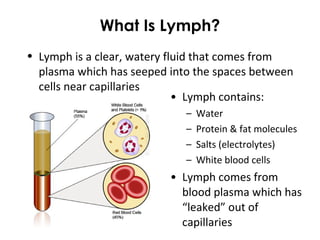
• Lymph is a clear, watery fluid that comes from
plasma which has seeped into the spaces between
cells near capillaries
• Lymph contains:
– Water
– Protein & fat molecules
– Salts (electrolytes)
– White blood cells
• Lymph comes from
blood plasma which has
“leaked” out of
capillaries
• Some plasma seeps out of capillaries to the spaces between
cells (called interstitial fluid)
• This fluid is collected into lymph vessels and taken to nodes
where the lymph is “cleaned” by immune cells
Lymph Edema
• If the lymphatic system is not working properly,
excess interstitial fluid can remain uncollected,
causing severe swelling.
Lymph Nodes
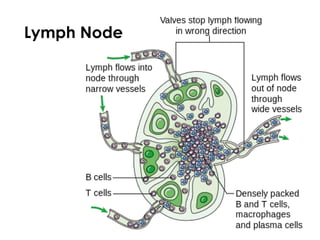
• Lymph is transported to small nodes where immune
cells attack pathogens and respond to infection.
– Skeletal muscles squeeze lymph
through vessels
– Nodes concentrated in neck, groin,
under arms, & in abdomen
Screening Lymph Nodes
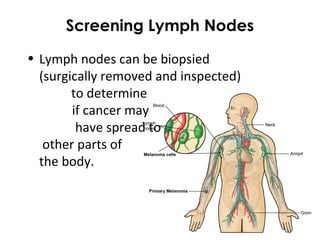
• Lymph nodes can be biopsied
(surgically removed and inspected)
to determine
if cancer may
have spread to
other parts of
the body.
Lymph Node
Immune Cells
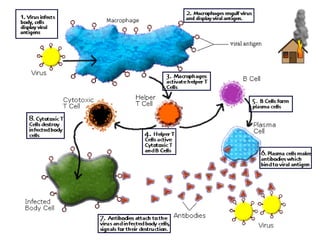
• White Blood Cells form a major part of your
body’s defense against disease and infection.
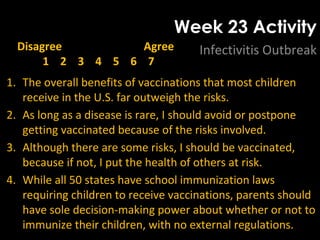
Week 23 Activity
Infectivitis Outbreak
1. The overall benefits of vaccinations that most children
receive in the U.S. far outweigh the risks.
2. As long as a disease is rare, I should avoid or postpone
getting vaccinated because of the risks involved.
3. Although there are some risks, I should be vaccinated,
because if not, I put the health of others at risk.
4. While all 50 states have school immunization laws
requiring children to receive vaccinations, parents should
have sole decision-making power about whether or not to
immunize their children, with no external regulations.
Disagree Agree
1 2 3 4 5 6 7
Endocrine System
• Glands
– Pituitary (master gland)
– Hypothalamus
– Thyroid/Parathyroid
– Thymus (more active in children)
– Adrenal
– Gonads (ovaries, testes)
• Make & release hormones
– chemical messengers
– travel through bloodstream
– cause changes all over the body
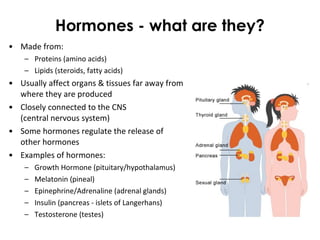
Hormones - what are they?
• Made from:
– Proteins (amino acids)
– Lipids (steroids, fatty acids)
• Usually affect organs & tissues far away from
where they are produced
• Closely connected to the CNS
(central nervous system)
• Some hormones regulate the release of
other hormones
• Examples of hormones:
– Growth Hormone (pituitary/hypothalamus)
– Melatonin (pineal)
– Epinephrine/Adrenaline (adrenal glands)
– Insulin (pancreas - islets of Langerhans)
– Testosterone (testes)
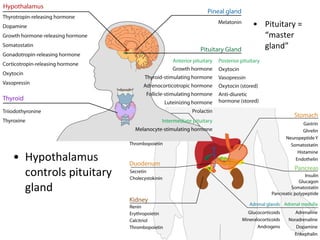
• Hypothalamus
controls pituitary
gland
• Pituitary =
“master
gland”
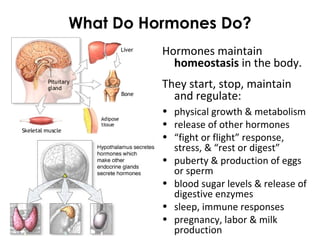
What Do Hormones Do?
Hormones maintain
homeostasis in the body.
They start, stop, maintain
and regulate:
• physical growth & metabolism
• release of other hormones
• “fight or flight” response,
stress, & “rest or digest”
• puberty & production of eggs
or sperm
• blood sugar levels & release of
digestive enzymes
• sleep, immune responses
• pregnancy, labor & milk
production
Week 23 Activity
Endocrine Excitement
1. Do NOT look at your puzzle piece until instructed.
2. Spread evenly throughout the room, then freeze.
3. Now check your puzzle piece to discover your role:
• RECEPTORs must stay frozen in place.
• HORMONEs may move about the room to find
their match.
4. Once a match is made, you must perform the action
written on the connected puzzle pieces.
• When a GLAND secretes a HORMONE, it travels throughout the
body through blood vessels.
• Only TARGET CELLS that have a RECEPTOR for a specific
hormone will be activated when the hormone & receptor fit
together.
• What examples can you think of where a certain object will
only fit into or together with a perfectly matched shape?
• The ENDOCRINE SYSTEM is a method of communication
between the brain and many different body parts.
• Why not just use lightning-fast nerves to relay messages?
Some signals need to reach every cell, like insulin which instructs cells to take in glucose.
If nerves had to relay this message, there would need to be an individual pathway
between the brain and every single cell in your body.
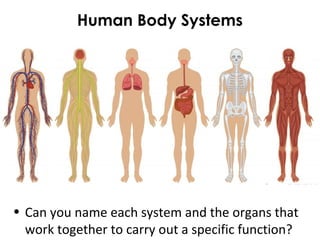
Human Body Systems
• Can you name each system and the organs that
work together to carry out a specific function?