Life Science
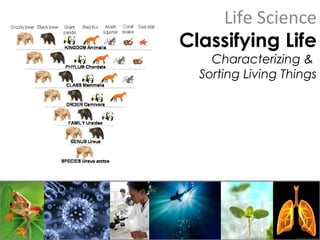
Classifying Life
Characterizing &
Sorting Living Things
In your lab notebook, please answer as best you can:
Week 11
Review Quiz
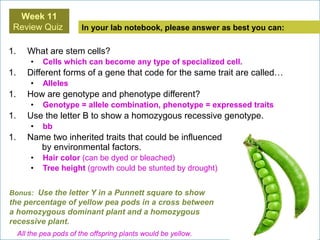
Bonus: Use the letter Y in a Punnett square to show
the percentage of yellow pea pods in a cross between
a homozygous dominant plant and a homozygous
recessive plant.
All the pea pods of the offspring plants would be yellow.
1. What are stem cells?
• Cells which can become any type of specialized cell.
1. Different forms of a gene that code for the same trait are called…
• Alleles
1. How are genotype and phenotype different?
• Genotype = allele combination, phenotype = expressed traits
1. Use the letter B to show a homozygous recessive genotype.
• bb
1. Name two inherited traits that could be influenced
by environmental factors.
• Hair color (can be dyed or bleached)
• Tree height (growth could be stunted by drought)
Note-Taking
• Note-Taking Methods:
– Full Sentences
– Outlining
– Cornell Method
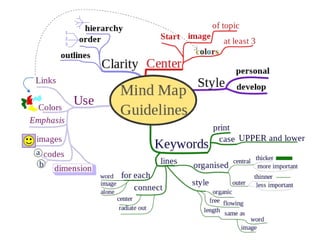
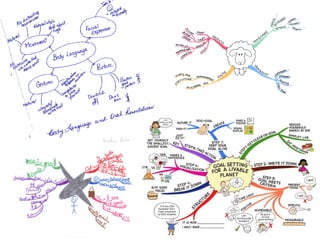
– Mind Mapping
– Flow-Based Diagramming
• Tip # 5:
– Resist distractions.
• talking, texting, doodling
• day-dreaming (spacing out)
– If you miss something, leave a blank
space and fill it in later.
• ask a friend to show you their notes
• check the class wiki slides
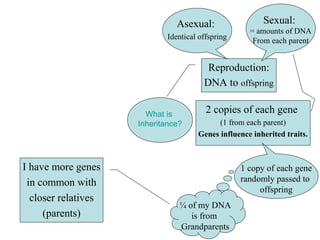
What is
Inheritance?
Reproduction:
DNA to offspring
Asexual:
Identical offspring
Sexual:
= amounts of DNA
From each parent
2 copies of each gene
(1 from each parent)
Genes influence inherited traits.
1 copy of each gene
randomly passed to
offspring
¼ of my DNA
is from
Grandparents
I have more genes
in common with
closer relatives
(parents)
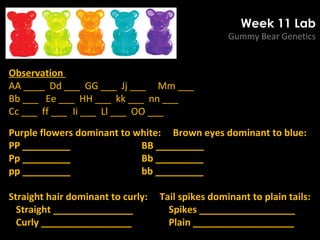
Week 11 Lab
Gummy Bear Genetics
Observation
AA ____ Dd ___ GG ___ Jj ___ Mm ___
Bb ___ Ee ___ HH ___ kk ___ nn ___
Cc ___ ff ___ Ii ___ Ll ___ OO ___
Purple flowers dominant to white: Brown eyes dominant to blue:
PP _________ BB _________
Pp _________ Bb _________
pp _________ bb _________
Straight hair dominant to curly: Tail spikes dominant to plain tails:
Straight _______________ Spikes __________________
Curly _________________ Plain ___________________
Week 11 Lab
Gummy Bear Genetics
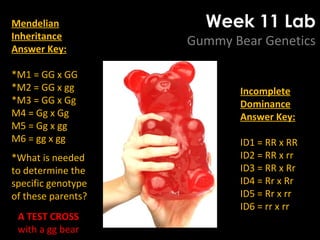
Mendelian
Inheritance
Answer Key:
*M1 = GG x GG
*M2 = GG x gg
*M3 = GG x Gg
M4 = Gg x Gg
M5 = Gg x gg
M6 = gg x gg
*What is needed
to determine the
specific genotype
of these parents?
Incomplete
Dominance
Answer Key:
ID1 = RR x RR
ID2 = RR x rr
ID3 = RR x Rr
ID4 = Rr x Rr
ID5 = Rr x rr
ID6 = rr x rr
A TEST CROSS
with a gg bear
Facts are Stupid Things!
• Organized things are
easier to understand.
– Patterns
– Interactions
– “Big picture”
– How individual things
work & fit together
• The interpretation of
facts brings meaning.
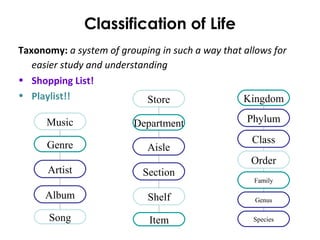
Classification of Life
Taxonomy: a system of grouping in such a way that allows for
easier study and understanding
• Shopping List!
• Playlist!! Store
Department
Aisle
Section
Shelf
Item
Music
Genre
Artist
Album
Song
Domain
Kingdom
Phylum
Class
Order
Family
Genus
Species
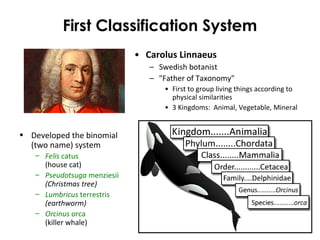
First Classification System
• Developed the binomial
(two name) system
– Felis catus
(house cat)
– Pseudotsuga menziesii
(Christmas tree)
– Lumbricus terrestris
(earthworm)
– Orcinus orca
(killer whale)
• Carolus Linnaeus
– Swedish botanist
– "Father of Taxonomy"
• First to group living things according to
physical similarities
• 3 Kingdoms: Animal, Vegetable, Mineral
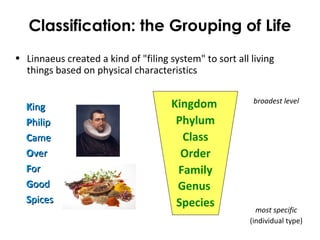
Classification: the Grouping of Life
Kingdom
Phylum
Class
Order
Family
Genus
Species
• Linnaeus created a kind of "filing system" to sort all living
things based on physical characteristics
KKinging
PPhiliphilip
CCameame
OOverver
FForor
GGoodood
SSpicespices
broadest level
most specific
(individual type)
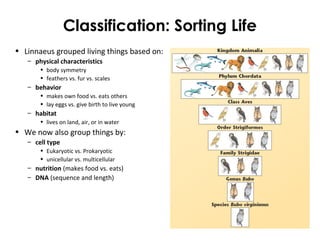
Classification: Sorting Life
• Linnaeus grouped living things based on:
– physical characteristics
• body symmetry
• feathers vs. fur vs. scales
– behavior
• makes own food vs. eats others
• lay eggs vs. give birth to live young
– habitat
• lives on land, air, or in water
• We now also group things by:
– cell type
• Eukaryotic vs. Prokaryotic
• unicellular vs. multicellular
– nutrition (makes food vs. eats)
– DNA (sequence and length)
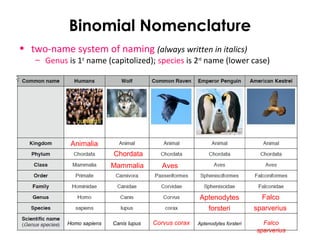
Binomial Nomenclature
• two-name system of naming (always written in italics)
– Genus is 1st
name (capitolized); species is 2nd
name (lower case)
Animalia
Chordata
Aves
Aptenodytes
Mammalia
Corvus corax Falco
sparverius
forsteri sparverius
Falco
Aptenodytes forsteriCanis lupusHomo sapiens
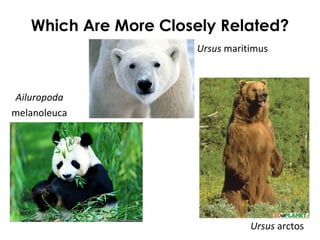
Which Are More Closely Related?
Ursus maritimus
Ailuropoda
melanoleuca
Ursus arctos
Week 11 Activity
Shoe Classification
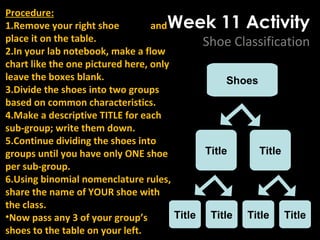
Procedure:
1.Remove your right shoe and
place it on the table.
2.In your lab notebook, make a flow
chart like the one pictured here, only
leave the boxes blank.
3.Divide the shoes into two groups
based on common characteristics.
4.Make a descriptive TITLE for each
sub-group; write them down.
5.Continue dividing the shoes into
groups until you have only ONE shoe
per sub-group.
6.Using binomial nomenclature rules,
share the name of YOUR shoe with
the class.
•Now pass any 3 of your group’s
shoes to the table on your left.
Shoes
Title Title
Title TitleTitleTitle
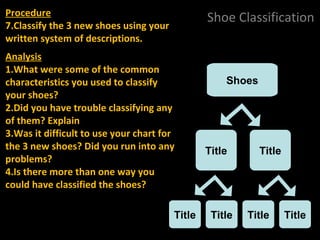
Shoe ClassificationProcedure
7.Classify the 3 new shoes using your
written system of descriptions.
Analysis
1.What were some of the common
characteristics you used to classify
your shoes?
2.Did you have trouble classifying any
of them? Explain
3.Was it difficult to use your chart for
the 3 new shoes? Did you run into any
problems?
4.Is there more than one way you
could have classified the shoes?
Shoes
Title Title
Title TitleTitleTitle
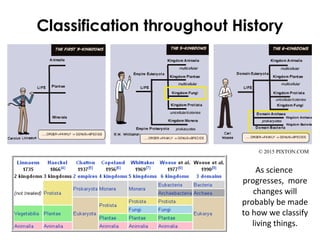
Classification throughout History
© 2015 PIXTON.COM
As science
progresses, more
changes will
probably be made
to how we classify
living things.
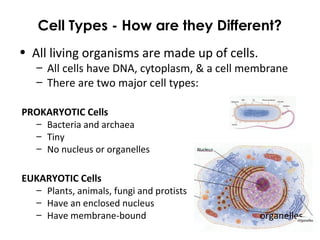
• All living organisms are made up of cells.
– All cells have DNA, cytoplasm, & a cell membrane
– There are two major cell types:
PROKARYOTIC Cells
– Bacteria and archaea
– Tiny
– No nucleus or organelles
EUKARYOTIC Cells
– Plants, animals, fungi and protists
– Have an enclosed nucleus
– Have membrane-bound organelles
Cell Types - How are they Different?
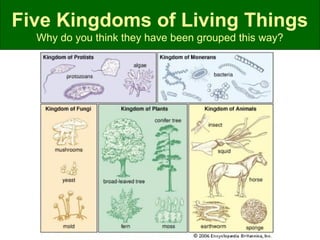
Five Kingdoms of Living Things
Why do you think they have been grouped this way?
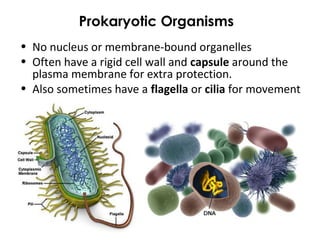
• No nucleus or membrane-bound organelles
• Often have a rigid cell wall and capsule around the
plasma membrane for extra protection.
• Also sometimes have a flagella or cilia for movement
Prokaryotic Organisms
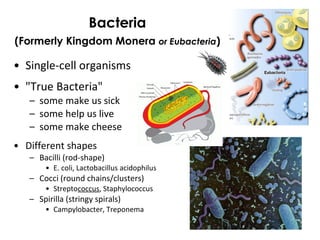
Bacteria
(Formerly Kingdom Monera or Eubacteria)
• Single-cell organisms
• "True Bacteria"
– some make us sick
– some help us live
– some make cheese
• Different shapes
– Bacilli (rod-shape)
• E. coli, Lactobacillus acidophilus
– Cocci (round chains/clusters)
• Streptococcus, Staphylococcus
– Spirilla (stringy spirals)
• Campylobacter, Treponema
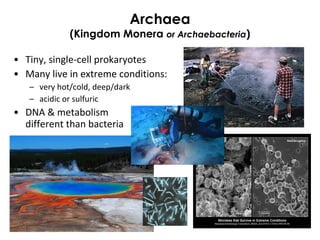
Archaea
(Kingdom Monera or Archaebacteria)
• Tiny, single-cell prokaryotes
• Many live in extreme conditions:
– very hot/cold, deep/dark
– acidic or sulfuric
• DNA & metabolism
different than bacteria
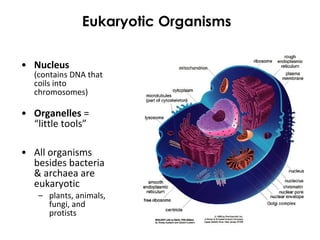
• Nucleus
(contains DNA that
coils into
chromosomes)
• Organelles =
“little tools”
• All organisms
besides bacteria
& archaea are
eukaryotic
– plants, animals,
fungi, and
protists
Eukaryotic Organisms
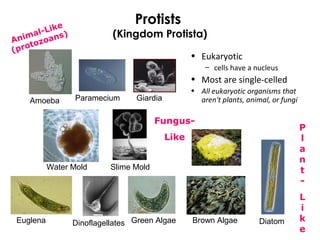
Protists
(Kingdom Protista)
Amoeba Paramecium Giardia
Water Mold Slime Mold
Euglena Dinoflagellates DiatomBrown AlgaeGreen Algae
Fungus-
Like
P
l
a
n
t
-
L
i
k
e
• Eukaryotic
– cells have a nucleus
• Most are single-celled
• All eukaryotic organisms that
aren't plants, animal, or fungi
Animal-Like
(protozoans)
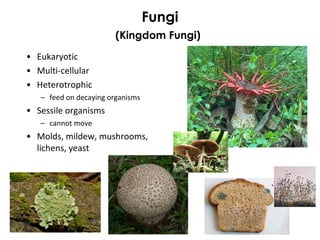
Fungi
(Kingdom Fungi)
• Eukaryotic
• Multi-cellular
• Heterotrophic
– feed on decaying organisms
• Sessile organisms
– cannot move
• Molds, mildew, mushrooms,
lichens, yeast
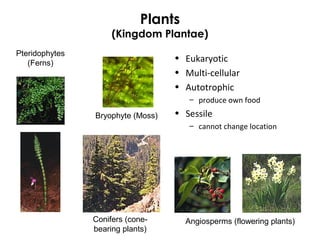
Plants
(Kingdom Plantae)
Bryophyte (Moss)
Pteridophytes
(Ferns)
Conifers (cone-
bearing plants)
Angiosperms (flowering plants)
• Eukaryotic
• Multi-cellular
• Autotrophic
– produce own food
• Sessile
– cannot change location
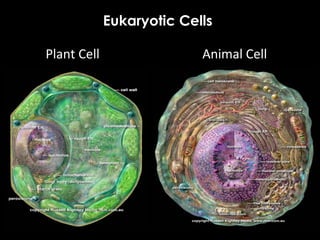
Plant Cell Animal Cell
Eukaryotic Cells
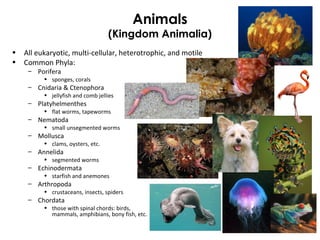
Animals
(Kingdom Animalia)
• All eukaryotic, multi-cellular, heterotrophic, and motile
• Common Phyla:
– Porifera
• sponges, corals
– Cnidaria & Ctenophora
• jellyfish and comb jellies
– Platyhelmenthes
• flat worms, tapeworms
– Nematoda
• small unsegmented worms
– Mollusca
• clams, oysters, etc.
– Annelida
• segmented worms
– Echinodermata
• starfish and anemones
– Arthropoda
• crustaceans, insects, spiders
– Chordata
• those with spinal chords: birds,
mammals, amphibians, bony fish, etc.
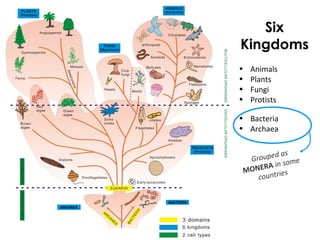
Grouped as
MONERA in some
countries
Six
Kingdoms
• Animals
• Plants
• Fungi
• Protists
• Bacteria
• Archaea
6
ARCHAEA
BACTERIA