Download or save this slide show in order to get the PowerPoint custom animations.


                                       Scientific
                                       Method
                                                                Complemented by
                                                                my slideshow
                                                                Scientific Method
             By Moira Whitehouse                                Variables
We introduced the variables
used in the Scientific Method in
a previous presentation. Let’s
think back about what was
covered in that presentation.
Do you remember what the
Scientific Method is?
The scientific method is:
1. One way scientists find out
about the world around us.

2. A method that scientists use
to answer specific questions.
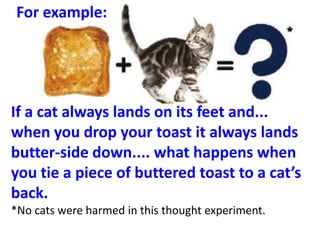
For example:


If a cat always lands on its feet and...
when you drop your toast it always lands
butter-side down.... what happens when
you tie a piece of buttered toast to a cat’s
back.
*No cats were harmed in this thought experiment.
In order to understand the
Scientific Method, we first
need to know what a

      VARIABLE
            is.
Do you… remember… what
a variable is?
Yes,
        a variable is
anything in an experiment
that can change.
Remember there are three
types of variables.
What do you recall about
these three variables?
… a change
 …a responding
variable?
   …a control
 variable?
  variable?
Let’s start with:

                    … a change
                    variable?
Change variable—the thing the
experimenter changes on purpose.
Then comes:


              …a responding
              variable?
Responding variable-- what the
experimenter observes or measures to
see if the change variable is making an
difference.
And finally:


               …a control
               variable?
The control variable: all the other things
that could cause the responding variable
to change—must be kept the same.
One more thing to remember:
The experimenter always
          ? ??
starts with a
? ? question ? ? ?
that can be answered by
changing a variable and
observing the results.
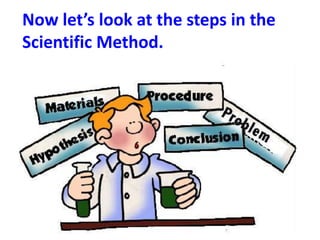
Now let’s look at the steps in the
Scientific Method.
The first step in this and any
experiment is coming up with a


      Problem
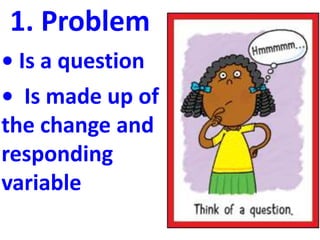
1. Problem
• Is a question
• Is made up of
the change and
responding
variable
Jane knows that plants
need light to grow. But she
wonders—what about
seeds. Do seeds need light
to sprout? She decides to
design an experiment to
answer her question.
So in Jane’s experiment with the seeds
what will her change variable be?
Yes, it will be whether or not the
seeds receive light.

What could her responding variable
be?—what could she observe or
measure to see whether or not seeds
need light to sprout or grow?
She plans to put 3 seeds in light and 3
seeds in the dark and then count the
number of seeds that sprout when
light is present and the number when
light is not present.
Now that we have the change variable
(light and dark) and the responding
variable (the number of seeds that
sprout), let us write the problem—the
question with the change and
responding variable.
Will more seeds sprout in the light
 than in the dark?
              or


Does light affect the number of
     seeds that sprout?
After you come up with a Problem, the
next step in the Scientific Method is
coming up with:


The Hypothesis.
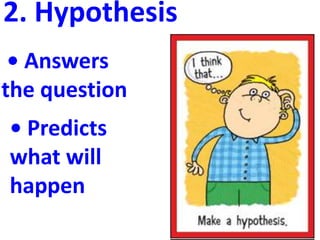
2. Hypothesis
 • Answers
the question
• Predicts
what will
happen
What will be the hypothesis for Jane’s
experiment with light and sprouting
seeds?
What do you think? Will more seeds
sprout in the light or in the dark?
Because plants need light to grow, Jane
thinks seeds will also need light to
sprout. So her hypothesis will be:
More seeds will sprout in the light
than in the dark.
After coming up with an
Hypothesis, the experimenter
writes out a plan to test the
Hypothesis.

       This plan is called


   The Procedure
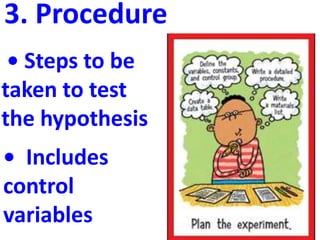
3. Procedure
 • Steps to be
taken to test
the hypothesis
• Includes
control
variables
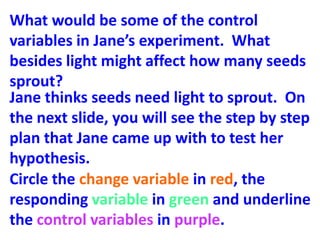
What would be some of the control
variables in Jane’s experiment. What
besides light might affect how many seeds
sprout?
Jane thinks seeds need light to sprout. On
the next slide, you will see the step by step
plan that Jane came up with to test her
hypothesis.
Circle the change variable in red, the
responding variable in green and underline
the control variables in purple.
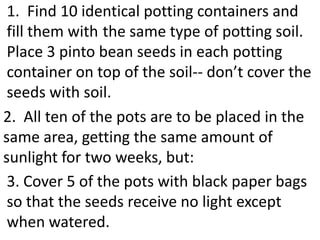
1. Find 10 identical potting containers and
 fill them with the same type of potting soil.
 Place 3 pinto bean seeds in each potting
 container on top of the soil-- don’t cover the
 seeds with soil.
2. All ten of the pots are to be placed in the
same area, getting the same amount of
sunlight for two weeks, but:
 3. Cover 5 of the pots with black paper bags
 so that the seeds receive no light except
 when watered.
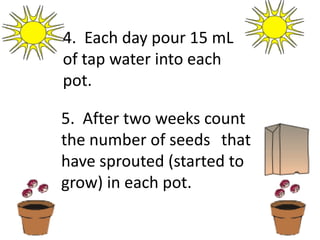
4. Each day pour 15 mL
of tap water into each
pot.

5. After two weeks count
the number of seeds that
have sprouted (started to
grow) in each pot.
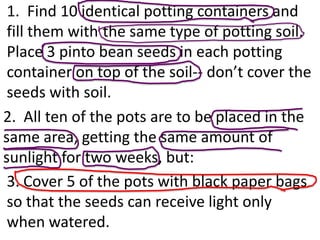
Did your
product look
like this?
1. Find 10 identical potting containers and
 fill them with the same type of potting soil.
 Place 3 pinto bean seeds in each potting
 container on top of the soil-- don’t cover the
 seeds with soil.
2. All ten of the pots are to be placed in the
same area, getting the same amount of
sunlight for two weeks, but:
 3. Cover 5 of the pots with black paper bags
 so that the seeds can receive light only
 when watered.
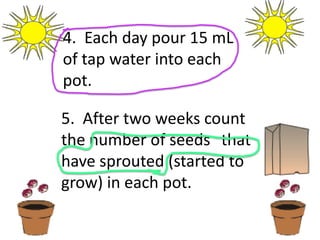
4. Each day pour 15 mL
of tap water into each
pot.

5. After two weeks count
the number of seeds that
have sprouted (started to
grow) in each pot.
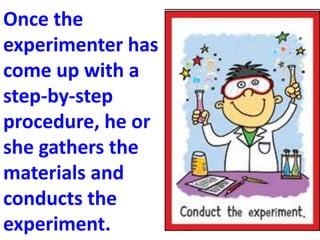
Once the
experimenter has
come up with a
step-by-step
procedure, he or
she gathers the
materials and
conducts the
experiment.
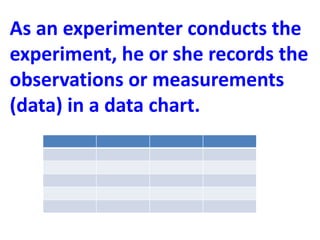
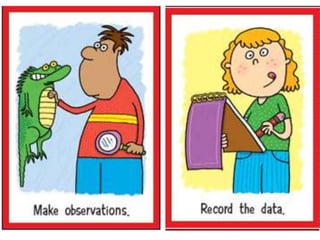
As an experimenter conducts the
experiment, he or she records the
observations or measurements
(data) in a data chart.
To make sure that the results did
not occur due to chance, an
experimenter repeats the
experiment several times
collecting data each time.
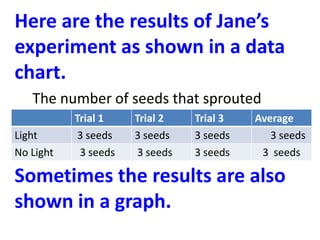
Here are the results of Jane’s
experiment as shown in a data
chart.
   The number of seeds that sprouted
           Trial 1    Trial 2    Trial 3   Average
Light       3 seeds   3 seeds    3 seeds      3 seeds
No Light    3 seeds    3 seeds   3 seeds    3 seeds

Sometimes the results are also
shown in a graph.
After conducting the
experiment and gathering the
data using the steps in the
Procedure, the experimenter
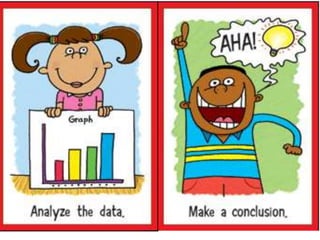
4. analyzes the data
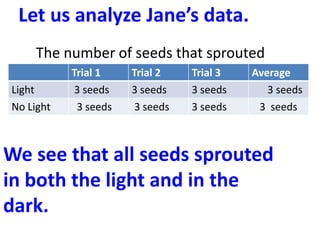
Let us analyze Jane’s data.
     The number of seeds that sprouted
           Trial 1    Trial 2    Trial 3   Average
Light       3 seeds   3 seeds    3 seeds      3 seeds
No Light    3 seeds    3 seeds   3 seeds    3 seeds


We see that all seeds sprouted
in both the light and in the
dark.
After analyzing the data, the
experimenter comes up with a

5. Conclusion
• answers the question
allowing the experimenter to
decide if the hypothesis is right
or wrong.
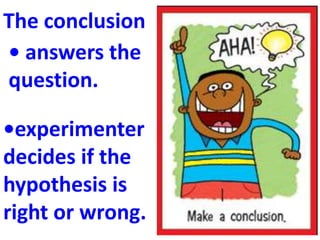
The conclusion
• answers the
question.

•experimenter
decides if the
hypothesis is
right or wrong.
So what can Jane conclude?


From her data, Jane can
conclude that seeds DO
NOT need light to
sprout.
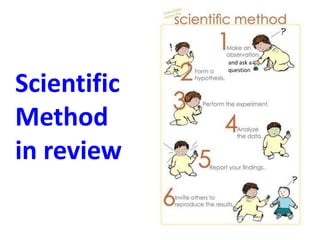
and ask a
             question


Scientific
Method
in review
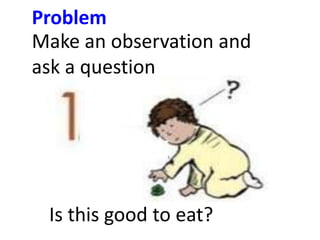
Problem
Make an observation and
ask a question


 Is this good to eat?
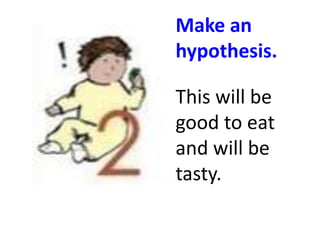
Make an
hypothesis.

This will be
good to eat
and will be
tasty.
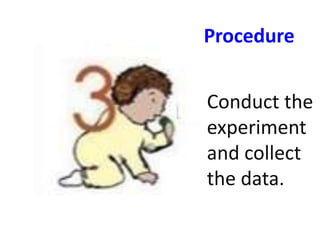
Procedure


Conduct the
experiment
and collect
the data.
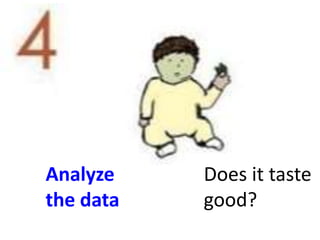
Analyze    Does it taste
the data   good?
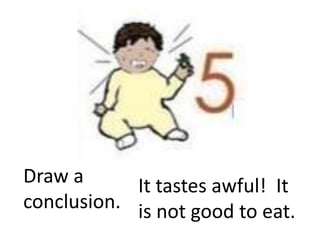
Draw a      It tastes awful! It
conclusion. is not good to eat.
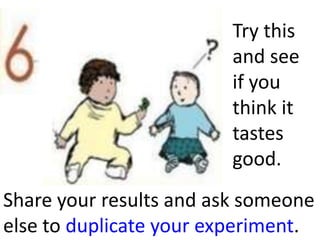
Try this
                         and see
                         if you
                         think it
                         tastes
                         good.
Share your results and ask someone
else to duplicate your experiment.
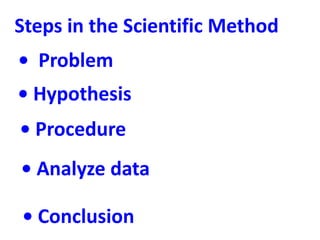
Steps in the Scientific Method
• Problem
• Hypothesis
• Procedure
• Analyze data

• Conclusion

Scientific method procedures (Teach)

  • 1.
    Download or savethis slide show in order to get the PowerPoint custom animations. Scientific Method Complemented by my slideshow Scientific Method By Moira Whitehouse Variables
  • 2.
    We introduced thevariables used in the Scientific Method in a previous presentation. Let’s think back about what was covered in that presentation. Do you remember what the Scientific Method is?
  • 3.
    The scientific methodis: 1. One way scientists find out about the world around us. 2. A method that scientists use to answer specific questions.
  • 4.
    For example: If acat always lands on its feet and... when you drop your toast it always lands butter-side down.... what happens when you tie a piece of buttered toast to a cat’s back. *No cats were harmed in this thought experiment.
  • 5.
    In order tounderstand the Scientific Method, we first need to know what a VARIABLE is.
  • 6.
    Do you… remember…what a variable is?
  • 7.
    Yes, a variable is anything in an experiment that can change. Remember there are three types of variables. What do you recall about these three variables?
  • 8.
    … a change …a responding variable? …a control variable? variable?
  • 9.
    Let’s start with: … a change variable?
  • 10.
    Change variable—the thingthe experimenter changes on purpose.
  • 11.
    Then comes: …a responding variable?
  • 12.
    Responding variable-- whatthe experimenter observes or measures to see if the change variable is making an difference.
  • 13.
    And finally: …a control variable?
  • 14.
    The control variable:all the other things that could cause the responding variable to change—must be kept the same.
  • 15.
    One more thingto remember: The experimenter always ? ?? starts with a ? ? question ? ? ? that can be answered by changing a variable and observing the results.
  • 16.
    Now let’s lookat the steps in the Scientific Method.
  • 17.
    The first stepin this and any experiment is coming up with a Problem
  • 18.
    1. Problem • Isa question • Is made up of the change and responding variable
  • 19.
    Jane knows thatplants need light to grow. But she wonders—what about seeds. Do seeds need light to sprout? She decides to design an experiment to answer her question.
  • 20.
    So in Jane’sexperiment with the seeds what will her change variable be? Yes, it will be whether or not the seeds receive light. What could her responding variable be?—what could she observe or measure to see whether or not seeds need light to sprout or grow?
  • 21.
    She plans toput 3 seeds in light and 3 seeds in the dark and then count the number of seeds that sprout when light is present and the number when light is not present. Now that we have the change variable (light and dark) and the responding variable (the number of seeds that sprout), let us write the problem—the question with the change and responding variable.
  • 22.
    Will more seedssprout in the light than in the dark? or Does light affect the number of seeds that sprout?
  • 23.
    After you comeup with a Problem, the next step in the Scientific Method is coming up with: The Hypothesis.
  • 24.
    2. Hypothesis •Answers the question • Predicts what will happen
  • 25.
    What will bethe hypothesis for Jane’s experiment with light and sprouting seeds? What do you think? Will more seeds sprout in the light or in the dark? Because plants need light to grow, Jane thinks seeds will also need light to sprout. So her hypothesis will be: More seeds will sprout in the light than in the dark.
  • 26.
    After coming upwith an Hypothesis, the experimenter writes out a plan to test the Hypothesis. This plan is called The Procedure
  • 27.
    3. Procedure •Steps to be taken to test the hypothesis • Includes control variables
  • 28.
    What would besome of the control variables in Jane’s experiment. What besides light might affect how many seeds sprout? Jane thinks seeds need light to sprout. On the next slide, you will see the step by step plan that Jane came up with to test her hypothesis. Circle the change variable in red, the responding variable in green and underline the control variables in purple.
  • 29.
    1. Find 10identical potting containers and fill them with the same type of potting soil. Place 3 pinto bean seeds in each potting container on top of the soil-- don’t cover the seeds with soil. 2. All ten of the pots are to be placed in the same area, getting the same amount of sunlight for two weeks, but: 3. Cover 5 of the pots with black paper bags so that the seeds receive no light except when watered.
  • 30.
    4. Each daypour 15 mL of tap water into each pot. 5. After two weeks count the number of seeds that have sprouted (started to grow) in each pot.
  • 31.
  • 32.
    1. Find 10identical potting containers and fill them with the same type of potting soil. Place 3 pinto bean seeds in each potting container on top of the soil-- don’t cover the seeds with soil. 2. All ten of the pots are to be placed in the same area, getting the same amount of sunlight for two weeks, but: 3. Cover 5 of the pots with black paper bags so that the seeds can receive light only when watered.
  • 33.
    4. Each daypour 15 mL of tap water into each pot. 5. After two weeks count the number of seeds that have sprouted (started to grow) in each pot.
  • 34.
    Once the experimenter has comeup with a step-by-step procedure, he or she gathers the materials and conducts the experiment.
  • 35.
    As an experimenterconducts the experiment, he or she records the observations or measurements (data) in a data chart.
  • 37.
    To make surethat the results did not occur due to chance, an experimenter repeats the experiment several times collecting data each time.
  • 38.
    Here are theresults of Jane’s experiment as shown in a data chart. The number of seeds that sprouted Trial 1 Trial 2 Trial 3 Average Light 3 seeds 3 seeds 3 seeds 3 seeds No Light 3 seeds 3 seeds 3 seeds 3 seeds Sometimes the results are also shown in a graph.
  • 39.
    After conducting the experimentand gathering the data using the steps in the Procedure, the experimenter 4. analyzes the data
  • 41.
    Let us analyzeJane’s data. The number of seeds that sprouted Trial 1 Trial 2 Trial 3 Average Light 3 seeds 3 seeds 3 seeds 3 seeds No Light 3 seeds 3 seeds 3 seeds 3 seeds We see that all seeds sprouted in both the light and in the dark.
  • 42.
    After analyzing thedata, the experimenter comes up with a 5. Conclusion • answers the question allowing the experimenter to decide if the hypothesis is right or wrong.
  • 43.
    The conclusion • answersthe question. •experimenter decides if the hypothesis is right or wrong.
  • 44.
    So what canJane conclude? From her data, Jane can conclude that seeds DO NOT need light to sprout.
  • 45.
    and ask a question Scientific Method in review
  • 46.
    Problem Make an observationand ask a question Is this good to eat?
  • 47.
    Make an hypothesis. This willbe good to eat and will be tasty.
  • 48.
  • 49.
    Analyze Does it taste the data good?
  • 50.
    Draw a It tastes awful! It conclusion. is not good to eat.
  • 51.
    Try this and see if you think it tastes good. Share your results and ask someone else to duplicate your experiment.
  • 52.
    Steps in theScientific Method • Problem • Hypothesis • Procedure • Analyze data • Conclusion