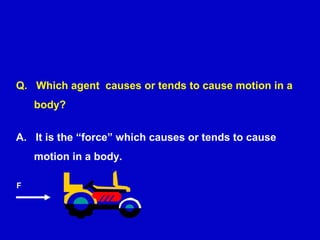
Q. Which agent causes or tends to cause motion in a
    body?


A. It is the “force” which causes or tends to cause
    motion in a body.

F
Q. What is force ?

A. The agent which ;

 Stops or tends to stop the motion
                OR
 Produces or tends to produce the motion
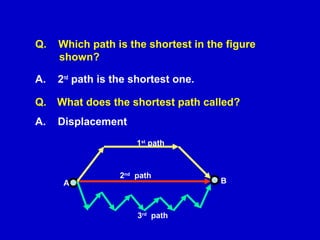
Q.   Which path is the shortest in the figure
     shown?

A.   2nd path is the shortest one.

Q.   What does the shortest path called?
A.   Displacement
                      1st path


                  2nd path
      A                              B


                      3rd path
Q. Which quantity depends upon force and
   displacement?
A. Work depends upon force and displacement.
WORK


 Definition

 Mathematical Form

 Unit

 Cases of Work
WORK
In general work is said to be done when
  someone pushes against a brick wall
  and does not able to move it
   A boy studies a book for a few hours
But in Physics work is defined differently
WORK
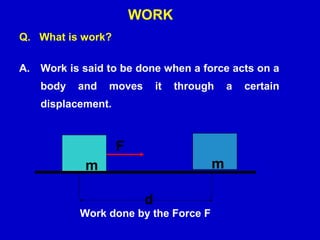
Q. What is work?

A.   Work is said to be done when a force acts on a
     body   and   moves       it   through   a   certain
     displacement.


                     F
             m                           m

                          d
            Work done by the Force F
WORK
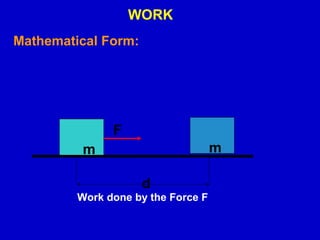
Mathematical Form:


               F
          m                         m

                     d
         Work done by the Force F
WORK

      If force is applied on a body and it moves the
body through a displacement ‘d ’, then the work 'W' is
defined by the relation
             W     =      F. d

We have already studied scalars and vectors.
Q. What is the nature of work?
A.   Work is a scalar quantity.
WORK
 If the force makes an angle θ with the
 direction of the displacement then,
 We take the component of the force in the
 direction of the displacement
WORK

Unit of work:

The SI unit of work is joule (J).


One Joule

      When a force of one Newton moves a body
through a distance of one meter in the direction of
force, then the work done is equal to one joule.
CASES OF WORK
Positive Work
       When force and displacement are in the same
direction


Then              θ     =       0°


                  W     =       F d cos 0°


                            =    Fd x1
                        =       Fd
CASES OF WORK
Positive Work

     In this case work done is maximum and is
equal to the product of the magnitude of force
and displacement.
CASES OF WORK

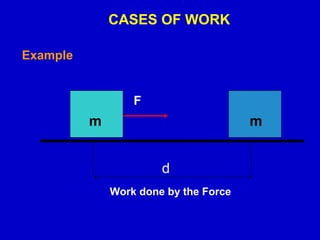
Example


                  F
          m                            m


                       d
              Work done by the Force
CASES OF WORK
Zero Work

       When    force   is       perpendicular    to   the
displacement
Then               θ        =      90°
                   W        =      F S cos 90°
                            =      Fx0
                            =      0
In this case work done is zero.
CASES OF WORK
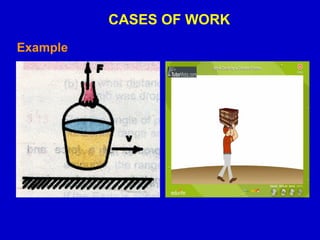
Example
CASES OF WORK
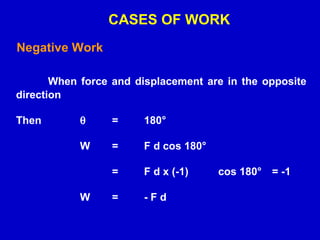
Negative Work

       When force and displacement are in the opposite
direction

Then       θ     =     180°

           W     =     F d cos 180°

                 =     F d x (-1)     cos 180° = -1

           W     =     -Fd
CASES OF WORK

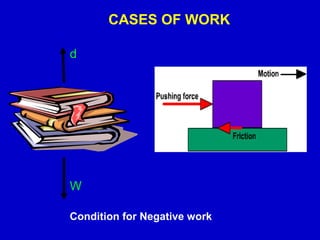
d


W

Condition for Negative work
ACTIVITY

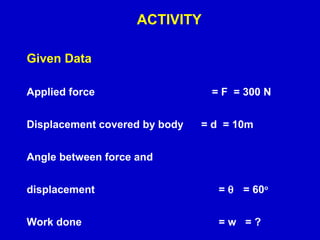
Given Data

Applied force                   = F = 300 N


Displacement covered by body   = d = 10m


Angle between force and


displacement                      = θ = 60o


Work done                         =w =?
WORK

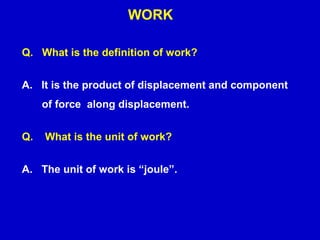
Q. What is the definition of work?


A. It is the product of displacement and component
     of force along displacement.


Q.   What is the unit of work?


A. The unit of work is “joule”.
WORK

Q. Give an example of positive work?


A. Pushing something horizontally is an example of
   positive work.


Q. Give an example of negative work?


A. Lifting something vertically upwards is an example
   of negative work.
CASES OF WORK


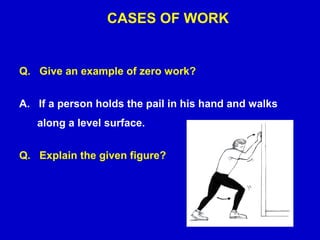
Q. Give an example of zero work?


A. If a person holds the pail in his hand and walks
   along a level surface.


Q. Explain the given figure?
THANK YOU