Life Science
Human Body Systems
The Five Senses
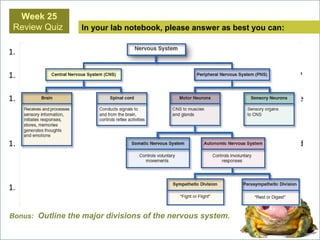
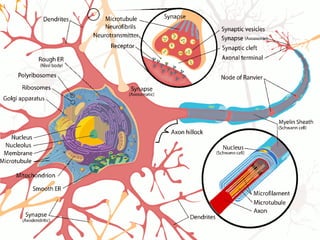
Bonus: Outline the major divisions of the nervous system.
In your lab notebook, please answer as best you can:
Week 25
Review Quiz
1. What two major structures make up the CNS?
• Brain and spinal cord
1. Are sensory neurons that carry info to the brain afferent or efferent nerves?
• Afferent (afferent arrive, efferent exit)
1. True or False? The Autonomic Nervous System, regulated by the frontal lobe
of the brain, operates in the background to control vital functions like
breathing.
• False (the brainstem, NOT the frontal lobe of the cerebrum, controls the ANS)
1. Do neurons use chemical or electrical mechanisms to transmit signals to and
from the brain?
• Both (neurotransmitters across the synapse to relay signals and electrical current
along the length of the axon within each nerve)
1. What does the cerebellum do?
• Coordinates muscle movements (posture, balance, & muscle memory)
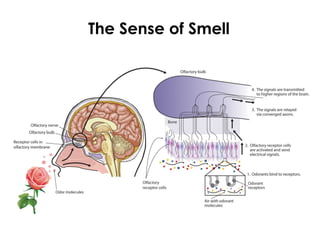
The Sense of Smell
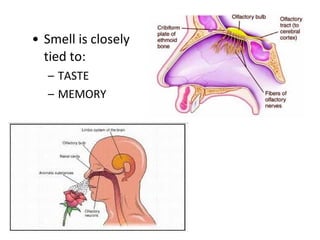
• Smell is closely
tied to:
– TASTE
– MEMORY
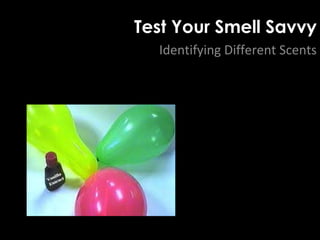
Test Your Smell Savvy
Identifying Different Scents
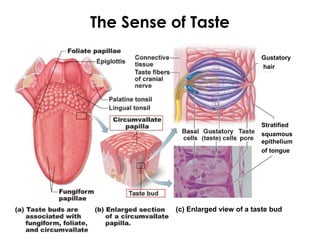
The Sense of Taste
Gustatory
hair
Stratified
squamous
epithelium
of tongue
(c) Enlarged view of a taste bud
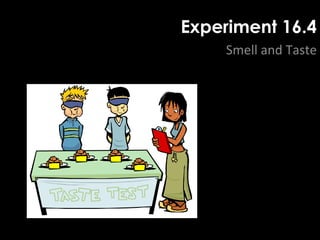
Experiment 16.4
Smell and Taste
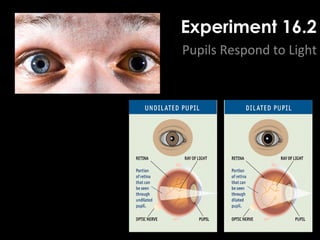
Experiment 16.2
Pupils Respond to Light
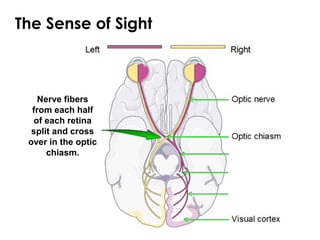
The Sense of Sight
Nerve fibers
from each half
of each retina
split and cross
over in the optic
chiasm.
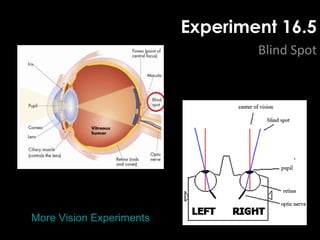
Experiment 16.5
Blind Spot
More Vision Experiments
Blind Spot Test
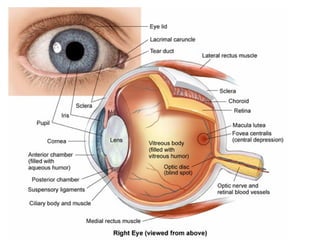
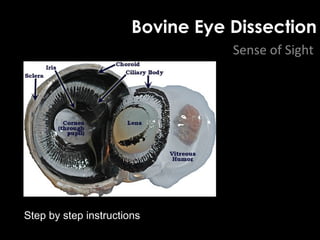
Bovine Eye Dissection
Sense of Sight
Step by step instructions
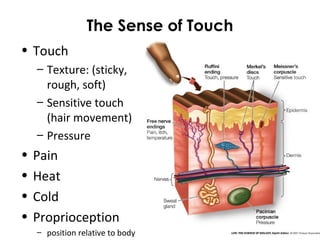
The Sense of Touch
• Touch
– Texture: (sticky,
rough, soft)
– Sensitive touch
(hair movement)
– Pressure
• Pain
• Heat
• Cold
• Proprioception
– position relative to body
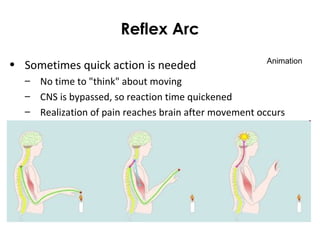
Reflex Arc
• Sometimes quick action is needed
– No time to "think" about moving
– CNS is bypassed, so reaction time quickened
– Realization of pain reaches brain after movement occurs
Animation
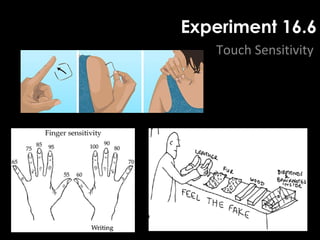
Experiment 16.6
Touch Sensitivity
Human Senses

Human Senses

  • 1.
    Life Science Human BodySystems The Five Senses
  • 2.
    Bonus: Outline themajor divisions of the nervous system. In your lab notebook, please answer as best you can: Week 25 Review Quiz 1. What two major structures make up the CNS? • Brain and spinal cord 1. Are sensory neurons that carry info to the brain afferent or efferent nerves? • Afferent (afferent arrive, efferent exit) 1. True or False? The Autonomic Nervous System, regulated by the frontal lobe of the brain, operates in the background to control vital functions like breathing. • False (the brainstem, NOT the frontal lobe of the cerebrum, controls the ANS) 1. Do neurons use chemical or electrical mechanisms to transmit signals to and from the brain? • Both (neurotransmitters across the synapse to relay signals and electrical current along the length of the axon within each nerve) 1. What does the cerebellum do? • Coordinates muscle movements (posture, balance, & muscle memory)
  • 3.
  • 4.
    • Smell isclosely tied to: – TASTE – MEMORY
  • 5.
    Test Your SmellSavvy Identifying Different Scents
  • 6.
    The Sense ofTaste Gustatory hair Stratified squamous epithelium of tongue (c) Enlarged view of a taste bud
  • 7.
  • 9.
  • 10.
    The Sense ofSight Nerve fibers from each half of each retina split and cross over in the optic chiasm.
  • 11.
    Experiment 16.5 Blind Spot MoreVision Experiments Blind Spot Test
  • 13.
    Bovine Eye Dissection Senseof Sight Step by step instructions
  • 14.
    The Sense ofTouch • Touch – Texture: (sticky, rough, soft) – Sensitive touch (hair movement) – Pressure • Pain • Heat • Cold • Proprioception – position relative to body
  • 16.
    Reflex Arc • Sometimesquick action is needed – No time to "think" about moving – CNS is bypassed, so reaction time quickened – Realization of pain reaches brain after movement occurs Animation
  • 17.

Editor's Notes

  • #6 Fill several balloons with different spices, oils, and extracts. Include things like lemon juice, cinnamon, baby powder, and almond extract. Label them #1 – 10 and supply an answer key.
  • #8 Module #16: The Human Nervous System EXPERIMENT 16.4 The Sense of Smell and the Sense of Taste Supplies : Toothpicks Apple Onion Blindfold A person to help you A knife Two paper towels Introduction - The sense of smell affects the sense of taste. This experiment will demonstrate that fact for most people. Procedure : Make sure that your helper is not in the room when you start this experiment. Cut a few bite-sized pieces from both the apple and the onion. Put the pieces on a paper towel and cover them with the other paper towel. Put away the rest of the apple and onion so that your helper has no idea what you have been cutting up. This is very important. Blindfold your helper and have your helper pinch his or her nose to make sure he or she cannot smell. Use the toothpick to spear one of the pieces and feed it to your helper. Ask him or her to identify the food by taste. Do not give him or her any hints. If he or she cannot identify the taste, don't worry about it. Do this with three more pieces of food so that your helper has had two onion pieces and two apple pieces. Each time, ask the helper to identify the food by taste. Now repeat steps (F) and (G), but this time allow your helper to stop pinching his or her nose. Let your helper smell the food before he or she tastes it. Once again, ask him or her to identify the food. Clean everything up.
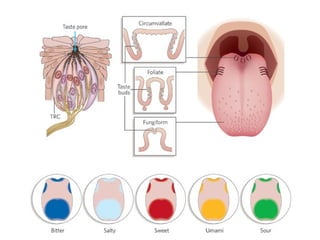
  • #9 Since at least 2006, the old “tongue map” theory has been dispelled by research in favor of the idea that ALL taste receptors are found in all areas of the tongue: http://www.nature.com/nature/journal/v444/n7117/full/nature05401.html#B78 There are very FEW taste buds in the center of your tongue.
  • #10 Diagram copyright: https://www.nei.nih.gov/healthyeyes/eyeexam
  • #12 https://visionaryeyecare.wordpress.com/2008/08/04/eye-test-find-your-blind-spot-in-each-eye/
  • #15 Proprioception = position of the body part in relation to the rest of the body.