Atomic
Interactions:
Chemical Bonding
Basic
Chemistry
i wonder why
Physical Science
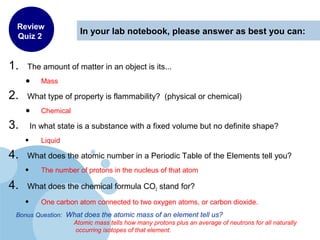
In your lab notebook, please answer as best you can:
1. The amount of matter in an object is its...
• Mass
2. What type of property is flammability? (physical or chemical)
• Chemical
3. In what state is a substance with a fixed volume but no definite shape?
• Liquid
4. What does the atomic number in a Periodic Table of the Elements tell you?
• The number of protons in the nucleus of that atom
4. What does the chemical formula CO2 stand for?
• One carbon atom connected to two oxygen atoms, or carbon dioxide.
Bonus Question: What does the atomic mass of an element tell us?
Atomic mass tells how many protons plus an average of neutrons for all naturally
occurring isotopes of that element.
Review
Quiz 2
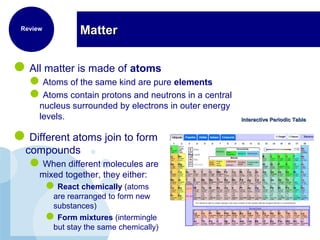
All matter is made of atoms
Atoms of the same kind are pure elements
Atoms contain protons and neutrons in a central
nucleus surrounded by electrons in outer energy
levels.
MatterMatter
Interactive Periodic TableInteractive Periodic Table
Review
Different atoms join to form
compounds
When different molecules are
mixed together, they either:
React chemically (atoms
are rearranged to form new
substances)
Form mixtures (intermingle
but stay the same chemically)
Natural Forms of Elements
• Most elements are not found in nature as pure substances.
• You will never find pure sodium or chlorine gas occurring in nature.
• Why is that?
• Most elements are found as a
combination of several different atoms
joined together into compounds.
• Iron is only found naturally occurring as
iron ore (a mixture of iron and oxygen)
• Why?
Sodium Chloride CrystalsSodium Chloride Crystals
Iron OreIron Ore
Van der Waals Attractions
- forces between charged particles
• Protons(+) ATTRACT electrons(-)
• Opposite charges attract
• The bigger the nucleus (more
protons), the greater the attraction on
electrons.
• Protons(+) REPEL other protons(+)
• Like charges repel
• The protons of one atom will repel the
protons in another atom’s nucleus
Advanced
Topic
• Atoms that are very near each other interact because of the electrical
charges of their particles.
Atomic Interactions SIM
Reactivity
- What makes atoms interact?
• Atoms are happiest (most stable):
• with full energy levels (filled electron shells)
• with paired electrons
• Atoms will interact with other atoms to make electron pairs
and filled shells happen
Phosphorus
Drawing Invisible Matter
- Two ways to draw an atom
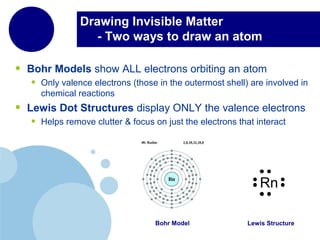
• Bohr Models show ALL electrons orbiting an atom
• Only valence electrons (those in the outermost shell) are involved in
chemical reactions
• Lewis Dot Structures display ONLY the valence electrons
• Helps remove clutter & focus on just the electrons that interact
Lewis StructureBohr Model
Rn
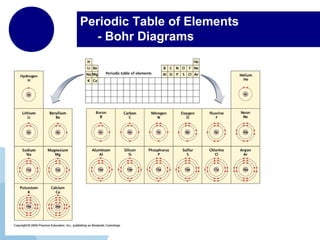
Periodic Table of Elements
- Bohr Diagrams
Periodic Table of Elements
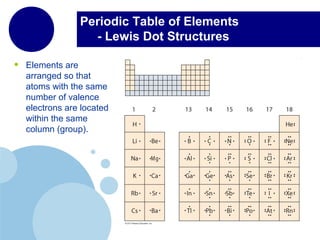
- Lewis Dot Structures
• Elements are
arranged so that
atoms with the same
number of valence
electrons are located
within the same
column (group).
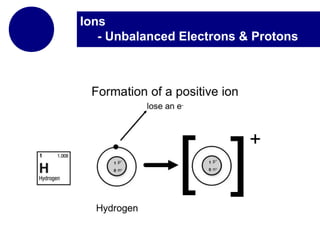
Ions
- Unbalanced Electrons & Protons
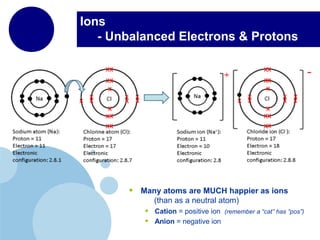
Ions
- Unbalanced Electrons & Protons
• Many atoms are MUCH happier as ions
(than as a neutral atom)
• Cation = positive ion (remember a “cat” has “pos”)
• Anion = negative ion
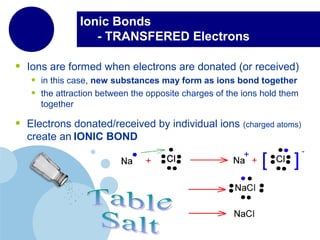
Ionic Bonds
- TRANSFERED Electrons
• Ions are formed when electrons are donated (or received)
• in this case, new substances may form as ions bond together
• the attraction between the opposite charges of the ions hold them
together
• Electrons donated/received by individual ions (charged atoms)
create an IONIC BOND
Covalent Bonds
- SHARED Electrons
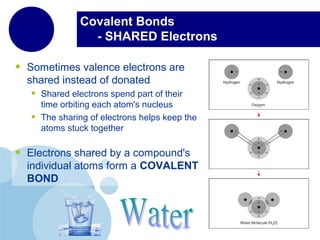
• Sometimes valence electrons are
shared instead of donated
• Shared electrons spend part of their
time orbiting each atom's nucleus
• The sharing of electrons helps keep the
atoms stuck together
• Electrons shared by a compound's
individual atoms form a COVALENT
BOND
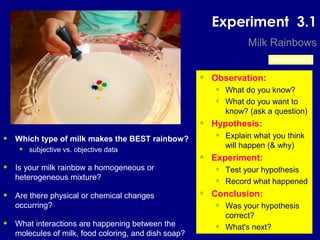
Experiment 3.1
Milk Rainbows
• Which type of milk makes the BEST rainbow?
• subjective vs. objective data
• Is your milk rainbow a homogeneous or
heterogeneous mixture?
• Are there physical or chemical changes
occurring?
• What interactions are happening between the
molecules of milk, food coloring, and dish soap?
• Observation:
• What do you know?
• What do you want to
know? (ask a question)
• Hypothesis:
• Explain what you think
will happen (& why)
• Experiment:
• Test your hypothesis
• Record what happened
• Conclusion:
• Was your hypothesis
correct?
• What's next?
Milk Chemistry
Hydrogen Bonds
- WEAK attractions
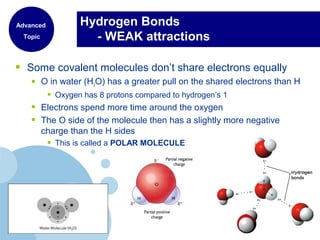
• Some covalent molecules don’t share electrons equally
• O in water (H2O) has a greater pull on the shared electrons than H
• Oxygen has 8 protons compared to hydrogen’s 1
• Electrons spend more time around the oxygen
• The O side of the molecule then has a slightly more negative
charge than the H sides
• This is called a POLAR MOLECULE
Advanced
Topic
Molecular Polarity
• Molecules that share electrons equally have no polarity (equal charge all over)
• Nonpolar molecules like each other
• They are all balanced
• Nonpolar molecules do NOT like polar molecules (such as water)
• Balanced molecules repel (push away) any slightly + or – charge
• Oil (nonpolar) & water (polar) don’t mix
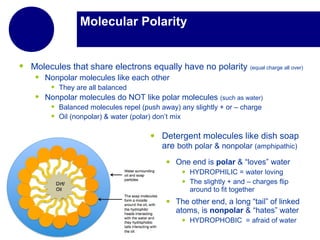
• Detergent molecules like dish soap
are both polar & nonpolar (amphipathic)
• One end is polar & “loves” water
• HYDROPHILIC = water loving
• The slightly + and – charges flip
around to fit together
• The other end, a long “tail” of linked
atoms, is nonpolar & “hates” water
• HYDROPHOBIC = afraid of water
Metallic Bonds
- Electron Soup
• How many valence electrons do most metals have?
• 1, 2, or 3
• These electrons are not held tightly, so they often escape
• Resulting atoms are positive ions (+1, +2 or +3 charge)
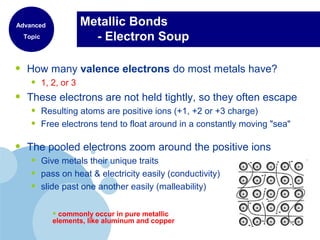
• Free electrons tend to float around in a constantly moving "sea"
• The pooled electrons zoom around the positive ions
• Give metals their unique traits
• pass on heat & electricity easily (conductivity)
• slide past one another easily (malleability)
• commonly occur in pure metallic
elements, like aluminum and copper
Advanced
Topic