Hydrosphere Review
Water's Special Properties & The Water Cycle
 
In your lab notebook, please answer as best you can:
1. Where do glaciers form? 
• High elevations & latitudes (polar regions) where more snow falls than 
melts each year.
1. Where do icebergs come from? 
• Glaciers (chunks of ice break off into the sea from tidewater glaciers)
3.  True or False: glacial ice moves out in all directions from the center of 
greatest accumulation of a confined glacier.
• False– confined glaciers move downhill in one direction 
4. Chunks of ice breaking off into the sea from tidewater glaciers is called:
• Calving
4. What does “permeable” mean? 
• Contains pores (tiny pockets or spaces) that water can run through.
Bonus Question: How is sea ice different than icebergs?
-Sea ice = thin sheets from frozen ocean water
-Icebergs = big chunks of glacier ice
Week 15
Review Quiz 
The Wat er Cycl e & Gl aci ers
1. The amount of Earth’s FRESH water which can be found flowing in lakes,
streams, rivers, and wetlands. 0.3%
2. Percentage of Earth’s FRESH water stored underground in aquifers and in
the soil? 30.1%
3. Earth’s fresh water trapped in glaciers & sea ice? 68.7%
4. A region surrounded by higher ground from which precipitation drains into
a river system: watershed
5. An aquifer is an underground layer of permeable rock, sediment, or soil
that contains water.
6. The top of the saturated zone of underground water levels in an area is
referred to as the water table
7. What happens when soil becomes fully saturated with precipitation?
Puddles, ponding, and flooding can occur
Wat er Cycl e & Gl aci ers worksheet
8. What affect do homes and farms using well water (pumped from aquifers)
have on the water table if they pull water out faster than precipitation can fill
it back up?
The water table is lowered in that area.
9. WHY will precipitation percolate down into an aquifer more quickly if the
surface layer is rocky rather than composed of fine clay particles?
Larger rock and soil particles have more spaces between them for water to
fill and flow through.
10. Describe how a snowflake becomes part of a glacier.
After about a year, a snowflake that gets buried and pressed down below
layers of snow above becomes firn (rounded ice globs). With more
pressure, all the air is pushed out an solid glacier ice is formed.
Wat er Cycl e & Gl aci ers worksheet
11. Explain the difference between these types of glaciers:
Confined: form at high elevations on the sides of mountains and flow
downhill
Unconfined: form in polar regions, cover entire mountain ranges, islands, or
continents, & flow out from the center
12. Alpine glaciers move in part due to basal sliding as the heavy ice is pulled
by gravity downhill.
13. Three factors affect the speed of glacial movement:
Thickness of the ice
Temperature of the ice.
Steepness of the glacial slope
14. What direction does the ice flow in polar ice caps and ice sheets?
- ice flows out in all directions from the point of greatest accumulation
(snowfall)
15. Give a short definition for each of the following:
Piedmont glacier: spreads out at the bottom of a valley
Tidewater glacier: a glacier that runs down into the ocean
Wat er Cycl e & Gl aci ers worksheet
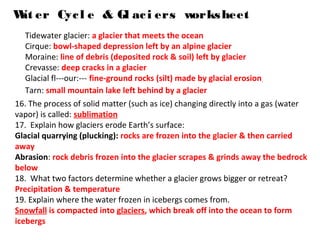
Tidewater glacier: a glacier that meets the ocean
Cirque: bowl-shaped depression left by an alpine glacier
Moraine: line of debris (deposited rock & soil) left by glacier
Crevasse: deep cracks in a glacier
Glacial fl­­­our:­­­ fine-ground rocks (silt) made by glacial erosion-
Tarn: small mountain lake left behind by a glacier
16. The process of solid matter (such as ice) changing directly into a gas (water
vapor) is called: sublimation
17. Explain how glaciers erode Earth’s surface:
Glacial quarrying (plucking): rocks are frozen into the glacier & then carried
away
Abrasion: rock debris frozen into the glacier scrapes & grinds away the bedrock
below
18. What two factors determine whether a glacier grows bigger or retreat?
Precipitation & temperature
19. Explain where the water frozen in icebergs comes from.
Snowfall is compacted into glaciers, which break off into the ocean to form
icebergs
Wat er Cycl e & Gl aci ers worksheet
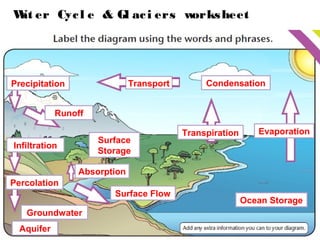
Precipitation Transport Condensation
Evaporation
Ocean Storage
Transpiration
Infiltration
Runoff
Aquifer
Groundwater
Surface
Storage
Absorption
Surface Flow
Percolation
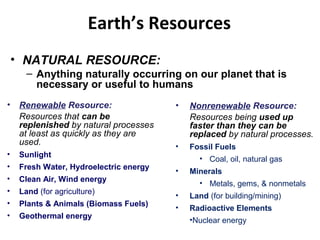
• NATURAL RESOURCE:
– Anything naturally occurring on our planet that is
necessary or useful to humans
Earth’s Resources
• Renewable Resource:
Resources that can be
replenished by natural processes
at least as quickly as they are
used.
• Sunlight
• Fresh Water, Hydroelectric energy
• Clean Air, Wind energy
• Land (for agriculture)
• Plants & Animals (Biomass Fuels)
• Geothermal energy
• Nonrenewable Resource:
Resources being used up
faster than they can be
replaced by natural processes.
• Fossil Fuels
• Coal, oil, natural gas
• Minerals
• Metals, gems, & nonmetals
• Land (for building/mining)
• Radioactive Elements 
•Nuclear energy
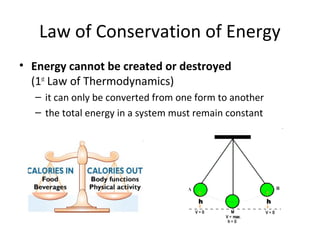
Law of Conservation of Energy
• Energy cannot be created or destroyed
(1st
Law of Thermodynamics)
– it can only be converted from one form to another
– the total energy in a system must remain constant
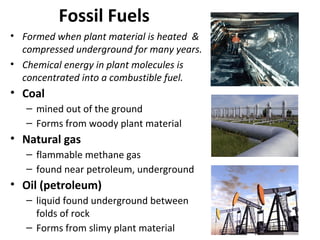
Fossil Fuels
• Formed when plant material is heated &
compressed underground for many years.
• Chemical energy in plant molecules is
concentrated into a combustible fuel.
• Coal
– mined out of the ground
– Forms from woody plant material
• Natural gas
– flammable methane gas
– found near petroleum, underground
• Oil (petroleum)
– liquid found underground between
folds of rock
– Forms from slimy plant material
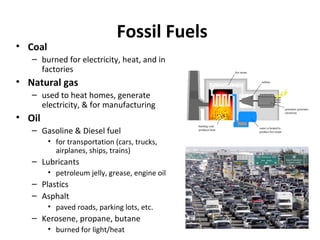
Fossil Fuels
• Coal
– burned for electricity, heat, and in
factories
• Natural gas
– used to heat homes, generate
electricity, & for manufacturing
• Oil
– Gasoline & Diesel fuel
• for transportation (cars, trucks,
airplanes, ships, trains)
– Lubricants
• petroleum jelly, grease, engine oil
– Plastics
– Asphalt
• paved roads, parking lots, etc.
– Kerosene, propane, butane
• burned for light/heat
Matter
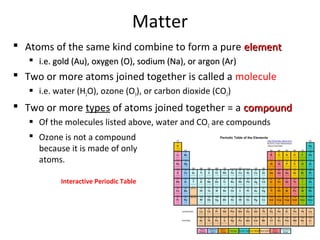
 Atoms of the same kind combine to form a pure elementelement
 i.e. gold (Au), oxygen (O), sodium (Na), or argon (Ar)i.e. gold (Au), oxygen (O), sodium (Na), or argon (Ar)
 Two or more atoms joined together is called a molecule
 i.e. water (H2O), ozone (O3), or carbon dioxide (CO2)
 Two or more types of atoms joined together = a compoundcompound
 Of the molecules listed above, water and CO2 are compounds
 Ozone is not a compound
because it is made of only oxygen
atoms.
Interactive Periodic Table
Atoms
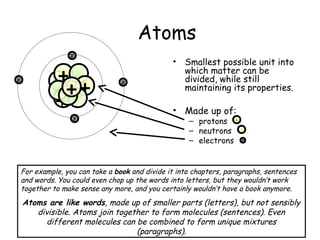
• Smallest possible unit into
which matter can be
divided, while still
maintaining its properties.
• Made up of:
– protons
– neutrons
– electrons
For example, you can take a book and divide it into chapters, paragraphs, sentences
and words. You could even chop up the words into letters, but they wouldn’t work
together to make sense any more, and you certainly wouldn’t have a book anymore.
Atoms are like words, made up of smaller parts (letters), but not sensibly
divisible. Atoms join together to form molecules (sentences). Even
different molecules can be combined to form unique mixtures
(paragraphs).
+
-
+
+
+
-
-
- -
+
Changes of State
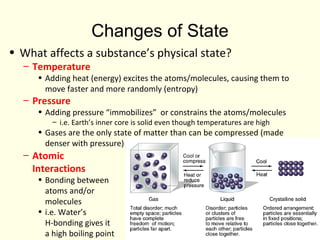
• What affects a substance’s physical state?
– Temperature
• Adding heat (energy) excites the atoms/molecules, causing them to
move faster and more randomly (entropy)
– Pressure
• Adding pressure “immobilizes” or constrains the atoms/molecules
– i.e. Earth’s inner core is solid even though temperatures are high
• Gases are the only state of matter than can be compressed (made
denser with pressure)
– Atomic
Interactions
• Bonding between
atoms and/or
molecules
• i.e. Water’s
H-bonding gives it
a high boiling point
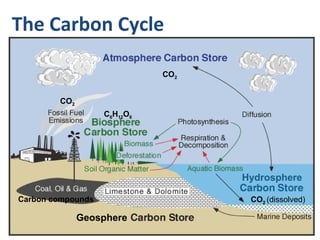
The Carbon Cycle
C6H12O6
CO2 (dissolved)
CO2
CO2
Carbon compounds
Geosphere
Hydrosphere
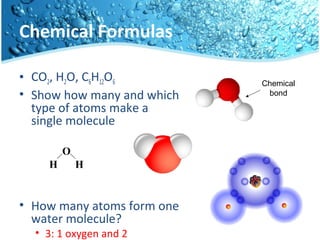
Chemical Formulas
• CO2, H2O, C6H12O6
• Show how many and which
type of atoms make a
single molecule
• How many atoms form one
water molecule?
• 3: 1 oxygen and 2
O
H H
Chemical
bond
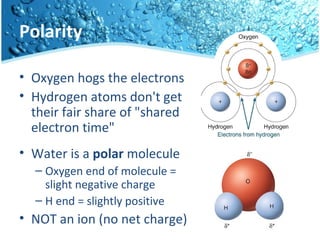
Polarity
• Oxygen hogs the electrons
• Hydrogen atoms don't get
their fair share of "shared
electron time"
• Water is a polar molecule
– Oxygen end of molecule =
slight negative charge
– H end = slightly positive
• NOT an ion (no net charge)
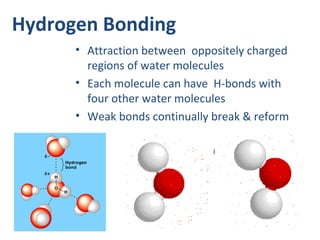
Hydrogen Bonding
• Attraction between oppositely charged
regions of water molecules
• Each molecule can have H-bonds with
four other water molecules
• Weak bonds continually break & reform
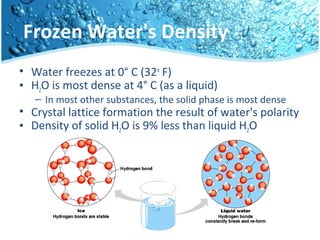
Frozen Water's Density
• Water freezes at 0° C (32o
F)
• H2O is most dense at 4° C (as a liquid)
– In most other substances, the solid phase is most dense
• Crystal lattice formation the result of water's polarity
• Density of solid H2O is 9% less than liquid H2O
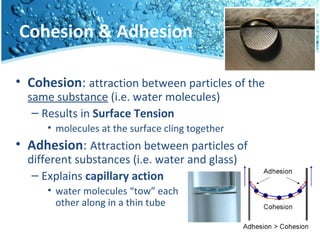
Cohesion & Adhesion
• Cohesion: attraction between particles of the
same substance (i.e. water molecules)
– Results in Surface Tension
• molecules at the surface cling together
• Adhesion: Attraction between particles of
different substances (i.e. water and glass)
– Explains capillary action
• water molecules “tow” each
other along in a thin tube
Water Resists Temperature Changes
• Heat = how fast molecules are moving
• Water's polarity makes the molecules both "sticky" and
"slippery" (like magnets that attract & repel)
– stickiness: resistant to vaporizing because of cohesion
– slipperiness: resistant to freezing because they keep sliding around
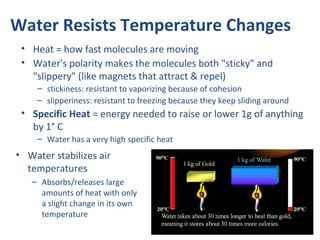
• Specific Heat = energy needed to raise or lower 1g of anything
by 1° C
– Water has a very high specific heat
• Water stabilizes air
temperatures
– Absorbs/releases large
amounts of heat with only
a slight change in its own
temperature
Water Vapor
• Water boils at 100°C (212o
F)
– LOTS of energy to break hydrogen bonds
• Evaporation can occur at much lower temperatures, when
molecules at the surface of a liquid change to their gas state
• Water vapor in atmosphere resists temperature changes
• Evaporation absorbs lots of heat energy
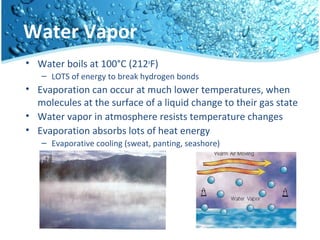
– Evaporative cooling (sweat, panting, seashore)
Groundwater
• Precipitation seeps down through soil & rock
• Layers act as filters that trap contaminants
• Water table: imaginary line between the water-logged
soil and the soil not saturated with water
– varies with seasonal precipitation, pumping, & geography
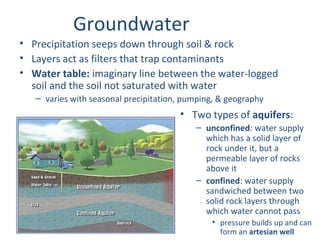
• Two types of aquifers:
– unconfined: water supply
which has a solid layer of
rock under it, but a
permeable layer of rocks
above it
– confined: water supply
sandwiched between two
solid rock layers through
which water cannot pass
• pressure builds up and can
form an artesian well
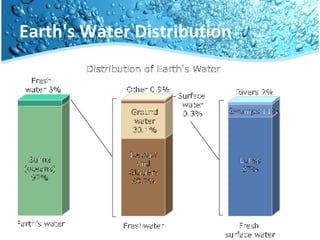
Earth's Water Distribution
• 97% in oceans (salt water)
• 2% trapped in glaciers, icebergs and polar ice caps
• .7% groundwater and soil moisture
• .01 % surface fresh water (lakes, rivers, wetlands)
• .001% atmospheric moisture
(rain, dew, water vapor)
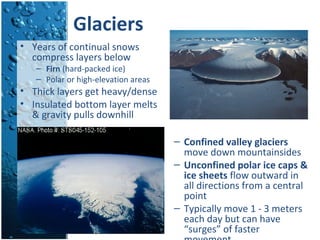
Glaciers
– Confined valley glaciers
move down mountainsides
– Unconfined polar ice caps &
ice sheets flow outward in
all directions from a central
point
– Typically move 1 - 3 meters
each day but can have
“surges” of faster
• Years of continual snows
compress layers below
– Firn (hard-packed ice)
– Polar or high-elevation areas
• Thick layers get heavy/dense
• Insulated bottom layer melts
& gravity pulls downhill
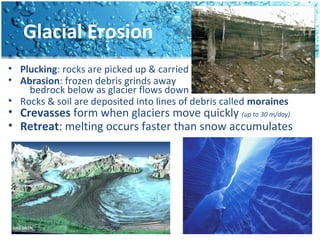
Glacial Erosion
• Plucking: rocks are picked up & carried
• Abrasion: frozen debris grinds away
bedrock below as glacier flows down
• Rocks & soil are deposited into lines of debris called moraines
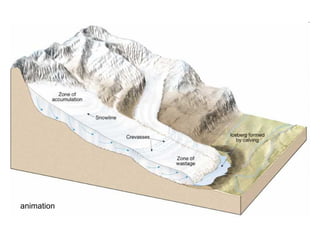
• Crevasses form when glaciers move quickly (up to 30 m/day)
• Retreat: melting occurs faster than snow accumulates
animation
Icebergs
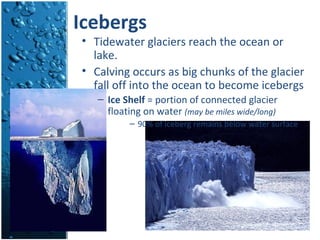
• Tidewater glaciers reach the ocean or
lake.
• Calving occurs as big chunks of the glacier
fall off into the ocean to become icebergs
– Ice Shelf = portion of connected glacier
floating on water (may be miles wide/long)
– 90% of iceberg remains below water surface
Humidity
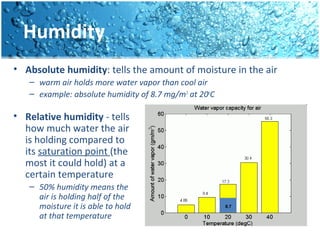
• Absolute humidity: tells the amount of moisture in the air
– warm air holds more water vapor than cool air
– example: absolute humidity of 8.7 mg/m3
at 20o
C
• Relative humidity - tells
how much water the air
is holding compared to
its saturation point (the
most it could hold) at a
certain temperature
– 50% humidity means the
air is holding half of the
moisture it is able to hold
at that temperature
8.7
Dew
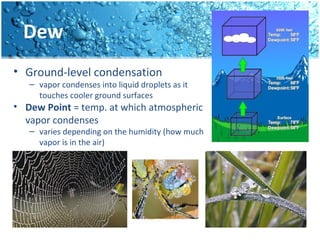
• Ground-level condensation
– vapor condenses into liquid droplets as it
touches cooler ground surfaces
• Dew Point = temp. at which atmospheric
vapor condenses
– varies depending on the humidity (how much
vapor is in the air)
Frost
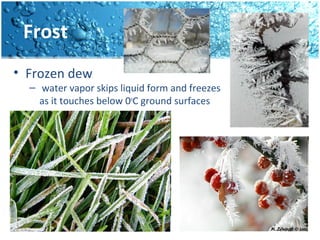
• Frozen dew
– water vapor skips liquid form and freezes
as it touches below 0o
C ground surfaces