Electrical Energy  What is it? How does it work?   Where does it come from?
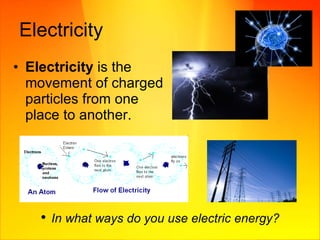
Electricity Electricity  is the movement of charged particles from one place to another. In what ways do you use electric energy?
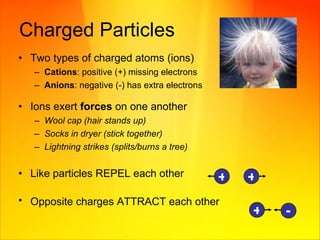
Charged Particles Two types of charged atoms (ions) Cations : positive (+) missing electrons Anions : negative (-) has extra electrons Ions exert  forces  on one another Wool cap (hair stands up) Socks in dryer (stick together) Lightning strikes (splits/burns a tree) Like particles REPEL each other  Opposite charges ATTRACT each other   + + - +
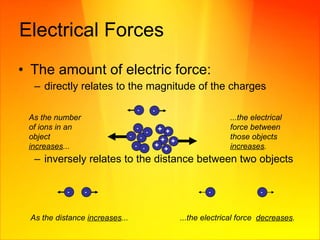
Electrical Forces The amount of electric force:  directly relates to the magnitude of the charges  inversely relates to the distance between two objects As the number of ions in an object  increases ... ...the electrical force between those objects  increases . As the distance  increases ... ...the electrical force  decreases . + + + + + + + + + + + + + + + + + +
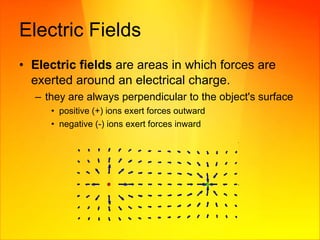
Electric Fields Electric fields  are areas in which forces are exerted around an electrical charge. they are always perpendicular to the object's surface positive (+) ions exert forces outward negative (-) ions exert forces inward
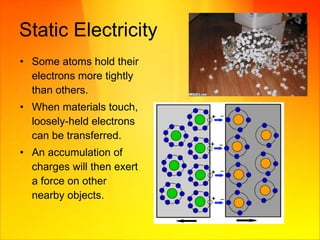
Static Electricity Some atoms hold their electrons more tightly than others. When materials touch, loosely-held electrons can be transferred. An accumulation of charges will then exert a force on other nearby objects.
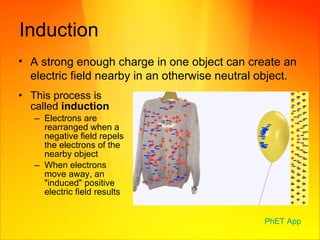
Induction This process is called  induction Electrons are rearranged when a negative field repels the electrons of the nearby object When electrons move away, an "induced" positive electric field results  A strong enough charge in one object can create an electric field nearby in an otherwise neutral object. PhET  App
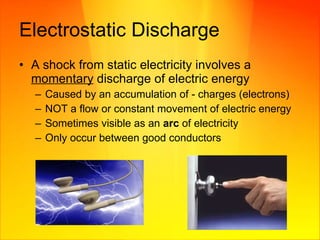
Electrostatic Discharge A shock from static electricity involves a  momentary  discharge of electric energy  Caused by an accumulation of - charges (electrons) NOT a flow or constant movement of electric energy Sometimes visible as an  arc  of electricity Only occur between good conductors
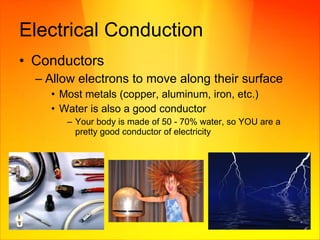
Electrical Conduction Conductors Allow electrons to move along their surface Most metals (copper, aluminum, iron, etc.) Water is also a good conductor Your body is made of 50 - 70% water, so YOU are a pretty good conductor of electricity
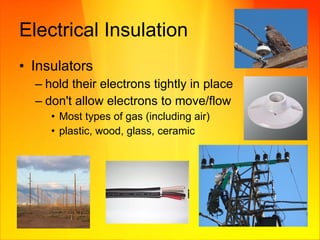
Electrical Insulation Insulators hold their electrons tightly in place don't allow electrons to move/flow Most types of gas (including air) plastic, wood, glass, ceramic
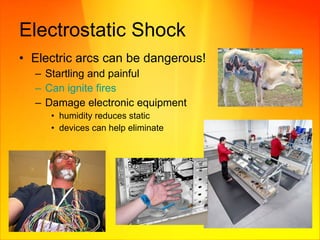
Electrostatic Shock Electric arcs can be dangerous! Startling and painful Can ignite fires Damage electronic equipment humidity reduces static devices can help eliminate

Electric Energy

  • 1.
    Electrical Energy What is it? How does it work? Where does it come from?
  • 2.
    Electricity Electricity is the movement of charged particles from one place to another. In what ways do you use electric energy?
  • 3.
    Charged Particles Twotypes of charged atoms (ions) Cations : positive (+) missing electrons Anions : negative (-) has extra electrons Ions exert forces on one another Wool cap (hair stands up) Socks in dryer (stick together) Lightning strikes (splits/burns a tree) Like particles REPEL each other Opposite charges ATTRACT each other + + - +
  • 4.
    Electrical Forces Theamount of electric force: directly relates to the magnitude of the charges inversely relates to the distance between two objects As the number of ions in an object increases ... ...the electrical force between those objects increases . As the distance increases ... ...the electrical force decreases . + + + + + + + + + + + + + + + + + +
  • 5.
    Electric Fields Electricfields are areas in which forces are exerted around an electrical charge. they are always perpendicular to the object's surface positive (+) ions exert forces outward negative (-) ions exert forces inward
  • 6.
    Static Electricity Someatoms hold their electrons more tightly than others. When materials touch, loosely-held electrons can be transferred. An accumulation of charges will then exert a force on other nearby objects.
  • 7.
    Induction This processis called induction Electrons are rearranged when a negative field repels the electrons of the nearby object When electrons move away, an "induced" positive electric field results A strong enough charge in one object can create an electric field nearby in an otherwise neutral object. PhET App
  • 8.
    Electrostatic Discharge Ashock from static electricity involves a momentary discharge of electric energy Caused by an accumulation of - charges (electrons) NOT a flow or constant movement of electric energy Sometimes visible as an arc of electricity Only occur between good conductors
  • 9.
    Electrical Conduction ConductorsAllow electrons to move along their surface Most metals (copper, aluminum, iron, etc.) Water is also a good conductor Your body is made of 50 - 70% water, so YOU are a pretty good conductor of electricity
  • 10.
    Electrical Insulation Insulatorshold their electrons tightly in place don't allow electrons to move/flow Most types of gas (including air) plastic, wood, glass, ceramic
  • 11.
    Electrostatic Shock Electricarcs can be dangerous! Startling and painful Can ignite fires Damage electronic equipment humidity reduces static devices can help eliminate

Editor's Notes

  • #6 *little blue arrows illustrate FORCE
  • #7 Which elements would NOT hold their electrons tightly? (those with unpaired electrons or unfilled energy shells)
  • #9 *NOT flow or constant movement of electrical energy GOOD CONDUCTORS = metals, water
  • #12 Antistatic mats and wrist strap Electricity always "flows downhill" - it looks for a "ground" or neutral - The planet is a good conductor, and it's huge, so it makes a handy return path for electrons. "Ground" in the power-distribution grid is literally the ground that's all around you when you are walking outside. It is the dirt, rocks, groundwater and so on.