Life Science
Human Body Systems
Nutrition
1. Name the organs of the alimentary canal (digestive tract), in the order which
food travels through them.
• Mouth, pharynx, esophagus, stomach, small intestine, large intestine
1. What organ in the body produces bile?
• Liver
1. True or False? The churning movement in the stomach called peristalsis is an
example of chemical digestion.
• False (peristalsis is a physical/mechanical form of digestion)
1. What does bile do?
• Helps break down fat molecules
1. Where do most of the nutrients in your food get absorbed into the
bloodstream?
• Small Intestine
In your lab notebook, please answer as best you can:
Bonus: If a person has their colon (large intestine) surgically
removed, what part of the digestive process will be lost?
- Resorption of water and vitamin K production
Week 20
Review Quiz
Digestive System Review
• Organs
– mouth
– esophagus
– stomach
– gall bladder & liver
– pancreas
– small intestine
– large intestine
• Role
– to extract nutrients and water from
ingested food and beverages
– to conveniently store and eliminate all
leftover waste products
Your Are What You Eat
By mass, your body is made of
•Mostly water, then protein & lipids
– Less than 5% is made up of carbohydrates and minerals
Food Basics
• Non-food additives in
processed foods:
– artificial colors & sweeteners
(dyes, aspartame, HFCS)
– chemical preservatives (nitrates,
BHT/BHA)
– flavor enhancers (MSG)
Organic
molecules
 Basic components of food:
 Carbohydrates (simple & complex)
 Proteins
 Fats
 Vitamins
 Minerals
 Fiber
 Water
Nutrients
• 3 Types of Nutrients
– Carbohydrates – fuel for all
cell functions
• 60% of calories
– Lipids (fats) – stored
energy, insulation &
membrane structure
• 30% of calories
– Proteins – many cell
functions
• 10% of calories
What Are Calories?
• Calories measure the thermal energy required to heat water
– 1 Calorie (capital) = 1,000 calories = 1 kcal
– 1 gram of water = 1 cubic centimeter (cc)
– 1 kg water = 1,000 cc = a 10x10x10 cm cube of water
 Calories are a unit of
thermal energy (heat)
 Food Calories measure
the amount of energy
food gives your body
The average adult needs ~
2,000 Cal
per day.
Calories (kcal)
110
150
160
13
280
210
210
70
105
220
35
150
Understanding Nutrition Labels
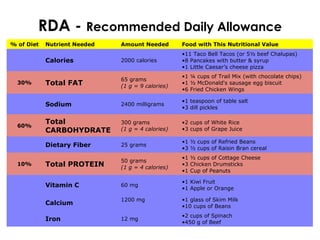
RDA - Recommended Daily Allowance
% of Diet Nutrient Needed Amount Needed Food with This Nutritional Value
Calories 2000 calories
•11 Taco Bell Tacos (or 5½ beef Chalupas)
•8 Pancakes with butter & syrup
•1 Little Caesar’s cheese pizza
30% Total FAT
65 grams
(1 g = 9 calories)
•1 ¼ cups of Trail Mix (with chocolate chips)
•1 ½ McDonald's sausage egg biscuit
•6 Fried Chicken Wings
Sodium 2400 milligrams
•1 teaspoon of table salt
•3 dill pickles
60%
Total
CARBOHYDRATE
300 grams
(1 g = 4 calories)
•2 cups of White Rice
•3 cups of Grape Juice
Dietary Fiber 25 grams
•1 ½ cups of Refried Beans
•3 ½ cups of Raisin Bran cereal
10% Total PROTEIN
50 grams
(1 g = 4 calories)
•1 ½ cups of Cottage Cheese
•3 Chicken Drumsticks
•1 Cup of Peanuts
Vitamin C 60 mg
•1 Kiwi Fruit
•1 Apple or Orange
Calcium
1200 mg •1 glass of Skim Milk
•10 cups of Beans
Iron 12 mg
•2 cups of Spinach
•450 g of Beef
Find the Food Game
Which team can find the following values?
1.Any food with less than 50 Total Calories
2.A food with over 70 grams of carbohydrate.
3.A grain with more than 3 grams of fiber.
4.A grain with 5 or more grams of protein.
5.A protein with less than 400 g sodium.
6.A protein with less than 5 grams of fat.
7.A dessert with no total fat.
8.A dessert with more than 25%DV saturated fat.
9.Two foods that together offer 100%DV vitamin C.
10. A food with at least 100 mg of potassium.
Find the Food Game
11. A snack with less than 20 g carbohydrates.
12. A snack with 50% or more of any one vitamin or mineral.
13. A collection of foods that together offer 100%DV of iron.
14. A food rich in vitamin D (more than 20%DV).
15. A food rich in vitamin A (more than 20%DV).
16. A complete breakfast (fruit or veggie/protein/grain) under
550 calories that provides at least 35%DV of calcium.
17. A complete lunch or dinner (veggie/protein/grain) that is
under 650 calories and has 25%DV or less of sodium.
18. Make a sandwich with the highest %DV for fiber, iron, and
calcium, AND the least saturated fat, sodium, and sugars.
**What you make is what you will get to EAT!
A Well-Balanced Diet
Macronutrients
Nutrient Function Food Source Building Block Examples
Carbohydrate
Fast (easy-access)
energy
Fruits,
vegetables,
grains, dairy
& starchy
foods
Saccharides
(sugars)
Glucose,
Dextrose,
Maltose,
Lactose,
Fructose,
Cellulose
Fat Stored energy,
insulation, vitamin
storage, hormone-
building, cell
membranes
Animal fats &
vegetable oils
Fatty Acids Saturated &
Unsaturated
fats
Protein Building cell
structures, oxygen
transport,
immune defenses,
& chemical
reactions
Meat, fish,
poultry, eggs,
nuts, dairy,
legumes
Amino Acids Membrane
receptors,
hemoglobin,
antibodies,
enzymes
Macronutrients
Nutrients your body needs
in large amounts:
•Carbohydrates
– Quick fuel for cell functions
•Lipids
– Stored energy, insulation &
cushioning, vitamin storage,
and cell membrane structure
•Proteins
– many cell functions (reactions
& building cell structures)
Carbohydrates
• Fast fuel for cell functions
• In fruits, vegetables & grains
• Building block = saccharides
(sugars)
• All carbs are
NOT equal!
– some are better
for you than others
C6H12O6
Carbohydrate Digestion, 1g = 4cal
Polysaccharide
Chain
Monosaccharides
1. Saliva begins to break down sugars
– simple sugars break down quickly
– complex carbohydrates take longer to digest
(fiber & starch)
2. In stomach, most carbs have already been
digested into single or double sugars (mono- or
disaccharides)
– some glucose diffuses into bloodstream here
(active transport)
3. Intestines absorb remaining carbohydrates
– most sugars are first sent to the liver for
conversion to into glucose and release into the
bloodstream
– excess glucose is stored in the liver (up to 100g)
or muscles (up to 500g) as glycogen
– with the help of insulin, blood glucose is
transported into cells for ATP production
4. Carbs that cannot be used by cells or stored as
glycogen are converted into fat
Disaccharide
s
i.e. galactose,
fructose
glucose  ATP
Lipids (Fats)
• Slow/stored fuel for cell functions
– also for insulation, cell structure,
hormone production & vitamin storage
• In animal fats (butter/lard) &
vegetable oils (olive/canola/corn)
• Building block = fatty acids
• NOT all fats are equal!
– some are better for you than others
– our bodies can make some kinds of fats
– others, we can only get through food
C12H25COOH
Fat Digestion, 1g = 9cal
Fatty
Acids
 mechanical digestion & bile salts chop up
big molecules in intestines
 emulsifiers & smooth muscle peristalsis
break down big lipids into smaller droplets
 pancreatic juices then surround fats as
they are further broken up
 monoglycerides and fatty acids diffuse into
microvilli cells
 smooth ER & Golgi process molecules
before sending them into bloodstream
 fat-soluble vitamins (A, D, E, & K) tag along
with fats as they cross membranes
 body uses or stores for energy, to produce
hormones, & to replace cell structures
Monoglycerides
Big Lipid
Molecule
Protein Digestion, 1g = 4cal
Whole Protein
Chain
Amino
Acids
• Stomach acid and enzymes (pepsin) break
long chains into short segments
• Pancreatic juices break bonds further in
the intestine
• Amino acids enter intestinal wall cells via
active transport or endocytosis
– bloodstream carries to cells
– DNA provides instructions to build
antibodies & hemoglobin, muscle fibers,
collagen in skin, & other cell structures
Peptide
Fragments
Good vs. Bad Nutrients
Good Bad
Carbohydrates
Unprocessed, high in fiber,
"whole" natural foods
Refined, processed, artificial
additives - empty calories
examples:
Fruits, vegetables, beans, whole grain
breads/cereals/pastas
candy, baked goods with refined white
flour, white pastas, soda pop, sugary juice
Fats
Mono- and Poly-unsaturated
fats, Omega fatty acids
Saturated and Trans fats
examples:
nuts, seeds, avocado, canola, olive, &
safflower oils, fish, corn, soy (small bits)
meat, dairy, egg yolks, seafood, coconut
& palm kernel oils, packaged & fried foods
Protein Low or good fat, unprocessed High fat, additives, salty
examples:
Nuts, seeds, lean beef/chicken/pork, egg
whites, fish, grain burgers, hummus,
lentils, beans, mozzarella cheese, yogurt
bacon, hot dogs, fried shrimp, chicken
nuggets, beef jerky, sausage, whole milk,
cheddar cheese
 Virtually all foods contain some of each type of nutrient
 1 cup cooked rice has 5g protein & spaghetti has about 7g protein
 1 cup cooked pinto beans has almost 16 g protein AND 45 g carbohydrate
 2 tablespoons of peanut butter has 8 g protein, 7 g carbohydrate and 16 g fat
Human Nutrition