6th GRADE
SCIENCE
COMPOSITION OF
MATTER
 Matter is everything around you.
 MATTER IS ANYTHING THAT HAS MASS AND TAKES UP
SPACE.
 Matter is made up of one or more substances which consist of tiny
particles, called atoms.
All things are made of matter: our bodies, a notebook, a
pen, a flower, the air, the water, etc.
SOLID
SOLIDS HAVE WEIGHT AND TAKE UP SPACE.
LIQUID
LIQUIDS HAVE WEIGHT AND TAKE UP SPACE.
GAS
 GASES HAVE WEIGHT AND TAKE UP SPACE.
TYPES OF MATTER
There are two types of matter:
PURE SUBSTANCES. They contain only one type of
component. They cannot be separated into other substances.
TYPES OF MATTER
MIXTURES. The mix of two or more pure substances.
TYPES OF MIXTURES
 HETEROGENEOUS MIXTURES. The different components can be
distinguished.
 HOMOGENEOUS MIXTURES. The different components cannot be
distinguished.
SEPARATION OF MIXTURES
 Depending on the type of mixture, different methods of separation can be used.
 FILTRATION
 EVAPORATION
 DISTILLATION
 DECANTATION
This is a more common method of separating an insoluble solid
from a liquid in a heterogeneous mixtures. Or solids with different
sizes.
https://www.youtube.com/watch?v=tUabxsvfuPk
Evaporation is used to separate solids from liquids in homogeneous
mixtures.
 Distillation uses boiling to separate liquid solutions in homogeneous mixtures.
Decantation is used to separate substances of different density in
heterogeneous mixtures.
 https://www.youtube.com/watch?v=tuE1LePDZ4Y
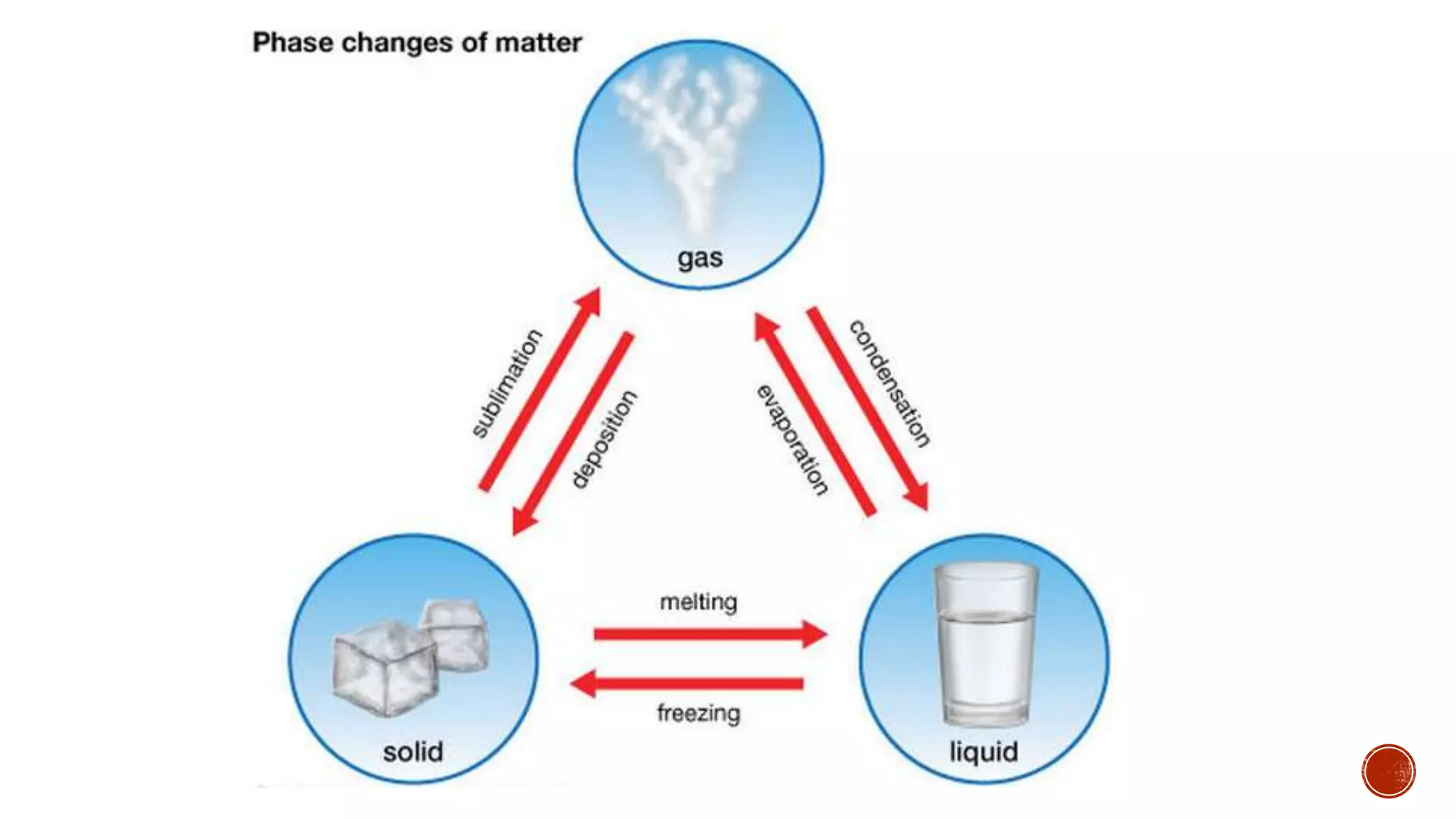
 Matter exists in three different states: solid, liquid and gaseous.
 HEATING or COOLING can cause changes of state.
SOLIDIFICATIO
N
REVERSE SUBLIMATION
VAPORIZATION
HEATIN
G
COOLING
HEATING MATTER
MELTING: when a solid substance turns into a liquid.
VAPORIZATION: when a liquid substance turns into a gas.
 EVAPORATION: liquid does not boil.
 BOILING: liquid reaches a certain temperature.
SUBLIMATION: when a solid substance turns into a gas.
COOLING MATTER
 CONDENSATION: when a gas turns into a liquid.
 SOLIDIFICATION: when a liquid turns into a solid.
 REVERSE SUBLIMATION : when a gas turns into a solid.
MELTING BOILING
MELTING BOILING
 MELTING POINT is the temperature at which something becomes a liquid.
 BOILING POINT is the temperature at which something becomes a gas.
Water has a melting point of 0ºC.
This means that at 0ºC, water
changes from a solid to a liquid.
Water has a boiling point of
100ºC.
This means that at 100ºC, water
changes from a liquid to a gas.
 Chemical changes happen when the original matter transforms into
other new substances.
TYPES OF CHEMICAL REACTIONS
 OXIDATION
 COMBUSTION
 FERMENTATION
• OXIDATION: when a metal substance combine with water and oxygen.
• COMBUSTION: when a substance is burned. This reaction needs
oxygen. They produce carbon dioxide, light and heat.
• FERMENTATION: this reaction happens in some living things.
Fermentation occurs when yeast and bacteria inside the dough
convert carbohydrates to carbon dioxide causing gas bubbles.
It is the ability to work or cause change.
Energy is everything that produces changes in things.
It is invisible.
It does not have a volume or a mass, so energy is NOT
MATTER.
Energy only TRANSFORMS.
 MECHANICAL ENERGY
 CHEMICAL ENERGY
 ELECTRICAL ENERGY
 LIGHT ENERGY
 NUCLEAR ENERGY
 THERMAL ENERGY
Energy in MOTION.
 POTENTIAL ENERGY
 It is when the energy is stored up in the object.
 This energy is ready to use.
 The object does not move
 KINETIC ENERGY
 It is when an object moves.
 Every moving object has Kinetic energy.
POTENTIAL
ENERGY KINETIC
ENERGY
POTENTIAL ENERGY
KINETIC
ENERGY
 Chemical Energy is energy caused by chemical reactions. /STORED
ENERGY.
 FOOD Mechanical and Thermal energy
 FUEL Mechanical energy or Electrical energy
 BATTERY Electrical energy
 Electrical Energy comes from tiny charged particles called
electrons.
 Electrical energy is when electricity creates motion, light or heat.
 Light energy COMES from light sources, such as the Sun or light
bulbs.
 Nuclear energy is stored in some substances, NUCLEAR FUELS,
such as uranium and plutonium.
 Thermal energy is the energy in an object related to its
temperature.
 The higher the temperature of an object, the greater its thermal
energy.
TEACHER LETICIA

Science Matter and energy

  • 1.
  • 2.
    COMPOSITION OF MATTER  Matteris everything around you.  MATTER IS ANYTHING THAT HAS MASS AND TAKES UP SPACE.  Matter is made up of one or more substances which consist of tiny particles, called atoms.
  • 3.
    All things aremade of matter: our bodies, a notebook, a pen, a flower, the air, the water, etc.
  • 4.
    SOLID SOLIDS HAVE WEIGHTAND TAKE UP SPACE.
  • 5.
    LIQUID LIQUIDS HAVE WEIGHTAND TAKE UP SPACE.
  • 6.
    GAS  GASES HAVEWEIGHT AND TAKE UP SPACE.
  • 7.
    TYPES OF MATTER Thereare two types of matter: PURE SUBSTANCES. They contain only one type of component. They cannot be separated into other substances.
  • 8.
    TYPES OF MATTER MIXTURES.The mix of two or more pure substances.
  • 9.
    TYPES OF MIXTURES HETEROGENEOUS MIXTURES. The different components can be distinguished.  HOMOGENEOUS MIXTURES. The different components cannot be distinguished.
  • 10.
    SEPARATION OF MIXTURES Depending on the type of mixture, different methods of separation can be used.  FILTRATION  EVAPORATION  DISTILLATION  DECANTATION
  • 11.
    This is amore common method of separating an insoluble solid from a liquid in a heterogeneous mixtures. Or solids with different sizes. https://www.youtube.com/watch?v=tUabxsvfuPk
  • 12.
    Evaporation is usedto separate solids from liquids in homogeneous mixtures.
  • 13.
     Distillation usesboiling to separate liquid solutions in homogeneous mixtures.
  • 14.
    Decantation is usedto separate substances of different density in heterogeneous mixtures.
  • 15.
  • 16.
     Matter existsin three different states: solid, liquid and gaseous.  HEATING or COOLING can cause changes of state. SOLIDIFICATIO N REVERSE SUBLIMATION VAPORIZATION HEATIN G COOLING
  • 18.
    HEATING MATTER MELTING: whena solid substance turns into a liquid. VAPORIZATION: when a liquid substance turns into a gas.  EVAPORATION: liquid does not boil.  BOILING: liquid reaches a certain temperature. SUBLIMATION: when a solid substance turns into a gas.
  • 19.
    COOLING MATTER  CONDENSATION:when a gas turns into a liquid.  SOLIDIFICATION: when a liquid turns into a solid.  REVERSE SUBLIMATION : when a gas turns into a solid.
  • 20.
  • 21.
    MELTING BOILING  MELTINGPOINT is the temperature at which something becomes a liquid.  BOILING POINT is the temperature at which something becomes a gas. Water has a melting point of 0ºC. This means that at 0ºC, water changes from a solid to a liquid. Water has a boiling point of 100ºC. This means that at 100ºC, water changes from a liquid to a gas.
  • 22.
     Chemical changeshappen when the original matter transforms into other new substances. TYPES OF CHEMICAL REACTIONS  OXIDATION  COMBUSTION  FERMENTATION
  • 23.
    • OXIDATION: whena metal substance combine with water and oxygen. • COMBUSTION: when a substance is burned. This reaction needs oxygen. They produce carbon dioxide, light and heat.
  • 24.
    • FERMENTATION: thisreaction happens in some living things. Fermentation occurs when yeast and bacteria inside the dough convert carbohydrates to carbon dioxide causing gas bubbles.
  • 25.
    It is theability to work or cause change. Energy is everything that produces changes in things. It is invisible. It does not have a volume or a mass, so energy is NOT MATTER. Energy only TRANSFORMS.
  • 26.
     MECHANICAL ENERGY CHEMICAL ENERGY  ELECTRICAL ENERGY  LIGHT ENERGY  NUCLEAR ENERGY  THERMAL ENERGY
  • 27.
    Energy in MOTION. POTENTIAL ENERGY  It is when the energy is stored up in the object.  This energy is ready to use.  The object does not move  KINETIC ENERGY  It is when an object moves.  Every moving object has Kinetic energy. POTENTIAL ENERGY KINETIC ENERGY POTENTIAL ENERGY KINETIC ENERGY
  • 28.
     Chemical Energyis energy caused by chemical reactions. /STORED ENERGY.  FOOD Mechanical and Thermal energy  FUEL Mechanical energy or Electrical energy  BATTERY Electrical energy
  • 29.
     Electrical Energycomes from tiny charged particles called electrons.  Electrical energy is when electricity creates motion, light or heat.
  • 30.
     Light energyCOMES from light sources, such as the Sun or light bulbs.
  • 31.
     Nuclear energyis stored in some substances, NUCLEAR FUELS, such as uranium and plutonium.
  • 32.
     Thermal energyis the energy in an object related to its temperature.  The higher the temperature of an object, the greater its thermal energy.
  • 33.