Scientific
Method
What?
The scientific method is a
process for experimentation that
is used to explore observations
and answer questions.
In fact, there are probably as many versions of the
scientific method as there are scientists! But even when
modified, the goal remains the same: to discover cause
and effect relationships by asking questions, carefully
gathering and examining the evidence, and seeing if all
the available information can be combined in to a
logical answer.
Whether you are doing a science
fair project, a classroom science
activity, independent research, or
any other hands-on science
inquiry understanding the steps
of the scientific method will help
you focus your scientific question
and work through your
observations and data to answer
the question as well as possible.
Scientific
Method
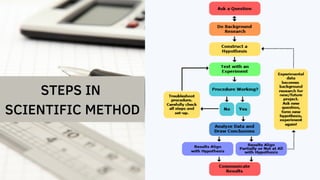
STEPS IN
SCIENTIFIC METHOD
1. Ask a Question
The scientific method starts when you ask a
question about something that you observe:
How, What, When, Who, Which, Why, or
Where?
For a science fair project some teachers
require that the question be something you
can measure, preferably with a number.
2. Research
Background Research Plan
Finding information
Bibliography
Research Paper
Rather than starting from scratch in putting
together a plan for answering your question,
you want to be a savvy scientist using
library and Internet research to help you
find the best way to do things and ensure
that you don't repeat mistakes from the
past.
3. Hypothesis
Propose a hypothesis. This is a sort of
educated guess about what you expect. It is
a statement used to predict the outcome of
an experiment.
It is written in terms of cause and effect.
Alternatively, it may describe the
relationship between two phenomena.
In reality, you probably expect a change but
rejecting a hypothesis may be more useful
than accepting one.
4. Experiment
Design and perform an experiment to test your
hypothesis.
An experiment has an independent and dependent
variable. You change or control the independent
variable and record the effect it has on the
dependent variable.
It's important to change only one variable for an
experiment rather than try to combine the effects
of variables in an experiment.
• Procedure
• Materials List
5. Data/ Analysis
Record observations and analyze the
meaning of the data. Often, you'll prepare a
table or graph of the data.
Don't throw out data points you think are
bad or that don't support your predictions.
Once you have the data, you may need to
perform a mathematical analysis to support
or refute your hypothesis.
6. Results
Communicate your results. The results may be
compiled into a lab report or formally submitted as
a paper. Whether you accept or reject the
hypothesis, you likely learned something about the
subject and may wish to revise the original
hypothesis or form a new one for a future
experiment.
• Final Report
• Abstract
• Display Board
Sources:
https://www.sciencebuddies.org/science-fair-projects/science-fair/steps-of-the-scientific-
method
R
https://www.thoughtco.com/steps-of-the-scientific-method-p2-606045

Scientific Method

  • 1.
  • 2.
    What? The scientific methodis a process for experimentation that is used to explore observations and answer questions.
  • 3.
    In fact, thereare probably as many versions of the scientific method as there are scientists! But even when modified, the goal remains the same: to discover cause and effect relationships by asking questions, carefully gathering and examining the evidence, and seeing if all the available information can be combined in to a logical answer.
  • 4.
    Whether you aredoing a science fair project, a classroom science activity, independent research, or any other hands-on science inquiry understanding the steps of the scientific method will help you focus your scientific question and work through your observations and data to answer the question as well as possible. Scientific Method
  • 5.
  • 6.
    1. Ask aQuestion The scientific method starts when you ask a question about something that you observe: How, What, When, Who, Which, Why, or Where? For a science fair project some teachers require that the question be something you can measure, preferably with a number.
  • 7.
    2. Research Background ResearchPlan Finding information Bibliography Research Paper Rather than starting from scratch in putting together a plan for answering your question, you want to be a savvy scientist using library and Internet research to help you find the best way to do things and ensure that you don't repeat mistakes from the past.
  • 8.
    3. Hypothesis Propose ahypothesis. This is a sort of educated guess about what you expect. It is a statement used to predict the outcome of an experiment. It is written in terms of cause and effect. Alternatively, it may describe the relationship between two phenomena. In reality, you probably expect a change but rejecting a hypothesis may be more useful than accepting one.
  • 9.
    4. Experiment Design andperform an experiment to test your hypothesis. An experiment has an independent and dependent variable. You change or control the independent variable and record the effect it has on the dependent variable. It's important to change only one variable for an experiment rather than try to combine the effects of variables in an experiment. • Procedure • Materials List
  • 10.
    5. Data/ Analysis Recordobservations and analyze the meaning of the data. Often, you'll prepare a table or graph of the data. Don't throw out data points you think are bad or that don't support your predictions. Once you have the data, you may need to perform a mathematical analysis to support or refute your hypothesis.
  • 11.
    6. Results Communicate yourresults. The results may be compiled into a lab report or formally submitted as a paper. Whether you accept or reject the hypothesis, you likely learned something about the subject and may wish to revise the original hypothesis or form a new one for a future experiment. • Final Report • Abstract • Display Board
  • 12.