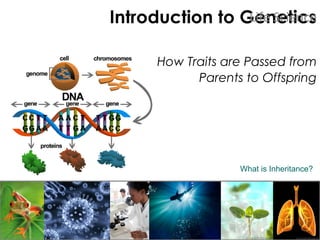
Introduction to Genetics
How Traits are Passed from
Parents to Offspring
Life Science
What is Inheritance?
In your lab notebook, please answer as best you can:
1. What are germ cells?
• Cells which divide by meiosis to become gametes (eggs or sperm).
1. How is metaphase I of meiosis different than metaphase in mitosis?
• Homologous pairs line up in the middle and divided into the new cells.
1. A small segment of DNA that codes for a specific protein which
determines a certain trait in an organism is called a…
• Gene
1. What is the ploidy of a germ cell after it divides by meiosis?
• Haploid (or n)
1. When homologous pairs line up during Metaphase 1 of meiosis, they
often swap sections of DNA. This process increases genetic variation in
the resulting gametes and is called…
• Crossing over
Week 10
Review Quiz
Bonus: How are the daughter cells of mitosis different
than those formed by meiosis?
Mitosis ends with two, identical, diploid daughter cells while
meiosis yields four, unique, haploid daughter cells.
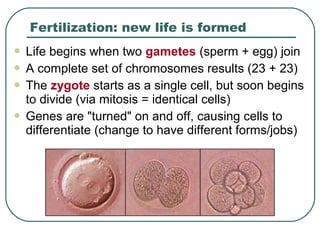
 Life begins when two gametes (sperm + egg) join
 A complete set of chromosomes results (23 + 23)
 The zygote starts as a single cell, but soon begins
to divide (via mitosis = identical cells)
 Genes are "turned" on and off, causing cells to
differentiate (change to have different forms/jobs)
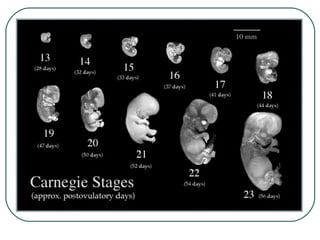
Fertilization: new life is formed
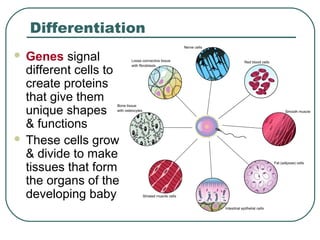
Differentiation
 Genes signal
different cells to
create proteins
that give them
unique shapes
& functions
 These cells grow
& divide to make
tissues that form
the organs of the
developing baby
 The chromosomes from your mom and dad have
given your cells instructions to make YOU!
 Each characteristic you inherited from your
parents is called a trait (eye color, earlobe shape,
height, personality traits, etc.)
 For each trait, you have
a pair of alleles (one
from your mother and
one from your father)
Heredity & Inherited Traits
Alleles: variations of a gene
Gene Alleles
Eye Color Blue, brown, green,
hazel
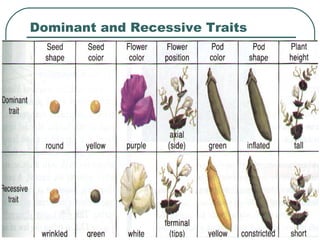
Pea height Tall, short
Pea color Yellow, green
Flower position Axial, terminal
1822-1884
Gregor Mendel
 An Austrian scientist-turned-monk
noticed patterns in the monastery's
garden
 Studied the inherited traits of pea
plants and found predictable,
numerical ratios in the offspring
 Observed some traits were
dominant over others (i.e. yellow
peas overpowered or occurred
more often than green pea seeds)
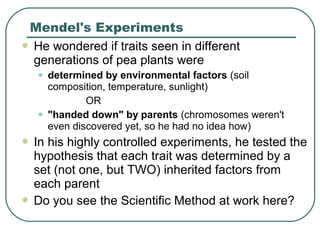
Mendel's Experiments
 He wondered if traits seen in different
generations of pea plants were
• determined by environmental factors (soil
composition, temperature, sunlight)
OR
• "handed down" by parents (chromosomes weren't
even discovered yet, so he had no idea how)
 In his highly controlled experiments, he tested the
hypothesis that each trait was determined by a
set (not one, but TWO) inherited factors from
each parent
 Do you see the Scientific Method at work here?
Dominant and Recessive Traits
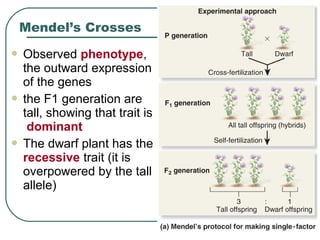
 Observed phenotype,
the outward expression
of the genes
 the F1 generation are
tall, showing that trait is
dominant
 The dwarf plant has the
recessive trait (it is
overpowered by the tall
allele)
Mendel’s Crosses
Genotypes: Genes and Alleles
 The genetic make-
up of an organism
is its genotype
 Every organism is
diploid (has 2 copies
of each chromosome)
 Each trait is
designated by a
different letter
 DOMINANT
ALLELES ARE
CAPITAL
LETTERS
 Recessive alleles
are lowercase
letters
Genotype Genotype Phenotype
Homozygous
dominant
TT Dominant
Homozygous
recessive
tt Recessive
Heterozygous Tt Dominant
 Homozygous means the two alleles are the same
 Heterozygous means the two alleles are different
Genotype determines Phenotype
Punnet Square: Monohybrid Cross
 Used to predict the outcome of a genetic cross
The Law of
Segregation
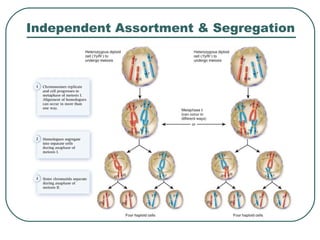
 Diploid chromosomes
of parents undergo
meiosis
 Alleles separate as
they become haploid
egg or sperm
 They are combined
again during
fertilization to
produce a diploid
offspring
Independent Assortment & Segregation
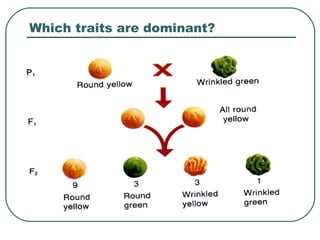
Which traits are dominant?
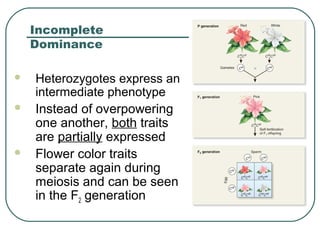
 Heterozygotes express an
intermediate phenotype
 Instead of overpowering
one another, both traits
are partially expressed
 Flower color traits
separate again during
meiosis and can be seen
in the F2 generation
Incomplete
Dominance
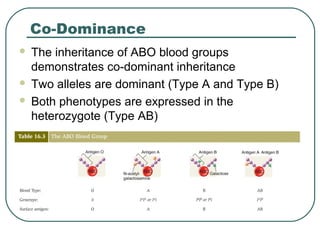
Co-Dominance
 The inheritance of ABO blood groups
demonstrates co-dominant inheritance
 Two alleles are dominant (Type A and Type B)
 Both phenotypes are expressed in the
heterozygote (Type AB)
Polygenic Traits
 The control of a trait by
more than one gene
• Skin color is controlled by at
least 6 alleles or genes
 Each gene product is
additive to others
 The hallmark of a
polygenic trait is
• A bell curve distribution
• A continuous distribution
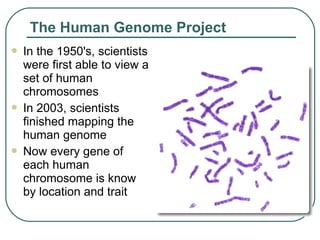
The Human Genome Project
 In the 1950's, scientists
were first able to view a
set of human
chromosomes
 In 2003, scientists
finished mapping the
human genome
 Now every gene of
each human
chromosome is know
by location and trait
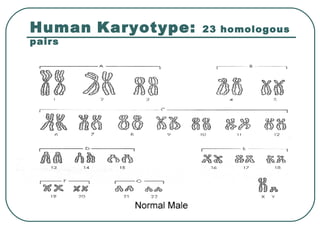
Human Karyotype: 23 homologous
pairs
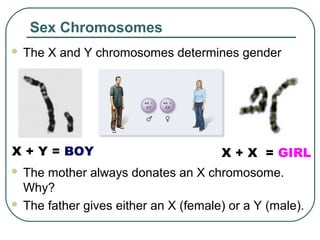
X + X = GIRLX + Y = BOY
 The X and Y chromosomes determines gender
Sex Chromosomes
 The mother always donates an X chromosome.
Why?
 The father gives either an X (female) or a Y (male).