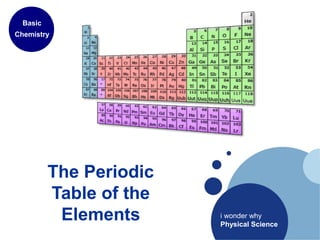
The Periodic
Table of the
Elements
Basic
Chemistry
i wonder why
Physical Science
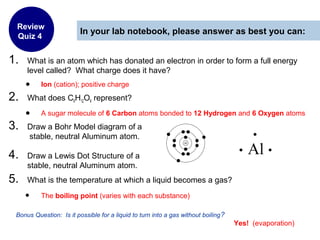
In your lab notebook, please answer as best you can:
1. What is an atom which has donated an electron in order to form a full energy
level called? What charge does it have?
• Ion (cation); positive charge
2. What does C6H12O6 represent?
• A sugar molecule of 6 Carbon atoms bonded to 12 Hydrogen and 6 Oxygen atoms
3. Draw a Bohr Model diagram of a
stable, neutral Aluminum atom.
4. Draw a Lewis Dot Structure of a
stable, neutral Aluminum atom.
5. What is the temperature at which a liquid becomes a gas?
• The boiling point (varies with each substance)
Bonus Question: Is it possible for a liquid to turn into a gas without boiling?
Yes! (evaporation)
Review
Quiz 4
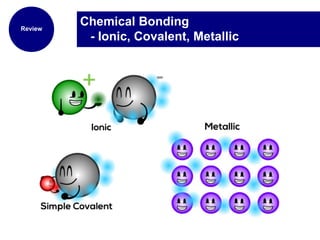
Chemical Bonding
- Ionic, Covalent, Metallic
Review
All matter is made of atoms
Atoms of the same kind are pure elements with distinct properties
What gives each element its unique characteristics?
What makes gold soft and shiny?
What causes salt to form into crystals?
Why is Helium "lighter than air"
MatterMatter
 Interactive Periodic TableInteractive Periodic Table
Review
Answer:
The number and
arrangement of particles in
each atom determines the
properties of the elements.
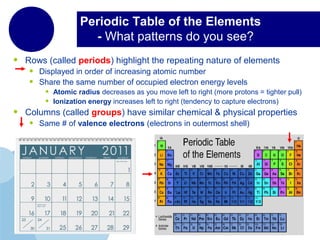
• Rows (called periods) highlight the repeating nature of elements
• Displayed in order of increasing atomic number
• Share the same number of occupied electron energy levels
• Atomic radius decreases as you move left to right (more protons = tighter pull)
• Ionization energy increases left to right (tendency to capture electrons)
• Columns (called groups) have similar chemical & physical properties
• Same # of valence electrons (electrons in outermost shell)
Periodic Table of the Elements
- What patterns do you see?
Periodic Table of Elements
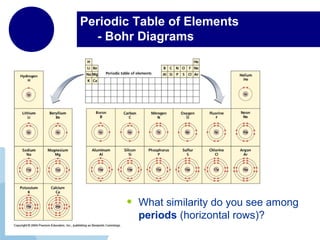
- Bohr Diagrams
• What similarity do you see among
periods (horizontal rows)?
Periodic Table of Elements
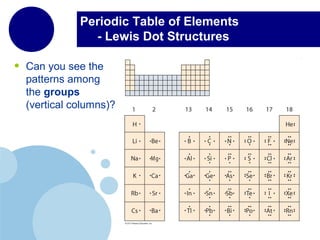
- Lewis Dot Structures
• Can you see the
patterns among
the groups
(vertical columns)?
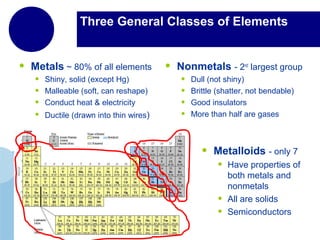
Three General Classes of Elements
• Metals ~ 80% of all elements
• Shiny, solid (except Hg)
• Malleable (soft, can reshape)
• Conduct heat & electricity
• Ductile (drawn into thin wires)
• Metalloids - only 7
• Have properties of
both metals and
nonmetals
• All are solids
• Semiconductors
• Nonmetals - 2nd
largest group
• Dull (not shiny)
• Brittle (shatter, not bendable)
• Good insulators
• More than half are gases
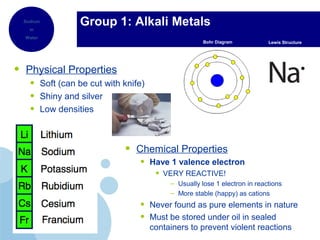
Group 1: Alkali Metals
• Physical Properties
• Soft (can be cut with knife)
• Shiny and silver
• Low densities
Bohr Diagram Lewis Structure
• Chemical Properties
• Have 1 valence electron
• VERY REACTIVE!
– Usually lose 1 electron in reactions
– More stable (happy) as cations
• Never found as pure elements in nature
• Must be stored under oil in sealed
containers to prevent violent reactions
Sodium
in
Water
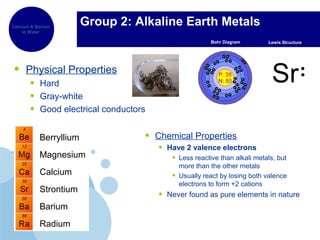
Group 2: Alkaline Earth Metals
• Physical Properties
• Hard
• Gray-white
• Good electrical conductors
Bohr Diagram Lewis Structure
• Chemical Properties
• Have 2 valence electrons
• Less reactive than alkali metals, but
more than the other metals
• Usually react by losing both valence
electrons to form +2 cations
• Never found as pure elements in nature
Berryllium
Magnesium
Calcium
Strontium
Barium
Radium
Sr
Calcium & Barium
in Water
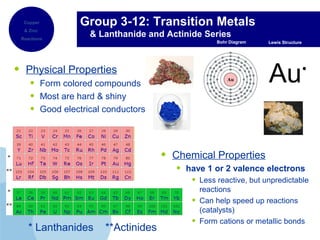
Group 3-12: Transition Metals
& Lanthanide and Actinide Series
• Physical Properties
• Form colored compounds
• Most are hard & shiny
• Good electrical conductors
Bohr Diagram Lewis Structure
• Chemical Properties
• have 1 or 2 valence electrons
• Less reactive, but unpredictable
reactions
• Can help speed up reactions
(catalysts)
• Form cations or metallic bonds
Au
* Lanthanides **Actinides
Copper
& Zinc
Reactions
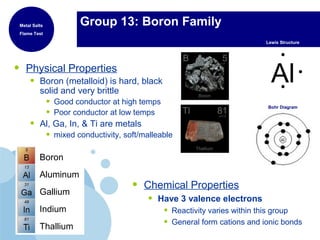
Group 13: Boron Family
• Physical Properties
• Boron (metalloid) is hard, black
solid and very brittle
• Good conductor at high temps
• Poor conductor at low temps
• Al, Ga, In, & Ti are metals
• mixed conductivity, soft/malleable
Bohr Diagram
• Chemical Properties
• Have 3 valence electrons
• Reactivity varies within this group
• General form cations and ionic bonds
Boron
Aluminum
Gallium
Indium
Thallium
Lewis Structure
Al
Metal Salts
Flame Test
• Physical Properties
• Carbon (nonmetal) is found in
nearly every living thing
• Elemental forms in nature:
– Graphite & diamonds
• Si & Ge are metalloids
• Sn & Pb are metals
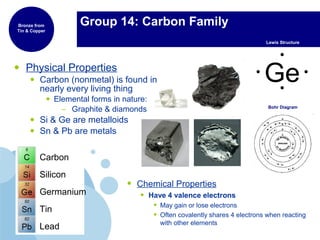
Group 14: Carbon Family
Bohr Diagram
• Chemical Properties
• Have 4 valence electrons
• May gain or lose electrons
• Often covalently shares 4 electrons when reacting
with other elements
Carbon
Silicon
Germanium
Tin
Lead
Lewis Structure
Bronze from
Tin & Copper
Ge
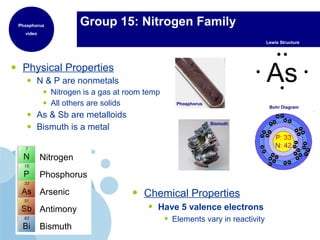
• Physical Properties
• N & P are nonmetals
• Nitrogen is a gas at room temp
• All others are solids
• As & Sb are metalloids
• Bismuth is a metal
Group 15: Nitrogen Family
Bohr Diagram
• Chemical Properties
• Have 5 valence electrons
• Elements vary in reactivity
Nitrogen
Phosphorus
Arsenic
Antimony
Bismuth
Lewis Structure
Phosphorus
video
As
Phosphorus
Bismuth
• Physical Properties
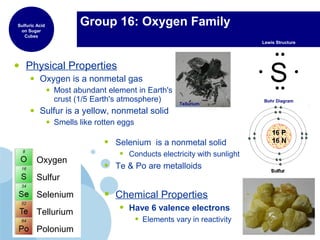
• Oxygen is a nonmetal gas
• Most abundant element in Earth's
crust (1/5 Earth's atmosphere)
• Sulfur is a yellow, nonmetal solid
• Smells like rotten eggs
Group 16: Oxygen Family
Bohr Diagram
• Selenium is a nonmetal solid
• Conducts electricity with sunlight
• Te & Po are metalloids
• Chemical Properties
• Have 6 valence electrons
• Elements vary in reactivity
Oxygen
Sulfur
Selenium
Tellurium
Polonium
Lewis Structure
Sulfuric Acid
on Sugar
Cubes
Tellurium
S
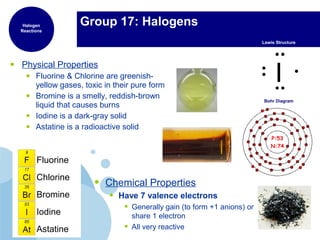
• Physical Properties
• Fluorine & Chlorine are greenish-
yellow gases, toxic in their pure form
• Bromine is a smelly, reddish-brown
liquid that causes burns
• Iodine is a dark-gray solid
• Astatine is a radioactive solid
Group 17: Halogens
P:53
N:74
Bohr Diagram
• Chemical Properties
• Have 7 valence electrons
• Generally gain (to form +1 anions) or
share 1 electron
• All very reactive
Fluorine
Chlorine
Bromine
Iodine
Astatine
Lewis Structure
Halogen
Reactions
I
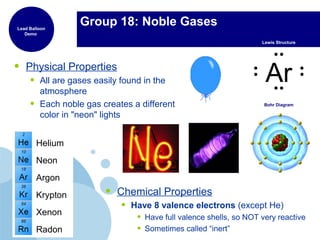
• Physical Properties
• All are gases easily found in the
atmosphere
• Each noble gas creates a different
color in "neon" lights
Group 18: Noble Gases
Bohr Diagram
• Chemical Properties
• Have 8 valence electrons (except He)
• Have full valence shells, so NOT very reactive
• Sometimes called “inert”
Helium
Neon
Argon
Krypton
Xenon
Radon
Lewis Structure
Lead Balloon
Demo
Ar
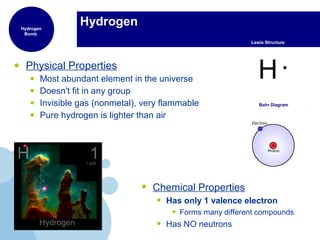
• Physical Properties
• Most abundant element in the universe
• Doesn't fit in any group
• Invisible gas (nonmetal), very flammable
• Pure hydrogen is lighter than air
Hydrogen
Bohr Diagram
• Chemical Properties
• Has only 1 valence electron
• Forms many different compounds
• Has NO neutrons
Lewis Structure
Hydrogen
Bomb
H

The Periodic Table

  • 1.
    The Periodic Table ofthe Elements Basic Chemistry i wonder why Physical Science
  • 2.
    In your labnotebook, please answer as best you can: 1. What is an atom which has donated an electron in order to form a full energy level called? What charge does it have? • Ion (cation); positive charge 2. What does C6H12O6 represent? • A sugar molecule of 6 Carbon atoms bonded to 12 Hydrogen and 6 Oxygen atoms 3. Draw a Bohr Model diagram of a stable, neutral Aluminum atom. 4. Draw a Lewis Dot Structure of a stable, neutral Aluminum atom. 5. What is the temperature at which a liquid becomes a gas? • The boiling point (varies with each substance) Bonus Question: Is it possible for a liquid to turn into a gas without boiling? Yes! (evaporation) Review Quiz 4
  • 3.
    Chemical Bonding - Ionic,Covalent, Metallic Review
  • 4.
    All matter ismade of atoms Atoms of the same kind are pure elements with distinct properties What gives each element its unique characteristics? What makes gold soft and shiny? What causes salt to form into crystals? Why is Helium "lighter than air" MatterMatter  Interactive Periodic TableInteractive Periodic Table Review Answer: The number and arrangement of particles in each atom determines the properties of the elements.
  • 5.
    • Rows (calledperiods) highlight the repeating nature of elements • Displayed in order of increasing atomic number • Share the same number of occupied electron energy levels • Atomic radius decreases as you move left to right (more protons = tighter pull) • Ionization energy increases left to right (tendency to capture electrons) • Columns (called groups) have similar chemical & physical properties • Same # of valence electrons (electrons in outermost shell) Periodic Table of the Elements - What patterns do you see?
  • 6.
    Periodic Table ofElements - Bohr Diagrams • What similarity do you see among periods (horizontal rows)?
  • 7.
    Periodic Table ofElements - Lewis Dot Structures • Can you see the patterns among the groups (vertical columns)?
  • 8.
    Three General Classesof Elements • Metals ~ 80% of all elements • Shiny, solid (except Hg) • Malleable (soft, can reshape) • Conduct heat & electricity • Ductile (drawn into thin wires) • Metalloids - only 7 • Have properties of both metals and nonmetals • All are solids • Semiconductors • Nonmetals - 2nd largest group • Dull (not shiny) • Brittle (shatter, not bendable) • Good insulators • More than half are gases
  • 9.
    Group 1: AlkaliMetals • Physical Properties • Soft (can be cut with knife) • Shiny and silver • Low densities Bohr Diagram Lewis Structure • Chemical Properties • Have 1 valence electron • VERY REACTIVE! – Usually lose 1 electron in reactions – More stable (happy) as cations • Never found as pure elements in nature • Must be stored under oil in sealed containers to prevent violent reactions Sodium in Water
  • 10.
    Group 2: AlkalineEarth Metals • Physical Properties • Hard • Gray-white • Good electrical conductors Bohr Diagram Lewis Structure • Chemical Properties • Have 2 valence electrons • Less reactive than alkali metals, but more than the other metals • Usually react by losing both valence electrons to form +2 cations • Never found as pure elements in nature Berryllium Magnesium Calcium Strontium Barium Radium Sr Calcium & Barium in Water
  • 11.
    Group 3-12: TransitionMetals & Lanthanide and Actinide Series • Physical Properties • Form colored compounds • Most are hard & shiny • Good electrical conductors Bohr Diagram Lewis Structure • Chemical Properties • have 1 or 2 valence electrons • Less reactive, but unpredictable reactions • Can help speed up reactions (catalysts) • Form cations or metallic bonds Au * Lanthanides **Actinides Copper & Zinc Reactions
  • 12.
    Group 13: BoronFamily • Physical Properties • Boron (metalloid) is hard, black solid and very brittle • Good conductor at high temps • Poor conductor at low temps • Al, Ga, In, & Ti are metals • mixed conductivity, soft/malleable Bohr Diagram • Chemical Properties • Have 3 valence electrons • Reactivity varies within this group • General form cations and ionic bonds Boron Aluminum Gallium Indium Thallium Lewis Structure Al Metal Salts Flame Test
  • 13.
    • Physical Properties •Carbon (nonmetal) is found in nearly every living thing • Elemental forms in nature: – Graphite & diamonds • Si & Ge are metalloids • Sn & Pb are metals Group 14: Carbon Family Bohr Diagram • Chemical Properties • Have 4 valence electrons • May gain or lose electrons • Often covalently shares 4 electrons when reacting with other elements Carbon Silicon Germanium Tin Lead Lewis Structure Bronze from Tin & Copper Ge
  • 14.
    • Physical Properties •N & P are nonmetals • Nitrogen is a gas at room temp • All others are solids • As & Sb are metalloids • Bismuth is a metal Group 15: Nitrogen Family Bohr Diagram • Chemical Properties • Have 5 valence electrons • Elements vary in reactivity Nitrogen Phosphorus Arsenic Antimony Bismuth Lewis Structure Phosphorus video As Phosphorus Bismuth
  • 15.
    • Physical Properties •Oxygen is a nonmetal gas • Most abundant element in Earth's crust (1/5 Earth's atmosphere) • Sulfur is a yellow, nonmetal solid • Smells like rotten eggs Group 16: Oxygen Family Bohr Diagram • Selenium is a nonmetal solid • Conducts electricity with sunlight • Te & Po are metalloids • Chemical Properties • Have 6 valence electrons • Elements vary in reactivity Oxygen Sulfur Selenium Tellurium Polonium Lewis Structure Sulfuric Acid on Sugar Cubes Tellurium S
  • 16.
    • Physical Properties •Fluorine & Chlorine are greenish- yellow gases, toxic in their pure form • Bromine is a smelly, reddish-brown liquid that causes burns • Iodine is a dark-gray solid • Astatine is a radioactive solid Group 17: Halogens P:53 N:74 Bohr Diagram • Chemical Properties • Have 7 valence electrons • Generally gain (to form +1 anions) or share 1 electron • All very reactive Fluorine Chlorine Bromine Iodine Astatine Lewis Structure Halogen Reactions I
  • 17.
    • Physical Properties •All are gases easily found in the atmosphere • Each noble gas creates a different color in "neon" lights Group 18: Noble Gases Bohr Diagram • Chemical Properties • Have 8 valence electrons (except He) • Have full valence shells, so NOT very reactive • Sometimes called “inert” Helium Neon Argon Krypton Xenon Radon Lewis Structure Lead Balloon Demo Ar
  • 18.
    • Physical Properties •Most abundant element in the universe • Doesn't fit in any group • Invisible gas (nonmetal), very flammable • Pure hydrogen is lighter than air Hydrogen Bohr Diagram • Chemical Properties • Has only 1 valence electron • Forms many different compounds • Has NO neutrons Lewis Structure Hydrogen Bomb H

Editor's Notes

  • #5 All because of the atoms that form them - different atoms have different properties that react depending on their number of protons, electrons & neutrons
  • #6 Like the days of the month, the chemical elements can be arranged in a way that shows a repeating, or PERIODIC pattern. DRY ERASE EXERCISE Patterns: atomic # increases as you move left to right Groups share same # of valence electron Energy levels increase as you move down a group
  • #9 luster is a measure of shinyness
  • #10 Common uses: Sodium chloride is table salt, lithium in batteries, Cesium in clocks, potassium in fireworks, liquid detergents, fertilizers and vitamins, rubidium in photocells (motion detectors) Pure sodium in water = flames
  • #11 Common uses: Beryllium in high-speed aircraft, missiles, spacecraft & satellites, Magnesium combined with other metals to form strong but lightweight alloys. Calcium in limestone & marble, essential for strong teeth & bones, Strontium gives fireworks their red color, barium in ceramics and some types of glass (and GI x-rays). Radium is radioactive (too many protons or too few neutrons causes unstable atom where particles are released) and used in cancer chemotherapy.
  • #12 Elements with atomic number greater than 92 are manufactured in laboratories and are highly unstable (radioactive)
  • #13 Common uses: Boron makes boric acid (mild antiseptic), borax (laundry water softener & ant killer) and a small component of silly putty - produces green flame when burned Aluminum (most abundant metal in Earth's crust) is soft and light - found in baseball bats, drink cans, bikes & cooking utensils. Gallium is solid at room temp but melts in your hand - used in electronic devices Indium also has a low melting point - used in alloys in thermometers and flat-screen TV's Thallium is poisonous - not many uses, but sometimes mixed with other compounds to form types of glass.
  • #14 Common uses: Graphite in pencils and powder lubricant, silicon comprises sand and used in semiconductors (computer chips), Tin lines steel food cans, mixed with copper makes bronze, Lead resists corrosion - used in ceramics, plumbing, glassmaking
  • #15 Common uses: Nitrogen (largest component of air), builds proteins in cells, DNA/RNA Phosphorus - highly reactive/corrosive solid, also found in human body, used in match heads (very flammable) Arsenic - pesticides, pyrotechnics Antimony - hardens & strengthens lead, semiconductors, batteries Bismuth - carrier for uranium fuel in nuclear reactors, fire extinguishing systems, cosmetics, medicine
  • #16 Common uses: Sulfur - food preservative, rubber product, bleaching & refrigeration Selenium - solar cells, light meters, photocopiers Tellurium - semiconductors, ceramics, tinting glass Polonium - rare radioactive element, named after Poland (discoverers Marie & Pierre Curie's native country)
  • #17 Common uses: Fluorine - fluoride toothpaste, teflon Chlorine - table salt, disinfectant, bleaching of paper product or clothing Bromine - dye, disinfectant, photographic chemicals Iodine - essential for thyroid function
  • #18 Common uses:
  • #19 The Eagle Nebula. (External Sample)By weight, 75 percent of the visible universe is hydrogen. Ordinarily it is a colorless gas, but vast quantities of it in space absorb starlight, creating spectacular sights such as the Eagle Nebula (seen by the Hubble Space telescope). Found in: water, sugar, ammonia, rocket fuel, stars & nebulae, and air
  • #20 Beauty salon peroxide to show how difference in concentration affects rate of reaction
  • #21 Like the days of the month, the chemical elements can be arranged in a way that shows a repeating, or PERIODIC pattern. DRY ERASE EXERCISE Patterns: atomic # increases as you move left to right Groups share same # of valence electron Energy levels increase as you move down a group