Energy - The Fuel of Life
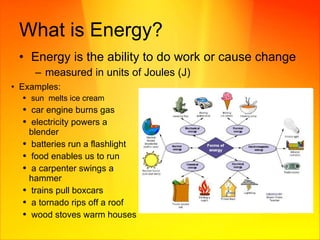
What is Energy? Energy is the ability to do work or cause change measured in units of Joules (J) Examples: sun  melts ice cream car engine burns gas electricity powers a blender batteries run a flashlight  food enables us to run a carpenter swings a hammer trains pull boxcars a tornado rips off a roof wood stoves warm houses
Forms of Energy Thermal Energy   (heat) faster moving atoms collide more often and cause higher temperatures i.e. water boils on the stove Chemical Energy   (stored in atomic bonds) heat/light/sound is released during chemical reactions  i.e. your body gains energy after eating Electrical Energy   (movement of electrons) the flow of electrons is converted into heat, light, sound or movement i.e. hair dryer, radio, light bulb, MAX train
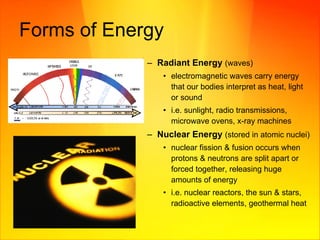
Forms of Energy Radiant Energy   (waves) electromagnetic waves carry energy that our bodies interpret as heat, light or sound i.e. sunlight, radio transmissions, microwave ovens, x-ray machines Nuclear Energy   (stored in atomic nuclei) nuclear fission & fusion occurs when protons & neutrons are split apart or forced together, releasing huge amounts of energy  i.e. nuclear reactors, the sun & stars, radioactive elements, geothermal heat
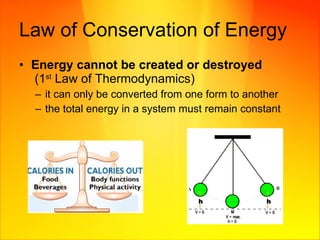
Law of Conservation of Energy Energy cannot be created or destroyed   (1 st  Law of Thermodynamics) it can only be converted from one form to another the total energy in a system must remain constant
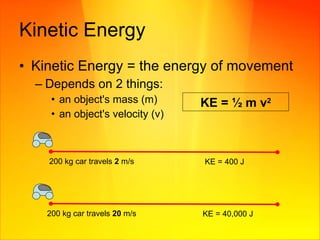
Kinetic Energy Kinetic Energy = the energy of movement Depends on 2 things: an object's mass (m) an object's velocity (v)  KE =  ½  m v 2 KE = 400 J  200 kg car travels  2  m/s KE = 40,000 J 200 kg car travels  20  m/s
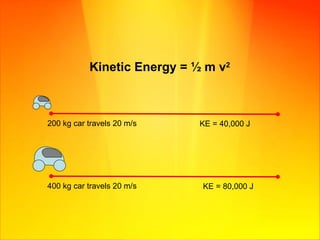
KE = 40,000 J  200 kg car travels 20 m/s KE = 80,000 J 400 kg car travels 20 m/s Kinetic Energy =  ½  m v 2
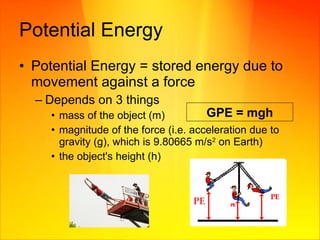
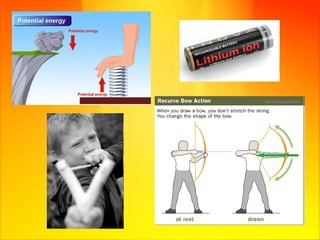
Potential Energy Potential Energy = stored energy due to movement against a force  Depends on 3 things mass of the object (m) magnitude of the force (i.e. acceleration due to gravity (g), which is 9.80665 m/s 2  on Earth)  the object's height (h)  GPE =  mgh
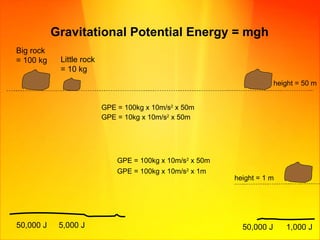
GPE = 100kg x 10m/s 2  x 50m  GPE = 10kg x 10m/s 2  x 50m  GPE = 100kg x 10m/s 2  x 50m  GPE = 100kg x 10m/s 2  x 1m  Gravitational Potential Energy =  mgh height = 50 m height = 1 m Big rock = 100 kg Little rock  = 10 kg 50,000 J 5,000 J 50,000 J 1,000 J
 
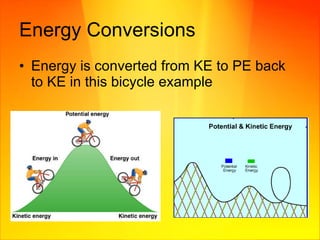
Energy Conversions Energy is converted from KE to PE back to KE in this bicycle example
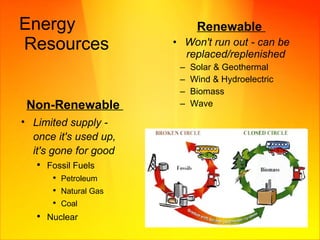
Energy  Resources Renewable  Won't run out - can be replaced/replenished   Solar & Geothermal Wind & Hydroelectric  Biomass Wave Non-Renewable  Limited supply - once it's used up, it's gone for good Fossil Fuels Petroleum Natural Gas Coal Nuclear
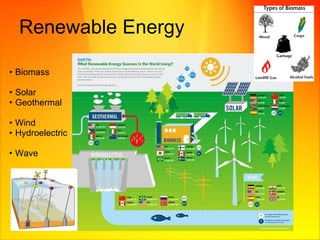
Renewable Energy  Biomass Solar  Geothermal Wind  Hydroelectric  Wave
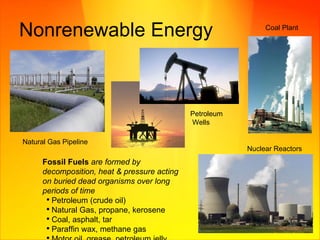
Nonrenewable Energy Coal Plant Petroleum Wells Natural Gas Pipeline Nuclear Reactors Fossil Fuels   are   formed by decomposition, heat & pressure acting on buried dead organisms over long periods of time  Petroleum (crude oil) Natural Gas, propane, kerosene Coal, asphalt, tar Paraffin wax, methane gas Motor oil, grease, petroleum jelly
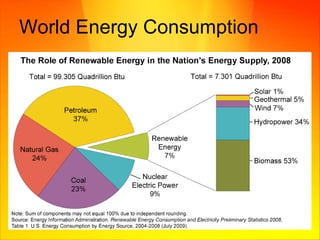
World Energy Consumption
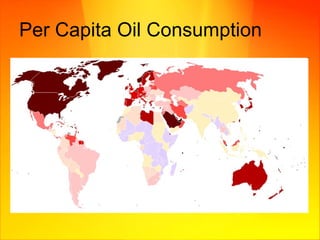
Per Capita Oil Consumption

Energy

  • 1.
    Energy - TheFuel of Life
  • 2.
    What is Energy?Energy is the ability to do work or cause change measured in units of Joules (J) Examples: sun melts ice cream car engine burns gas electricity powers a blender batteries run a flashlight food enables us to run a carpenter swings a hammer trains pull boxcars a tornado rips off a roof wood stoves warm houses
  • 3.
    Forms of EnergyThermal Energy (heat) faster moving atoms collide more often and cause higher temperatures i.e. water boils on the stove Chemical Energy (stored in atomic bonds) heat/light/sound is released during chemical reactions i.e. your body gains energy after eating Electrical Energy (movement of electrons) the flow of electrons is converted into heat, light, sound or movement i.e. hair dryer, radio, light bulb, MAX train
  • 4.
    Forms of EnergyRadiant Energy (waves) electromagnetic waves carry energy that our bodies interpret as heat, light or sound i.e. sunlight, radio transmissions, microwave ovens, x-ray machines Nuclear Energy (stored in atomic nuclei) nuclear fission & fusion occurs when protons & neutrons are split apart or forced together, releasing huge amounts of energy i.e. nuclear reactors, the sun & stars, radioactive elements, geothermal heat
  • 5.
    Law of Conservationof Energy Energy cannot be created or destroyed (1 st Law of Thermodynamics) it can only be converted from one form to another the total energy in a system must remain constant
  • 6.
    Kinetic Energy KineticEnergy = the energy of movement Depends on 2 things: an object's mass (m) an object's velocity (v) KE = ½ m v 2 KE = 400 J 200 kg car travels 2 m/s KE = 40,000 J 200 kg car travels 20 m/s
  • 7.
    KE = 40,000J 200 kg car travels 20 m/s KE = 80,000 J 400 kg car travels 20 m/s Kinetic Energy = ½ m v 2
  • 8.
    Potential Energy PotentialEnergy = stored energy due to movement against a force Depends on 3 things mass of the object (m) magnitude of the force (i.e. acceleration due to gravity (g), which is 9.80665 m/s 2 on Earth) the object's height (h) GPE = mgh
  • 9.
    GPE = 100kgx 10m/s 2 x 50m GPE = 10kg x 10m/s 2 x 50m GPE = 100kg x 10m/s 2 x 50m GPE = 100kg x 10m/s 2 x 1m Gravitational Potential Energy = mgh height = 50 m height = 1 m Big rock = 100 kg Little rock = 10 kg 50,000 J 5,000 J 50,000 J 1,000 J
  • 10.
  • 11.
    Energy Conversions Energyis converted from KE to PE back to KE in this bicycle example
  • 12.
    Energy ResourcesRenewable Won't run out - can be replaced/replenished Solar & Geothermal Wind & Hydroelectric Biomass Wave Non-Renewable Limited supply - once it's used up, it's gone for good Fossil Fuels Petroleum Natural Gas Coal Nuclear
  • 13.
    Renewable Energy Biomass Solar Geothermal Wind Hydroelectric Wave
  • 14.
    Nonrenewable Energy CoalPlant Petroleum Wells Natural Gas Pipeline Nuclear Reactors Fossil Fuels are formed by decomposition, heat & pressure acting on buried dead organisms over long periods of time Petroleum (crude oil) Natural Gas, propane, kerosene Coal, asphalt, tar Paraffin wax, methane gas Motor oil, grease, petroleum jelly
  • 15.
  • 16.
    Per Capita OilConsumption

Editor's Notes

  • #6 Usually, some energy is "lost" or transferred into friction (heat and movement loss), so efficiency is never 100%. Still the overall amount of energy remains the same.
  • #9 round gravity to 10 in most cases
  • #10 round gravity (9.8m/s 2 ) to 10 in most cases
  • #12 If the law of conservation of energy is true, where does the energy come from at the start of the uphill climb? (chemical/mechanical energy of the bicyclist) Where does the energy go at the end of the roller coaster? (heat of friction)
  • #14 Discuss advantages/disadvantages of each
  • #15 Discuss advantages/disadvantages of each
  • #17 per capita = per person According to the CIA World Factbook estimate for 2010 the world consumes about 87 million barrels of oil each day.