Life Processes in Animals
BY : K SANDEEP SWAMY
"If your food is fully digested before you eat again, you won't need medicine for pain."
This ancient wisdom from Thirukkural reminds us of the importance of understanding
how our bodies process food.
In this chapter, we explore the fascinating journey of nutrition and respiration in
animals4the essential life processes that keep us alive and thriving.
The Diversity of Animal
Nutrition
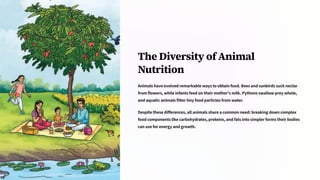
Animals have evolved remarkable ways to obtain food. Bees and sunbirds suck nectar
from flowers, while infants feed on their mother's milk. Pythons swallow prey whole,
and aquatic animals filter tiny food particles from water.
Despite these differences, all animals share a common need: breaking down complex
food components like carbohydrates, proteins, and fats into simpler forms their bodies
can use for energy and growth.
The Human Digestive System
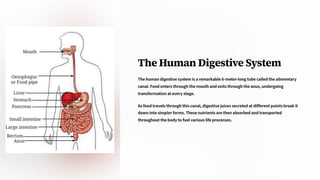
The human digestive system is a remarkable 6-meter-long tube called the alimentary
canal. Food enters through the mouth and exits through the anus, undergoing
transformation at every stage.
As food travels through this canal, digestive juices secreted at different points break it
down into simpler forms. These nutrients are then absorbed and transported
throughout the body to fuel various life processes.
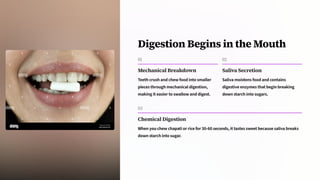
Digestion Begins in the Mouth
01
Mechanical Breakdown
Teeth crush and chew food into smaller
pieces through mechanical digestion,
making it easier to swallow and digest.
02
Saliva Secretion
Saliva moistens food and contains
digestive enzymes that begin breaking
down starch into sugars.
03
Chemical Digestion
When you chew chapati or rice for 30-60 seconds, it tastes sweet because saliva breaks
down starch into sugar.
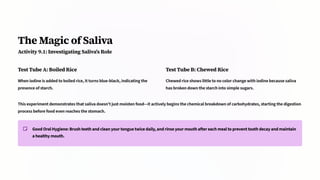
The Magic of Saliva
Activity 9.1: Investigating Saliva's Role
Test Tube A: Boiled Rice
When iodine is added to boiled rice, it turns blue-black, indicating the
presence of starch.
Test Tube B: Chewed Rice
Chewed rice shows little to no color change with iodine because saliva
has broken down the starch into simple sugars.
This experiment demonstrates that saliva doesn't just moisten food4it actively begins the chemical breakdown of carbohydrates, starting the digestion
process before food even reaches the stomach.
Good Oral Hygiene: Brush teeth and clean your tongue twice daily, and rinse your mouth after each meal to prevent tooth decay and maintain
a healthy mouth.
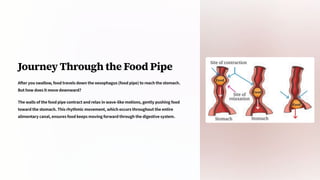
Journey Through the Food Pipe
After you swallow, food travels down the oesophagus (food pipe) to reach the stomach.
But how does it move downward?
The walls of the food pipe contract and relax in wave-like motions, gently pushing food
toward the stomach. This rhythmic movement, which occurs throughout the entire
alimentary canal, ensures food keeps moving forward through the digestive system.
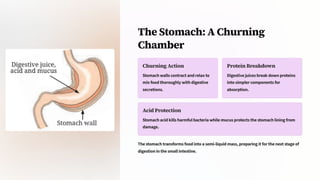
The Stomach: A Churning
Chamber
Churning Action
Stomach walls contract and relax to
mix food thoroughly with digestive
secretions.
Protein Breakdown
Digestive juices break down proteins
into simpler components for
absorption.
Acid Protection
Stomach acid kills harmful bacteria while mucus protects the stomach lining from
damage.
The stomach transforms food into a semi-liquid mass, preparing it for the next stage of
digestion in the small intestine.
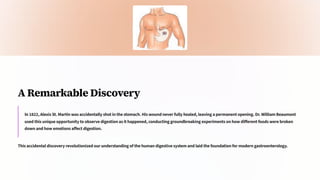
A Remarkable Discovery
In 1822, Alexis St. Martin was accidentally shot in the stomach. His wound never fully healed, leaving a permanent opening. Dr. William Beaumont
used this unique opportunity to observe digestion as it happened, conducting groundbreaking experiments on how different foods were broken
down and how emotions affect digestion.
This accidental discovery revolutionized our understanding of the human digestive system and laid the foundation for modern gastroenterology.
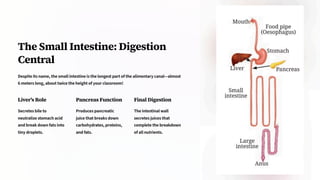
The Small Intestine: Digestion
Central
Despite its name, the small intestine is the longest part of the alimentary canal4almost
6 meters long, about twice the height of your classroom!
Liver's Role
Secretes bile to
neutralize stomach acid
and break down fats into
tiny droplets.
Pancreas Function
Produces pancreatic
juice that breaks down
carbohydrates, proteins,
and fats.
Final Digestion
The intestinal wall
secretes juices that
complete the breakdown
of all nutrients.
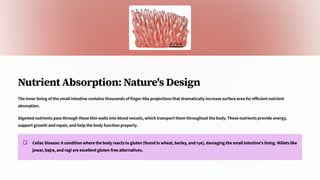
Nutrient Absorption: Nature's Design
The inner lining of the small intestine contains thousands of finger-like projections that dramatically increase surface area for efficient nutrient
absorption.
Digested nutrients pass through these thin walls into blood vessels, which transport them throughout the body. These nutrients provide energy,
support growth and repair, and help the body function properly.
Celiac Disease: A condition where the body reacts to gluten (found in wheat, barley, and rye), damaging the small intestine's lining. Millets like
jowar, bajra, and ragi are excellent gluten-free alternatives.
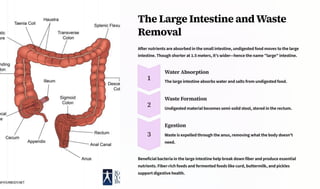
The Large Intestine and Waste
Removal
After nutrients are absorbed in the small intestine, undigested food moves to the large
intestine. Though shorter at 1.5 meters, it's wider4hence the name "large" intestine.
1
Water Absorption
The large intestine absorbs water and salts from undigested food.
2
Waste Formation
Undigested material becomes semi-solid stool, stored in the rectum.
3
Egestion
Waste is expelled through the anus, removing what the body doesn't
need.
Beneficial bacteria in the large intestine help break down fiber and produce essential
nutrients. Fiber-rich foods and fermented foods like curd, buttermilk, and pickles
support digestive health.
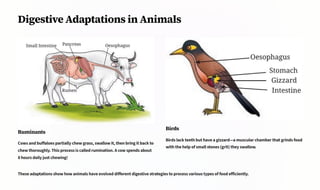
Digestive Adaptations in Animals
Ruminants
Cows and buffaloes partially chew grass, swallow it, then bring it back to
chew thoroughly. This process is called rumination. A cow spends about
8 hours daily just chewing!
Birds
Birds lack teeth but have a gizzard4a muscular chamber that grinds food
with the help of small stones (grit) they swallow.
These adaptations show how animals have evolved different digestive strategies to process various types of food efficiently.
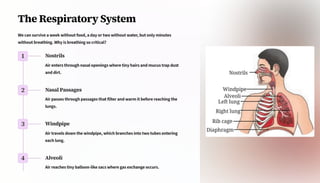
The Respiratory System
We can survive a week without food, a day or two without water, but only minutes
without breathing. Why is breathing so critical?
1 Nostrils
Air enters through nasal openings where tiny hairs and mucus trap dust
and dirt.
2 Nasal Passages
Air passes through passages that filter and warm it before reaching the
lungs.
3 Windpipe
Air travels down the windpipe, which branches into two tubes entering
each lung.
4 Alveoli
Air reaches tiny balloon-like sacs where gas exchange occurs.
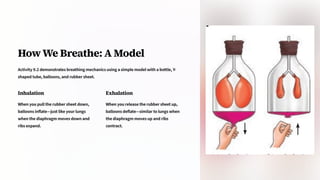
How We Breathe: A Model
Activity 9.2 demonstrates breathing mechanics using a simple model with a bottle, Y-
shaped tube, balloons, and rubber sheet.
Inhalation
When you pull the rubber sheet down,
balloons inflate4just like your lungs
when the diaphragm moves down and
ribs expand.
Exhalation
When you release the rubber sheet up,
balloons deflate4similar to lungs when
the diaphragm moves up and ribs
contract.
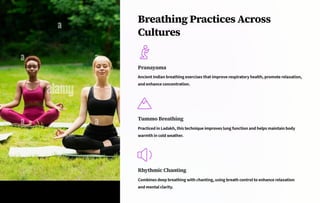
Breathing Practices Across
Cultures
Pranayama
Ancient Indian breathing exercises that improve respiratory health, promote relaxation,
and enhance concentration.
Tummo Breathing
Practiced in Ladakh, this technique improves lung function and helps maintain body
warmth in cold weather.
Rhythmic Chanting
Combines deep breathing with chanting, using breath control to enhance relaxation
and mental clarity.
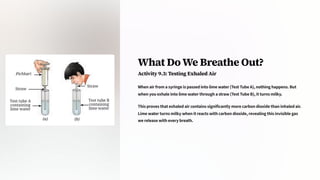
What Do We Breathe Out?
Activity 9.3: Testing Exhaled Air
When air from a syringe is passed into lime water (Test Tube A), nothing happens. But
when you exhale into lime water through a straw (Test Tube B), it turns milky.
This proves that exhaled air contains significantly more carbon dioxide than inhaled air.
Lime water turns milky when it reacts with carbon dioxide, revealing this invisible gas
we release with every breath.
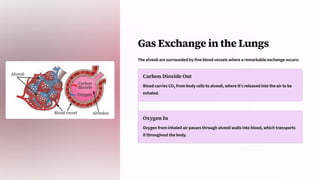
Gas Exchange in the Lungs
The alveoli are surrounded by fine blood vessels where a remarkable exchange occurs:
Carbon Dioxide Out
Blood carries CO¢ from body cells to alveoli, where it's released into the air to be
exhaled.
Oxygen In
Oxygen from inhaled air passes through alveoli walls into blood, which transports
it throughout the body.
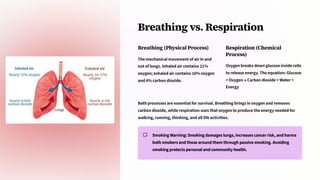
Breathing vs. Respiration
Breathing (Physical Process)
The mechanical movement of air in and
out of lungs. Inhaled air contains 21%
oxygen; exhaled air contains 16% oxygen
and 4% carbon dioxide.
Respiration (Chemical
Process)
Oxygen breaks down glucose inside cells
to release energy. The equation: Glucose
+ Oxygen ³ Carbon dioxide + Water +
Energy
Both processes are essential for survival. Breathing brings in oxygen and removes
carbon dioxide, while respiration uses that oxygen to produce the energy needed for
walking, running, thinking, and all life activities.
Smoking Warning: Smoking damages lungs, increases cancer risk, and harms
both smokers and those around them through passive smoking. Avoiding
smoking protects personal and community health.
Breathing Adaptations in Animals
Fish: Gills
Aquatic animals extract oxygen dissolved in
water through gills richly supplied with blood
vessels.
Frogs: Multiple Systems
Tadpoles breathe through gills; adult frogs use
lungs on land and skin for gas exchange in water.
Earthworms: Skin
These creatures exchange oxygen and carbon
dioxide directly through their moist skin.
Different animals have evolved diverse breathing mechanisms perfectly suited to their unique habitats4from ocean depths to mountain heights.
Key Takeaways
Digestive Journey
Food travels through the 6-meter alimentary canal, being broken
down by mechanical and chemical digestion. Nutrients are absorbed
primarily in the small intestine.
Breathing Mechanics
The diaphragm and ribs work together to move air in and out of
lungs. Gas exchange occurs in alveoli where oxygen enters blood and
carbon dioxide exits.
Respiration Process
Oxygen breaks down glucose to release energy: Glucose + Oxygen ³
Carbon dioxide + Water + Energy. This chemical process powers all
life activities.
Animal Adaptations
Different animals have evolved specialized digestive and respiratory
systems suited to their diets and habitats4from ruminants to fish
with gills.
Understanding these life processes reveals the remarkable complexity and efficiency of living systems that sustain life on Earth.