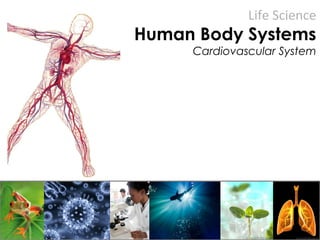
Life Science
Human Body Systems
Cardiovascular System
1. Name the building blocks (monomers) of proteins, carbs, fats, and nucleic
acids.
• Proteins: amino acids, Carbs: saccharides, Fats (lipids): fatty acids (& glycerol), and
Nucleic acids: nucleotides
1. What protein/hormone produced in the pancreas lowers blood sugar by
signaling body cells to take it in out of the bloodstream?
• Insulin
1. True or False? The liver and muscles store excess glucose as a long, branched
polysaccharide called glycogen.
• True (the pancreas produces glucagon to signal the breaking down of glycogen)
1. Why does your body need more carbohydrate than any other nutrient,
especially since most of the body is made of water, fat, and protein?
• All carbs are broken down into glucose, which provides energy (to make ATP) for all
anabolic chemical reactions and cellular processes.
1. What does %DV mean?
• Percent Daily Value (what part of the suggested amount of a nutrient
one serving provides - per day, for a 2,000 Calorie diet)
In your lab notebook, please answer as best you can:
Bonus: What is a Calorie?
- Heat energy that comes from food that your body can use or store up.
Week 20
Review Quiz
The Circulatory System
• Heart contracts about once/second
– Average adult heart = 65 beats/min.
• That's 100,000 times/day
– Blood has to reach every cell in the body
• If circulation stops, cells die
• Brain tissue dies within 5 - 7 min. without
oxygen
• Pumps 4,000 gallons blood per day
– Enough blood to fill a tanker truck!
Blood flow animation
The Human Heart
• Muscular Pump
– Striated cardiac muscle
– Size of your fist (child)
• About 2 fists for adult
• 4 Chambers
– Open spaces for blood to
gather before being
pumped out
• 4 One-Way Valves
– Prevent back-flow
– Allow pressure to build
Experiment
Heart Rate
Four Chambers of the Heart
• Red = oxygenated
• Blue = deoxygenated
• Septum: dividing wall
 Which chambers have the thinnest
muscular walls? Thickest? Why?
The Heart - a double pump
• Left & Right Atria Contract
– blood forced into ventricles
– Pulmonary/Aortic valves close
– Pacemaker within right atrium
• “sinoatrial node”
• Left & Right Ventricles Contract
– Mitral/Tricuspid valves close
– blood forced out to lungs & body
Four Valves of the Heart
• Prevent backflow of blood during contractions
• Tricuspid & Mitral valves have fibrous "anchors"
– Why?
Heart Sounds
• Clean ear buds with alcohol
• Listen for valves closing
– "lub" is Mitral & Tricuspid
– "dub" is Aortic & Pulmonary
Simplified
Animation
Heartbeat
Animation
Blood Flow in the Heart
Oxygenated blood
out to body
back from
trunk/legs
back from
head/arms
oxygenated
blood from
lungs
to lungs
to lungs
Blood Flow
Animation
Circulation
Lungs Lungs
Lower
Extremities
Brain
• Pulmonary (lungs)
– CO2 dropped off
– O2 picked up
• Systemic (body)
– O2 & nutrients delivered
– CO2 & waste picked up
• Coronary (heart’s blood supply)
– O2 to heart
– CO2 taken away
Circulation
Game
• Find your way around
the circulatory system!
• The “PLAYER” is a red
blood cell.
• Pick up O2 and CO2
– drop them off at the right
spot
• If you mess up, you're
OUT of the game!
Blood Vessels - Miles of Tubes
• Arteries
– carry blood AWAY from heart
• Take oxygen-rich blood (red) to extremities
• Take oxygen-depleted blood (blue) to the lungs
– thick, muscular
• withstand higher pressure than veins
• control blood flow
• Veins
– carry blood TO the heart
• Brings deoxygenated blood (blue) back from extremities
• Brings oxygenated blood (red) back from the lungs
– thinner, with valves
• valves prevent back-flow
• skeletal muscles aid in return blood flow
• Capillaries
– tiny network or "web" of vessels
– very thin - one cell thick!
• to allow exchange of molecules
– reaching every living cell in the body
• around air sacs in lungs
• all organ tissues
Blood - What's in it?
• Plasma
– liquid in which cells are suspended
• mostly H2O
• Macronutrients & micronutrients
• hormones, toxins, bacteria, glucose
& other nutrients, etc
• Red Blood Cells
– no nucleus, donut-shaped
– hemoglobin (iron)
• carries O2& CO2
• White Blood Cells
– help fight infection
– B cells produce antibodies
– neutrophils, basophils, monocytes,
eosinophils, lymphocytes,
• Platelets
– Clump together to form blood clots
that stop bleeding