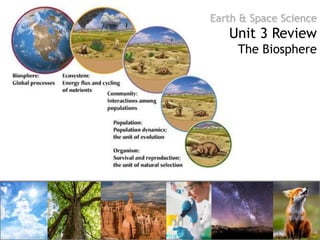
Earth & Space Science
Unit 3 Review
The Biosphere
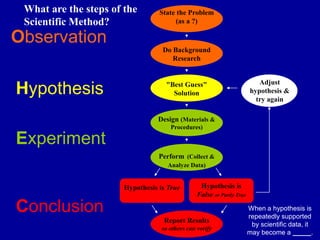
When a hypothesis is
repeatedly supported
by scientific data, it
may become a .
State the Problem
(as a ?)
Do Background
Research
"Best Guess"
Solution
Design (Materials &
Procedures)
Perform (Collect &
Analyze Data)
Report Results
so others can verify
Hypothesis is
False or Partly True
Hypothesis is True
Adjust
hypothesis &
try again
Conclusion
Experiment
Hypothesis
Observation
What are the steps of the
Scientific Method?
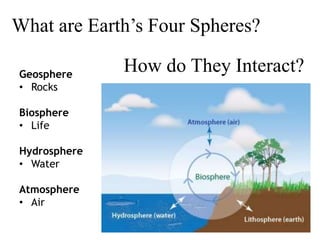
How do They Interact?
What are Earth’s Four Spheres?
Geosphere
• Rocks
Biosphere
• Life
Hydrosphere
• Water
Atmosphere
• Air
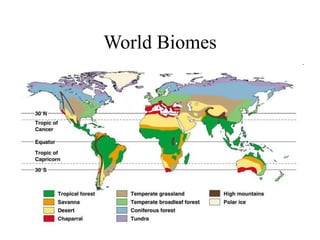
World Biomes
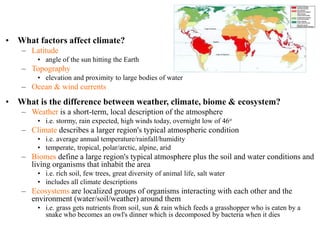
• What factors affect climate?
– Latitude
• angle of the sun hitting the Earth
– Topography
• elevation and proximity to large bodies of water
– Ocean & wind currents
• What is the difference between weather, climate, biome & ecosystem?
– Weather is a short-term, local description of the atmosphere
• i.e. stormy, rain expected, high winds today, overnight low of 46o
– Climate describes a larger region's typical atmospheric condition
• i.e. average annual temperature/rainfall/humidity
• temperate, tropical, polar/arctic, alpine, arid
– Biomes define a large region's typical atmosphere plus the soil and water conditions and
living organisms that inhabit the area
• i.e. rich soil, few trees, great diversity of animal life, salt water
• includes all climate descriptions
– Ecosystems are localized groups of organisms interacting with each other and the
environment (water/soil/weather) around them
• i.e. grass gets nutrients from soil, sun & rain which feeds a grasshopper who is eaten by a
snake who becomes an owl's dinner which is decomposed by bacteria when it dies
Major Biomes of the World
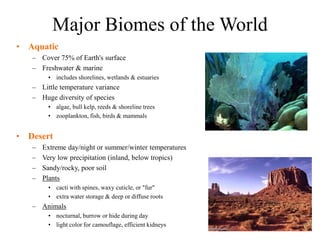
• Aquatic
– Cover 75% of Earth's surface
– Freshwater & marine
• includes shorelines, wetlands & estuaries
– Little temperature variance
– Huge diversity of species
• algae, bull kelp, reeds & shoreline trees
• zooplankton, fish, birds & mammals
• Desert
– Extreme day/night or summer/winter temperatures
– Very low precipitation (inland, below tropics)
– Sandy/rocky, poor soil
– Plants
• cacti with spines, waxy cuticle, or "fur"
• extra water storage & deep or diffuse roots
– Animals
• nocturnal, burrow or hide during day
• light color for camouflage, efficient kidneys
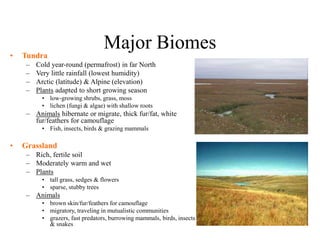
• Tundra
– Cold year-round (permafrost) in far North
– Very little rainfall (lowest humidity)
– Arctic (latitude) & Alpine (elevation)
– Plants adapted to short growing season
• low-growing shrubs, grass, moss
• lichen (fungi & algae) with shallow roots
– Animals hibernate or migrate, thick fur/fat, white
fur/feathers for camouflage
• Fish, insects, birds & grazing mammals
• Grassland
– Rich, fertile soil
– Moderately warm and wet
– Plants
• tall grass, sedges & flowers
• sparse, stubby trees
– Animals
• brown skin/fur/feathers for camouflage
• migratory, traveling in mutualistic communities
• grazers, fast predators, burrowing mammals, birds, insects
& snakes
Major Biomes
Forest Biomes
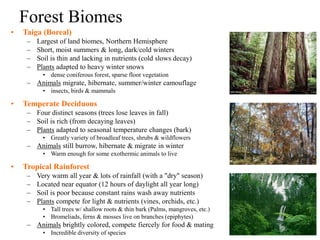
• Taiga (Boreal)
– Largest of land biomes, Northern Hemisphere
– Short, moist summers & long, dark/cold winters
– Soil is thin and lacking in nutrients (cold slows decay)
– Plants adapted to heavy winter snows
• dense coniferous forest, sparse floor vegetation
– Animals migrate, hibernate, summer/winter camouflage
• insects, birds & mammals
• Temperate Deciduous
– Four distinct seasons (trees lose leaves in fall)
– Soil is rich (from decaying leaves)
– Plants adapted to seasonal temperature changes (bark)
• Greatly variety of broadleaf trees, shrubs & wildflowers
– Animals still burrow, hibernate & migrate in winter
• Warm enough for some exothermic animals to live
• Tropical Rainforest
– Very warm all year & lots of rainfall (with a "dry" season)
– Located near equator (12 hours of daylight all year long)
– Soil is poor because constant rains wash away nutrients
– Plants compete for light & nutrients (vines, orchids, etc.)
• Tall trees w/ shallow roots & thin bark (Palms, mangroves, etc.)
• Bromeliads, ferns & mosses live on branches (epiphytes)
– Animals brightly colored, compete fiercely for food & mating
• Incredible diversity of species
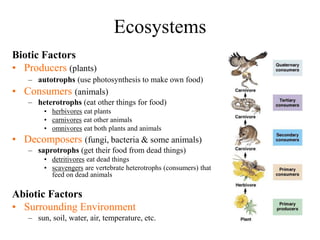
Ecosystems
Biotic Factors
• Producers (plants)
– autotrophs (use photosynthesis to make own food)
• Consumers (animals)
– heterotrophs (eat other things for food)
• herbivores eat plants
• carnivores eat other animals
• omnivores eat both plants and animals
• Decomposers (fungi, bacteria & some animals)
– saprotrophs (get their food from dead things)
• detritivores eat dead things
• scavengers are vertebrate heterotrophs (consumers) that
feed on dead animals
Abiotic Factors
• Surrounding Environment
– sun, soil, water, air, temperature, etc.
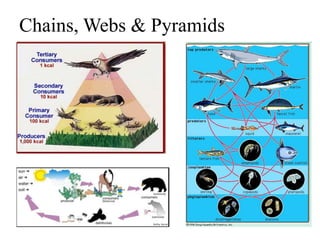
Chains, Webs & Pyramids
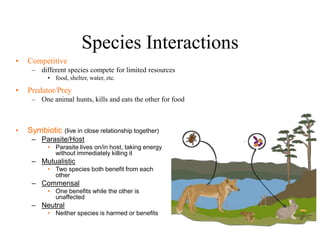
Species Interactions
• Competitive
– different species compete for limited resources
• food, shelter, water, etc.
• Predator/Prey
– One animal hunts, kills and eats the other for food
• Symbiotic (live in close relationship together)
– Parasite/Host
• Parasite lives on/in host, taking energy
without immediately killing it
– Mutualistic
• Two species both benefit from each
other
– Commensal
• One benefits while the other is
unaffected
– Neutral
• Neither species is harmed or benefits
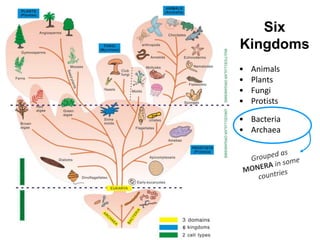
Six
Kingdoms
• Animals
• Plants
• Fungi
• Protists
• Bacteria
• Archaea
6
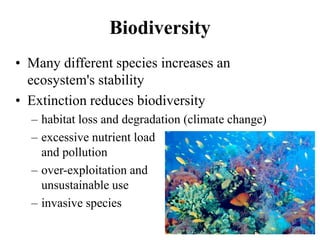
Biodiversity
• Many different species increases an
ecosystem's stability
• Extinction reduces biodiversity
– habitat loss and degradation (climate change)
– excessive nutrient load
and pollution
– over-exploitation and
unsustainable use
– invasive species
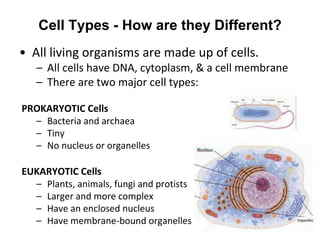
• All living organisms are made up of cells.
– All cells have DNA, cytoplasm, & a cell membrane
– There are two major cell types:
PROKARYOTIC Cells
– Bacteria and archaea
– Tiny
– No nucleus or organelles
EUKARYOTIC Cells
– Plants, animals, fungi and protists
– Larger and more complex
– Have an enclosed nucleus
– Have membrane-bound organelles
Cell Types - How are they Different?
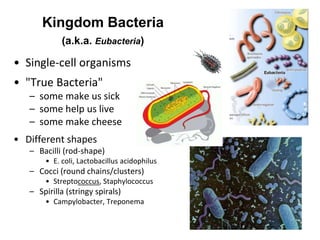
Kingdom Bacteria
(a.k.a. Eubacteria)
• Single-cell organisms
• "True Bacteria"
– some make us sick
– some help us live
– some make cheese
• Different shapes
– Bacilli (rod-shape)
• E. coli, Lactobacillus acidophilus
– Cocci (round chains/clusters)
• Streptococcus, Staphylococcus
– Spirilla (stringy spirals)
• Campylobacter, Treponema
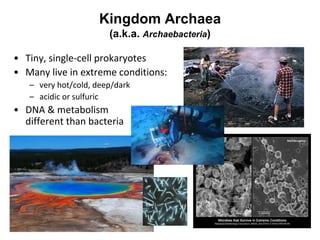
Kingdom Archaea
(a.k.a. Archaebacteria)
• Tiny, single-cell prokaryotes
• Many live in extreme conditions:
– very hot/cold, deep/dark
– acidic or sulfuric
• DNA & metabolism
different than bacteria
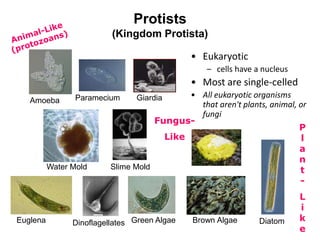
Protists
(Kingdom Protista)
Amoeba Paramecium Giardia
Water Mold Slime Mold
Euglena Dinoflagellates DiatomBrown AlgaeGreen Algae
Fungus-
Like
P
l
a
n
t
-
L
i
k
e
• Eukaryotic
– cells have a nucleus
• Most are single-celled
• All eukaryotic organisms
that aren't plants, animal, or
fungi
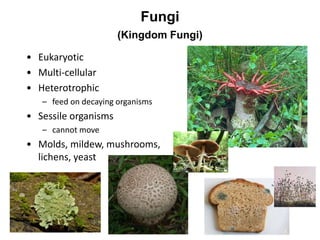
Fungi
(Kingdom Fungi)
• Eukaryotic
• Multi-cellular
• Heterotrophic
– feed on decaying organisms
• Sessile organisms
– cannot move
• Molds, mildew, mushrooms,
lichens, yeast
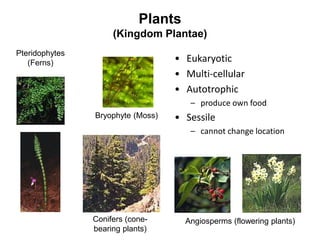
Plants
(Kingdom Plantae)
Bryophyte (Moss)
Pteridophytes
(Ferns)
Conifers (cone-
bearing plants)
Angiosperms (flowering plants)
• Eukaryotic
• Multi-cellular
• Autotrophic
– produce own food
• Sessile
– cannot change location
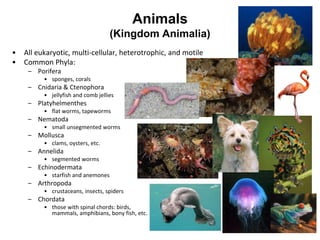
Animals
(Kingdom Animalia)
• All eukaryotic, multi-cellular, heterotrophic, and motile
• Common Phyla:
– Porifera
• sponges, corals
– Cnidaria & Ctenophora
• jellyfish and comb jellies
– Platyhelmenthes
• flat worms, tapeworms
– Nematoda
• small unsegmented worms
– Mollusca
• clams, oysters, etc.
– Annelida
• segmented worms
– Echinodermata
• starfish and anemones
– Arthropoda
• crustaceans, insects, spiders
– Chordata
• those with spinal chords: birds,
mammals, amphibians, bony fish, etc.
• NATURAL RESOURCE:
– Anything naturally occurring on our planet
that is necessary or useful to humans
The Earth’s Resources
• Renewable Resource:
Resources that can be
replenished by natural
processes at least as
quickly as they are
used.
• Nonrenewable
Resource:
Resources being used
up faster than they can
be replaced by natural
processes.
Renewable vs. Nonrenewable
• Sunlight*
• Fresh Water
• Hydroelectric* energy
• Air & Wind* energy
• Land (for agriculture)
• Plants & Animals
• Biomass Fuels
• Geothermal* energy
* Inexhaustible resources
• Fossil Fuels
– Coal, oil, natural
gas
• Minerals
– Metals, gems, &
nonmetals
• Land (for building)
• Radioactive
Elements
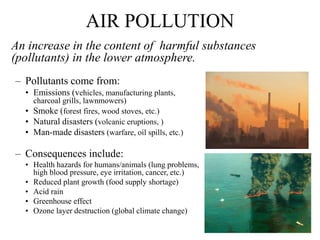
AIR POLLUTION
An increase in the content of harmful substances
(pollutants) in the lower atmosphere.
– Pollutants come from:
• Emissions (vehicles, manufacturing plants,
charcoal grills, lawnmowers)
• Smoke (forest fires, wood stoves, etc.)
• Natural disasters (volcanic eruptions, )
• Man-made disasters (warfare, oil spills, etc.)
– Consequences include:
• Health hazards for humans/animals (lung problems,
high blood pressure, eye irritation, cancer, etc.)
• Reduced plant growth (food supply shortage)
• Acid rain
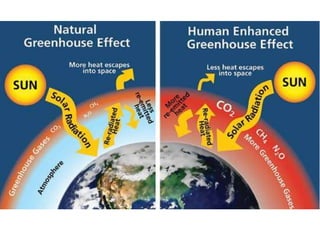
• Greenhouse effect
• Ozone layer destruction (global climate change)
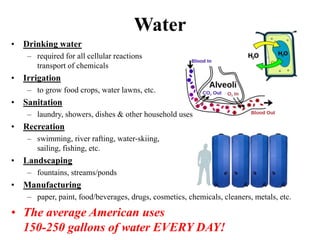
Water
• Drinking water
– required for all cellular reactions &
transport of chemicals
• Irrigation
– to grow food crops, water lawns, etc.
• Sanitation
– laundry, showers, dishes & other household uses
• Recreation
– swimming, river rafting, water-skiing,
sailing, fishing, etc.
• Landscaping
– fountains, streams/ponds
• Manufacturing
– paper, paint, food/beverages, drugs, cosmetics, chemicals, cleaners, metals, etc.
• The average American uses
150-250 gallons of water EVERY DAY!
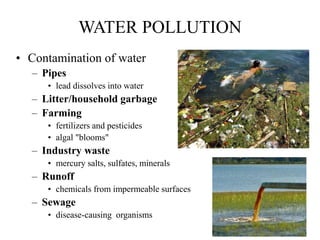
WATER POLLUTION
• Contamination of water
– Pipes
• lead dissolves into water
– Litter/household garbage
– Farming
• fertilizers and pesticides
• algal "blooms"
– Industry waste
• mercury salts, sulfates, minerals
– Runoff
• chemicals from impermeable surfaces
– Sewage
• disease-causing organisms
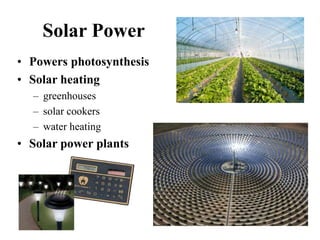
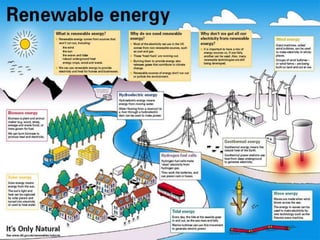
Solar Power
• Powers photosynthesis
• Solar heating
– greenhouses
– solar cookers
– water heating
• Solar power plants
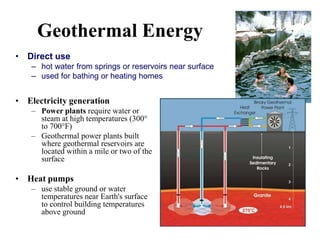
Geothermal Energy
• Electricity generation
– Power plants require water or
steam at high temperatures (300°
to 700°F)
– Geothermal power plants built
where geothermal reservoirs are
located within a mile or two of the
surface
• Heat pumps
– use stable ground or water
temperatures near Earth's surface
to control building temperatures
above ground
• Direct use
– hot water from springs or reservoirs near surface
– used for bathing or heating homes
Unit 3 Review: the biosphere

Unit 3 Review: the biosphere

  • 1.
    Earth & SpaceScience Unit 3 Review The Biosphere
  • 2.
    When a hypothesisis repeatedly supported by scientific data, it may become a . State the Problem (as a ?) Do Background Research "Best Guess" Solution Design (Materials & Procedures) Perform (Collect & Analyze Data) Report Results so others can verify Hypothesis is False or Partly True Hypothesis is True Adjust hypothesis & try again Conclusion Experiment Hypothesis Observation What are the steps of the Scientific Method?
  • 3.
    How do TheyInteract? What are Earth’s Four Spheres? Geosphere • Rocks Biosphere • Life Hydrosphere • Water Atmosphere • Air
  • 4.
  • 5.
    • What factorsaffect climate? – Latitude • angle of the sun hitting the Earth – Topography • elevation and proximity to large bodies of water – Ocean & wind currents • What is the difference between weather, climate, biome & ecosystem? – Weather is a short-term, local description of the atmosphere • i.e. stormy, rain expected, high winds today, overnight low of 46o – Climate describes a larger region's typical atmospheric condition • i.e. average annual temperature/rainfall/humidity • temperate, tropical, polar/arctic, alpine, arid – Biomes define a large region's typical atmosphere plus the soil and water conditions and living organisms that inhabit the area • i.e. rich soil, few trees, great diversity of animal life, salt water • includes all climate descriptions – Ecosystems are localized groups of organisms interacting with each other and the environment (water/soil/weather) around them • i.e. grass gets nutrients from soil, sun & rain which feeds a grasshopper who is eaten by a snake who becomes an owl's dinner which is decomposed by bacteria when it dies
  • 6.
    Major Biomes ofthe World • Aquatic – Cover 75% of Earth's surface – Freshwater & marine • includes shorelines, wetlands & estuaries – Little temperature variance – Huge diversity of species • algae, bull kelp, reeds & shoreline trees • zooplankton, fish, birds & mammals • Desert – Extreme day/night or summer/winter temperatures – Very low precipitation (inland, below tropics) – Sandy/rocky, poor soil – Plants • cacti with spines, waxy cuticle, or "fur" • extra water storage & deep or diffuse roots – Animals • nocturnal, burrow or hide during day • light color for camouflage, efficient kidneys
  • 7.
    • Tundra – Coldyear-round (permafrost) in far North – Very little rainfall (lowest humidity) – Arctic (latitude) & Alpine (elevation) – Plants adapted to short growing season • low-growing shrubs, grass, moss • lichen (fungi & algae) with shallow roots – Animals hibernate or migrate, thick fur/fat, white fur/feathers for camouflage • Fish, insects, birds & grazing mammals • Grassland – Rich, fertile soil – Moderately warm and wet – Plants • tall grass, sedges & flowers • sparse, stubby trees – Animals • brown skin/fur/feathers for camouflage • migratory, traveling in mutualistic communities • grazers, fast predators, burrowing mammals, birds, insects & snakes Major Biomes
  • 8.
    Forest Biomes • Taiga(Boreal) – Largest of land biomes, Northern Hemisphere – Short, moist summers & long, dark/cold winters – Soil is thin and lacking in nutrients (cold slows decay) – Plants adapted to heavy winter snows • dense coniferous forest, sparse floor vegetation – Animals migrate, hibernate, summer/winter camouflage • insects, birds & mammals • Temperate Deciduous – Four distinct seasons (trees lose leaves in fall) – Soil is rich (from decaying leaves) – Plants adapted to seasonal temperature changes (bark) • Greatly variety of broadleaf trees, shrubs & wildflowers – Animals still burrow, hibernate & migrate in winter • Warm enough for some exothermic animals to live • Tropical Rainforest – Very warm all year & lots of rainfall (with a "dry" season) – Located near equator (12 hours of daylight all year long) – Soil is poor because constant rains wash away nutrients – Plants compete for light & nutrients (vines, orchids, etc.) • Tall trees w/ shallow roots & thin bark (Palms, mangroves, etc.) • Bromeliads, ferns & mosses live on branches (epiphytes) – Animals brightly colored, compete fiercely for food & mating • Incredible diversity of species
  • 9.
    Ecosystems Biotic Factors • Producers(plants) – autotrophs (use photosynthesis to make own food) • Consumers (animals) – heterotrophs (eat other things for food) • herbivores eat plants • carnivores eat other animals • omnivores eat both plants and animals • Decomposers (fungi, bacteria & some animals) – saprotrophs (get their food from dead things) • detritivores eat dead things • scavengers are vertebrate heterotrophs (consumers) that feed on dead animals Abiotic Factors • Surrounding Environment – sun, soil, water, air, temperature, etc.
  • 10.
  • 11.
    Species Interactions • Competitive –different species compete for limited resources • food, shelter, water, etc. • Predator/Prey – One animal hunts, kills and eats the other for food • Symbiotic (live in close relationship together) – Parasite/Host • Parasite lives on/in host, taking energy without immediately killing it – Mutualistic • Two species both benefit from each other – Commensal • One benefits while the other is unaffected – Neutral • Neither species is harmed or benefits
  • 12.
    Six Kingdoms • Animals • Plants •Fungi • Protists • Bacteria • Archaea 6
  • 13.
    Biodiversity • Many differentspecies increases an ecosystem's stability • Extinction reduces biodiversity – habitat loss and degradation (climate change) – excessive nutrient load and pollution – over-exploitation and unsustainable use – invasive species
  • 14.
    • All livingorganisms are made up of cells. – All cells have DNA, cytoplasm, & a cell membrane – There are two major cell types: PROKARYOTIC Cells – Bacteria and archaea – Tiny – No nucleus or organelles EUKARYOTIC Cells – Plants, animals, fungi and protists – Larger and more complex – Have an enclosed nucleus – Have membrane-bound organelles Cell Types - How are they Different?
  • 15.
    Kingdom Bacteria (a.k.a. Eubacteria) •Single-cell organisms • "True Bacteria" – some make us sick – some help us live – some make cheese • Different shapes – Bacilli (rod-shape) • E. coli, Lactobacillus acidophilus – Cocci (round chains/clusters) • Streptococcus, Staphylococcus – Spirilla (stringy spirals) • Campylobacter, Treponema
  • 16.
    Kingdom Archaea (a.k.a. Archaebacteria) •Tiny, single-cell prokaryotes • Many live in extreme conditions: – very hot/cold, deep/dark – acidic or sulfuric • DNA & metabolism different than bacteria
  • 17.
    Protists (Kingdom Protista) Amoeba ParameciumGiardia Water Mold Slime Mold Euglena Dinoflagellates DiatomBrown AlgaeGreen Algae Fungus- Like P l a n t - L i k e • Eukaryotic – cells have a nucleus • Most are single-celled • All eukaryotic organisms that aren't plants, animal, or fungi
  • 18.
    Fungi (Kingdom Fungi) • Eukaryotic •Multi-cellular • Heterotrophic – feed on decaying organisms • Sessile organisms – cannot move • Molds, mildew, mushrooms, lichens, yeast
  • 19.
    Plants (Kingdom Plantae) Bryophyte (Moss) Pteridophytes (Ferns) Conifers(cone- bearing plants) Angiosperms (flowering plants) • Eukaryotic • Multi-cellular • Autotrophic – produce own food • Sessile – cannot change location
  • 20.
    Animals (Kingdom Animalia) • Alleukaryotic, multi-cellular, heterotrophic, and motile • Common Phyla: – Porifera • sponges, corals – Cnidaria & Ctenophora • jellyfish and comb jellies – Platyhelmenthes • flat worms, tapeworms – Nematoda • small unsegmented worms – Mollusca • clams, oysters, etc. – Annelida • segmented worms – Echinodermata • starfish and anemones – Arthropoda • crustaceans, insects, spiders – Chordata • those with spinal chords: birds, mammals, amphibians, bony fish, etc.
  • 21.
    • NATURAL RESOURCE: –Anything naturally occurring on our planet that is necessary or useful to humans The Earth’s Resources • Renewable Resource: Resources that can be replenished by natural processes at least as quickly as they are used. • Nonrenewable Resource: Resources being used up faster than they can be replaced by natural processes.
  • 22.
    Renewable vs. Nonrenewable •Sunlight* • Fresh Water • Hydroelectric* energy • Air & Wind* energy • Land (for agriculture) • Plants & Animals • Biomass Fuels • Geothermal* energy * Inexhaustible resources • Fossil Fuels – Coal, oil, natural gas • Minerals – Metals, gems, & nonmetals • Land (for building) • Radioactive Elements
  • 23.
    AIR POLLUTION An increasein the content of harmful substances (pollutants) in the lower atmosphere. – Pollutants come from: • Emissions (vehicles, manufacturing plants, charcoal grills, lawnmowers) • Smoke (forest fires, wood stoves, etc.) • Natural disasters (volcanic eruptions, ) • Man-made disasters (warfare, oil spills, etc.) – Consequences include: • Health hazards for humans/animals (lung problems, high blood pressure, eye irritation, cancer, etc.) • Reduced plant growth (food supply shortage) • Acid rain • Greenhouse effect • Ozone layer destruction (global climate change)
  • 25.
    Water • Drinking water –required for all cellular reactions & transport of chemicals • Irrigation – to grow food crops, water lawns, etc. • Sanitation – laundry, showers, dishes & other household uses • Recreation – swimming, river rafting, water-skiing, sailing, fishing, etc. • Landscaping – fountains, streams/ponds • Manufacturing – paper, paint, food/beverages, drugs, cosmetics, chemicals, cleaners, metals, etc. • The average American uses 150-250 gallons of water EVERY DAY!
  • 26.
    WATER POLLUTION • Contaminationof water – Pipes • lead dissolves into water – Litter/household garbage – Farming • fertilizers and pesticides • algal "blooms" – Industry waste • mercury salts, sulfates, minerals – Runoff • chemicals from impermeable surfaces – Sewage • disease-causing organisms
  • 27.
    Solar Power • Powersphotosynthesis • Solar heating – greenhouses – solar cookers – water heating • Solar power plants
  • 28.
    Geothermal Energy • Electricitygeneration – Power plants require water or steam at high temperatures (300° to 700°F) – Geothermal power plants built where geothermal reservoirs are located within a mile or two of the surface • Heat pumps – use stable ground or water temperatures near Earth's surface to control building temperatures above ground • Direct use – hot water from springs or reservoirs near surface – used for bathing or heating homes