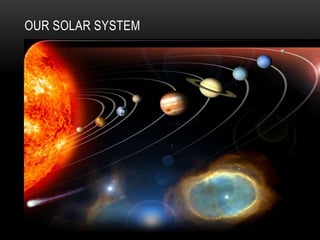
Our solar system
What is The Universe?What is Space?What keeps it all in place?How did everything get where it is today?
What's in our Solar System?The Sun - a star in the center of our planetary system, composed of hydrogen and helium, which produces its own energy and light
Planets - large celestial spheres, illuminated by light from the star around which they revolve
Moons - natural objects that orbit a planet
Comets - balls of ice and rock with elliptical orbits around the Sun which develop long tails as they near the Sun
Asteroids and Meteoroids - small rocky objects orbiting the Sun, which can collide with planets, moons or other objects
Dwarf Planets - larger than asteroids but smaller than planets
Kuiper Belt Objects - smaller icy/rocky objects beyond the orbit of Neptune which may supply materials for cometsBrief History of Astronomy2000 BC - Stonehenge & Mayan temples show ancient civilizations studied the night sky Early calendars developed based on lunar cycles200 AD - Greek astronomers (Ptolemy, Aristotle, etc.) map 1000's of starsGeocentric view of the universe1543 AD - Copernicus writes On the Revolution of Heavenly BodiesHeliocentric view of the universe presented but not accepted1580 to 1597 - Tycho Brahe and Johannes Kepler study the motion of planets1609 AD - Galileo studies the night sky with a telescope (he didn't invent it)1686 AD - Sir Isaac Newton formulates his Universal Law of GravitationHeliocentric view gains popularity1900's - Space exploration begins, huge advances made
History of Astronomy2000 BC - Stonehenge & Mayan temples show ancient civilizations studied the night sky Early calendars developed based on lunar cycles200 AD - Greek astronomers (Ptolemy, Aristotle, etc.) map 1000's of starsGeocentric view of the universe1543 AD - Copernicus writes On the Revolution of Heavenly BodiesHeliocentric view of the universe presented but not accepted1580 to 1597 - Tycho Brahe and Johannes Kepler study the motion of planets1609 AD - Galileo studies the night sky with a telescope (he didn't invent it)1686 AD - Sir Isaac Newton formulates his Universal Law of GravitationHeliocentric view gains popularity1900's - Space exploration begins (space shuttle missions, ISS, Hubble space telescope)
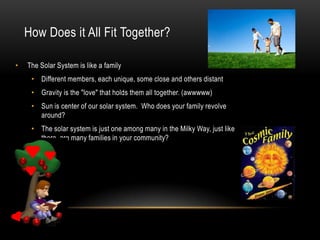
How Does it All Fit Together? The Solar System is like a familyDifferent members, each unique, some close and others distantGravity is the "love" that holds them all together. (awwwww)Sun is center of our solar system.  Who does your family revolve around?The solar system is just one among many in the Milky Way, just like there  are many families in your community?
What is The Universe?What is Space?What keeps our solar system in place?How did everything get where it is today?
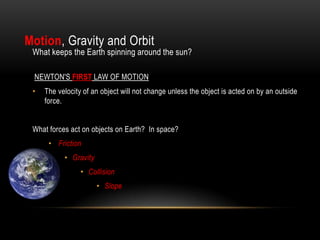
Motion, Gravity and OrbitWhat keeps the Earth spinning around the sun?NEWTON'SFIRST LAW OF MOTIONThe velocity of an object will not change unless the object is acted on by an outside force.What forces act on objects on Earth?  In space?FrictionGravityCollisionSlope
Motion, Gravity and OrbitWhat keeps the Earth spinning around the sun?NEWTON'S LAW OF GRAVITYAll objects with mass are attracted to one another by a gravitational force. If you've got "stuff" (mass) then you've got "love" (gravitational attraction).The gravitational force between two masses is directly proportional to the mass of each object. The bigger your "stuff," the bigger your "love."The gravitational force between two masses is inversely proportional to the square of the distance between those two objects. The more space between your "stuff" and mine, the less "love" there is between us, (a.k.a. distance does NOT make the heart grow fonder).

Our Solar System

  • 1.
  • 2.
    What is TheUniverse?What is Space?What keeps it all in place?How did everything get where it is today?
  • 3.
    What's in ourSolar System?The Sun - a star in the center of our planetary system, composed of hydrogen and helium, which produces its own energy and light
  • 4.
    Planets - largecelestial spheres, illuminated by light from the star around which they revolve
  • 5.
    Moons - naturalobjects that orbit a planet
  • 6.
    Comets - ballsof ice and rock with elliptical orbits around the Sun which develop long tails as they near the Sun
  • 7.
    Asteroids and Meteoroids- small rocky objects orbiting the Sun, which can collide with planets, moons or other objects
  • 8.
    Dwarf Planets -larger than asteroids but smaller than planets
  • 9.
    Kuiper Belt Objects- smaller icy/rocky objects beyond the orbit of Neptune which may supply materials for cometsBrief History of Astronomy2000 BC - Stonehenge & Mayan temples show ancient civilizations studied the night sky Early calendars developed based on lunar cycles200 AD - Greek astronomers (Ptolemy, Aristotle, etc.) map 1000's of starsGeocentric view of the universe1543 AD - Copernicus writes On the Revolution of Heavenly BodiesHeliocentric view of the universe presented but not accepted1580 to 1597 - Tycho Brahe and Johannes Kepler study the motion of planets1609 AD - Galileo studies the night sky with a telescope (he didn't invent it)1686 AD - Sir Isaac Newton formulates his Universal Law of GravitationHeliocentric view gains popularity1900's - Space exploration begins, huge advances made
  • 10.
    History of Astronomy2000BC - Stonehenge & Mayan temples show ancient civilizations studied the night sky Early calendars developed based on lunar cycles200 AD - Greek astronomers (Ptolemy, Aristotle, etc.) map 1000's of starsGeocentric view of the universe1543 AD - Copernicus writes On the Revolution of Heavenly BodiesHeliocentric view of the universe presented but not accepted1580 to 1597 - Tycho Brahe and Johannes Kepler study the motion of planets1609 AD - Galileo studies the night sky with a telescope (he didn't invent it)1686 AD - Sir Isaac Newton formulates his Universal Law of GravitationHeliocentric view gains popularity1900's - Space exploration begins (space shuttle missions, ISS, Hubble space telescope)
  • 11.
    How Does itAll Fit Together? The Solar System is like a familyDifferent members, each unique, some close and others distantGravity is the "love" that holds them all together. (awwwww)Sun is center of our solar system. Who does your family revolve around?The solar system is just one among many in the Milky Way, just like there are many families in your community?
  • 12.
    What is TheUniverse?What is Space?What keeps our solar system in place?How did everything get where it is today?
  • 13.
    Motion, Gravity andOrbitWhat keeps the Earth spinning around the sun?NEWTON'SFIRST LAW OF MOTIONThe velocity of an object will not change unless the object is acted on by an outside force.What forces act on objects on Earth? In space?FrictionGravityCollisionSlope
  • 14.
    Motion, Gravity andOrbitWhat keeps the Earth spinning around the sun?NEWTON'S LAW OF GRAVITYAll objects with mass are attracted to one another by a gravitational force. If you've got "stuff" (mass) then you've got "love" (gravitational attraction).The gravitational force between two masses is directly proportional to the mass of each object. The bigger your "stuff," the bigger your "love."The gravitational force between two masses is inversely proportional to the square of the distance between those two objects. The more space between your "stuff" and mine, the less "love" there is between us, (a.k.a. distance does NOT make the heart grow fonder).