Steps of  the  Scientific Method
The  Scientific Method  involves a series of steps that are used to investigate a natural occurrence.
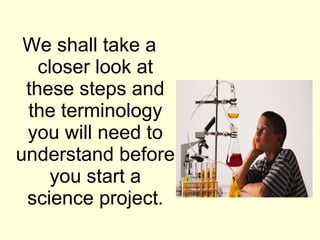
We shall take a closer look at these steps and the terminology you will need to understand before you start a science project.
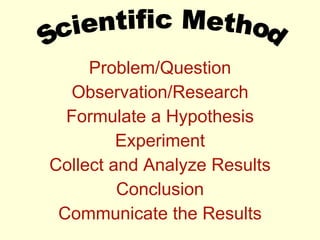
Problem/Question Observation/Research Formulate a Hypothesis Experiment Collect and Analyze Results Conclusion Communicate the Results Scientific Method
Steps of the  Scientific Method 1.  Problem/Question :  Develop a question or problem that can be solved through experimentation.
Steps of the  Scientific Method 2.  Observation/Research :  Make observations and research your topic of interest.
Do you remember the next step?
Steps of the  Scientific Method 3.  Formulate a Hypothesis :  Predict a possible answer to the problem or question. Example:  If  soil temperatures  rise, then  plant growth  will increase.
Steps of the  Scientific Method 4.  Experiment :  Develop and follow a  procedure . Include a detailed  materials  list. The outcome must be measurable (quantifiable).
Steps of the  Scientific Method 5.  Collect and Analyze Results :  Modify the procedure if needed. Confirm the results by retesting. Include tables, graphs, and photographs.
Steps of the  Scientific Method 6.  Conclusion :  Include a statement that accepts or rejects the hypothesis. Make recommendations for further study and possible improvements to the procedure.
Steps of the  Scientific Method 7.  Communicate the Results :  Be prepared to present the project to an audience. Expect questions from the audience.
Hypothesis The hypothesis is an educated guess about the relationship between the independent and dependent variables. Note: These variables will be defined in the next few slides.
Do you know the difference between the independent and dependent variables?
Independent Variable The independent, or manipulated variable, is a factor that’s intentionally varied by the experimenter.
Dependent Variable The dependent, or responding variable, is the factor that may change as a result of changes made in the independent variable.
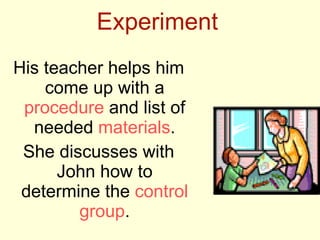
Experiment His teacher helps him come up with a  procedure   and list of needed  materials . She discusses with John how to determine the  control group .
Control Group In a scientific experiment, the control is the group that serves as the standard of comparison. The control group may be a “no treatment" or an “experimenter selected” group.
Control Group The control group is exposed to the same conditions as the experimental group, except for the variable being tested. All  experiments should have a control group.
Constants The constants in an experiment are all the factors that the experimenter attempts to keep the same.
Can you tell which group did the best?
Observe your world and come up with a question  to answer using the Scientific Method!

Scientific Method

  • 1.
    Steps of the Scientific Method
  • 2.
    The ScientificMethod involves a series of steps that are used to investigate a natural occurrence.
  • 3.
    We shall takea closer look at these steps and the terminology you will need to understand before you start a science project.
  • 4.
    Problem/Question Observation/Research Formulatea Hypothesis Experiment Collect and Analyze Results Conclusion Communicate the Results Scientific Method
  • 5.
    Steps of the Scientific Method 1. Problem/Question : Develop a question or problem that can be solved through experimentation.
  • 6.
    Steps of the Scientific Method 2. Observation/Research : Make observations and research your topic of interest.
  • 7.
    Do you rememberthe next step?
  • 8.
    Steps of the Scientific Method 3. Formulate a Hypothesis : Predict a possible answer to the problem or question. Example: If soil temperatures rise, then plant growth will increase.
  • 9.
    Steps of the Scientific Method 4. Experiment : Develop and follow a procedure . Include a detailed materials list. The outcome must be measurable (quantifiable).
  • 10.
    Steps of the Scientific Method 5. Collect and Analyze Results : Modify the procedure if needed. Confirm the results by retesting. Include tables, graphs, and photographs.
  • 11.
    Steps of the Scientific Method 6. Conclusion : Include a statement that accepts or rejects the hypothesis. Make recommendations for further study and possible improvements to the procedure.
  • 12.
    Steps of the Scientific Method 7. Communicate the Results : Be prepared to present the project to an audience. Expect questions from the audience.
  • 13.
    Hypothesis The hypothesisis an educated guess about the relationship between the independent and dependent variables. Note: These variables will be defined in the next few slides.
  • 14.
    Do you knowthe difference between the independent and dependent variables?
  • 15.
    Independent Variable Theindependent, or manipulated variable, is a factor that’s intentionally varied by the experimenter.
  • 16.
    Dependent Variable Thedependent, or responding variable, is the factor that may change as a result of changes made in the independent variable.
  • 17.
    Experiment His teacherhelps him come up with a procedure and list of needed materials . She discusses with John how to determine the control group .
  • 18.
    Control Group Ina scientific experiment, the control is the group that serves as the standard of comparison. The control group may be a “no treatment" or an “experimenter selected” group.
  • 19.
    Control Group Thecontrol group is exposed to the same conditions as the experimental group, except for the variable being tested. All experiments should have a control group.
  • 20.
    Constants The constantsin an experiment are all the factors that the experimenter attempts to keep the same.
  • 21.
    Can you tellwhich group did the best?
  • 22.
    Observe your worldand come up with a question to answer using the Scientific Method!