Life Science
Patterns of Evolution
Changes Over Time
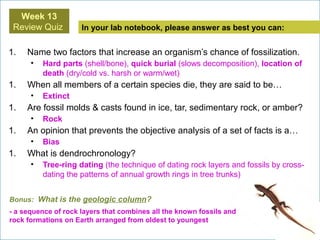
In your lab notebook, please answer as best you can:
Week 13
Review Quiz
Bonus: What is the geologic column?
- a sequence of rock layers that combines all the known fossils and
rock formations on Earth arranged from oldest to youngest
1. Name two factors that increase an organism’s chance of fossilization.
• Hard parts (shell/bone), quick burial (slows decomposition), location of
death (dry/cold vs. harsh or warm/wet)
1. When all members of a certain species die, they are said to be…
• Extinct
1. Are fossil molds & casts found in ice, tar, sedimentary rock, or amber?
• Rock
1. An opinion that prevents the objective analysis of a set of facts is a…
• Bias
1. What is dendrochronology?
• Tree-ring dating (the technique of dating rock layers and fossils by cross-
dating the patterns of annual growth rings in tree trunks)
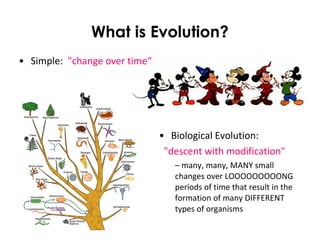
What is Evolution?
• Simple: "change over time“
• Biological Evolution:
"descent with modification"
– many, many, MANY small
changes over LOOOOOOOOONG
periods of time that result in the
formation of many DIFFERENT
types of organisms
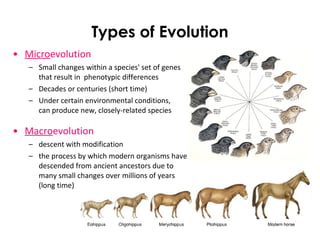
Types of Evolution
• Microevolution
– Small changes within a species' set of genes
that result in phenotypic differences
– Decades or centuries (short time)
– Under certain environmental conditions,
can produce new, closely-related species
• Macroevolution
– descent with modification
– the process by which modern organisms have
descended from ancient ancestors due to
many small changes over millions of years
(long time)
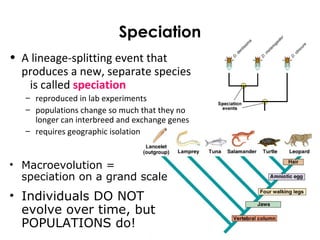
Speciation
• A lineage-splitting event that
produces a new, separate species
is called speciation
– reproduced in lab experiments
– populations change so much that they no
longer can interbreed and exchange genes
– requires geographic isolation
• Macroevolution =
speciation on a grand scale
• Individuals DO NOT
evolve over time, but
POPULATIONS do!
Week 13 Lab
Paper Airplane AdaptationsObservation
-A mutation is a change in the nucleotide base sequence of a gene (in a
cell’s DNA) that results in the manufacture of altered proteins which determine
an inherited trait.
-Mutations are rarely beneficial and only passed to offspring if they occur in
germ cells or gametes.
-Adaptations are traits caused by mutations that increase an organism’s or
population’s survival and/or ability to reproduce.
-Evolutionary fitness describes a population’s ability to survive and
reproduce in its current environment.
-Natural selection describes how a more fit population may be “chosen”
by their environment to survive. (This is really an awkward way of saying that
a less fit population that lacks adaptations will probably not survive or pass on
their genes.)
-Biological evolution occurs over long periods of time within populations of
living things due to differences in the frequency and combination of genes that
determine or influence inherited traits.
Paper Airplane Adaptations
- For this activity, paper
airplanes will represent
organisms of the same
species. Paper clips will
represent food, which the
organisms will be
competing for by trying to
reach the box. Certain
airplane designs may
provide an advantage for
the “organism” to reach
the food sooner and stay
alive. If your airplane is
the last to reach the box
in the center of the circle,
your organism will die
and you will have to sit
out for the rest of the
game!
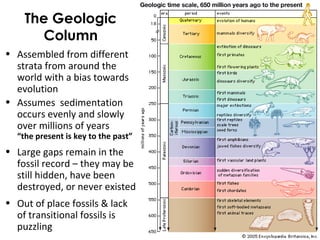
The Geologic
Column
• Assembled from different
strata from around the
world with a bias towards
evolution
• Assumes sedimentation
occurs evenly and slowly
over millions of years
“the present is key to the past”
• Large gaps remain in the
fossil record – they may be
still hidden, have been
destroyed, or never existed
• Out of place fossils & lack
of transitional fossils is
puzzling
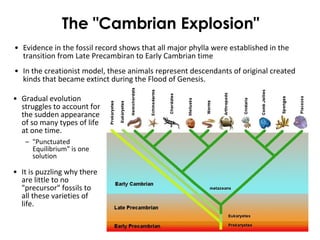
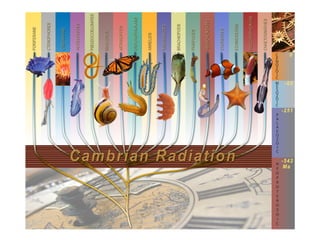
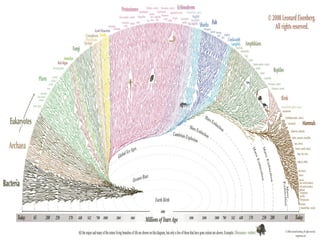
The "Cambrian Explosion"
• Evidence in the fossil record shows that all major phylla were established in the
transition from Late Precambiran to Early Cambrian time
• In the creationist model, these animals represent descendants of original created
kinds that became extinct during the Flood of Genesis.
• Gradual evolution
struggles to account for
the sudden appearance
of so many types of life
at one time.
– "Punctuated
Equilibrium" is one
solution
• It is puzzling why there
are little to no
"precursor" fossils to
all these varieties of
life.
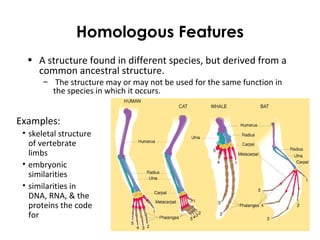
Homologous Features
• A structure found in different species, but derived from a
common ancestral structure.
– The structure may or may not be used for the same function in
the species in which it occurs.
Examples:
• skeletal structure
of vertebrate
limbs
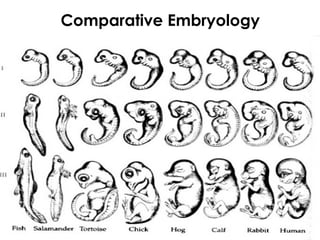
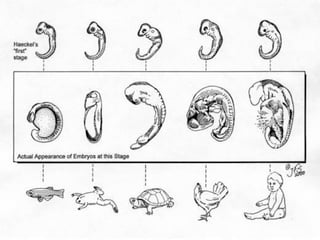
• embryonic
similarities
• similarities in
DNA, RNA, & the
proteins the code
for
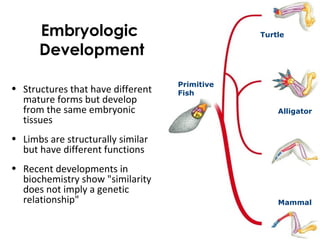
Embryologic
Development
• Structures that have different
mature forms but develop
from the same embryonic
tissues
• Limbs are structurally similar
but have different functions
• Recent developments in
biochemistry show "similarity
does not imply a genetic
relationship"
Alligator
Turtle
Primitive
Fish
Mammal
Comparative Embryology
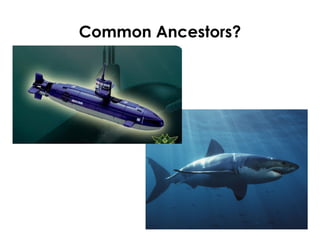
Common Ancestors?
Inherited Traits
• Neo-Darwinism sites the
similarities of genetics between
species as evidence of evolution
• Other scientists look DNA and see
the complexity and efficiency of
information transfer as evidence
for a single, intelligent “designer”
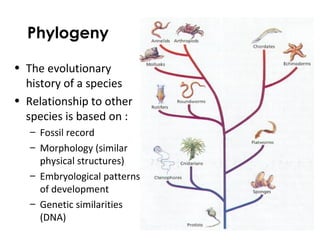
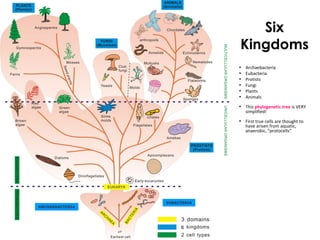
Phylogeny
• The evolutionary
history of a species
• Relationship to other
species is based on :
– Fossil record
– Morphology (similar
physical structures)
– Embryological patterns
of development
– Genetic similarities
(DNA)
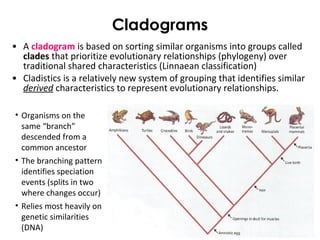
Cladograms
• A cladogram is based on sorting similar organisms into groups called
clades that prioritize evolutionary relationships (phylogeny) over
traditional shared characteristics (Linnaean classification)
• Cladistics is a relatively new system of grouping that identifies similar
derived characteristics to represent evolutionary relationships.
• Organisms on the
same “branch”
descended from a
common ancestor
• The branching pattern
identifies speciation
events (splits in two
where changes occur)
• Relies most heavily on
genetic similarities
(DNA)
Six
Kingdoms
• Archaebacteria
• Eubacteria
• Protists
• Fungi
• Plants
• Animals
• This phylogenetic tree is VERY
simplified!
• First true cells are thought to
have arisen from aquatic,
anaerobic, "protocells"
6
EUBACTERIA
ARCHAEBACTERIA
Patterns of Evolution