
Science is Organized Knowledge
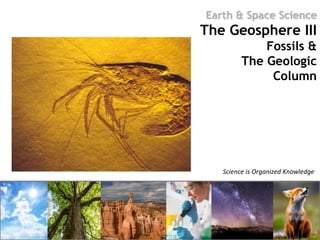
Earth & Space Science
The Geosphere III
Fossils &
The Geologic
Column
1. What naturally occurring, organic substances with crystalline structure combine to
form rocks?
• minerals
2. Name the three major rock types and briefly explain how they form.
• Igneous – cooled magma or lava
• Sedimentary – compressed layers of sand/sediment, cemented together via minerals
• Metamorphic – rocks changed by heat and pressure
3. True or False? Extrusive igneous formations occur when molten rock in Earth’s
mantle rises and cools within the crust (also called an igneous extrusion).
• False (extrusive = cooled lava, intrusive = cooled magma below the surface)
4. Which type of rock is most easily weathered?
• Sedimentary rock (is softer than igneous or metamorphic)
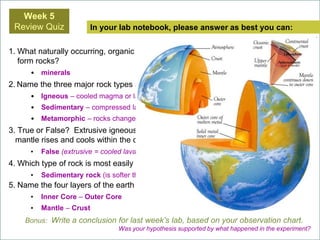
5. Name the four layers of the earth and give one fact about each.
• Inner Core – Outer Core
• Mantle – Crust
Bonus: Write a conclusion for last week’s lab, based on your observation chart.
Was your hypothesis supported by what happened in the experiment?
Week 5
Review Quiz In your lab notebook, please answer as best you can:
What do They Study?
• Archeologists
– study artifacts (evidence of human life on Earth)
• Geologists
– study rocks (the crust of Earth’s surface)
• Paleontologists
– study fossils (preserved remains of plants/animals)
Fossils
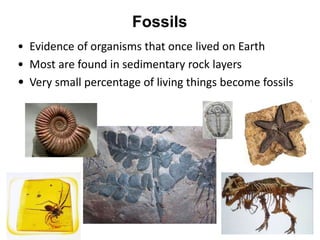
• Evidence of organisms that once lived on Earth
• Most are found in sedimentary rock layers
• Very small percentage of living things become fossils
Fossilization
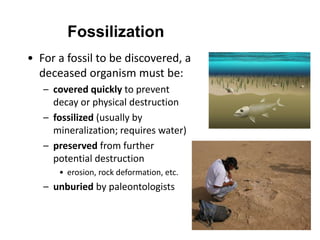
• For a fossil to be discovered, a
deceased organism must be:
– covered quickly to prevent
decay or physical destruction
– fossilized (usually by
mineralization; requires water)
– preserved from further
potential destruction
• erosion, rock deformation, etc.
– unburied by paleontologists
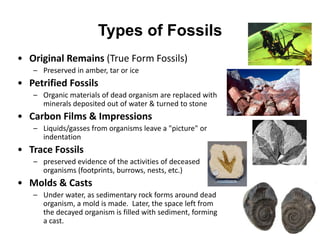
• Original Remains (True Form Fossils)
– Preserved in amber, tar or ice
• Petrified Fossils
– Organic materials of dead organism are replaced with
minerals deposited out of water & turned to stone
• Carbon Films & Impressions
– Liquids/gasses from organisms leave a "picture" or
indentation
• Trace Fossils
– preserved evidence of the activities of deceased
organisms (footprints, burrows, nests, etc.)
• Molds & Casts
– Under water, as sedimentary rock forms around dead
organism, a mold is made. Later, the space left from
the decayed organism is filled with sediment, forming
a cast.
Types of Fossils
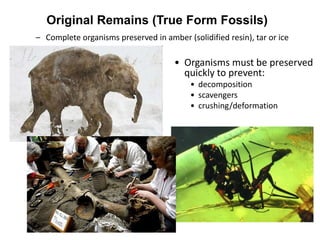
Original Remains (True Form Fossils)
– Complete organisms preserved in amber (solidified resin), tar or ice
• Organisms must be preserved
quickly to prevent:
• decomposition
• scavengers
• crushing/deformation
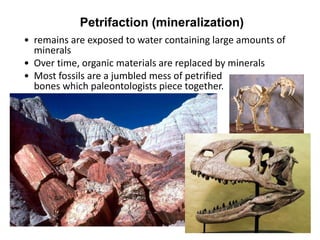
Petrifaction (mineralization)
• remains are exposed to water containing large amounts of
minerals
• Over time, organic materials are replaced by minerals
• Most fossils are a jumbled mess of petrified
bones which paleontologists piece together.
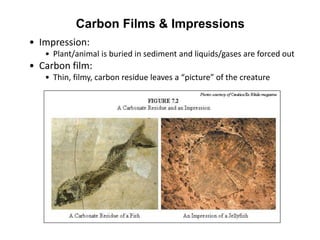
Carbon Films & Impressions
• Impression:
• Plant/animal is buried in sediment and liquids/gases are forced out
• Carbon film:
• Thin, filmy, carbon residue leaves a “picture” of the creature
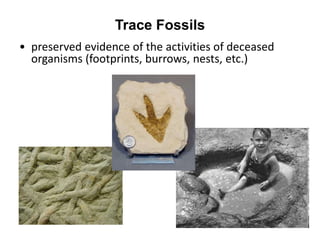
Trace Fossils
• preserved evidence of the activities of deceased
organisms (footprints, burrows, nests, etc.)
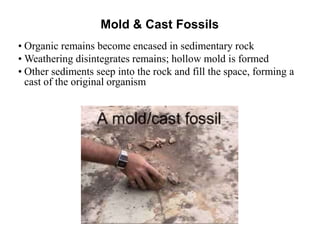
Mold & Cast Fossils
• Organic remains become encased in sedimentary rock
• Weathering disintegrates remains; hollow mold is formed
• Other sediments seep into the rock and fill the space, forming a
cast of the original organism
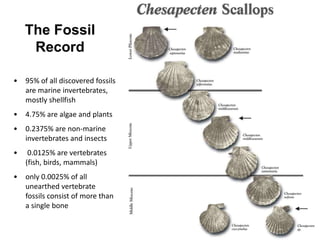
The Fossil
Record
• 95% of all discovered fossils
are marine invertebrates,
mostly shellfish
• 4.75% are algae and plants
• 0.2375% are non-marine
invertebrates and insects
• 0.0125% are vertebrates
(fish, birds, mammals)
• only 0.0025% of all
unearthed vertebrate
fossils consist of more than
a single bone
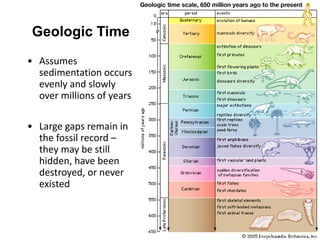
Geologic Time
• Assumes
sedimentation occurs
evenly and slowly
over millions of years
• Large gaps remain in
the fossil record –
they may be still
hidden, have been
destroyed, or never
existed
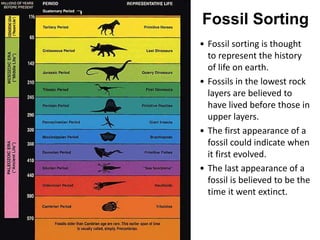
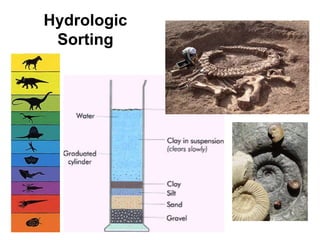
• Fossil sorting is thought
to represent the history
of life on earth.
• Fossils in the lowest rock
layers are believed to
have lived before those in
upper layers.
• The first appearance of a
fossil could indicate when
it first evolved.
• The last appearance of a
fossil is believed to be the
time it went extinct.
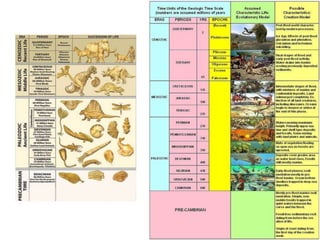
Fossil Sorting
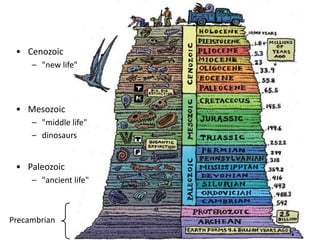
Precambrian
• Cenozoic
– "new life"
• Mesozoic
– "middle life"
– dinosaurs
• Paleozoic
– "ancient life"
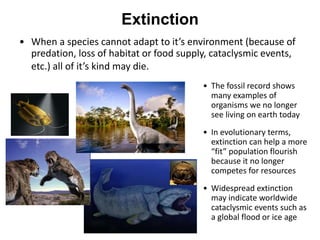
Extinction
• When a species cannot adapt to it’s environment (because of
predation, loss of habitat or food supply, cataclysmic events,
etc.) all of it’s kind may die.
• The fossil record shows
many examples of
organisms we no longer
see living on earth today
• In evolutionary terms,
extinction can help a more
“fit” population flourish
because it no longer
competes for resources
• Widespread extinction
may indicate worldwide
cataclysmic events such as
a global flood or ice age
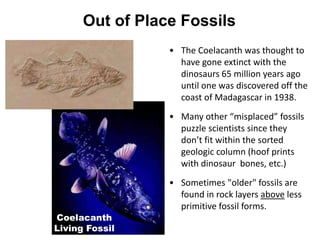
Out of Place Fossils
• The Coelacanth was thought to
have gone extinct with the
dinosaurs 65 million years ago
until one was discovered off the
coast of Madagascar in 1938.
• Many other “misplaced” fossils
puzzle scientists since they
don’t fit within the sorted
geologic column (hoof prints
with dinosaur bones, etc.)
• Sometimes "older" fossils are
found in rock layers above less
primitive fossil forms.
Coelacanth
Living Fossil
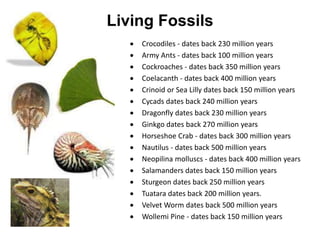
Living Fossils
 Crocodiles - dates back 230 million years
 Army Ants - dates back 100 million years
 Cockroaches - dates back 350 million years
 Coelacanth - dates back 400 million years
 Crinoid or Sea Lilly dates back 150 million years
 Cycads dates back 240 million years
 Dragonfly dates back 230 million years
 Ginkgo dates back 270 million years
 Horseshoe Crab - dates back 300 million years
 Nautilus - dates back 500 million years
 Neopilina molluscs - dates back 400 million years
 Salamanders dates back 150 million years
 Sturgeon dates back 250 million years
 Tuatara dates back 200 million years.
 Velvet Worm dates back 500 million years
 Wollemi Pine - dates back 150 million years
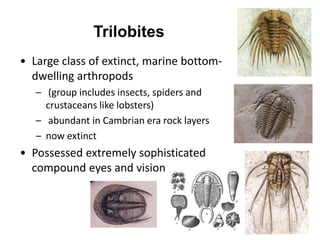
Trilobites
• Large class of extinct, marine bottom-
dwelling arthropods
– (group includes insects, spiders and
crustaceans like lobsters)
– abundant in Cambrian era rock layers
– now extinct
• Possessed extremely sophisticated
compound eyes and vision
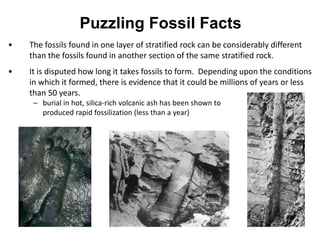
Puzzling Fossil Facts
• The fossils found in one layer of stratified rock can be considerably different
than the fossils found in another section of the same stratified rock.
• It is disputed how long it takes fossils to form. Depending upon the conditions
in which it formed, there is evidence that it could be millions of years or less
than 50 years.
– burial in hot, silica-rich volcanic ash has been shown to
produced rapid fossilization (less than a year)
The "Cambrian Explosion"
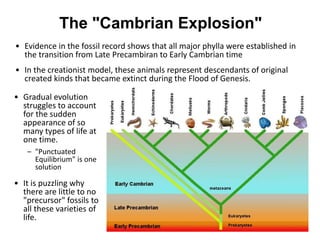
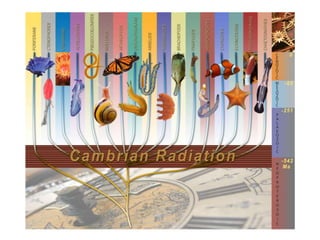
• Evidence in the fossil record shows that all major phylla were established in
the transition from Late Precambiran to Early Cambrian time
• In the creationist model, these animals represent descendants of original
created kinds that became extinct during the Flood of Genesis.
• Gradual evolution
struggles to account
for the sudden
appearance of so
many types of life at
one time.
– "Punctuated
Equilibrium" is one
solution
• It is puzzling why
there are little to no
"precursor" fossils to
all these varieties of
life.
Transitional Fossils
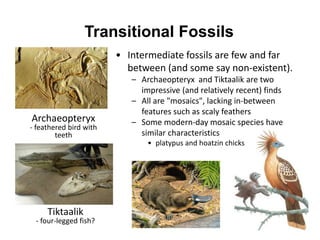
• Intermediate fossils are few and far
between (and some say non-existent).
– Archaeopteryx and Tiktaalik are two
impressive (and relatively recent) finds
– All are "mosaics", lacking in-between
features such as scaly feathers
– Some modern-day mosaic species have
similar characteristics
• platypus and hoatzin chicks
Archaeopteryx
- feathered bird with
teeth
Tiktaalik
- four-legged fish?
Fossil Dating Methods
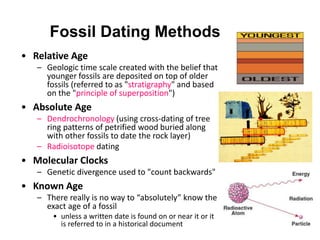
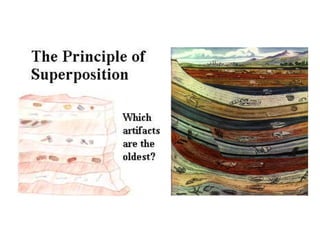
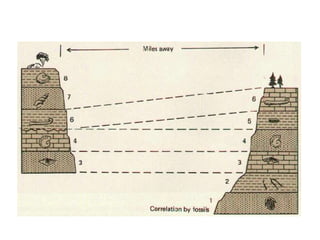
• Relative Age
– Geologic time scale created with the belief that
younger fossils are deposited on top of older
fossils (referred to as "stratigraphy" and based
on the "principle of superposition")
• Absolute Age
– Dendrochronology (using cross-dating of tree
ring patterns of petrified wood buried along
with other fossils to date the rock layer)
– Radioisotope dating
• Molecular Clocks
– Genetic divergence used to "count backwards"
• Known Age
– There really is no way to “absolutely” know the
exact age of a fossil
• unless a written date is found on or near it or it
is referred to in a historical document
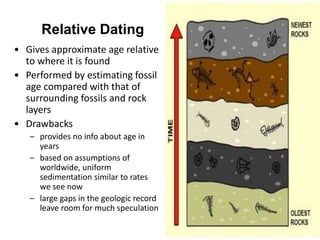
Relative Dating
• Gives approximate age relative
to where it is found
• Performed by estimating fossil
age compared with that of
surrounding fossils and rock
layers
• Drawbacks
– provides no info about age in
years
– based on assumptions of
worldwide, uniform
sedimentation similar to rates
we see now
– large gaps in the geologic record
leave room for much speculation
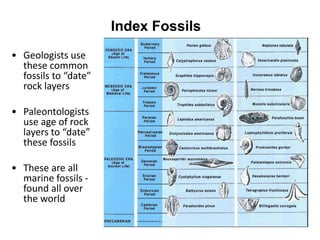
Index Fossils
• Geologists use
these common
fossils to “date”
rock layers
• Paleontologists
use age of rock
layers to “date”
these fossils
• These are all
marine fossils -
found all over
the world
Hydrologic
Sorting
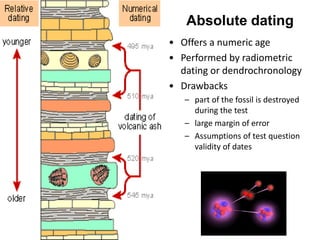
Absolute dating
• Offers a numeric age
• Performed by radiometric
dating or dendrochronology
• Drawbacks
– part of the fossil is destroyed
during the test
– large margin of error
– Assumptions of test question
validity of dates
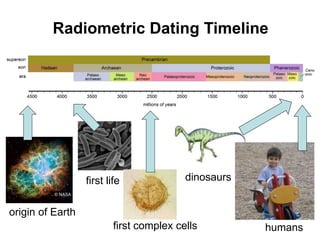
Radiometric Dating Timeline
dinosaurs
humans
first life
origin of Earth
© NASA
first complex cells
Geosphere III: Fossils

Geosphere III: Fossils

  • 1.
    Science is OrganizedKnowledge Earth & Space Science The Geosphere III Fossils & The Geologic Column
  • 2.
    1. What naturallyoccurring, organic substances with crystalline structure combine to form rocks? • minerals 2. Name the three major rock types and briefly explain how they form. • Igneous – cooled magma or lava • Sedimentary – compressed layers of sand/sediment, cemented together via minerals • Metamorphic – rocks changed by heat and pressure 3. True or False? Extrusive igneous formations occur when molten rock in Earth’s mantle rises and cools within the crust (also called an igneous extrusion). • False (extrusive = cooled lava, intrusive = cooled magma below the surface) 4. Which type of rock is most easily weathered? • Sedimentary rock (is softer than igneous or metamorphic) 5. Name the four layers of the earth and give one fact about each. • Inner Core – Outer Core • Mantle – Crust Bonus: Write a conclusion for last week’s lab, based on your observation chart. Was your hypothesis supported by what happened in the experiment? Week 5 Review Quiz In your lab notebook, please answer as best you can:
  • 3.
    What do TheyStudy? • Archeologists – study artifacts (evidence of human life on Earth) • Geologists – study rocks (the crust of Earth’s surface) • Paleontologists – study fossils (preserved remains of plants/animals)
  • 4.
    Fossils • Evidence oforganisms that once lived on Earth • Most are found in sedimentary rock layers • Very small percentage of living things become fossils
  • 5.
    Fossilization • For afossil to be discovered, a deceased organism must be: – covered quickly to prevent decay or physical destruction – fossilized (usually by mineralization; requires water) – preserved from further potential destruction • erosion, rock deformation, etc. – unburied by paleontologists
  • 6.
    • Original Remains(True Form Fossils) – Preserved in amber, tar or ice • Petrified Fossils – Organic materials of dead organism are replaced with minerals deposited out of water & turned to stone • Carbon Films & Impressions – Liquids/gasses from organisms leave a "picture" or indentation • Trace Fossils – preserved evidence of the activities of deceased organisms (footprints, burrows, nests, etc.) • Molds & Casts – Under water, as sedimentary rock forms around dead organism, a mold is made. Later, the space left from the decayed organism is filled with sediment, forming a cast. Types of Fossils
  • 7.
    Original Remains (TrueForm Fossils) – Complete organisms preserved in amber (solidified resin), tar or ice • Organisms must be preserved quickly to prevent: • decomposition • scavengers • crushing/deformation
  • 8.
    Petrifaction (mineralization) • remainsare exposed to water containing large amounts of minerals • Over time, organic materials are replaced by minerals • Most fossils are a jumbled mess of petrified bones which paleontologists piece together.
  • 9.
    Carbon Films &Impressions • Impression: • Plant/animal is buried in sediment and liquids/gases are forced out • Carbon film: • Thin, filmy, carbon residue leaves a “picture” of the creature
  • 10.
    Trace Fossils • preservedevidence of the activities of deceased organisms (footprints, burrows, nests, etc.)
  • 11.
    Mold & CastFossils • Organic remains become encased in sedimentary rock • Weathering disintegrates remains; hollow mold is formed • Other sediments seep into the rock and fill the space, forming a cast of the original organism
  • 12.
    The Fossil Record • 95%of all discovered fossils are marine invertebrates, mostly shellfish • 4.75% are algae and plants • 0.2375% are non-marine invertebrates and insects • 0.0125% are vertebrates (fish, birds, mammals) • only 0.0025% of all unearthed vertebrate fossils consist of more than a single bone
  • 13.
    Geologic Time • Assumes sedimentationoccurs evenly and slowly over millions of years • Large gaps remain in the fossil record – they may be still hidden, have been destroyed, or never existed
  • 14.
    • Fossil sortingis thought to represent the history of life on earth. • Fossils in the lowest rock layers are believed to have lived before those in upper layers. • The first appearance of a fossil could indicate when it first evolved. • The last appearance of a fossil is believed to be the time it went extinct. Fossil Sorting
  • 15.
    Precambrian • Cenozoic – "newlife" • Mesozoic – "middle life" – dinosaurs • Paleozoic – "ancient life"
  • 16.
    Extinction • When aspecies cannot adapt to it’s environment (because of predation, loss of habitat or food supply, cataclysmic events, etc.) all of it’s kind may die. • The fossil record shows many examples of organisms we no longer see living on earth today • In evolutionary terms, extinction can help a more “fit” population flourish because it no longer competes for resources • Widespread extinction may indicate worldwide cataclysmic events such as a global flood or ice age
  • 17.
    Out of PlaceFossils • The Coelacanth was thought to have gone extinct with the dinosaurs 65 million years ago until one was discovered off the coast of Madagascar in 1938. • Many other “misplaced” fossils puzzle scientists since they don’t fit within the sorted geologic column (hoof prints with dinosaur bones, etc.) • Sometimes "older" fossils are found in rock layers above less primitive fossil forms. Coelacanth Living Fossil
  • 18.
    Living Fossils  Crocodiles- dates back 230 million years  Army Ants - dates back 100 million years  Cockroaches - dates back 350 million years  Coelacanth - dates back 400 million years  Crinoid or Sea Lilly dates back 150 million years  Cycads dates back 240 million years  Dragonfly dates back 230 million years  Ginkgo dates back 270 million years  Horseshoe Crab - dates back 300 million years  Nautilus - dates back 500 million years  Neopilina molluscs - dates back 400 million years  Salamanders dates back 150 million years  Sturgeon dates back 250 million years  Tuatara dates back 200 million years.  Velvet Worm dates back 500 million years  Wollemi Pine - dates back 150 million years
  • 19.
    Trilobites • Large classof extinct, marine bottom- dwelling arthropods – (group includes insects, spiders and crustaceans like lobsters) – abundant in Cambrian era rock layers – now extinct • Possessed extremely sophisticated compound eyes and vision
  • 20.
    Puzzling Fossil Facts •The fossils found in one layer of stratified rock can be considerably different than the fossils found in another section of the same stratified rock. • It is disputed how long it takes fossils to form. Depending upon the conditions in which it formed, there is evidence that it could be millions of years or less than 50 years. – burial in hot, silica-rich volcanic ash has been shown to produced rapid fossilization (less than a year)
  • 21.
    The "Cambrian Explosion" •Evidence in the fossil record shows that all major phylla were established in the transition from Late Precambiran to Early Cambrian time • In the creationist model, these animals represent descendants of original created kinds that became extinct during the Flood of Genesis. • Gradual evolution struggles to account for the sudden appearance of so many types of life at one time. – "Punctuated Equilibrium" is one solution • It is puzzling why there are little to no "precursor" fossils to all these varieties of life.
  • 23.
    Transitional Fossils • Intermediatefossils are few and far between (and some say non-existent). – Archaeopteryx and Tiktaalik are two impressive (and relatively recent) finds – All are "mosaics", lacking in-between features such as scaly feathers – Some modern-day mosaic species have similar characteristics • platypus and hoatzin chicks Archaeopteryx - feathered bird with teeth Tiktaalik - four-legged fish?
  • 24.
    Fossil Dating Methods •Relative Age – Geologic time scale created with the belief that younger fossils are deposited on top of older fossils (referred to as "stratigraphy" and based on the "principle of superposition") • Absolute Age – Dendrochronology (using cross-dating of tree ring patterns of petrified wood buried along with other fossils to date the rock layer) – Radioisotope dating • Molecular Clocks – Genetic divergence used to "count backwards" • Known Age – There really is no way to “absolutely” know the exact age of a fossil • unless a written date is found on or near it or it is referred to in a historical document
  • 25.
    Relative Dating • Givesapproximate age relative to where it is found • Performed by estimating fossil age compared with that of surrounding fossils and rock layers • Drawbacks – provides no info about age in years – based on assumptions of worldwide, uniform sedimentation similar to rates we see now – large gaps in the geologic record leave room for much speculation
  • 27.
    Index Fossils • Geologistsuse these common fossils to “date” rock layers • Paleontologists use age of rock layers to “date” these fossils • These are all marine fossils - found all over the world
  • 29.
  • 30.
    Absolute dating • Offersa numeric age • Performed by radiometric dating or dendrochronology • Drawbacks – part of the fossil is destroyed during the test – large margin of error – Assumptions of test question validity of dates
  • 31.
    Radiometric Dating Timeline dinosaurs humans firstlife origin of Earth © NASA first complex cells