Chemistry
REVIEW
Basic
Chemistry
i wonder why
Physical Science
In your lab notebook, please answer as best you can:
1. Which subatomic particles are involved in chemical reactions?
• VALENCE electrons (electrons in the outermost energy level)
2. A molecule in which electrons are shared by two or more atoms
has which type of bond? (ionic, covalent, hydrogen, or metallic)
• Covalent bond
3. Draw a Bohr Model diagram of a
stable, neutral Lithium atom.
4. Draw a Lewis Dot Structure of a
stable, neutral Lithium atom.
5. What makes for a happy atom (stable/unreactive)?
• Paired electrons and full energy levels (filled valence electron shell)
Bonus Question: What are the building blocks of matter?
Atoms
Review
Quiz 3
H
H
H
H
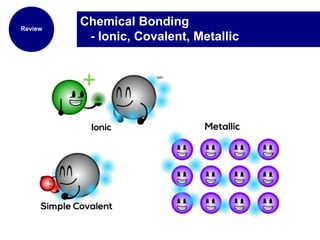
Chemical Bonding
- Ionic, Covalent, Metallic
Review
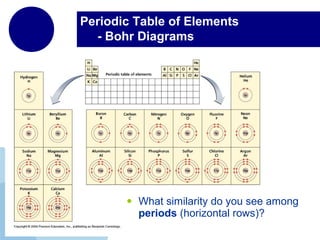
Periodic Table of Elements
- Bohr Diagrams
• What similarity do you see among
periods (horizontal rows)?
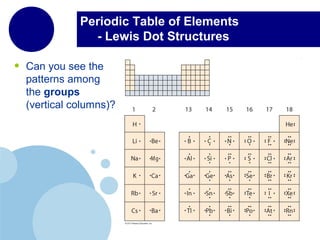
Periodic Table of Elements
- Lewis Dot Structures
• Can you see the
patterns among
the groups
(vertical columns)?
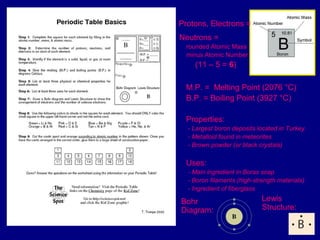
Protons, Electrons =
Neutrons =
rounded Atomic Mass
minus Atomic Number
(11 – 5 = 6)
M.P. = Melting Point (2076 °C)
B.P. = Boiling Point (3927 °C)
Properties:
- Largest boron deposits located in Turkey
- Metalloid found in meteorites
- Brown powder (or black crystals)
Uses:
- Main ingredient in Borax soap
- Boron filaments (high-strength materials)
- Ingredient of fiberglass
Bohr
Diagram:
Lewis
Structure:
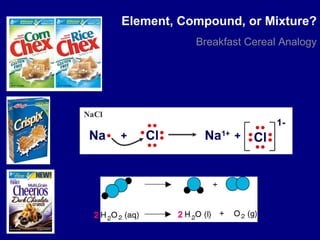
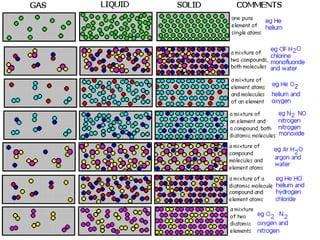
Element, Compound, or Mixture?
Breakfast Cereal Analogy
2 2
Chemical Bonding
- Ionic, Covalent, Metallic
Element, Compound, or Mixture?
Chemical Bonding
- Ionic, Covalent, Metallic
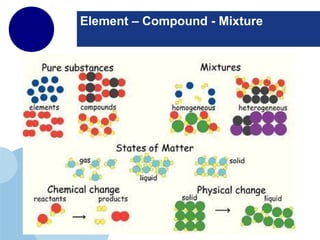
Element – Compound - Mixture
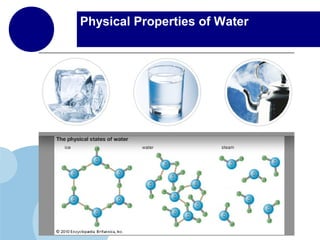
Physical Properties of Water
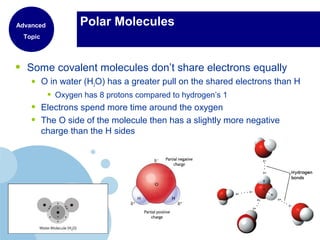
Polar Molecules
• Some covalent molecules don’t share electrons equally
• O in water (H2O) has a greater pull on the shared electrons than H
• Oxygen has 8 protons compared to hydrogen’s 1
• Electrons spend more time around the oxygen
• The O side of the molecule then has a slightly more negative
charge than the H sides
Advanced
Topic
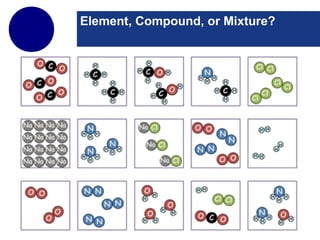
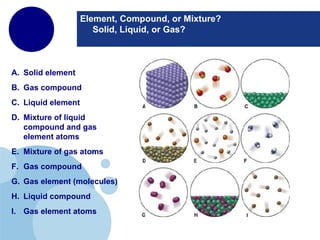
Element, Compound, or Mixture?
Solid, Liquid, or Gas?
A. Solid element
B. Gas compound
C. Liquid element
D. Mixture of liquid
compound and gas
element atoms
E. Mixture of gas atoms
F. Gas compound
G. Gas element (molecules)
H. Liquid compound
I. Gas element atoms