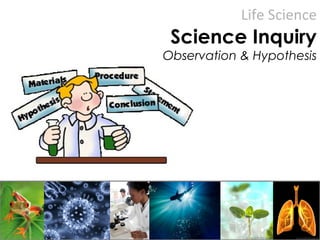
Life Science
Science Inquiry
Observation & Hypothesis
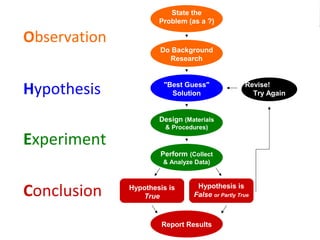
State the
Problem (as a ?)
Do Background
Research
"Best Guess"
Solution
Design (Materials
& Procedures)
Perform (Collect
& Analyze Data)
Report Results
Hypothesis is
False or Partly True
Hypothesis is
True
Revise!
Try Again
Conclusion
Experiment
Hypothesis
Observation
Week 27 Lab
The Scientific Method
Click on the picture to watch a video.
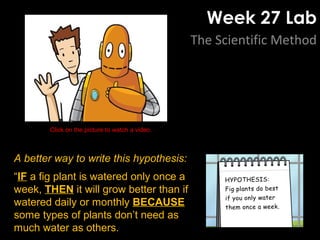
A better way to write this hypothesis:
“IF a fig plant is watered only once a
week, THEN it will grow better than if
watered daily or monthly BECAUSE
some types of plants don’t need as
much water as others.
The Scientific Method -
Observation
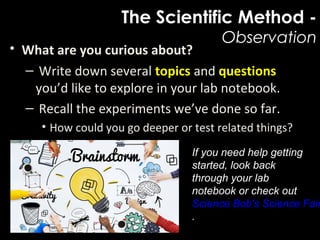
• What are you curious about?
– Write down several topics and questions
you’d like to explore in your lab notebook.
– Recall the experiments we’ve done so far.
• How could you go deeper or test related things?
If you need help getting
started, look back
through your lab
notebook or check out
Science Bob's Science Fair
.
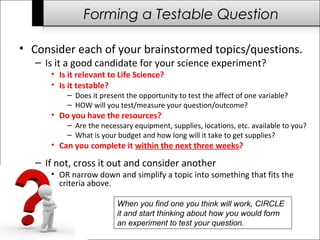
Forming a Testable Question
• Consider each of your brainstormed topics/questions.
– Is it a good candidate for your science experiment?
• Is it relevant to Life Science?
• Is it testable?
– Does it present the opportunity to test the affect of one variable?
– HOW will you test/measure your question/outcome?
• Do you have the resources?
– Are the necessary equipment, supplies, locations, etc. available to you?
– What is your budget and how long will it take to get supplies?
• Can you complete it within the next three weeks?
– If not, cross it out and consider another
• OR narrow down and simplify a topic into something that fits the
criteria above.
When you find one you think will work, CIRCLE
it and start thinking about how you would form
an experiment to test your question.
Scientific Questions
• Scientific questions are:
– Testable
• Considers cause/effect.
– “If I do ________, then ____________ will happen.”
– i.e. What effect does the amount of water have on plant survival?
– Specific
• Narrows down an idea to a manageable investigation
• Takes into account how the question will be tested/measured
• Explores ONE manipulated variable (change that may cause an
effect)
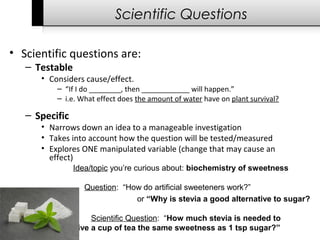
Idea/topic you’re curious about: biochemistry of sweetness
Question: “How do artificial sweeteners work?”
or “Why is stevia a good alternative to sugar?
Scientific Question: “How much stevia is needed to
give a cup of tea the same sweetness as 1 tsp sugar?”
The Scientific Method –
Forming a Question
• Turn one of your “topics” or ideas into a:
Good Scientific Question  
–Has ONE variable (factor) that is tested
–The outcome (result) can be objectively 
measured and compared
–Other variables can be controlled
–Materials & time resources are available
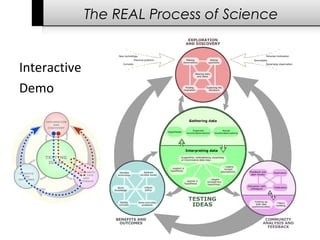
The REAL Process of Science
Interactive
Demo
The Scientific Method - Hypothesis
• A hypothesis is an educated guess that answers your scientific 
question.
• Incorporates the experiment design.
• Often follows the cause/effect formula.
– “If ________, then ____________ because _____.”
Scientific Question: “How much stevia is needed to give a cup of tea the
same sweetness as 1 tsp sugar?”
Hypothesis:
“If we add different amounts of stevia and compare its sweetness to
sugar-sweetened tea,
then less stevia will be needed
because it has a stronger ability to sweeten than sugar.”
Bias in Scientific Research
• Hypothesizing requires speculation based on inference.
– bias is an assumed belief that affect the way you see and 
understand things
– bias is always present when formulating a hypothesis
• The Scientific Method forces only the 
facts to be considered
– seeks to eliminate variables that can skew 
results and focus on OBJECTIVE data
– encourages collaboration & accountability 
• shared results, repeated studies
– still, bias is ALWAYS present & affects 
many research outcomes
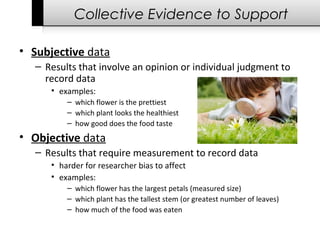
Collective Evidence to Support
• Subjective data 
– Results that involve an opinion or individual judgment to 
record data
• examples:
– which flower is the prettiest
– which plant looks the healthiest
– how good does the food taste
• Objective data
– Results that require measurement to record data 
• harder for researcher bias to affect
• examples:
– which flower has the largest petals (measured size)
– which plant has the tallest stem (or greatest number of leaves)
– how much of the food was eaten
The Scientific Method -
Hypothesis
• CHOOSE ONE QUESTION and write your
best-guess answer to the question.  
–Tell what you think will happen in an 
“if-then-because” statement.
–Support your hypothesis with facts.
• If needed, do more background research
– Internet, books/magazines, interview experts
Applying the Scientific Method
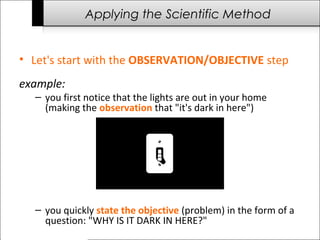
• Let's start with the OBSERVATION/OBJECTIVE step
example:
– you first notice that the lights are out in your home
(making the observation that "it's dark in here")
– you quickly state the objective (problem) in the form of a
question: "WHY IS IT DARK IN HERE?"
While fumbling around in the dark, you do a little
background research and observe that:
• the weather outside is calm and clear
• the other homes on your street still have power
• the T.V. and computer upstairs are working, but the
lights and outlets downstairs are not working
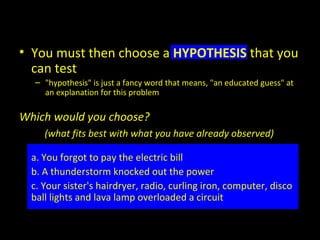
• You must then choose a HYPOTHESIS that you
can test
– "hypothesis" is just a fancy word that means, "an educated guess" at
an explanation for this problem
Which would you choose?
(what fits best with what you have already observed)
a. You forgot to pay the electric bill
b. A thunderstorm knocked out the power
c. Your sister's hairdryer, radio, curling iron, computer, disco
ball lights and lava lamp overloaded a circuit
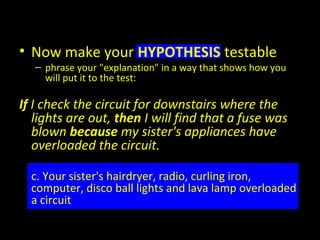
• Now make your HYPOTHESIS testable
– phrase your "explanation" in a way that shows how you
will put it to the test:
If I check the circuit for downstairs where the
lights are out, then I will find that a fuse was
blown because my sister's appliances have
overloaded the circuit.
c. Your sister's hairdryer, radio, curling iron,
computer, disco ball lights and lava lamp overloaded
a circuit
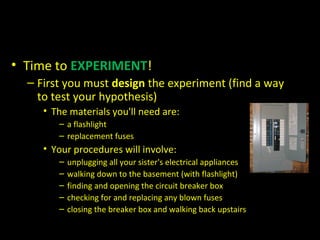
• Time to EXPERIMENT!
– First you must design the experiment (find a way
to test your hypothesis)
• The materials you'll need are:
– a flashlight
– replacement fuses
• Your procedures will involve:
– unplugging all your sister's electrical appliances
– walking down to the basement (with flashlight)
– finding and opening the circuit breaker box
– checking for and replacing any blown fuses
– closing the breaker box and walking back upstairs
– Next you must perform the experiment and
record all the results
• You gather the materials and follow the procedures
carefully, collecting data as you go
• Upon reaching the circuit box, you find a blown fuse
and replace it. As you climb the stairs, you notice ALL
the lights back on in the house.
• A quick mental analysis of this information leads you
to...
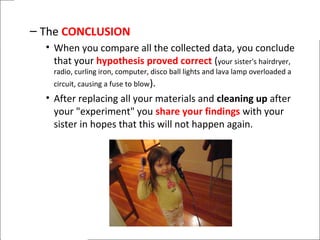
– The CONCLUSION
• When you compare all the collected data, you conclude
that your hypothesis proved correct (your sister's hairdryer,
radio, curling iron, computer, disco ball lights and lava lamp overloaded a
circuit, causing a fuse to blow).
• After replacing all your materials and cleaning up after
your "experiment" you share your findings with your
sister in hopes that this will not happen again.
Now, if you wanted to use the scientific
method to its fullest extent, you could
• Repeat the experiment
• See if the results are the same
OR even better yet, let someone else follow your
procedures and repeat the experiment to see if
THEY get the same results
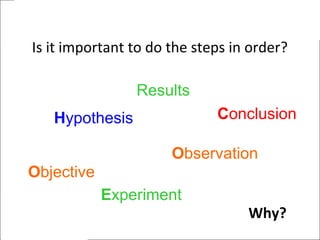
Is it important to do the steps in order?
Why?
Observation
Hypothesis
Experiment
Conclusion
Objective
Results
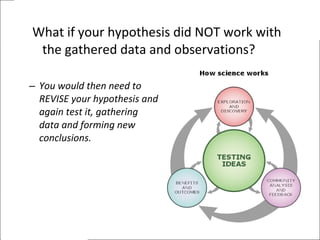
– You would then need to
REVISE your hypothesis and
again test it, gathering
data and forming new
conclusions.
What if your hypothesis did NOT work with
the gathered data and observations?

Science Inquiry: Question and Hypothesis

  • 1.
  • 2.
    State the Problem (asa ?) Do Background Research "Best Guess" Solution Design (Materials & Procedures) Perform (Collect & Analyze Data) Report Results Hypothesis is False or Partly True Hypothesis is True Revise! Try Again Conclusion Experiment Hypothesis Observation
  • 3.
    Week 27 Lab TheScientific Method Click on the picture to watch a video. A better way to write this hypothesis: “IF a fig plant is watered only once a week, THEN it will grow better than if watered daily or monthly BECAUSE some types of plants don’t need as much water as others.
  • 4.
    The Scientific Method- Observation • What are you curious about? – Write down several topics and questions you’d like to explore in your lab notebook. – Recall the experiments we’ve done so far. • How could you go deeper or test related things? If you need help getting started, look back through your lab notebook or check out Science Bob's Science Fair .
  • 5.
    Forming a TestableQuestion • Consider each of your brainstormed topics/questions. – Is it a good candidate for your science experiment? • Is it relevant to Life Science? • Is it testable? – Does it present the opportunity to test the affect of one variable? – HOW will you test/measure your question/outcome? • Do you have the resources? – Are the necessary equipment, supplies, locations, etc. available to you? – What is your budget and how long will it take to get supplies? • Can you complete it within the next three weeks? – If not, cross it out and consider another • OR narrow down and simplify a topic into something that fits the criteria above. When you find one you think will work, CIRCLE it and start thinking about how you would form an experiment to test your question.
  • 6.
    Scientific Questions • Scientificquestions are: – Testable • Considers cause/effect. – “If I do ________, then ____________ will happen.” – i.e. What effect does the amount of water have on plant survival? – Specific • Narrows down an idea to a manageable investigation • Takes into account how the question will be tested/measured • Explores ONE manipulated variable (change that may cause an effect) Idea/topic you’re curious about: biochemistry of sweetness Question: “How do artificial sweeteners work?” or “Why is stevia a good alternative to sugar? Scientific Question: “How much stevia is needed to give a cup of tea the same sweetness as 1 tsp sugar?”
  • 7.
    The Scientific Method– Forming a Question • Turn one of your “topics” or ideas into a: Good Scientific Question   –Has ONE variable (factor) that is tested –The outcome (result) can be objectively  measured and compared –Other variables can be controlled –Materials & time resources are available
  • 8.
    The REAL Processof Science Interactive Demo
  • 9.
    The Scientific Method- Hypothesis • A hypothesis is an educated guess that answers your scientific  question. • Incorporates the experiment design. • Often follows the cause/effect formula. – “If ________, then ____________ because _____.” Scientific Question: “How much stevia is needed to give a cup of tea the same sweetness as 1 tsp sugar?” Hypothesis: “If we add different amounts of stevia and compare its sweetness to sugar-sweetened tea, then less stevia will be needed because it has a stronger ability to sweeten than sugar.”
  • 10.
    Bias in ScientificResearch • Hypothesizing requires speculation based on inference. – bias is an assumed belief that affect the way you see and  understand things – bias is always present when formulating a hypothesis • The Scientific Method forces only the  facts to be considered – seeks to eliminate variables that can skew  results and focus on OBJECTIVE data – encourages collaboration & accountability  • shared results, repeated studies – still, bias is ALWAYS present & affects  many research outcomes
  • 11.
    Collective Evidence toSupport • Subjective data  – Results that involve an opinion or individual judgment to  record data • examples: – which flower is the prettiest – which plant looks the healthiest – how good does the food taste • Objective data – Results that require measurement to record data  • harder for researcher bias to affect • examples: – which flower has the largest petals (measured size) – which plant has the tallest stem (or greatest number of leaves) – how much of the food was eaten
  • 12.
    The Scientific Method- Hypothesis • CHOOSE ONE QUESTION and write your best-guess answer to the question.   –Tell what you think will happen in an  “if-then-because” statement. –Support your hypothesis with facts. • If needed, do more background research – Internet, books/magazines, interview experts
  • 13.
    Applying the ScientificMethod • Let's start with the OBSERVATION/OBJECTIVE step example: – you first notice that the lights are out in your home (making the observation that "it's dark in here") – you quickly state the objective (problem) in the form of a question: "WHY IS IT DARK IN HERE?"
  • 14.
    While fumbling aroundin the dark, you do a little background research and observe that: • the weather outside is calm and clear • the other homes on your street still have power • the T.V. and computer upstairs are working, but the lights and outlets downstairs are not working
  • 15.
    • You mustthen choose a HYPOTHESIS that you can test – "hypothesis" is just a fancy word that means, "an educated guess" at an explanation for this problem Which would you choose? (what fits best with what you have already observed) a. You forgot to pay the electric bill b. A thunderstorm knocked out the power c. Your sister's hairdryer, radio, curling iron, computer, disco ball lights and lava lamp overloaded a circuit
  • 16.
    • Now makeyour HYPOTHESIS testable – phrase your "explanation" in a way that shows how you will put it to the test: If I check the circuit for downstairs where the lights are out, then I will find that a fuse was blown because my sister's appliances have overloaded the circuit. c. Your sister's hairdryer, radio, curling iron, computer, disco ball lights and lava lamp overloaded a circuit
  • 17.
    • Time toEXPERIMENT! – First you must design the experiment (find a way to test your hypothesis) • The materials you'll need are: – a flashlight – replacement fuses • Your procedures will involve: – unplugging all your sister's electrical appliances – walking down to the basement (with flashlight) – finding and opening the circuit breaker box – checking for and replacing any blown fuses – closing the breaker box and walking back upstairs
  • 18.
    – Next youmust perform the experiment and record all the results • You gather the materials and follow the procedures carefully, collecting data as you go • Upon reaching the circuit box, you find a blown fuse and replace it. As you climb the stairs, you notice ALL the lights back on in the house. • A quick mental analysis of this information leads you to...
  • 19.
    – The CONCLUSION •When you compare all the collected data, you conclude that your hypothesis proved correct (your sister's hairdryer, radio, curling iron, computer, disco ball lights and lava lamp overloaded a circuit, causing a fuse to blow). • After replacing all your materials and cleaning up after your "experiment" you share your findings with your sister in hopes that this will not happen again.
  • 20.
    Now, if youwanted to use the scientific method to its fullest extent, you could • Repeat the experiment • See if the results are the same OR even better yet, let someone else follow your procedures and repeat the experiment to see if THEY get the same results
  • 21.
    Is it importantto do the steps in order? Why? Observation Hypothesis Experiment Conclusion Objective Results
  • 22.
    – You wouldthen need to REVISE your hypothesis and again test it, gathering data and forming new conclusions. What if your hypothesis did NOT work with the gathered data and observations?

Editor's Notes

  • #6 How to get from an idea (hoverboard) to a question (“how do hoverboards work” or “how can I build a hoverboard”)
  • #16 speculation
  • #17 speculation
  • #21 Why let someone else do it? Because sometimes we do things, have bias, etc. that we aren't even aware of that can affect the outcome or influence our conclusions.
  • #23 Why let someone else do it? Because sometimes we do things, have bias, etc. that we aren't even aware of that can affect the outcome or influence our conclusions.