The
Scientific Method
What is the scientific
method?
 It is a logical, systematic approach to solve
a problem
 The scientific method is a set of steps used
by the scientific community to organize
thoughts in order to solve or investigate
problems.
The Steps of the
scientific method
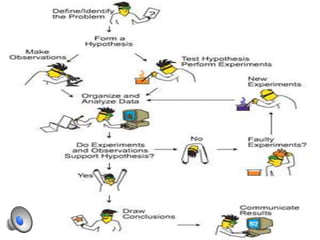
1. Identify the problem and make observation
2. Form a hypothesis
3. Design an experiment
4. Test your hypothesis (conduct experiment)
5. Draw conclusions
Step 1
Identify the problem
 This is always the first step
 Ask yourself,
 What am I trying to figure out in this investigation?
 What can I learn through my Observations?
 Observation is made by using your senses
 Sight, smell, touch, taste, hearing
 Problem should be related to observation that
you or someone else can make during the
investigation.
 The problem is written in the form of a question.
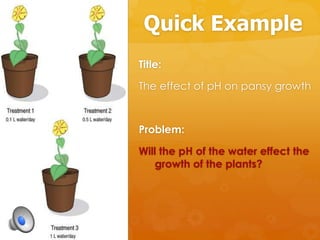
Quick Example
Title:
The effect of pH on pansy growth
Problem:
Will the pH of the water effect the
growth of the plants?
Gather information
 Gather information related to the question
 Use the “need to know” to get you started
 Research, Research, Research !!!!
 This step could answer the question for you or
make you realize that this question is not
appropriate for scientific study
Where do we go from
here?
 Once we know the problem, then we have to
look at gathering information to support our
problem.
 Ask yourself two questions….
What do we
know already?
Think of five to
ten things you
already know
about your
problem.
What do we
need to know?
Now what
are five to ten
things you
need to find
out?
Let’s do it together
What I know
Plants need water to
grow
The water has different
pH levels
The plants need
sunlight
The plants need the
same temperature
All of the plants are the
same.
What I need to find out
What is pH?
What is the difference
in a level 2, 7 and 9 on a
pH scale?
How much water
should I give each day?
What temperature does
the plants need to be
placed in for them to
grow?
 How much sunlight do
I need?
Form a
hypothesis
 Form a hypothesis based upon the research
and/or previous knowledge.
 Remember:
 A good hypothesis is one that you can test
 A hypothesis is a possible answer to your
question
 A hypothesis is always in the form of a
statement, never a question (you already have
one)
 It is usually in the form of IF….Then….Because
How do I write a
Hypothesis?
 A hypothesis is written in an (if…then...because…)
statement
 If…tells what you did in the experiment (verb)
 Then….tells the action what happen next (reaction)
 Because…..Explanation of the reaction
 “If………, then………because…..” statement
 Example:
 If I flip the light switch to on then the light will come on
because the switch allows power to go to the light.
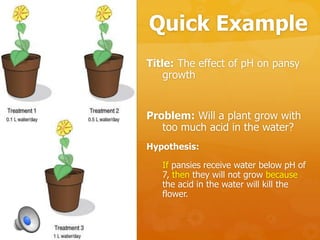
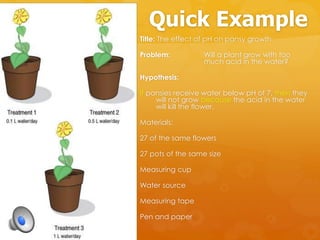
Quick Example
Title: The effect of pH on pansy
growth
Problem: Will a plant grow with
too much acid in the water?
Hypothesis:
If pansies receive water below pH of
7, then they will not grow because
the acid in the water will kill the
flower.
Design an experiment
 Why Design an experiment?
 Design an experiment to test your hypothesis
WAIT…Look at this
first
If this impossible, then you do not have a good
hypothesis
 Go back to step 2 (forming a hypothesis)
 If it is possible, then Keep going……
Materials
 What do you need to perform this problem?
 Use list or bullets (it is easer to read)
Quick Example
Title: The effect of pH on pansy growth
Problem: Will a plant grow with too
much acid in the water?
Hypothesis:
If pansies receive water below pH of 7, then they
will not grow because the acid in the water
will kill the flower.
Materials:
27 of the same flowers
27 pots of the same size
Measuring cup
Water source
Measuring tape
Pen and paper
Parts of an experiment
 Control
 Constant
 Variables
 Independent
 Dependent
 Replication (repeating the experiment MANY
Times
Control
 Every experiment must have a control group
that will be used for comparison with one or
more experimental groups
Constants
 The constants are the things that are will stay
the same in the control and experimental
group.
 The control is identical to the experimental
group in all aspects but one variable that is
being studied
Variables
 The variables are the things that change during
the experiment.
 The variable that is being manipulated by the
experimenter is called the independent
variable
 The thing that changes in reaction to the
independent variable is the dependent variable
 Both variables are often found in the title and
hypothesis.
Data Collection
(results)
 Make observations and collect data
 This involves taking notes, measurements, as you are
conducting your experiment
 Descriptive or qualitative data uses written descriptions of what
is observed.
 Numerical or quantitative data uses measurement that can be
recorded in a table or chart
 Most data gathering should include both descriptive
(qualitative) and numerical (quantitative) data
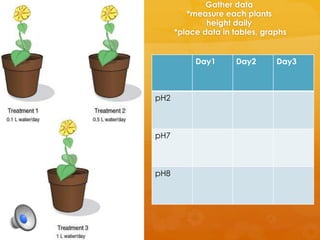
Gather data
*measure each plants
height daily
*place data in tables, graphs
Day1 Day2 Day3
pH2
pH7
pH8
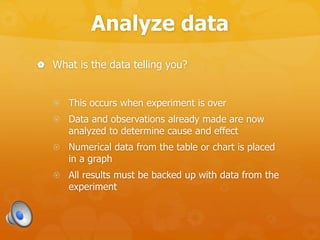
Analyze data
 What is the data telling you?
 This occurs when experiment is over
 Data and observations already made are now
analyzed to determine cause and effect
 Numerical data from the table or chart is placed
in a graph
 All results must be backed up with data from the
experiment
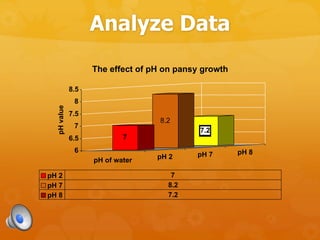
Analyze Data
7.2
8.2
7
6
6.5
7
7.5
8
8.5
pHvalue
pH 2 pH 7 pH 8
pH of water
The effect of pH on pansy growth
pH 2 7
pH 7 8.2
pH 8 7.2
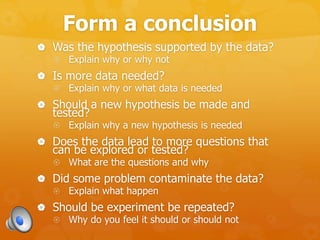
Form a conclusion
 Was the hypothesis supported by the data?
 Explain why or why not
 Is more data needed?
 Explain why or what data is needed
 Should a new hypothesis be made and
tested?
 Explain why a new hypothesis is needed
 Does the data lead to more questions that
can be explored or tested?
 What are the questions and why
 Did some problem contaminate the data?
 Explain what happen
 Should be experiment be repeated?
 Why do you feel it should or should not
Scientific method notes

Scientific method notes

  • 1.
  • 2.
    What is thescientific method?  It is a logical, systematic approach to solve a problem  The scientific method is a set of steps used by the scientific community to organize thoughts in order to solve or investigate problems.
  • 3.
    The Steps ofthe scientific method 1. Identify the problem and make observation 2. Form a hypothesis 3. Design an experiment 4. Test your hypothesis (conduct experiment) 5. Draw conclusions
  • 4.
    Step 1 Identify theproblem  This is always the first step  Ask yourself,  What am I trying to figure out in this investigation?  What can I learn through my Observations?  Observation is made by using your senses  Sight, smell, touch, taste, hearing  Problem should be related to observation that you or someone else can make during the investigation.  The problem is written in the form of a question.
  • 5.
    Quick Example Title: The effectof pH on pansy growth Problem: Will the pH of the water effect the growth of the plants?
  • 6.
    Gather information  Gatherinformation related to the question  Use the “need to know” to get you started  Research, Research, Research !!!!  This step could answer the question for you or make you realize that this question is not appropriate for scientific study
  • 7.
    Where do wego from here?  Once we know the problem, then we have to look at gathering information to support our problem.  Ask yourself two questions…. What do we know already? Think of five to ten things you already know about your problem. What do we need to know? Now what are five to ten things you need to find out?
  • 8.
    Let’s do ittogether What I know Plants need water to grow The water has different pH levels The plants need sunlight The plants need the same temperature All of the plants are the same. What I need to find out What is pH? What is the difference in a level 2, 7 and 9 on a pH scale? How much water should I give each day? What temperature does the plants need to be placed in for them to grow?  How much sunlight do I need?
  • 9.
    Form a hypothesis  Forma hypothesis based upon the research and/or previous knowledge.  Remember:  A good hypothesis is one that you can test  A hypothesis is a possible answer to your question  A hypothesis is always in the form of a statement, never a question (you already have one)  It is usually in the form of IF….Then….Because
  • 10.
    How do Iwrite a Hypothesis?  A hypothesis is written in an (if…then...because…) statement  If…tells what you did in the experiment (verb)  Then….tells the action what happen next (reaction)  Because…..Explanation of the reaction  “If………, then………because…..” statement  Example:  If I flip the light switch to on then the light will come on because the switch allows power to go to the light.
  • 11.
    Quick Example Title: Theeffect of pH on pansy growth Problem: Will a plant grow with too much acid in the water? Hypothesis: If pansies receive water below pH of 7, then they will not grow because the acid in the water will kill the flower.
  • 12.
    Design an experiment Why Design an experiment?  Design an experiment to test your hypothesis WAIT…Look at this first If this impossible, then you do not have a good hypothesis  Go back to step 2 (forming a hypothesis)  If it is possible, then Keep going……
  • 13.
    Materials  What doyou need to perform this problem?  Use list or bullets (it is easer to read)
  • 14.
    Quick Example Title: Theeffect of pH on pansy growth Problem: Will a plant grow with too much acid in the water? Hypothesis: If pansies receive water below pH of 7, then they will not grow because the acid in the water will kill the flower. Materials: 27 of the same flowers 27 pots of the same size Measuring cup Water source Measuring tape Pen and paper
  • 15.
    Parts of anexperiment  Control  Constant  Variables  Independent  Dependent  Replication (repeating the experiment MANY Times
  • 16.
    Control  Every experimentmust have a control group that will be used for comparison with one or more experimental groups
  • 17.
    Constants  The constantsare the things that are will stay the same in the control and experimental group.  The control is identical to the experimental group in all aspects but one variable that is being studied
  • 18.
    Variables  The variablesare the things that change during the experiment.  The variable that is being manipulated by the experimenter is called the independent variable  The thing that changes in reaction to the independent variable is the dependent variable  Both variables are often found in the title and hypothesis.
  • 19.
    Data Collection (results)  Makeobservations and collect data  This involves taking notes, measurements, as you are conducting your experiment  Descriptive or qualitative data uses written descriptions of what is observed.  Numerical or quantitative data uses measurement that can be recorded in a table or chart  Most data gathering should include both descriptive (qualitative) and numerical (quantitative) data
  • 20.
    Gather data *measure eachplants height daily *place data in tables, graphs Day1 Day2 Day3 pH2 pH7 pH8
  • 21.
    Analyze data  Whatis the data telling you?  This occurs when experiment is over  Data and observations already made are now analyzed to determine cause and effect  Numerical data from the table or chart is placed in a graph  All results must be backed up with data from the experiment
  • 22.
    Analyze Data 7.2 8.2 7 6 6.5 7 7.5 8 8.5 pHvalue pH 2pH 7 pH 8 pH of water The effect of pH on pansy growth pH 2 7 pH 7 8.2 pH 8 7.2
  • 23.
    Form a conclusion Was the hypothesis supported by the data?  Explain why or why not  Is more data needed?  Explain why or what data is needed  Should a new hypothesis be made and tested?  Explain why a new hypothesis is needed  Does the data lead to more questions that can be explored or tested?  What are the questions and why  Did some problem contaminate the data?  Explain what happen  Should be experiment be repeated?  Why do you feel it should or should not