8th
Grade Science
Content Standard
8.9 Scientific progress is made by
asking meaningful questions and
conducting careful investigations.
The Scientific Method
A series of steps that
scientists use to
answer questions and
solve problems.
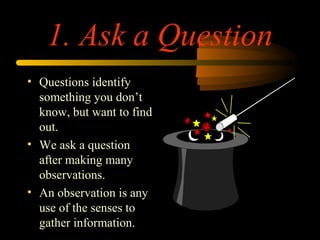
1. Ask a Question
• Questions identify
something you don’t
know, but want to find
out.
• We ask a question
after making many
observations.
• An observation is any
use of the senses to
gather information.
2. Form a Hypothesis
• A hypothesis is a
possible explanation
or answer to your
question.
• Use what you already
know and any
observations you have
made to form your
hypothesis.
3. Test the Hypothesis
• Test to determine if
your hypothesis is a
reasonable answer to
your question.
• Test only one variable
at a time
• Conduct a controlled
experiment with a
control group and an
experimental group.
• Both groups are the
same except for one
factor in the
experimental group,
called a variable.
• The experiment
determines the effect
of the variable.
Test the Hypothesis Cont.
• Sometimes a controlled experiment is not
possible.
• When this happens, scientists test their
hypothesis by making additional
observations or by conducting research.
• An observation is is any use of the senses to
gather information.
• Measurements are observations made with
instruments.
Collecting Data
• Data are any pieces of
information acquired
while testing your
hypothesis.
4. Analyze the Results
• You must analyze your data and
observations to determine whether the
results of your test support the hypothesis.
Example: make tables and graphs
• Organizing numerical data into tables and
graphs makes relationships between
information easier to see.
5. Draw Conclusions
• Do your results
support your
hypothesis?
• Do your results NOT
support your
hypothesis?
• Do you need more
information?
If the Results Don’t Support the
Hypothesis
• You should check your results or calculations for
errors.
• You may have to modify or form a new
hypothesis.
• You may need to gather more information, test
your hypothesis again, or redesign the procedure.
6. Communicate Results
• Telling others what
you have learned is
how science keeps
going.
• You can write a
scientific paper
explaining your
results.
• You can make a
presentation.
THINK ABOUT IT
• 1. What difference does it make what
question is asked to begin your experiment?
• 2. When following the scientific method,
what is the correct procedure for
investigation?

Scientific method notes

  • 1.
    8th Grade Science Content Standard 8.9Scientific progress is made by asking meaningful questions and conducting careful investigations.
  • 2.
    The Scientific Method Aseries of steps that scientists use to answer questions and solve problems.
  • 3.
    1. Ask aQuestion • Questions identify something you don’t know, but want to find out. • We ask a question after making many observations. • An observation is any use of the senses to gather information.
  • 4.
    2. Form aHypothesis • A hypothesis is a possible explanation or answer to your question. • Use what you already know and any observations you have made to form your hypothesis.
  • 5.
    3. Test theHypothesis • Test to determine if your hypothesis is a reasonable answer to your question. • Test only one variable at a time • Conduct a controlled experiment with a control group and an experimental group. • Both groups are the same except for one factor in the experimental group, called a variable. • The experiment determines the effect of the variable.
  • 6.
    Test the HypothesisCont. • Sometimes a controlled experiment is not possible. • When this happens, scientists test their hypothesis by making additional observations or by conducting research. • An observation is is any use of the senses to gather information. • Measurements are observations made with instruments.
  • 7.
    Collecting Data • Dataare any pieces of information acquired while testing your hypothesis.
  • 8.
    4. Analyze theResults • You must analyze your data and observations to determine whether the results of your test support the hypothesis. Example: make tables and graphs • Organizing numerical data into tables and graphs makes relationships between information easier to see.
  • 9.
    5. Draw Conclusions •Do your results support your hypothesis? • Do your results NOT support your hypothesis? • Do you need more information?
  • 10.
    If the ResultsDon’t Support the Hypothesis • You should check your results or calculations for errors. • You may have to modify or form a new hypothesis. • You may need to gather more information, test your hypothesis again, or redesign the procedure.
  • 11.
    6. Communicate Results •Telling others what you have learned is how science keeps going. • You can write a scientific paper explaining your results. • You can make a presentation.
  • 12.
    THINK ABOUT IT •1. What difference does it make what question is asked to begin your experiment? • 2. When following the scientific method, what is the correct procedure for investigation?