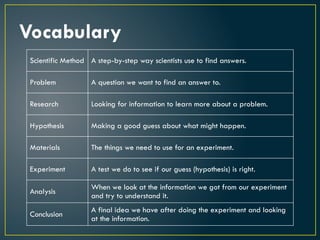
Scientific Method Astep-by-step way scientists use to find answers.
Problem A question we want to find an answer to.
Research Looking for information to learn more about a problem.
Hypothesis Making a good guess about what might happen.
Materials The things we need to use for an experiment.
Experiment A test we do to see if our guess (hypothesis) is right.
Analysis
When we look at the information we got from our experiment
and try to understand it.
Conclusion
A final idea we have after doing the experiment and looking
at the information.
Vocabulary
3.
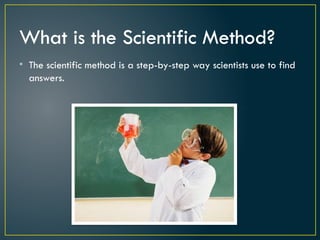
What is theScientific Method?
• The scientific method is a step-by-step way scientists use to find
answers.
4.
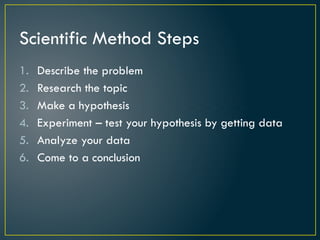
Scientific Method Steps
1.Describe the problem
2. Research the topic
3. Make a hypothesis
4. Experiment – test your hypothesis by getting data
5. Analyze your data
6. Come to a conclusion
5.
1. Problem/question
• Describethe problem that you are trying to find the answer to.
• The more specific your problem, the easier it will be to solve.
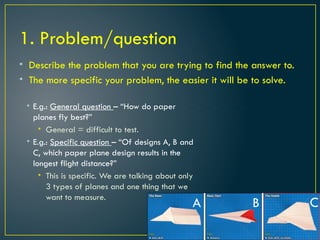
• E.g.: General question – “How do paper
planes fly best?”
• General = difficult to test.
• E.g.: Specific question – “Of designs A, B and
C, which paper plane design results in the
longest flight distance?”
• This is specific. We are talking about only
3 types of planes and one thing that we
want to measure.
A B C
6.
2. Research
• Afterdescribing your problem it is important to research your
topic. Then you will see if there is already an answer. If not, it
will let you make an intelligent hypothesis.
7.
3. Hypothesis
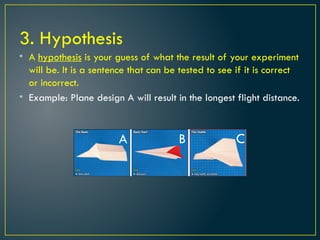
• Ahypothesis is your guess of what the result of your experiment
will be. It is a sentence that can be tested to see if it is correct
or incorrect.
• Example: Plane design A will result in the longest flight distance.
A B C
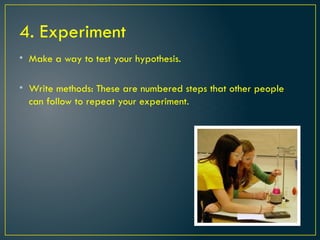
4. Experiment
• Makea way to test your hypothesis.
• Write methods: These are numbered steps that other people
can follow to repeat your experiment.
10.
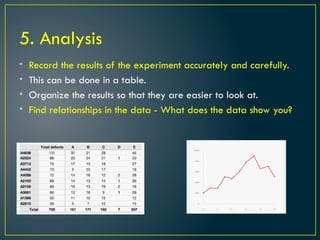
5. Analysis
• Recordthe results of the experiment accurately and carefully.
• This can be done in a table.
• Organize the results so that they are easier to look at.
• Find relationships in the data - What does the data show you?
11.
6. Conclusion
• Hereyou can say if the data shows that your hypothesis is
correct or incorrect.
• It is important to think about any mistakes in your experiment or
anything that could have affected the results.
12.
What If MyHypothesis is Wrong?
• Guessing incorrectly does not make your experiment
wrong/bad! If your hypothesis is wrong, this is still an answer to
your problem.
• Be honest - do not lie about your results to make yourself look right.
13.
You Already UseIt
• Your phone will not work – this is your problem
• You think that the phone needs to be charged – hypothesis
• You charge your phone to see if it will work – experiment
• Your phone works – Results
• You were right! Your phone needed to be charged – Conclusion