Simple Machines
Simple Machines A  machine  is a device that makes work easier.
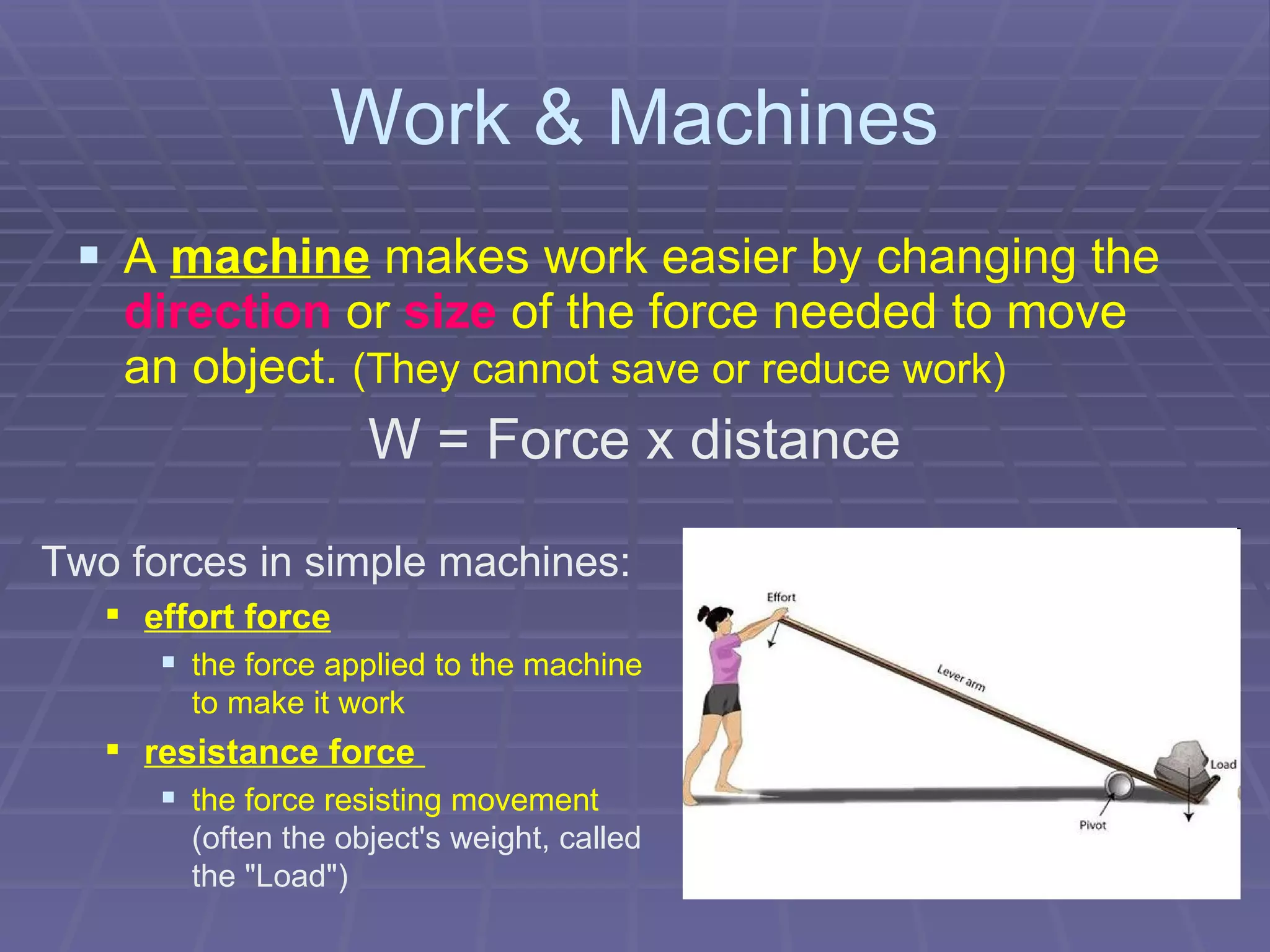
Work & Machines A  machine  makes work easier by changing the  direction  or  size  of the force needed to move an object.  (They cannot save or reduce work) W = Force x distance Two forces in simple machines: effort force   the force applied to the machine to make it work resistance force   the force resisting movement  (often the object's weight, called the "Load")
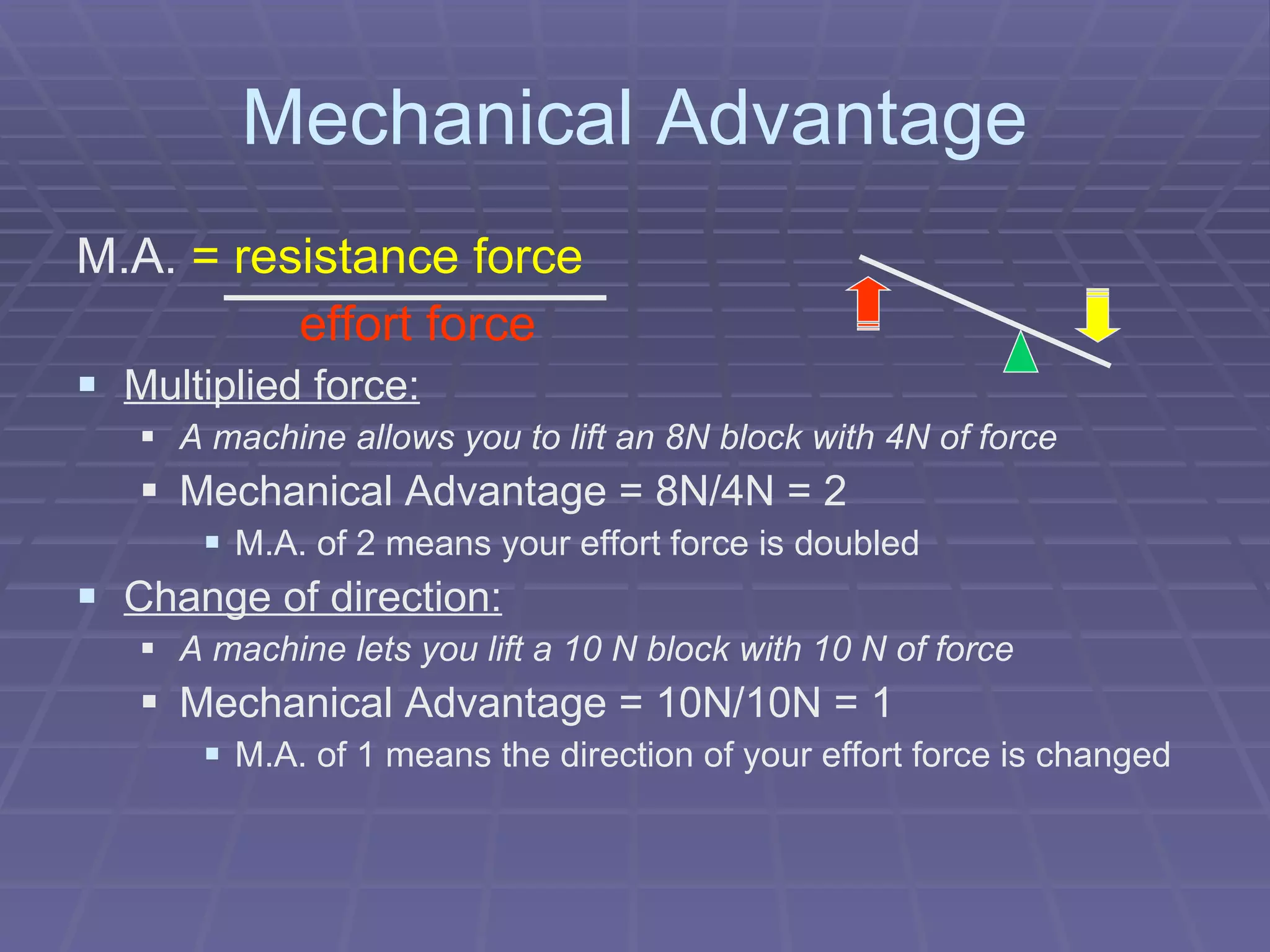
Mechanical Advantage M.A.  = resistance force   effort force Multiplied force: A machine allows you to lift an 8N block with 4N of force Mechanical Advantage = 8N/4N = 2 M.A. of 2 means your effort force is doubled  Change of direction: A machine lets you lift a 10 N block with 10 N of force Mechanical Advantage = 10N/10N = 1 M.A. of 1 means the direction of your effort force is changed
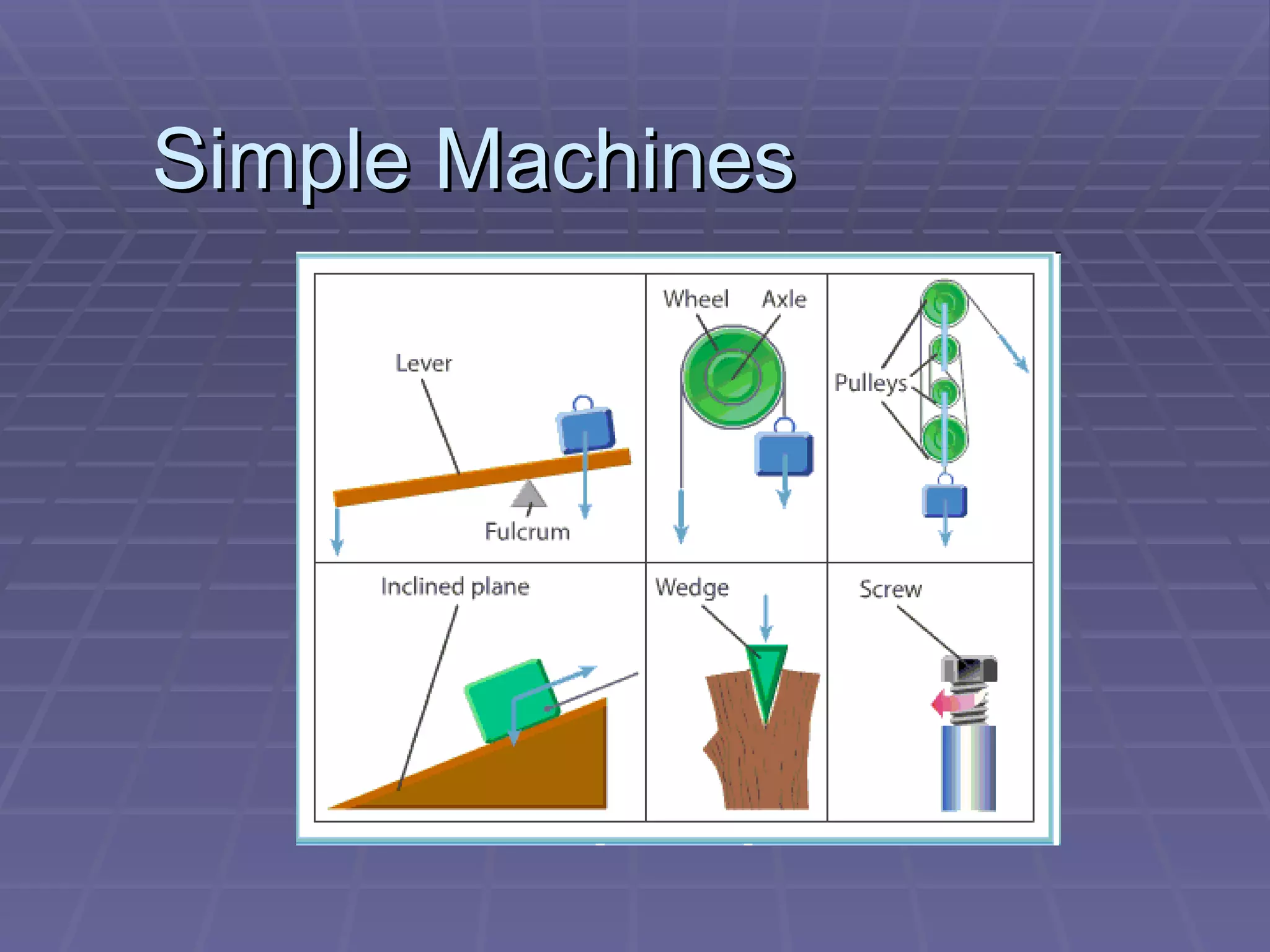
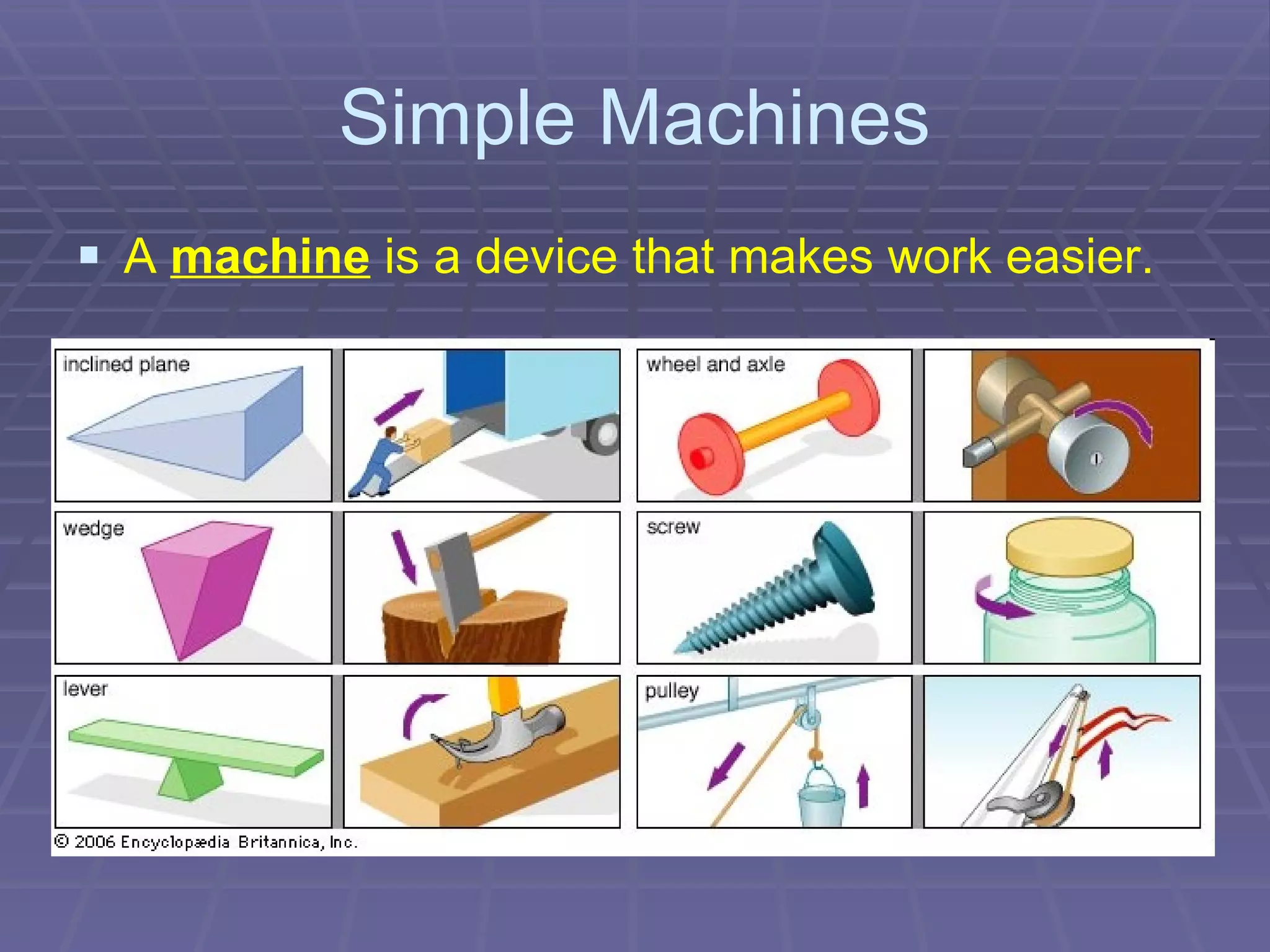
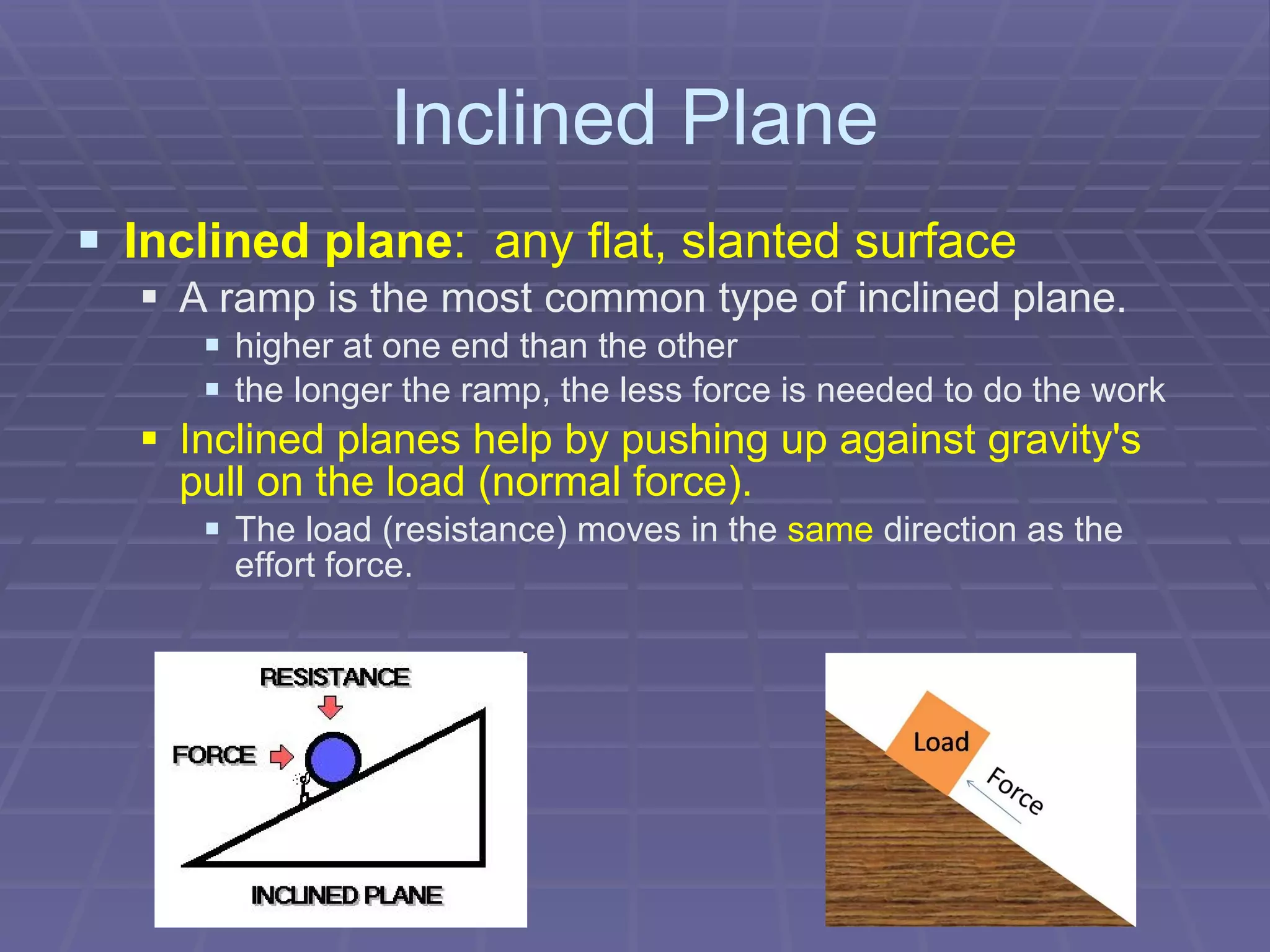
Inclined Plane Inclined plane :  any flat, slanted surface   A ramp is the most common type of inclined plane.   higher at one end than the other the longer the ramp, the less force is needed to do the work Inclined planes help by pushing up against gravity's pull on the load (normal force). The load (resistance) moves in the  same  direction as the effort force.
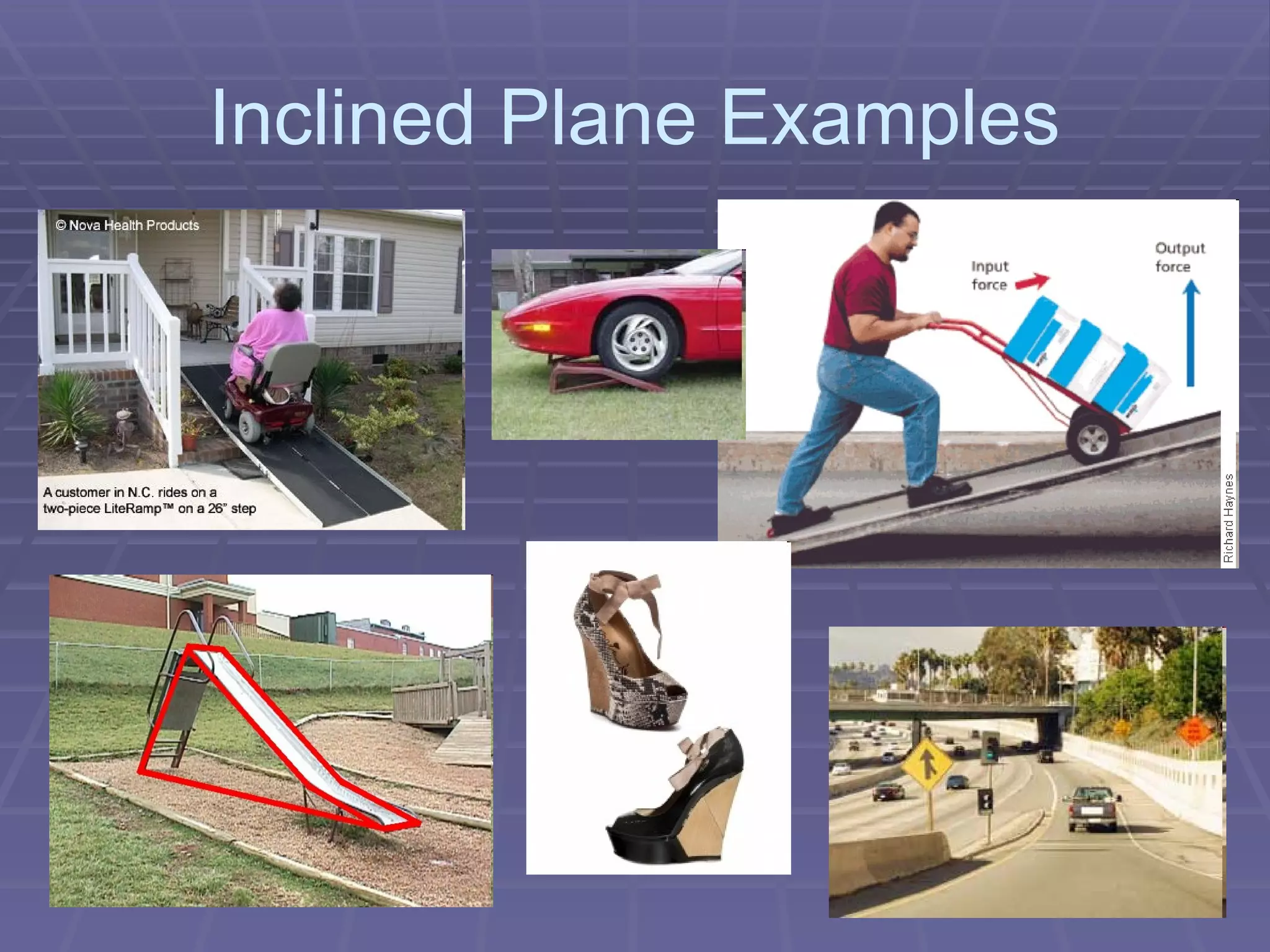
Inclined Plane Examples
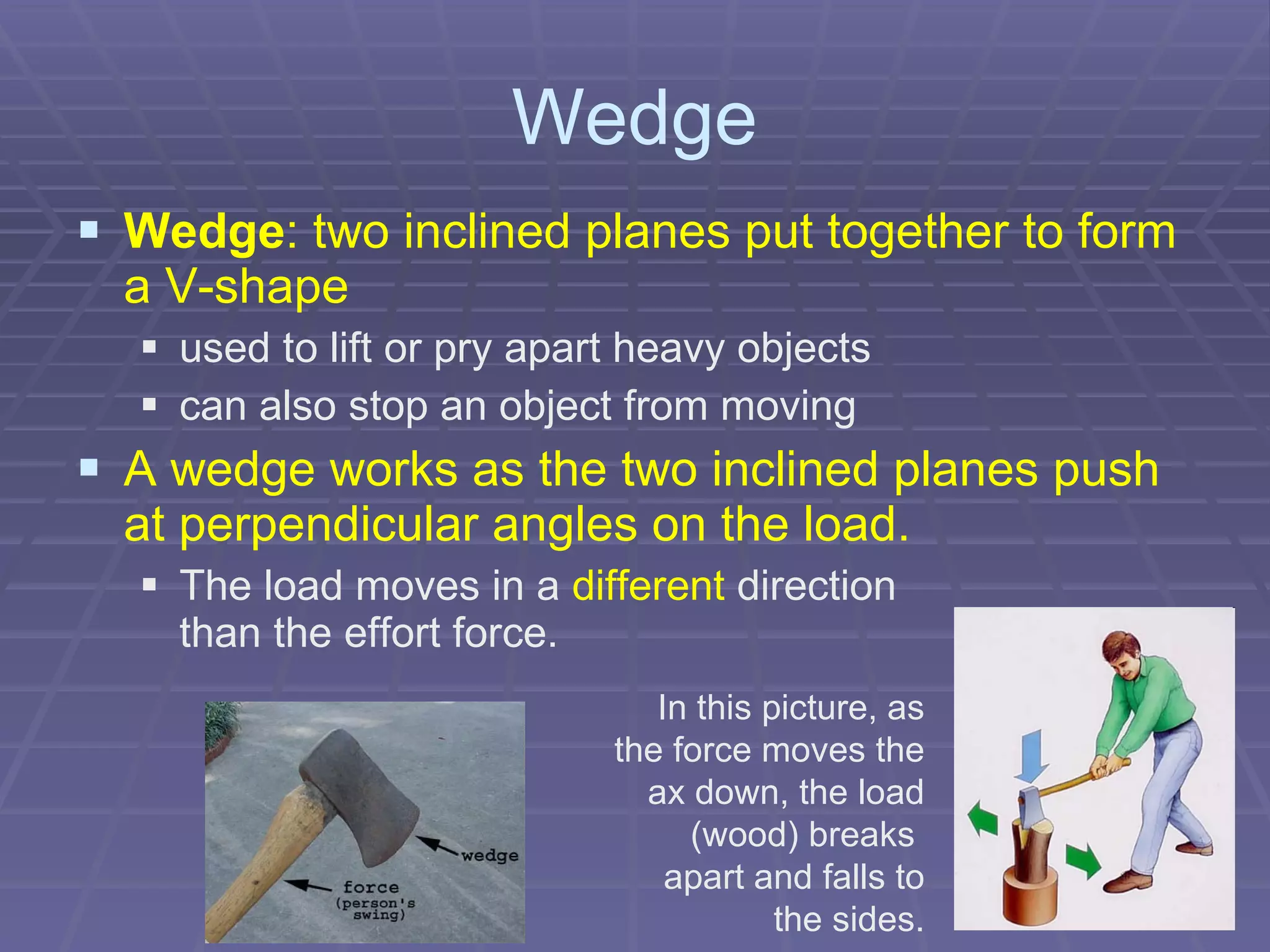
Wedge Wedge : two inclined planes put together to form a V-shape used to lift or pry apart heavy objects can also stop an object from moving  A wedge works as the two inclined planes push at perpendicular angles on the load. The load moves in a  different  direction   than the effort force. In this picture, as the force moves the ax down, the load (wood) breaks  apart and falls to the sides.
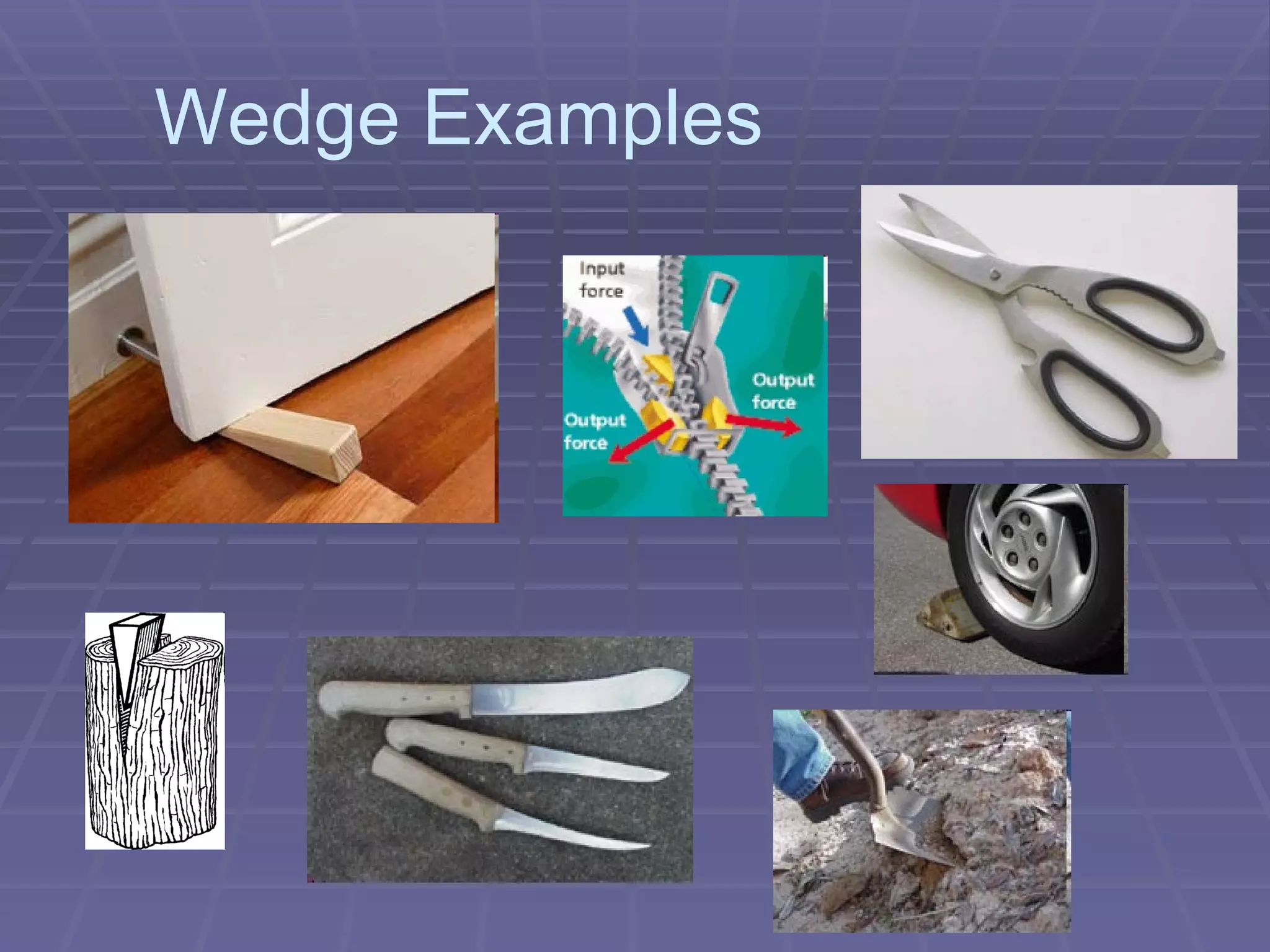
Wedge Examples
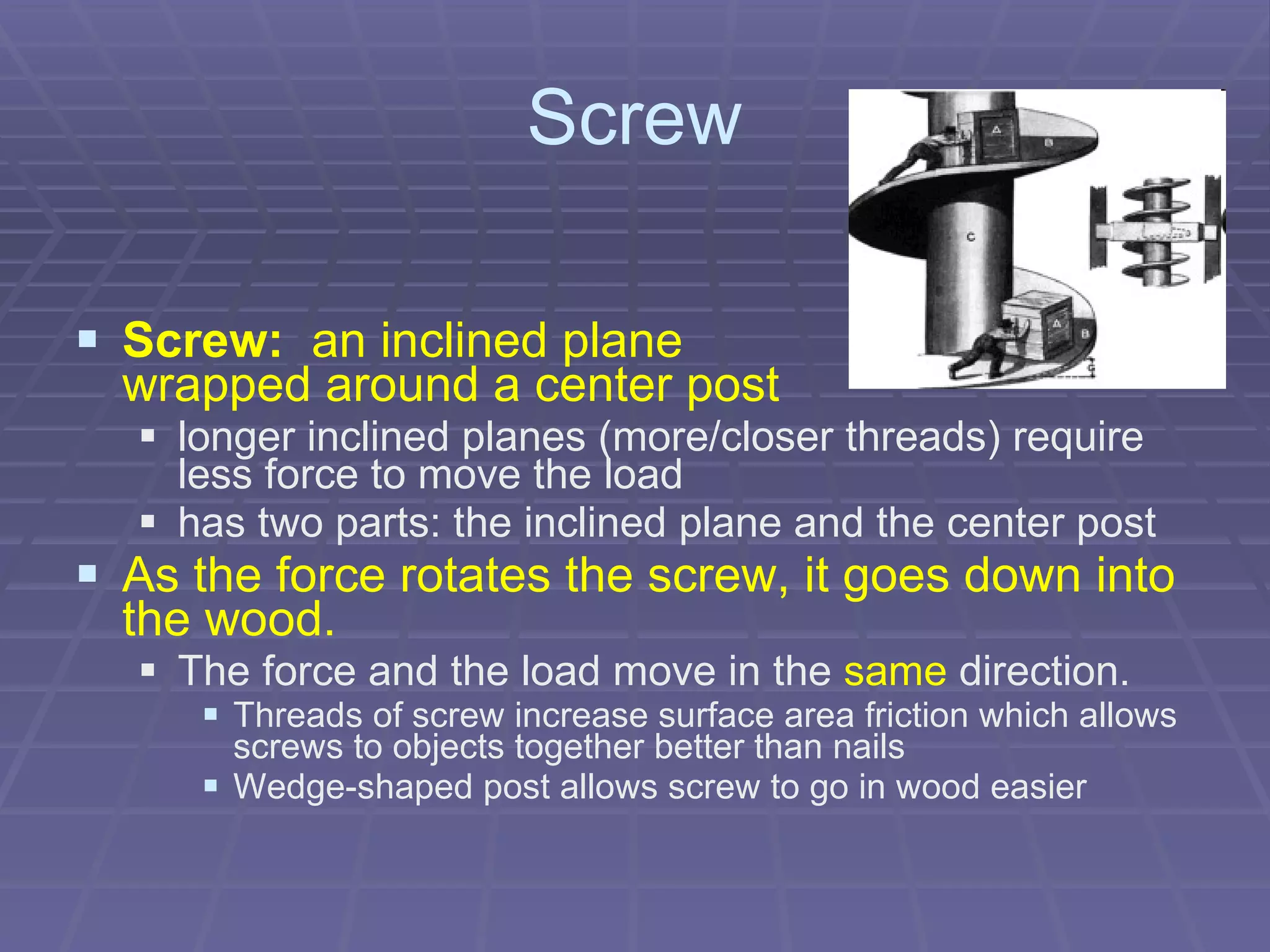
Screw Screw:   an inclined plane    wrapped around a center post longer inclined planes (more/closer threads) require less force to move the load  has two parts: the inclined plane and the center post   As the force rotates the screw, it goes down into the wood. The force and the load move in the  same  direction. Threads of screw increase surface area friction which allows screws to objects together better than nails  Wedge-shaped post allows screw to go in wood easier
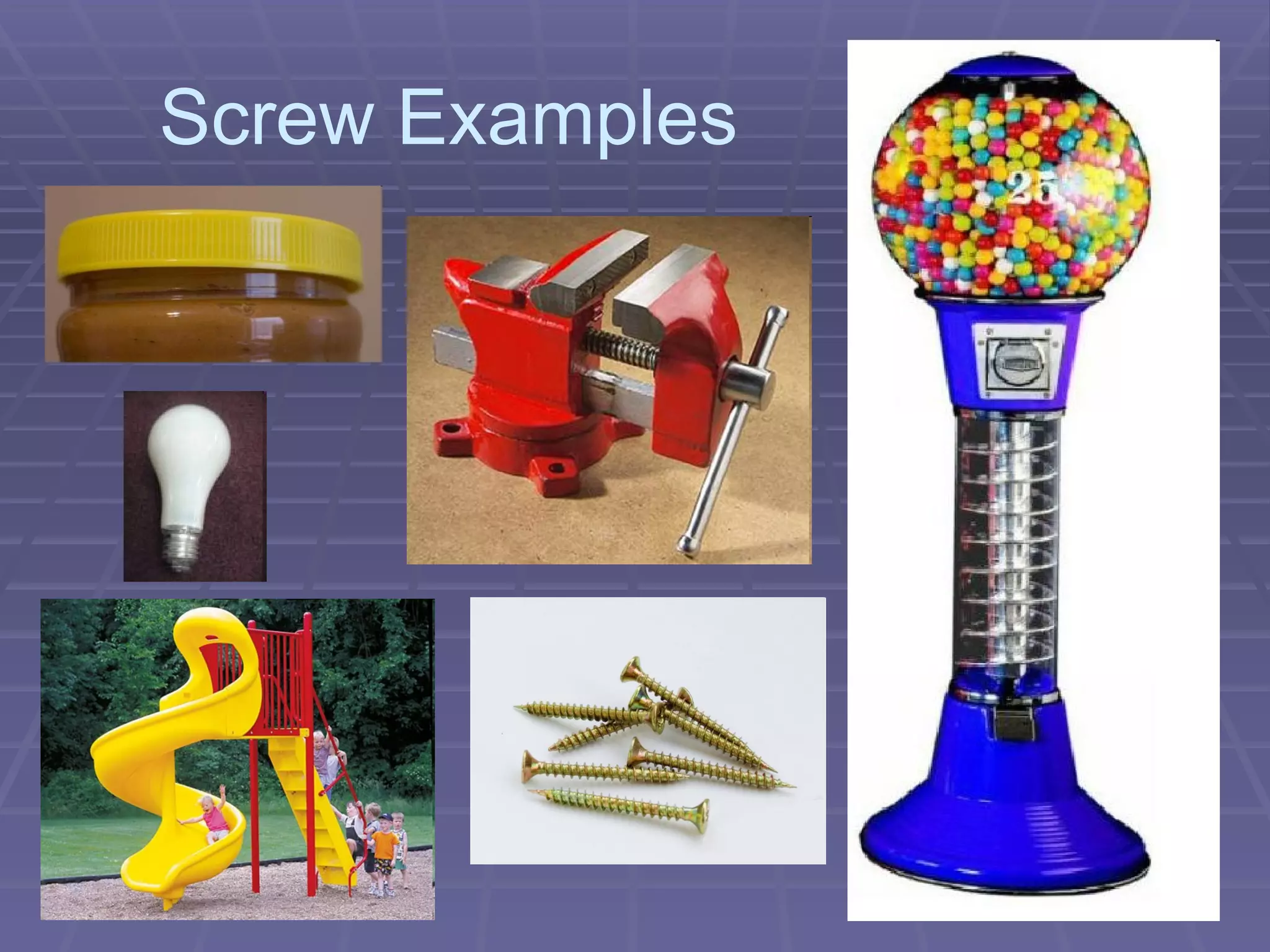
Screw Examples
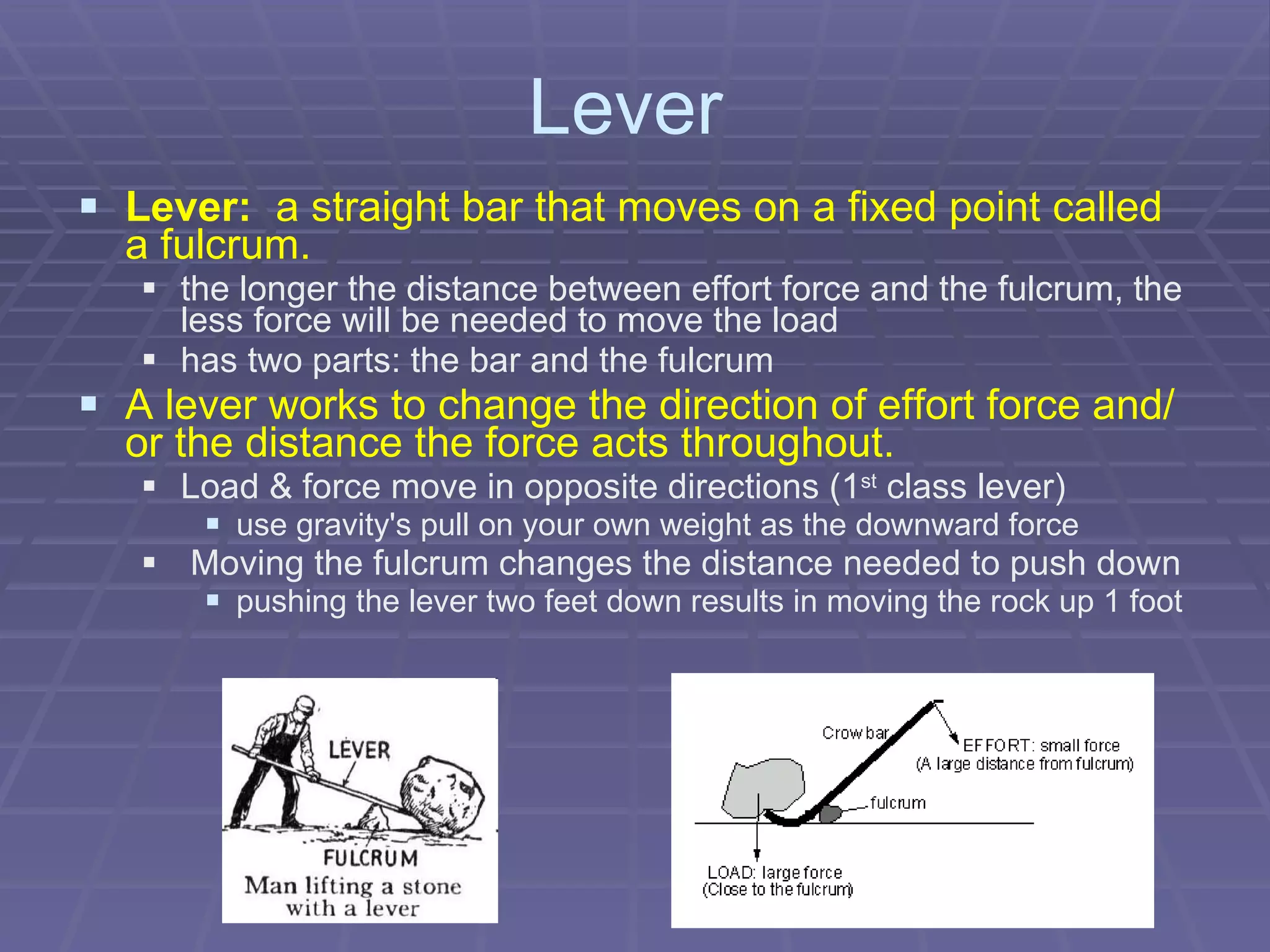
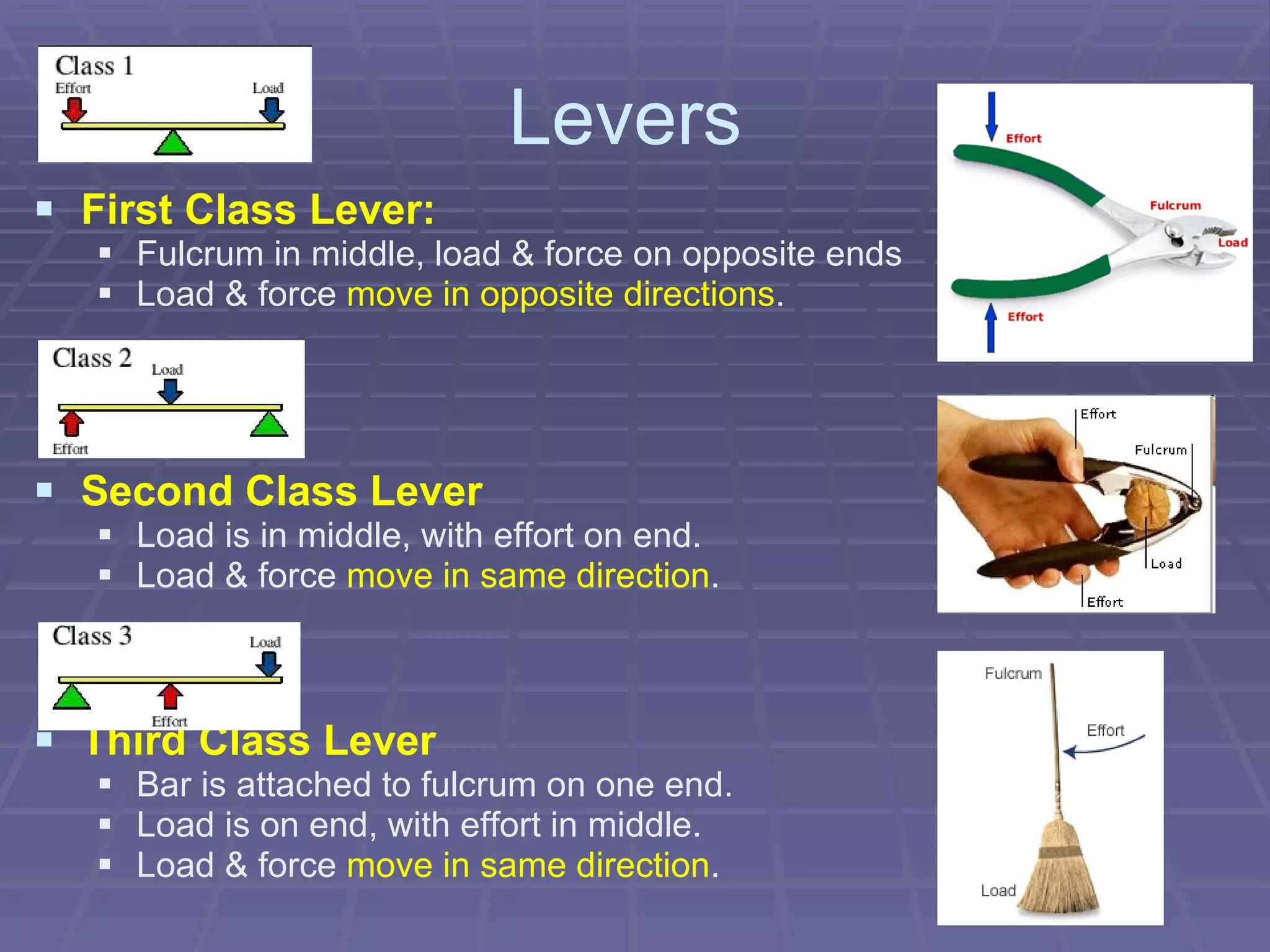
Lever  Lever:   a straight bar that moves on a fixed point called a fulcrum. the longer the distance between effort force and the fulcrum, the less force will be needed to move the load   has two parts: the bar and the fulcrum A lever works to change the direction of effort force and/or the distance the force acts throughout. Load & force move in opposite directions (1 st  class lever) use gravity's pull on your own weight as the downward force Moving the fulcrum changes the distance needed to push down pushing the lever two feet down results in moving the rock up 1 foot
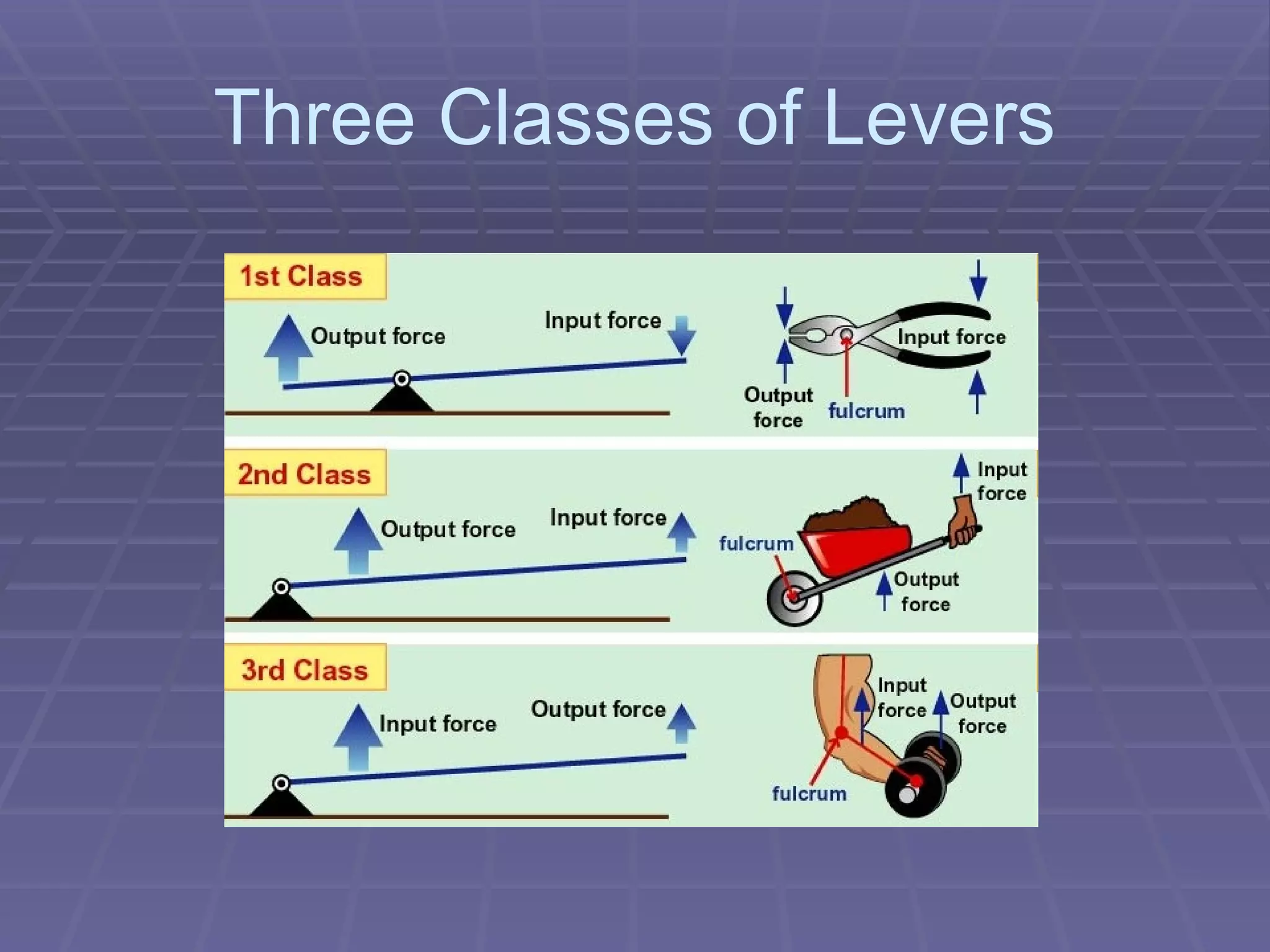
Three Classes of Levers
Levers  First Class Lever: Fulcrum in middle, load & force on opposite ends Load & force  move in opposite directions .  Second Class Lever Load is in middle, with effort on end. Load & force  move in same direction .  Third Class Lever Bar is attached to fulcrum on one end. Load is on end, with effort in middle. Load & force  move in same direction . 
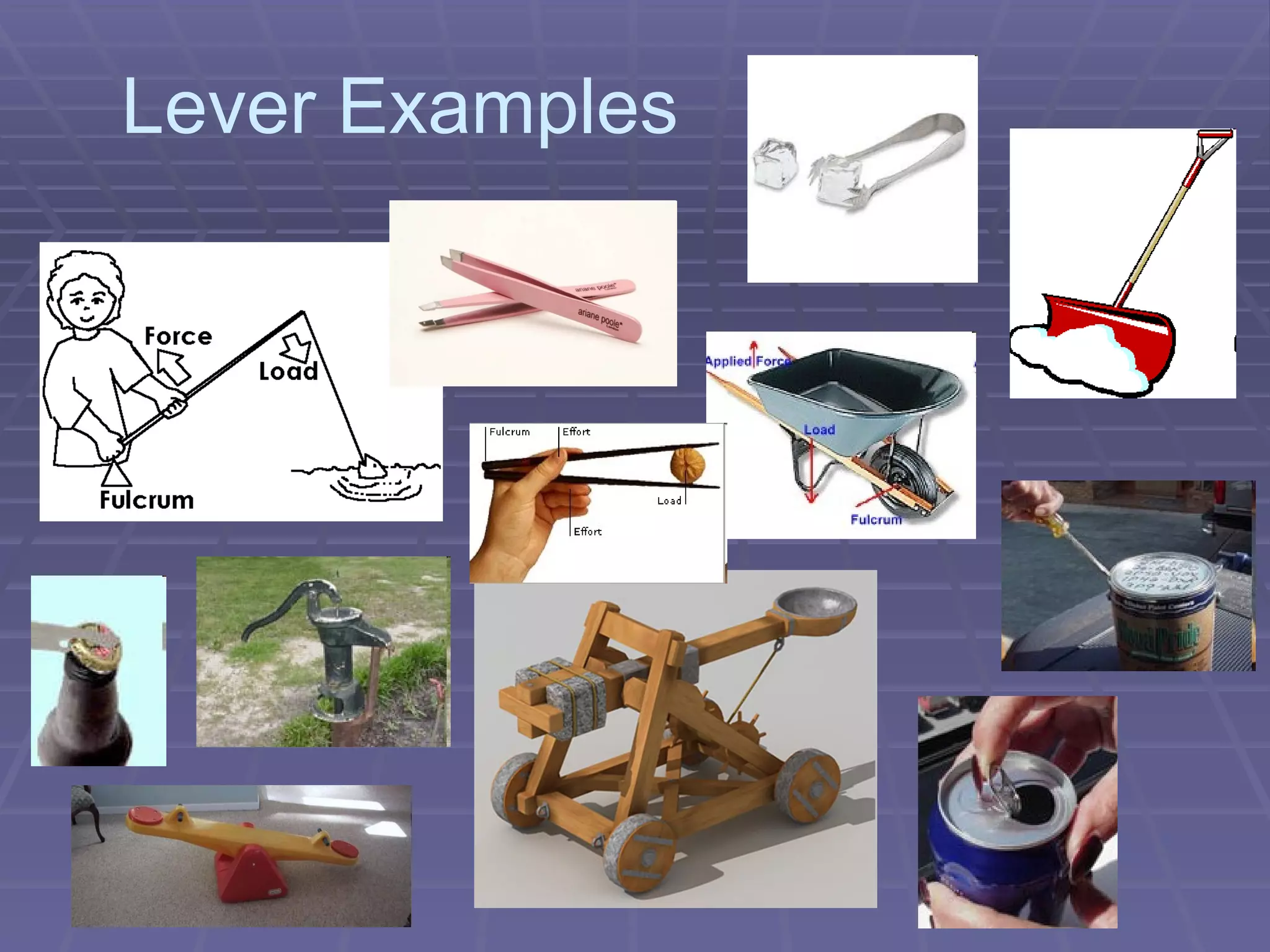
Lever Examples
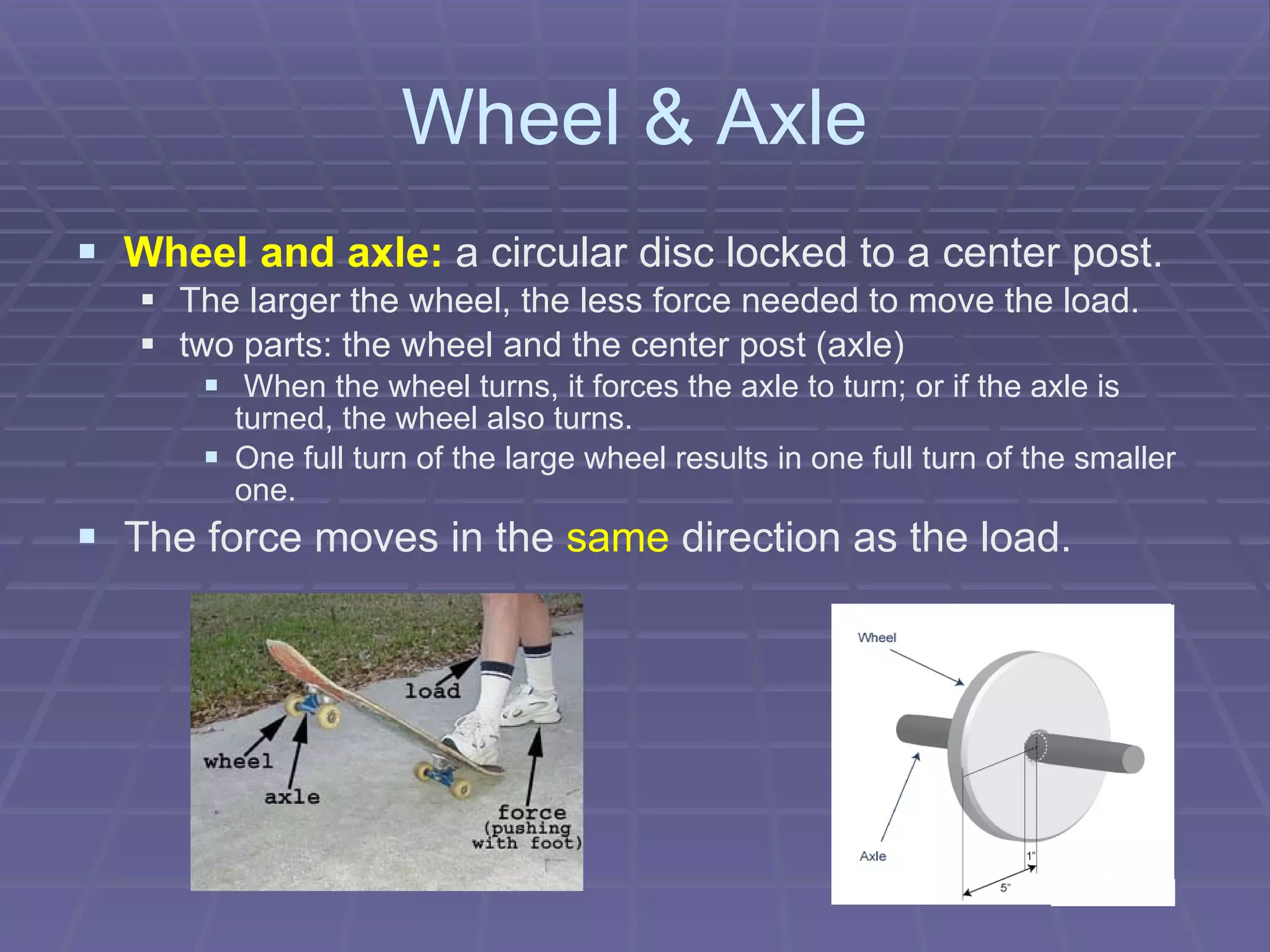
Wheel & Axle Wheel and axle:  a circular disc locked to a center post.   The larger the wheel, the less force needed to move the load. two parts: the wheel and the center post (axle) When the wheel turns, it forces the axle to turn; or if the axle is turned, the wheel also turns.  One full turn of the large wheel results in one full turn of the smaller one. The force moves in the  same  direction as the load. 
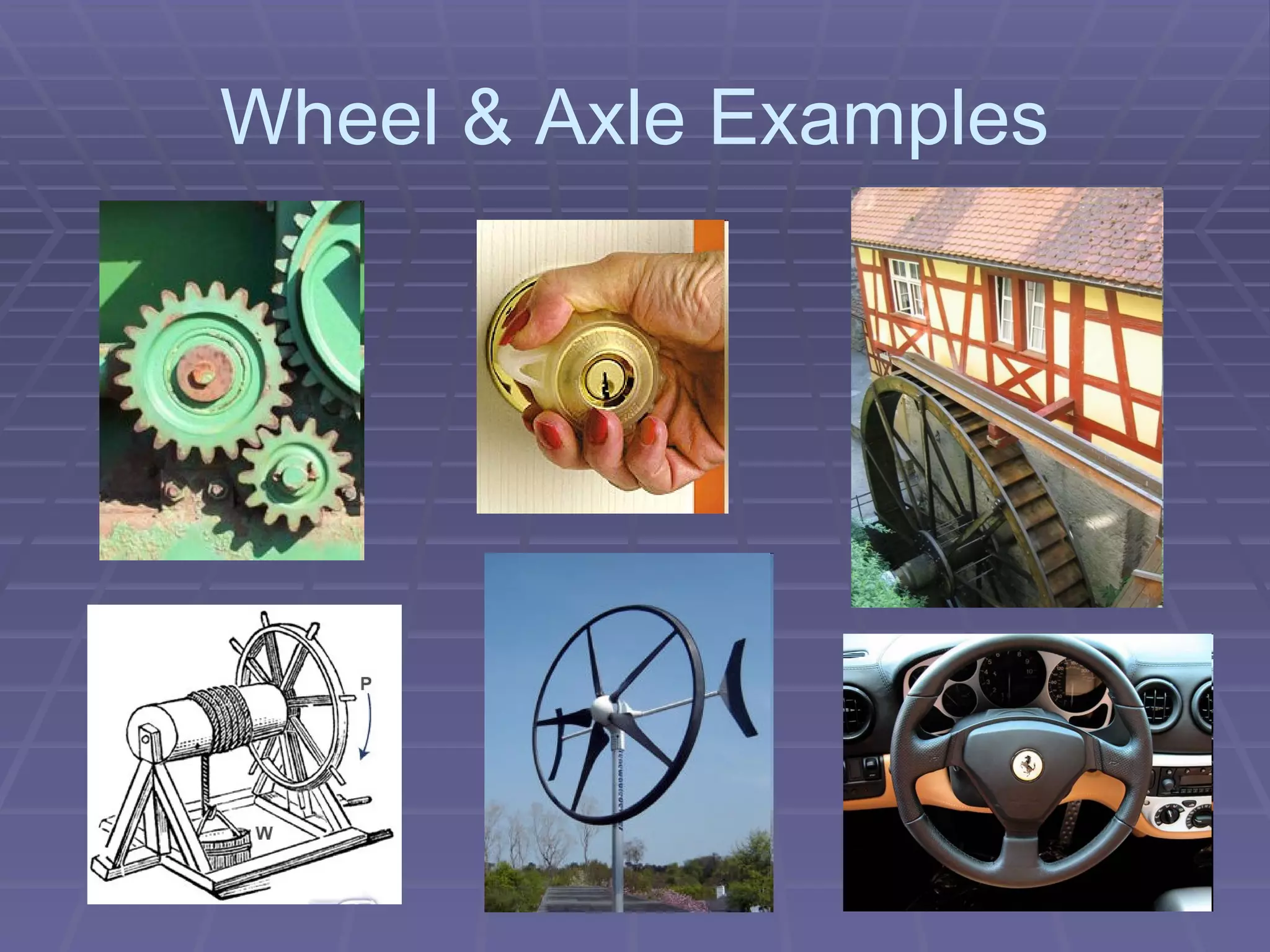
Wheel & Axle Examples
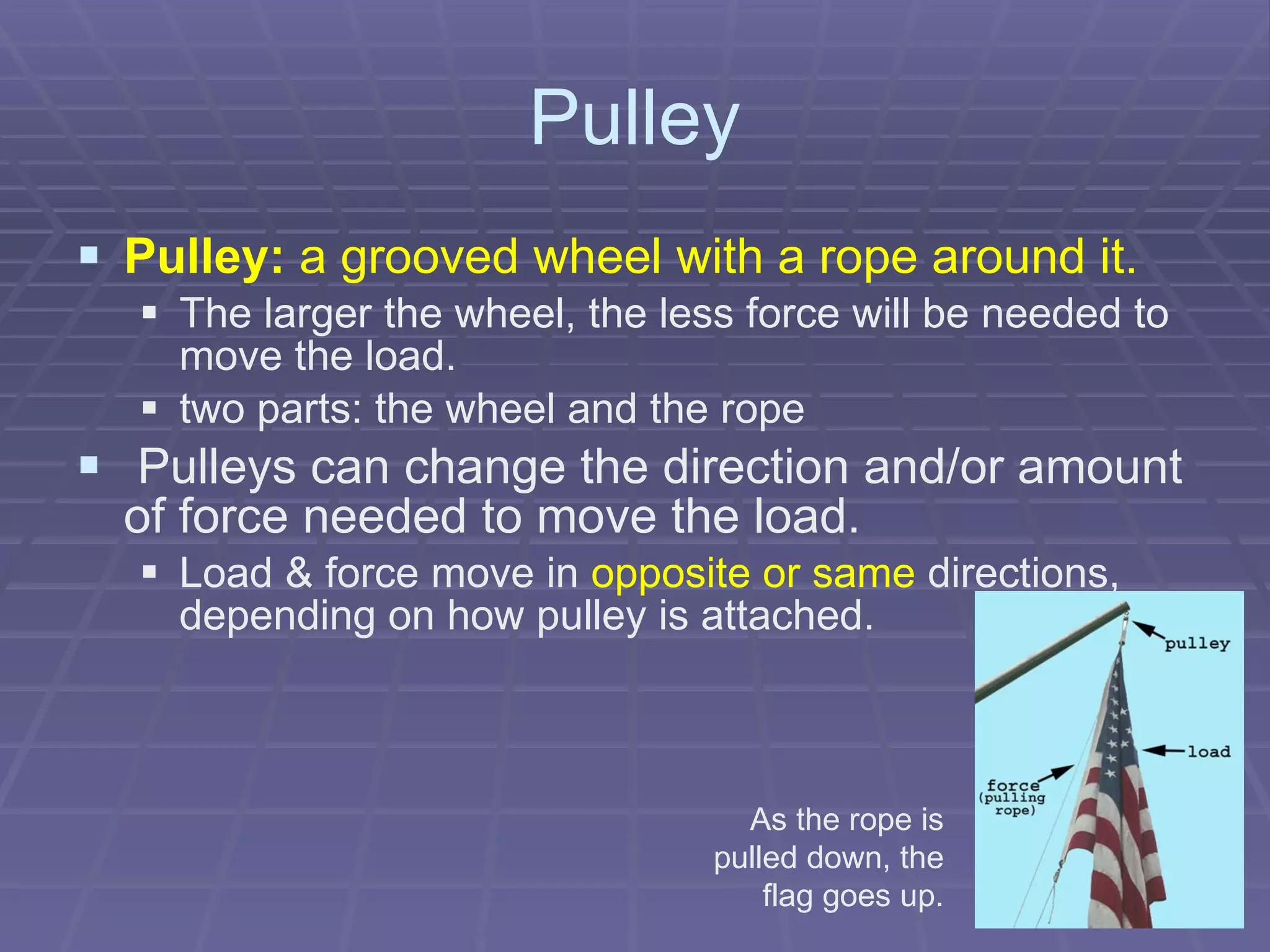
Pulley Pulley:  a grooved wheel with a rope around it. The larger the wheel, the less force will be needed to move the load. two parts: the wheel and the rope     Pulleys can change the direction and/or amount of force needed to move the load. Load & force move in  opposite or same  directions, depending on how pulley is attached.  As the rope is pulled down, the flag goes up.
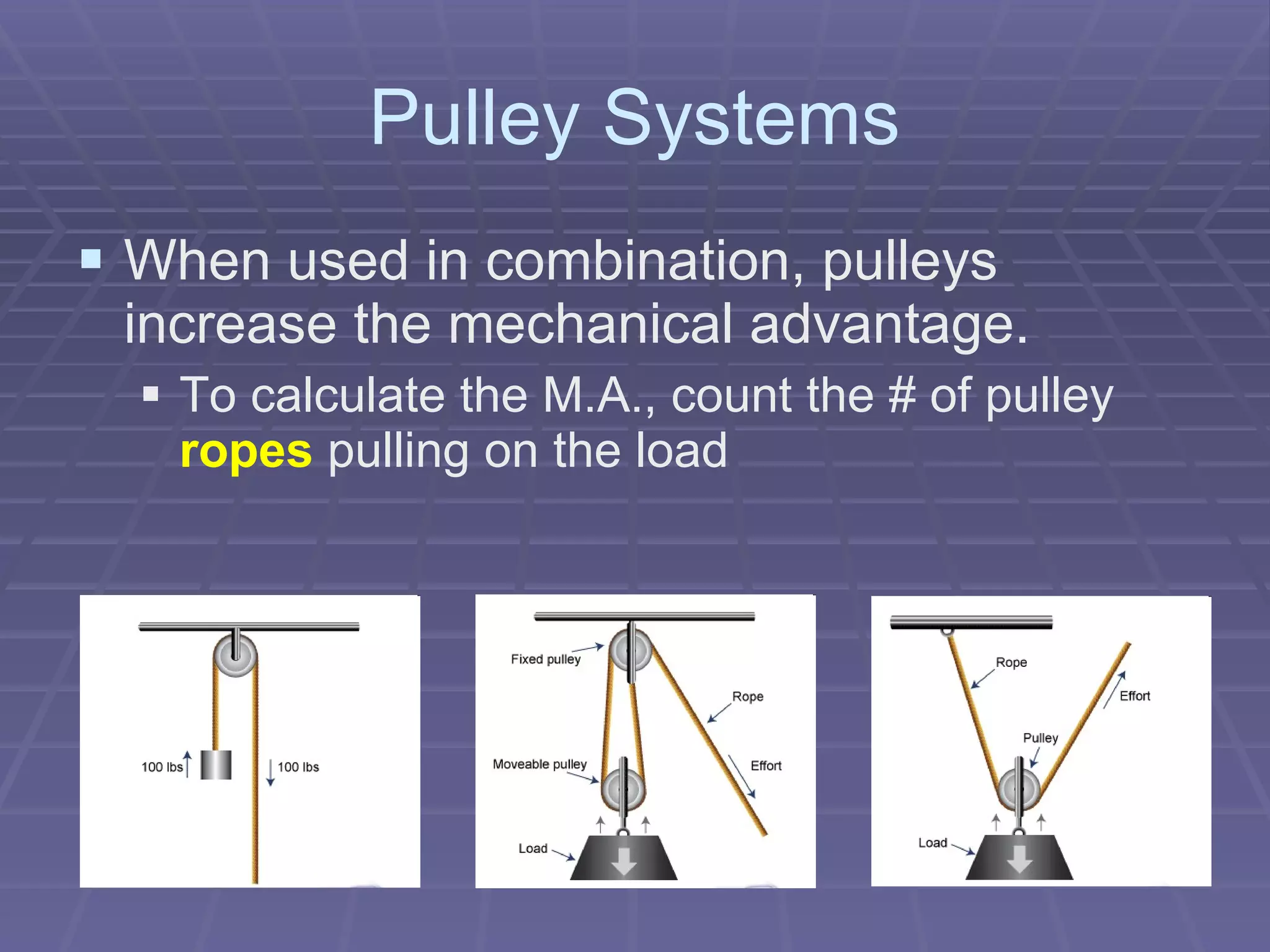
Pulley Systems When used in combination, pulleys increase the mechanical advantage. To calculate the M.A., count the # of pulley  ropes  pulling on the load
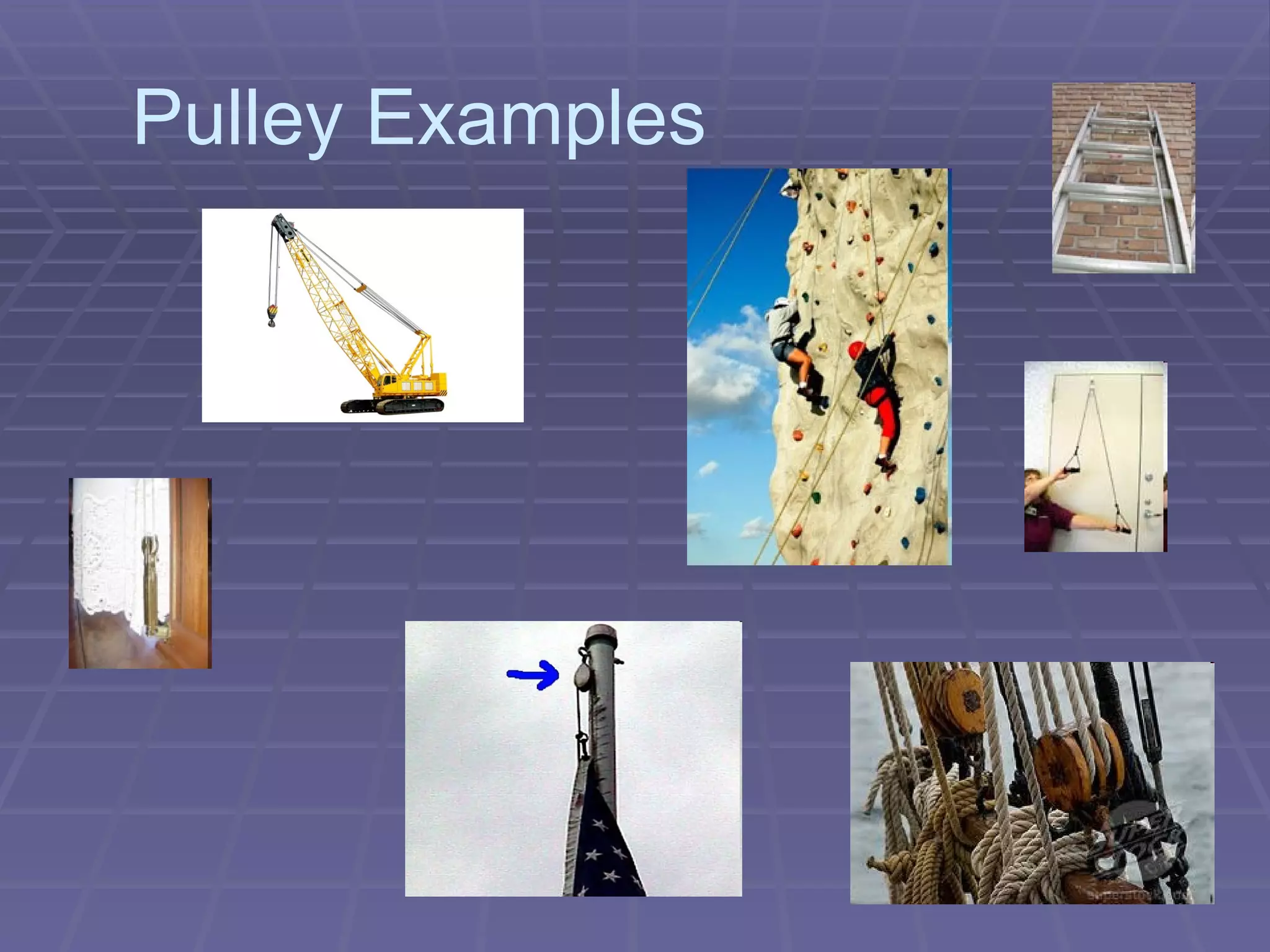
Pulley Examples
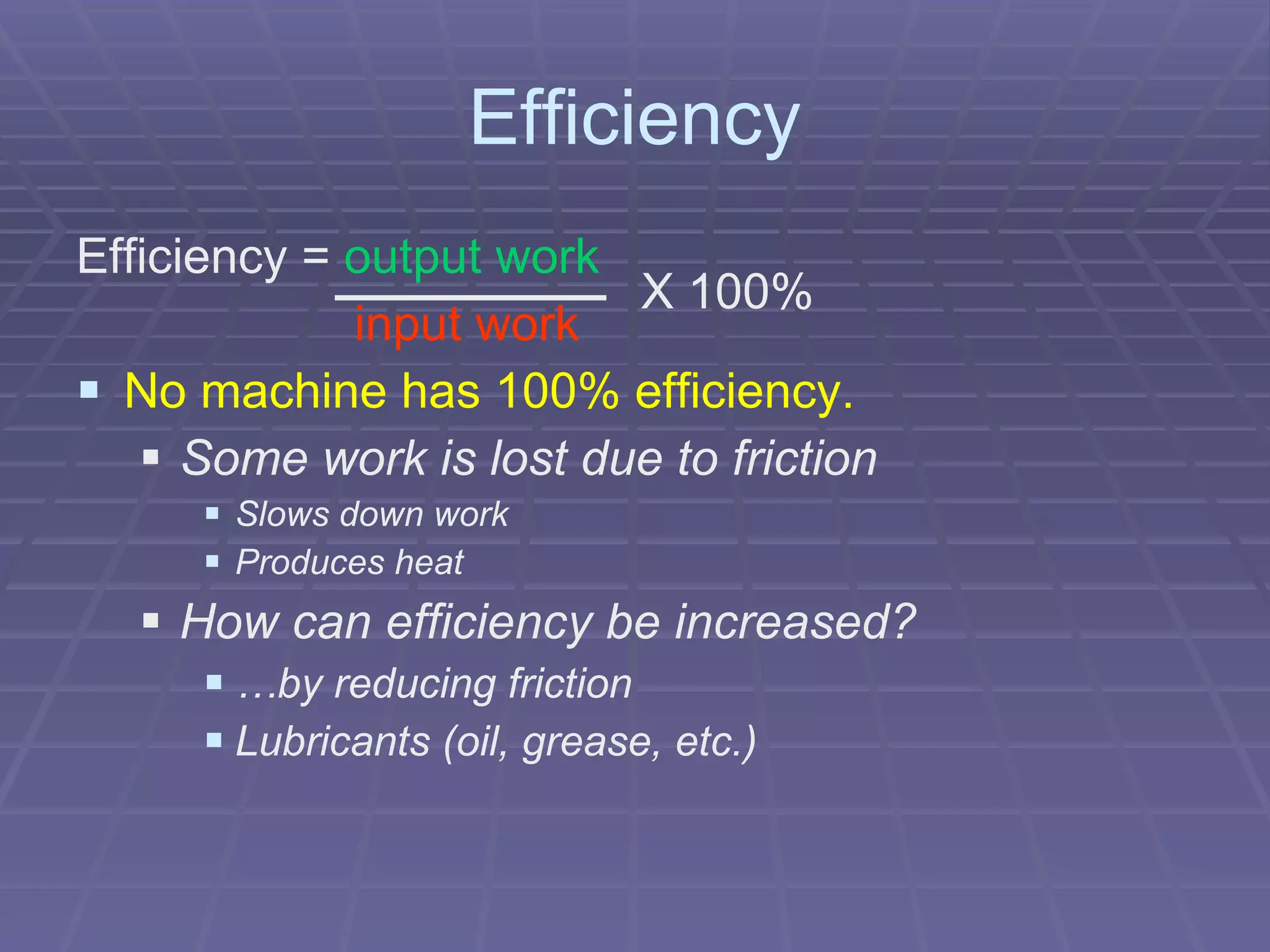
Efficiency Efficiency =   output work    input work No machine has 100% efficiency. Some work is lost due to friction Slows down work Produces heat How can efficiency be increased? … by reducing friction Lubricants (oil, grease, etc.) X 100%
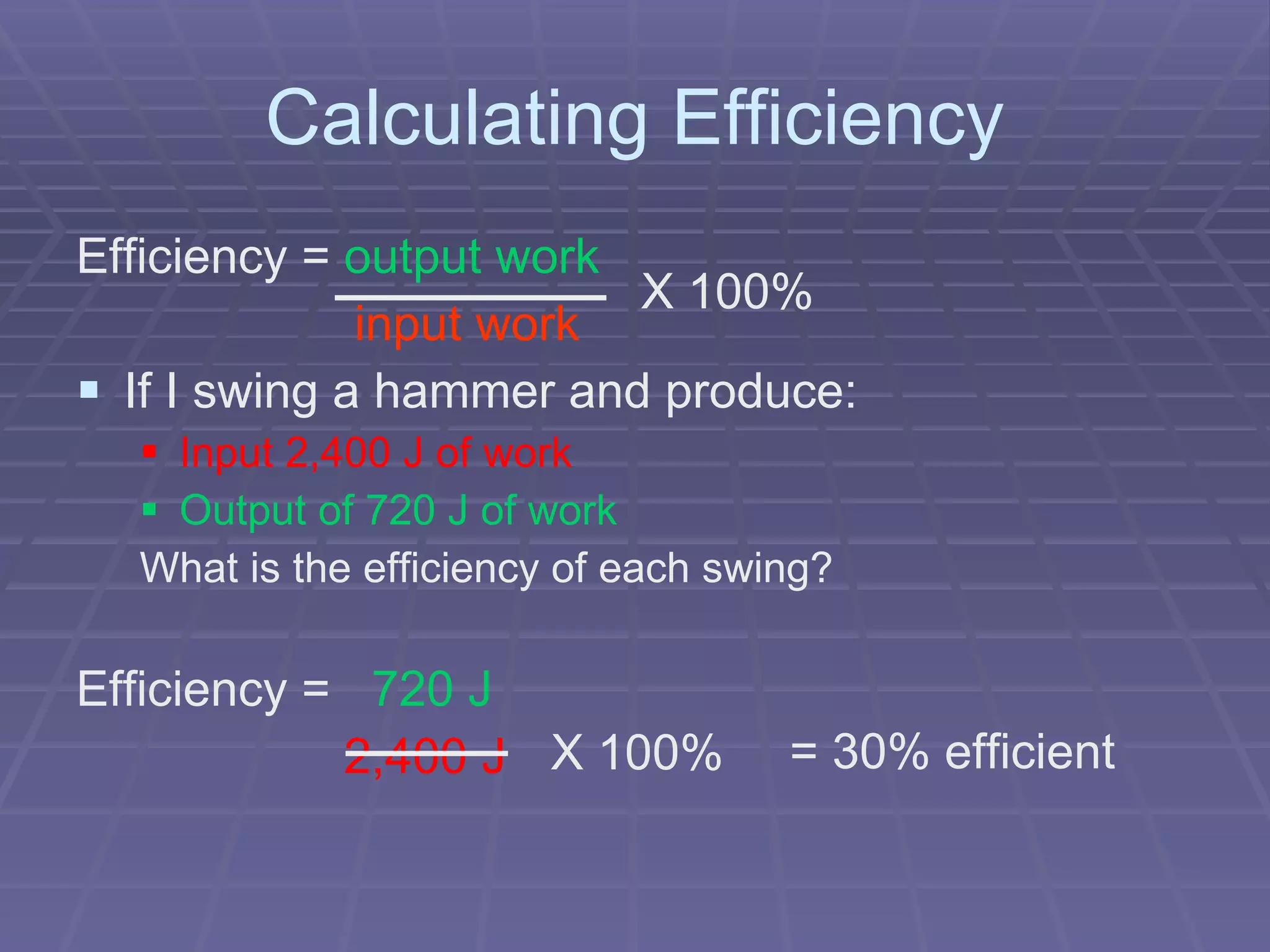
Calculating Efficiency Efficiency =   output work    input work If I swing a hammer and produce: Input 2,400 J of work Output of 720 J of work What is the efficiency of each swing? Efficiency =   720 J      2,400 J  X 100% X 100% = 30% efficient
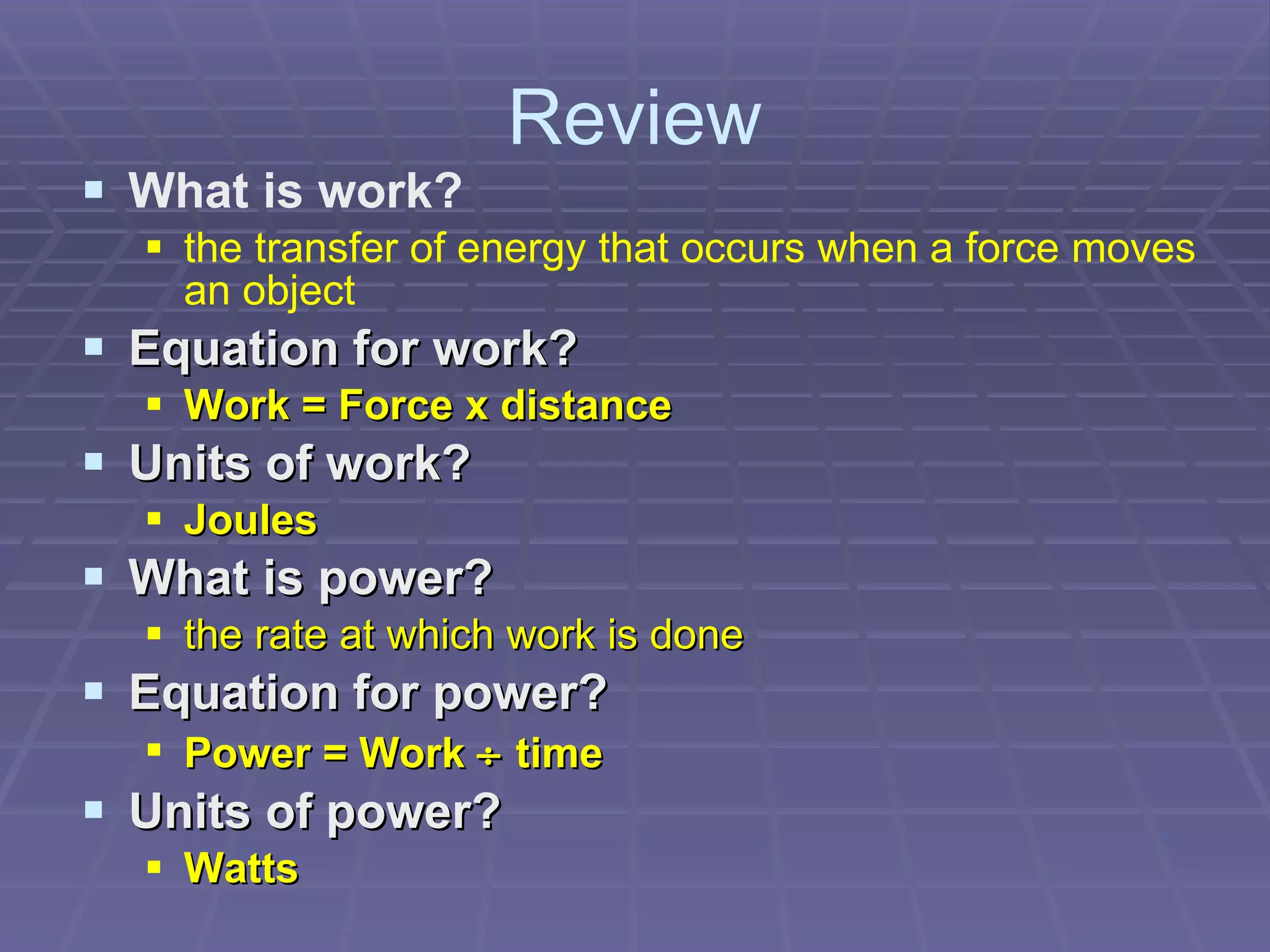
Review What is work? the transfer of energy that occurs when a force moves an object Equation for work? Work = Force x distance Units of work? Joules What is power? the rate at which work is done Equation for power? Power = Work    time Units of power? Watts
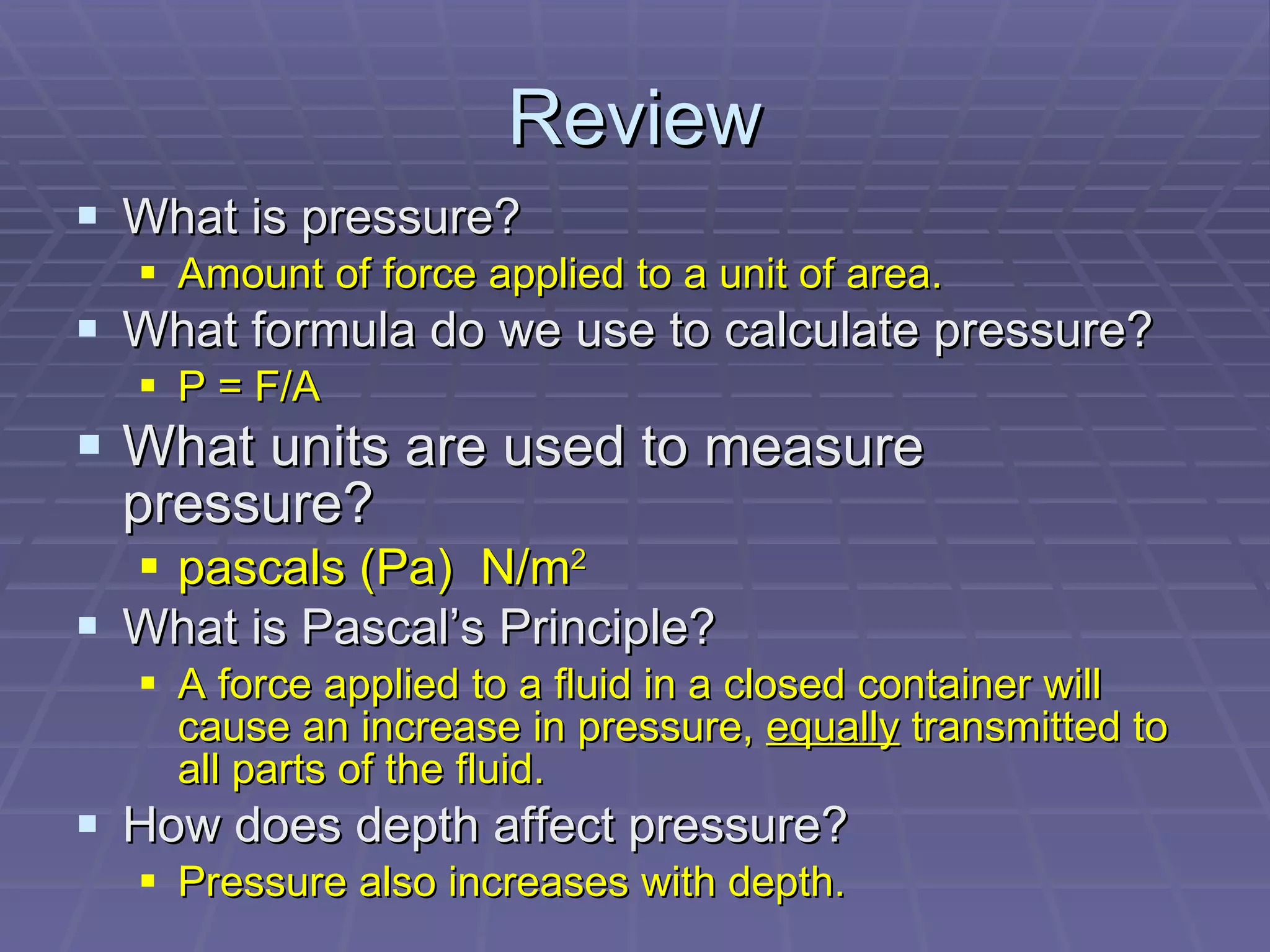
Review What is pressure? Amount of force applied to a unit of area.  What formula do we use to calculate pressure? P = F/A What units are used to measure pressure? pascals (Pa)  N/m 2 What is Pascal’s Principle? A force applied to a fluid in a closed container will cause an increase in pressure,  equally  transmitted to all parts of the fluid. How does depth affect pressure? Pressure also increases with depth.
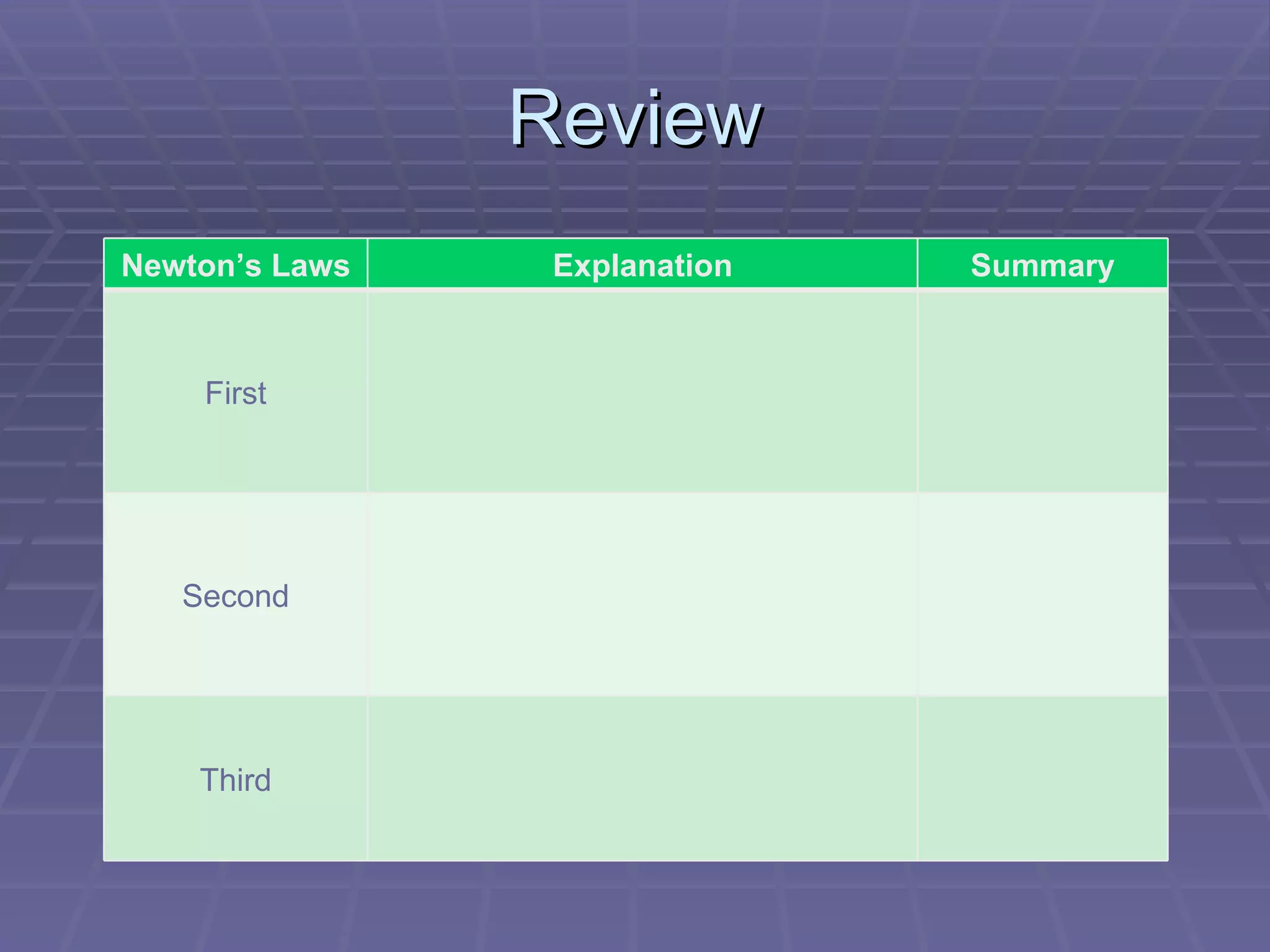
Review Newton’s Laws Explanation Summary First Second Third

Simple Machines

  • 1.
  • 2.
    Simple Machines A machine is a device that makes work easier.
  • 3.
    Work & MachinesA machine makes work easier by changing the direction or size of the force needed to move an object. (They cannot save or reduce work) W = Force x distance Two forces in simple machines: effort force the force applied to the machine to make it work resistance force the force resisting movement (often the object's weight, called the "Load")
  • 4.
    Mechanical Advantage M.A. = resistance force effort force Multiplied force: A machine allows you to lift an 8N block with 4N of force Mechanical Advantage = 8N/4N = 2 M.A. of 2 means your effort force is doubled Change of direction: A machine lets you lift a 10 N block with 10 N of force Mechanical Advantage = 10N/10N = 1 M.A. of 1 means the direction of your effort force is changed
  • 5.
    Inclined Plane Inclinedplane : any flat, slanted surface A ramp is the most common type of inclined plane.  higher at one end than the other the longer the ramp, the less force is needed to do the work Inclined planes help by pushing up against gravity's pull on the load (normal force). The load (resistance) moves in the same direction as the effort force.
  • 6.
  • 7.
    Wedge Wedge :two inclined planes put together to form a V-shape used to lift or pry apart heavy objects can also stop an object from moving  A wedge works as the two inclined planes push at perpendicular angles on the load. The load moves in a different direction than the effort force. In this picture, as the force moves the ax down, the load (wood) breaks apart and falls to the sides.
  • 8.
  • 9.
    Screw Screw: an inclined plane wrapped around a center post longer inclined planes (more/closer threads) require less force to move the load has two parts: the inclined plane and the center post  As the force rotates the screw, it goes down into the wood. The force and the load move in the same direction. Threads of screw increase surface area friction which allows screws to objects together better than nails  Wedge-shaped post allows screw to go in wood easier
  • 10.
  • 11.
    Lever Lever: a straight bar that moves on a fixed point called a fulcrum. the longer the distance between effort force and the fulcrum, the less force will be needed to move the load  has two parts: the bar and the fulcrum A lever works to change the direction of effort force and/or the distance the force acts throughout. Load & force move in opposite directions (1 st class lever) use gravity's pull on your own weight as the downward force Moving the fulcrum changes the distance needed to push down pushing the lever two feet down results in moving the rock up 1 foot
  • 12.
  • 13.
    Levers FirstClass Lever: Fulcrum in middle, load & force on opposite ends Load & force move in opposite directions .  Second Class Lever Load is in middle, with effort on end. Load & force move in same direction .  Third Class Lever Bar is attached to fulcrum on one end. Load is on end, with effort in middle. Load & force move in same direction . 
  • 14.
  • 15.
    Wheel & AxleWheel and axle: a circular disc locked to a center post.  The larger the wheel, the less force needed to move the load. two parts: the wheel and the center post (axle) When the wheel turns, it forces the axle to turn; or if the axle is turned, the wheel also turns. One full turn of the large wheel results in one full turn of the smaller one. The force moves in the same direction as the load. 
  • 16.
    Wheel & AxleExamples
  • 17.
    Pulley Pulley: a grooved wheel with a rope around it. The larger the wheel, the less force will be needed to move the load. two parts: the wheel and the rope    Pulleys can change the direction and/or amount of force needed to move the load. Load & force move in opposite or same directions, depending on how pulley is attached.  As the rope is pulled down, the flag goes up.
  • 18.
    Pulley Systems Whenused in combination, pulleys increase the mechanical advantage. To calculate the M.A., count the # of pulley ropes pulling on the load
  • 19.
  • 20.
    Efficiency Efficiency = output work input work No machine has 100% efficiency. Some work is lost due to friction Slows down work Produces heat How can efficiency be increased? … by reducing friction Lubricants (oil, grease, etc.) X 100%
  • 21.
    Calculating Efficiency Efficiency= output work input work If I swing a hammer and produce: Input 2,400 J of work Output of 720 J of work What is the efficiency of each swing? Efficiency = 720 J 2,400 J X 100% X 100% = 30% efficient
  • 22.
    Review What iswork? the transfer of energy that occurs when a force moves an object Equation for work? Work = Force x distance Units of work? Joules What is power? the rate at which work is done Equation for power? Power = Work  time Units of power? Watts
  • 23.
    Review What ispressure? Amount of force applied to a unit of area. What formula do we use to calculate pressure? P = F/A What units are used to measure pressure? pascals (Pa) N/m 2 What is Pascal’s Principle? A force applied to a fluid in a closed container will cause an increase in pressure, equally transmitted to all parts of the fluid. How does depth affect pressure? Pressure also increases with depth.
  • 24.
    Review Newton’s LawsExplanation Summary First Second Third

Editor's Notes

  • #12 Effort force acts on double the distance the load is raised = MA of 2 Effort force if half the weight of the load = MA of 2
  • #13 Overview only - next slide has more detailed explanation.
  • #15 First class levers: pop can, screw driver on lid, seesaw, catapult, pump handle Second Class: wheelbarrow, bottle cap, nut cracker Third Class: fishing pole, snow shovel, ice tongs/tweezers, chopsticks