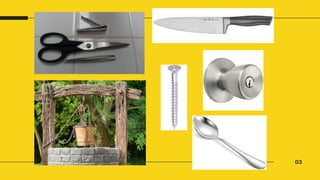
Simple
Machines
By Dionelyn M. Cruz
Work
Occurs when a force acts on an object to move it some
distance (displacement) from the start point
Work = Force x Distance
Measured in joules (J), which is the same as Newton-meter
03
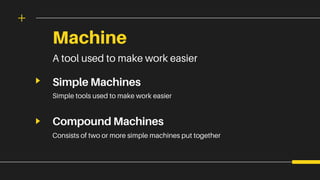
Simple Machines
Simple tools used to make work easier
Machine
A tool used to make work easier
Compound Machines
Consists of two or more simple machines put together
03
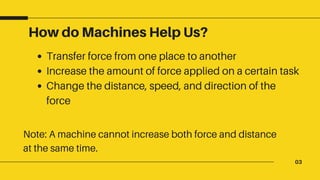
How do Machines Help Us?
Transfer force from one place to another
Increase the amount of force applied on a certain task
Change the distance, speed, and direction of the
force
Note: A machine cannot increase both force and distance
at the same time.
Forces Involved in Using a Machine
Effort Force
The force applied on the machine
Work input
Output Force
The force exerted by the machine on the load that needs to be moved
Work output
05
Example:
The man exerts an
input force (effort)
which is "multiplied"
by the pulley, resulting
to output force that
can lift the heavy
elephant.
06
Mechanical advantage
Produced by a machine which only needs a small effort force
but has an increased output force
Can be computed by dividing the output force by the input force
The closer the work output is to the work input, the more
efficient a machine is. But no machine is 100% efficient.
Basic Types of Simple Machines
Lever
Wheel and Axle
Pulley
Inclined Plane
Wedge
Screw
1.
2.
3.
4.
5.
6.
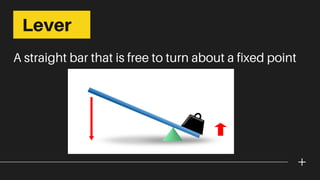
Lever
A straight bar that is free to turn about a fixed point
09
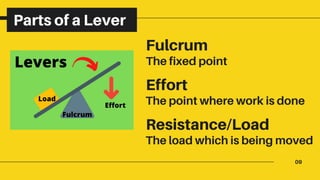
Parts of a Lever
The fixed point
Fulcrum
Effort
The point where work is done
Resistance/Load
The load which is being moved
How Does a Lever Work?
A lever multiplies the effort force, which
depends on the distances of the point of effort
from the load rom the fulcrum.
11
Classes of Levers
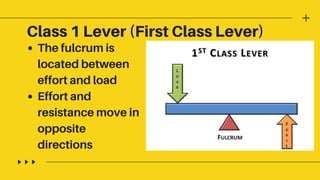
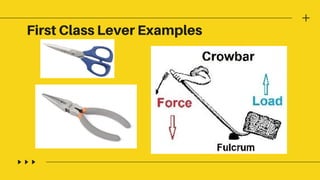
The fulcrum is
located between
effort and load
Effort and
resistance move in
opposite
directions
Class 1 Lever (First Class Lever)
First Class Lever Examples
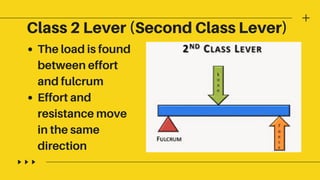
The load is found
between effort
and fulcrum
Effort and
resistance move
in the same
direction
Class 2 Lever (Second Class Lever)
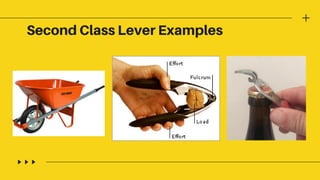
Second Class Lever Examples
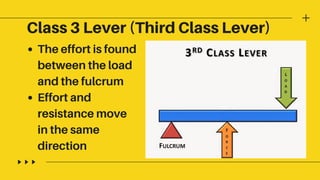
The effort is found
between the load
and the fulcrum
Effort and
resistance move
in the same
direction
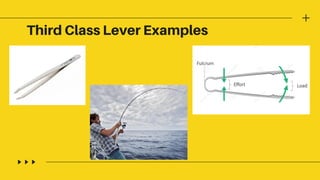
Class 3 Lever (Third Class Lever)
Third Class Lever Examples
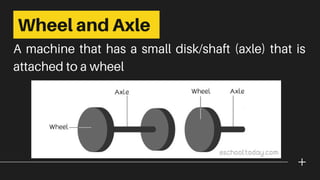
A machine that has a small disk/shaft (axle) that is
attached to a wheel
Wheel and Axle
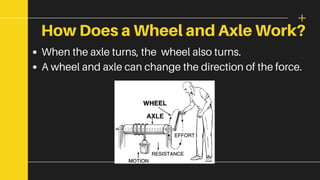
How Does a Wheel and Axle Work?
When the axle turns, the wheel also turns.
A wheel and axle can change the direction of the force.
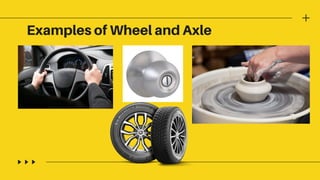
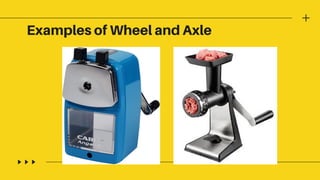
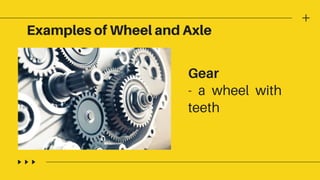
Examples of Wheel and Axle
Gear
- a wheel with
teeth
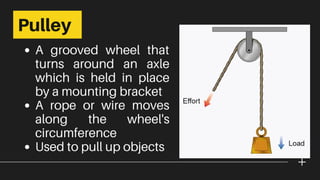
A grooved wheel that
turns around an axle
which is held in place
by a mounting bracket
A rope or wire moves
along the wheel's
circumference
Used to pull up objects
Pulley
11
Kinds of Pulley
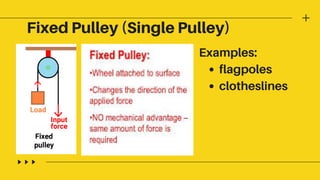
Fixed Pulley (Single Pulley)
flagpoles
clotheslines
Examples:
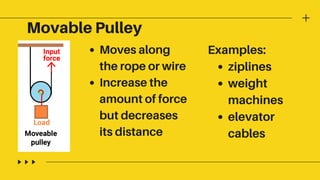
Movable Pulley
Moves along
the rope or wire
Increase the
amount of force
but decreases
its distance
ziplines
weight
machines
elevator
cables
Examples:
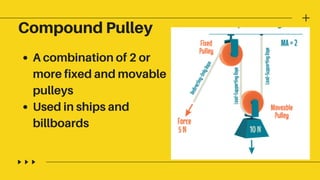
Compound Pulley
A combination of 2 or
more fixed and movable
pulleys
Used in ships and
billboards
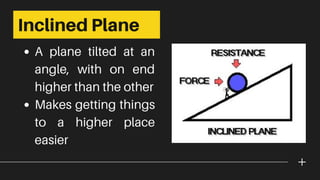
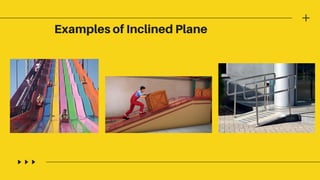
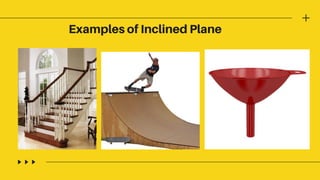
A plane tilted at an
angle, with on end
higher than the other
Makes getting things
to a higher place
easier
Inclined Plane
Examples of Inclined Plane
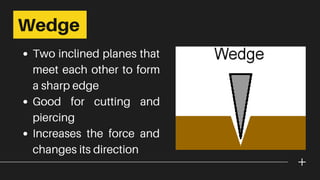
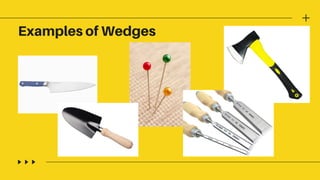
Two inclined planes that
meet each other to form
a sharp edge
Good for cutting and
piercing
Increases the force and
changes its direction
Wedge
Examples of Wedges
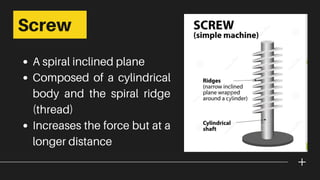
A spiral inclined plane
Composed of a cylindrical
body and the spiral ridge
(thread)
Increases the force but at a
longer distance
Screw
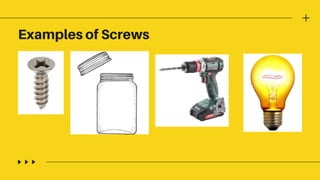
Examples of Screws
Compound
and Complex
Machines
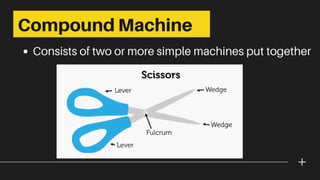
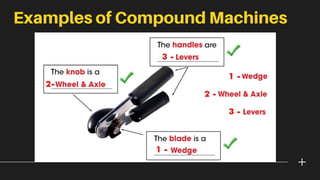
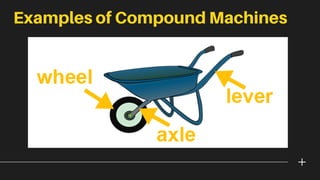
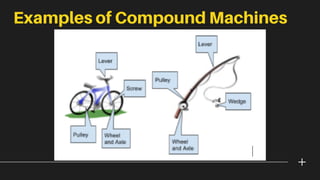
Consists of two or more simple machines put together
Compound Machine
Examples of Compound Machines
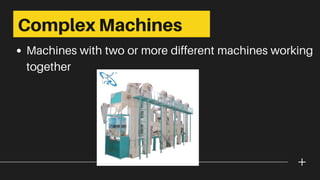
Machines with two or more different machines working
together
Complex Machines