Geologic Processes that Shape Planets
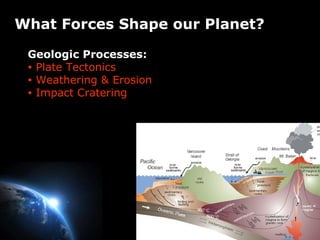
What Forces Shape our Planet? Geologic Processes: Plate Tectonics Weathering & Erosion Impact Cratering
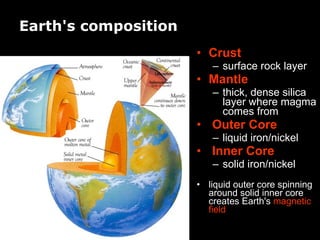
Earth's composition Crust surface rock layer   Mantle thick, dense silica layer where magma comes from Outer Core liquid iron/nickel Inner Core solid iron/nickel liquid outer core spinning around solid inner core creates Earth's  magnetic field
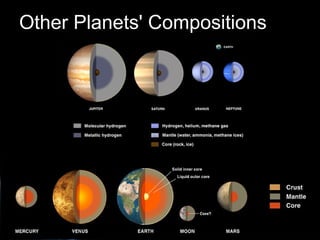
Other Planets' Compositions
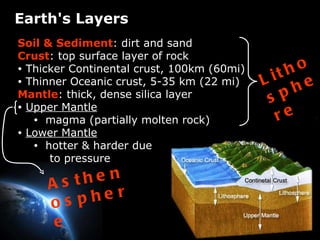
Earth's Layers Soil & Sediment : dirt and sand Crust : top surface layer of rock  Thicker Continental crust, 100km (60mi) Thinner Oceanic crust, 5-35 km (22 mi) Mantle : thick, dense silica layer  Upper Mantle magma (partially molten rock) Lower Mantle   hotter & harder due  to pressure Lithosphere Asthenosphere
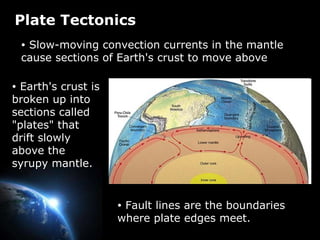
Plate Tectonics Slow-moving convection currents in the mantle cause sections of Earth's crust to move above Fault lines are the boundaries where plate edges meet.  Earth's crust is broken up into sections called "plates" that drift slowly above the syrupy mantle.
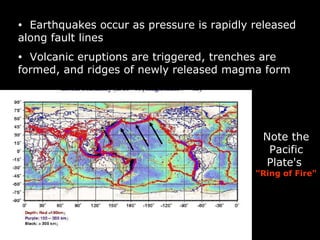
Earthquakes occur as pressure is rapidly released along fault lines  Volcanic eruptions are triggered, trenches are formed, and ridges of newly released magma form Note the Pacific Plate's  "Ring of Fire"
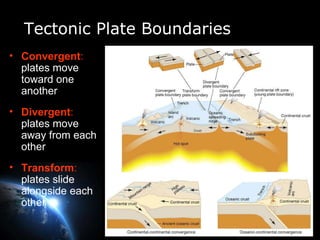
Tectonic Plate Boundaries Convergent :   plates move toward one another Divergent :   plates move away from each other Transform :   plates slide alongside each other
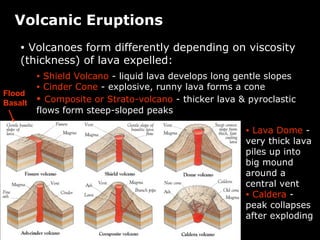
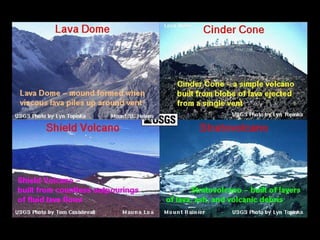
Volcanic Eruptions Volcanoes form differently depending on viscosity (thickness) of lava expelled: Shield Volcano  - liquid lava develops long gentle slopes Cinder Cone  - explosive, runny lava forms a cone Composite or Strato-volcano  - thicker lava & pyroclastic flows form steep-sloped peaks Lava Dome  - very thick lava piles up into big mound around a central vent Caldera  - peak collapses after exploding Flood Basalt
 
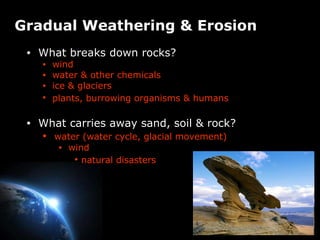
Gradual Weathering & Erosion What breaks down rocks? wind water & other chemicals ice & glaciers plants, burrowing organisms & humans   What carries away sand, soil & rock? water (water cycle, glacial movement) wind natural disasters
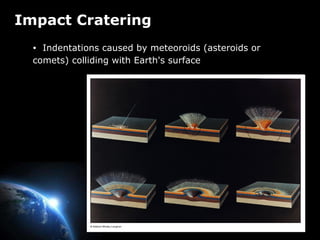
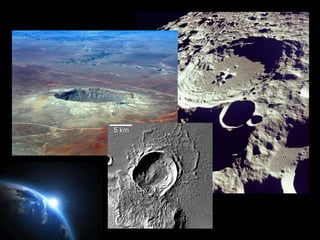
Impact Cratering Indentations caused by meteoroids (asteroids or comets) colliding with Earth's surface
 
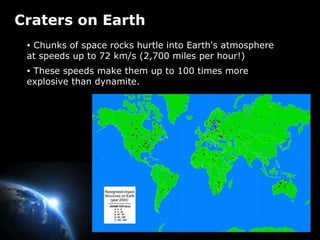
Craters on Earth Chunks of space rocks hurtle into Earth's atmosphere at speeds up to 72 km/s (2,700 miles per hour!) These speeds make them up to 100 times more explosive than dynamite.
 
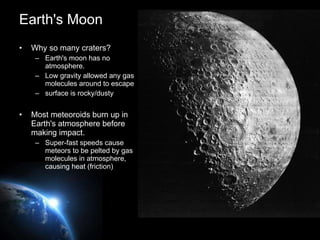
Why so many craters? Earth's moon has no atmosphere. Low gravity allowed any gas molecules around to escape surface is rocky/dusty Most meteoroids burn up in Earth's atmosphere before making impact. Super-fast speeds cause meteors to be pelted by gas molecules in atmosphere, causing heat (friction) Earth's Moon
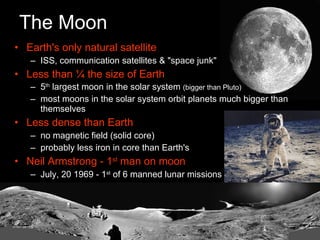
The Moon Earth's only natural satellite ISS, communication satellites & "space junk" Less than ¼ the size of Earth 5 th  largest moon in the solar system  (bigger than Pluto) most moons in the solar system orbit planets much bigger than themselves Less dense than Earth no magnetic field (solid core) probably less iron in core than Earth's Neil Armstrong - 1 st  man on moon July, 20 1969 - 1 st  of 6 manned lunar missions
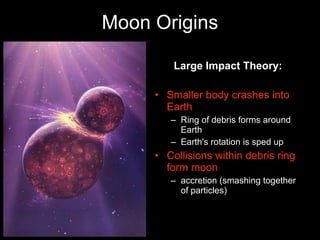
Moon Origins Large Impact Theory: Smaller body crashes into Earth Ring of debris forms around Earth Earth's rotation is sped up Collisions within debris ring form moon accretion (smashing together of particles)
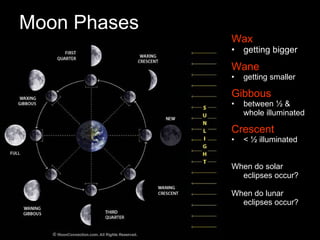
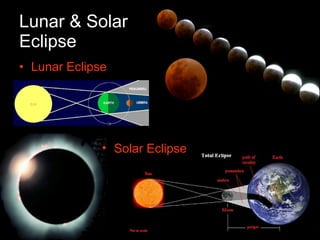
Moon Phases Wax getting bigger Wane   getting smaller Gibbous between ½ & whole illuminated Crescent < ½ illuminated When do solar eclipses occur? When do lunar eclipses occur?
Moon - Earth Interactions What Affects Tides? Moon pulls water Also pulls Earth Causes ocean &quot;bulges&quot; Earth's rotation causes 2 highs & 2 lows each day Centrifugal force also contributes Ocean Tides Up & down, not in and out
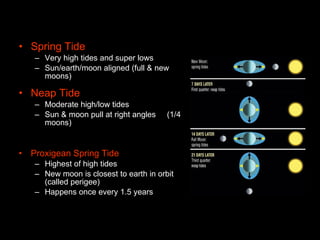
Spring Tide Very high tides and super lows Sun/earth/moon aligned (full & new moons) Neap Tide Moderate high/low tides Sun & moon pull at right angles  (1/4 moons) Proxigean Spring Tide Highest of high tides New moon is closest to earth in orbit (called perigee) Happens once every 1.5 years
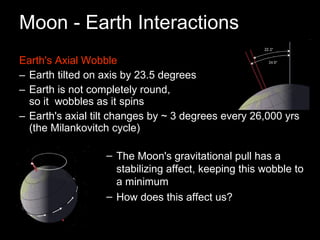
Moon - Earth Interactions Earth's Axial Wobble Earth tilted on axis by 23.5 degrees Earth is not completely round,  so it  wobbles as it spins Earth's axial tilt changes by ~ 3 degrees every 26,000 yrs (the Milankovitch cycle) The Moon's gravitational pull has a stabilizing affect, keeping this wobble to a minimum How does this affect us?
Lunar & Solar  Eclipse Lunar Eclipse Solar Eclipse

The Moon & Planetary Geology

  • 1.
  • 2.
    What Forces Shapeour Planet? Geologic Processes: Plate Tectonics Weathering & Erosion Impact Cratering
  • 3.
    Earth's composition Crustsurface rock layer Mantle thick, dense silica layer where magma comes from Outer Core liquid iron/nickel Inner Core solid iron/nickel liquid outer core spinning around solid inner core creates Earth's magnetic field
  • 4.
  • 5.
    Earth's Layers Soil& Sediment : dirt and sand Crust : top surface layer of rock Thicker Continental crust, 100km (60mi) Thinner Oceanic crust, 5-35 km (22 mi) Mantle : thick, dense silica layer Upper Mantle magma (partially molten rock) Lower Mantle hotter & harder due to pressure Lithosphere Asthenosphere
  • 6.
    Plate Tectonics Slow-movingconvection currents in the mantle cause sections of Earth's crust to move above Fault lines are the boundaries where plate edges meet. Earth's crust is broken up into sections called &quot;plates&quot; that drift slowly above the syrupy mantle.
  • 7.
    Earthquakes occur aspressure is rapidly released along fault lines Volcanic eruptions are triggered, trenches are formed, and ridges of newly released magma form Note the Pacific Plate's &quot;Ring of Fire&quot;
  • 8.
    Tectonic Plate BoundariesConvergent : plates move toward one another Divergent : plates move away from each other Transform : plates slide alongside each other
  • 9.
    Volcanic Eruptions Volcanoesform differently depending on viscosity (thickness) of lava expelled: Shield Volcano - liquid lava develops long gentle slopes Cinder Cone - explosive, runny lava forms a cone Composite or Strato-volcano - thicker lava & pyroclastic flows form steep-sloped peaks Lava Dome - very thick lava piles up into big mound around a central vent Caldera - peak collapses after exploding Flood Basalt
  • 10.
  • 11.
    Gradual Weathering &Erosion What breaks down rocks? wind water & other chemicals ice & glaciers plants, burrowing organisms & humans What carries away sand, soil & rock? water (water cycle, glacial movement) wind natural disasters
  • 12.
    Impact Cratering Indentationscaused by meteoroids (asteroids or comets) colliding with Earth's surface
  • 13.
  • 14.
    Craters on EarthChunks of space rocks hurtle into Earth's atmosphere at speeds up to 72 km/s (2,700 miles per hour!) These speeds make them up to 100 times more explosive than dynamite.
  • 15.
  • 16.
    Why so manycraters? Earth's moon has no atmosphere. Low gravity allowed any gas molecules around to escape surface is rocky/dusty Most meteoroids burn up in Earth's atmosphere before making impact. Super-fast speeds cause meteors to be pelted by gas molecules in atmosphere, causing heat (friction) Earth's Moon
  • 17.
    The Moon Earth'sonly natural satellite ISS, communication satellites & &quot;space junk&quot; Less than ¼ the size of Earth 5 th largest moon in the solar system (bigger than Pluto) most moons in the solar system orbit planets much bigger than themselves Less dense than Earth no magnetic field (solid core) probably less iron in core than Earth's Neil Armstrong - 1 st man on moon July, 20 1969 - 1 st of 6 manned lunar missions
  • 18.
    Moon Origins LargeImpact Theory: Smaller body crashes into Earth Ring of debris forms around Earth Earth's rotation is sped up Collisions within debris ring form moon accretion (smashing together of particles)
  • 19.
    Moon Phases Waxgetting bigger Wane getting smaller Gibbous between ½ & whole illuminated Crescent < ½ illuminated When do solar eclipses occur? When do lunar eclipses occur?
  • 20.
    Moon - EarthInteractions What Affects Tides? Moon pulls water Also pulls Earth Causes ocean &quot;bulges&quot; Earth's rotation causes 2 highs & 2 lows each day Centrifugal force also contributes Ocean Tides Up & down, not in and out
  • 21.
    Spring Tide Veryhigh tides and super lows Sun/earth/moon aligned (full & new moons) Neap Tide Moderate high/low tides Sun & moon pull at right angles (1/4 moons) Proxigean Spring Tide Highest of high tides New moon is closest to earth in orbit (called perigee) Happens once every 1.5 years
  • 22.
    Moon - EarthInteractions Earth's Axial Wobble Earth tilted on axis by 23.5 degrees Earth is not completely round, so it wobbles as it spins Earth's axial tilt changes by ~ 3 degrees every 26,000 yrs (the Milankovitch cycle) The Moon's gravitational pull has a stabilizing affect, keeping this wobble to a minimum How does this affect us?
  • 23.
    Lunar & Solar Eclipse Lunar Eclipse Solar Eclipse