Group members: Anil kumar, Hemanth, Sai chand, Vamsi, Ganesh
The document discusses pulley systems and their uses. It defines pulleys and describes different pulley types: fixed pulleys, movable pulleys, and block and tackle pulley systems. It explains how pulleys can increase mechanical advantage and make it easier to lift heavy loads using less force. The project aims to lift a 6kg weight using only 1kg of force by implementing a pulley system with 6 pulleys. Through their demonstration, the group successfully showed how pulleys can be used to lift heavier weights using less applied force.
Group members
• Anilkumar - 150040397
• Hemanth - 150040371
• Sai chand - 150040228
• Vamsi - 150040210
• Ganesh - 150040406
3.
You've probably seenthose amazing TV
strongmen who can pull cars with their
hair and drag trains with their teeth. But
did you know science can make you strong
too? If you need to lift huge weights, don't
strain your back: use the power of
science—and an amazing device called
a pulley. Let's take a closer look at how they
work!
4.
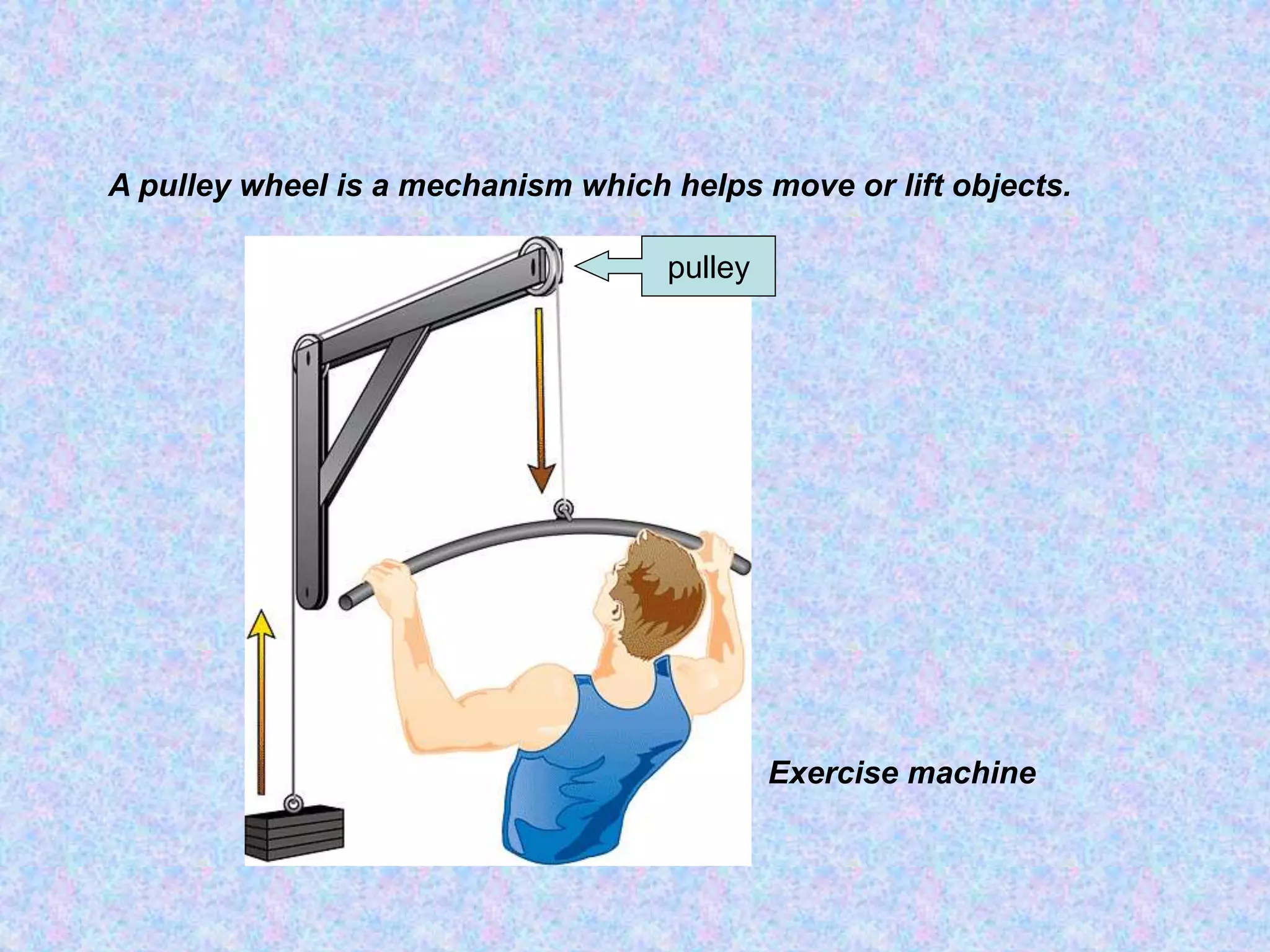
A pulley wheelis a mechanism which helps move or lift objects.
pulley
Exercise machine
5.
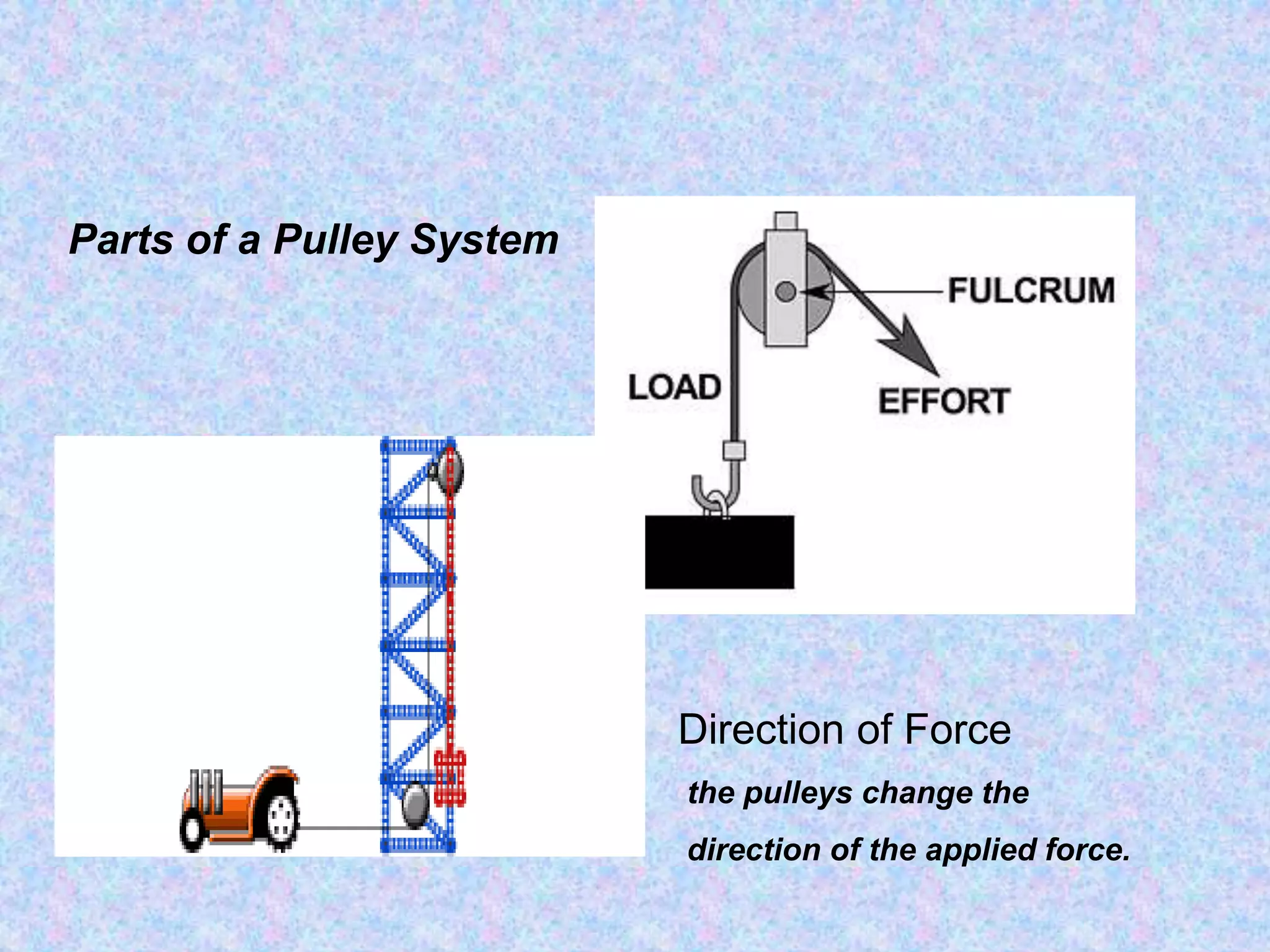
Parts of aPulley System
Direction of Force
the pulleys change the
direction of the applied force.
6.
Types of Pulley.
Aski lift operates on a fixed pulley system
1. A fixed pulley
7.
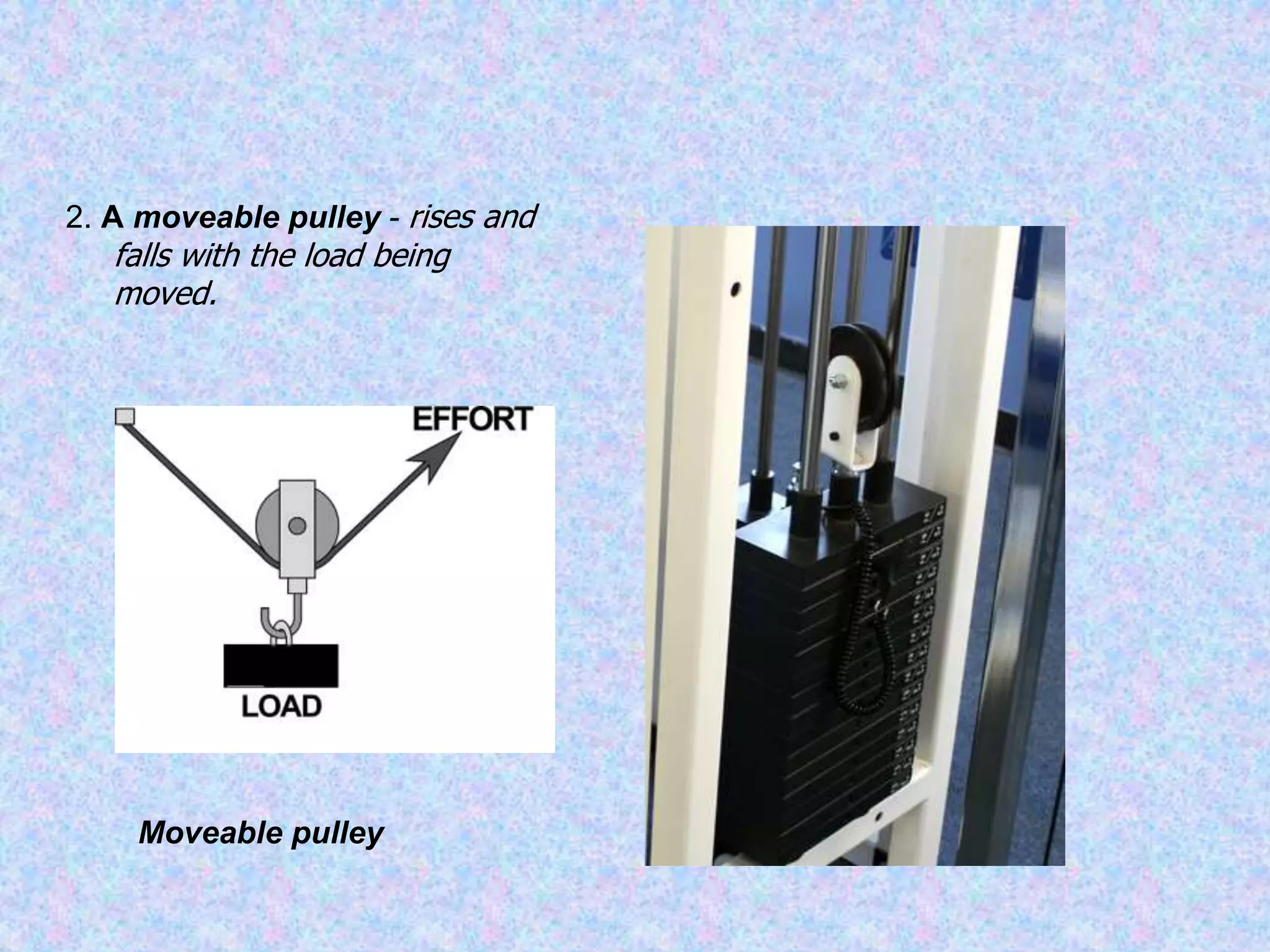
2. A moveablepulley - rises and
falls with the load being
moved.
Moveable pulley
8.
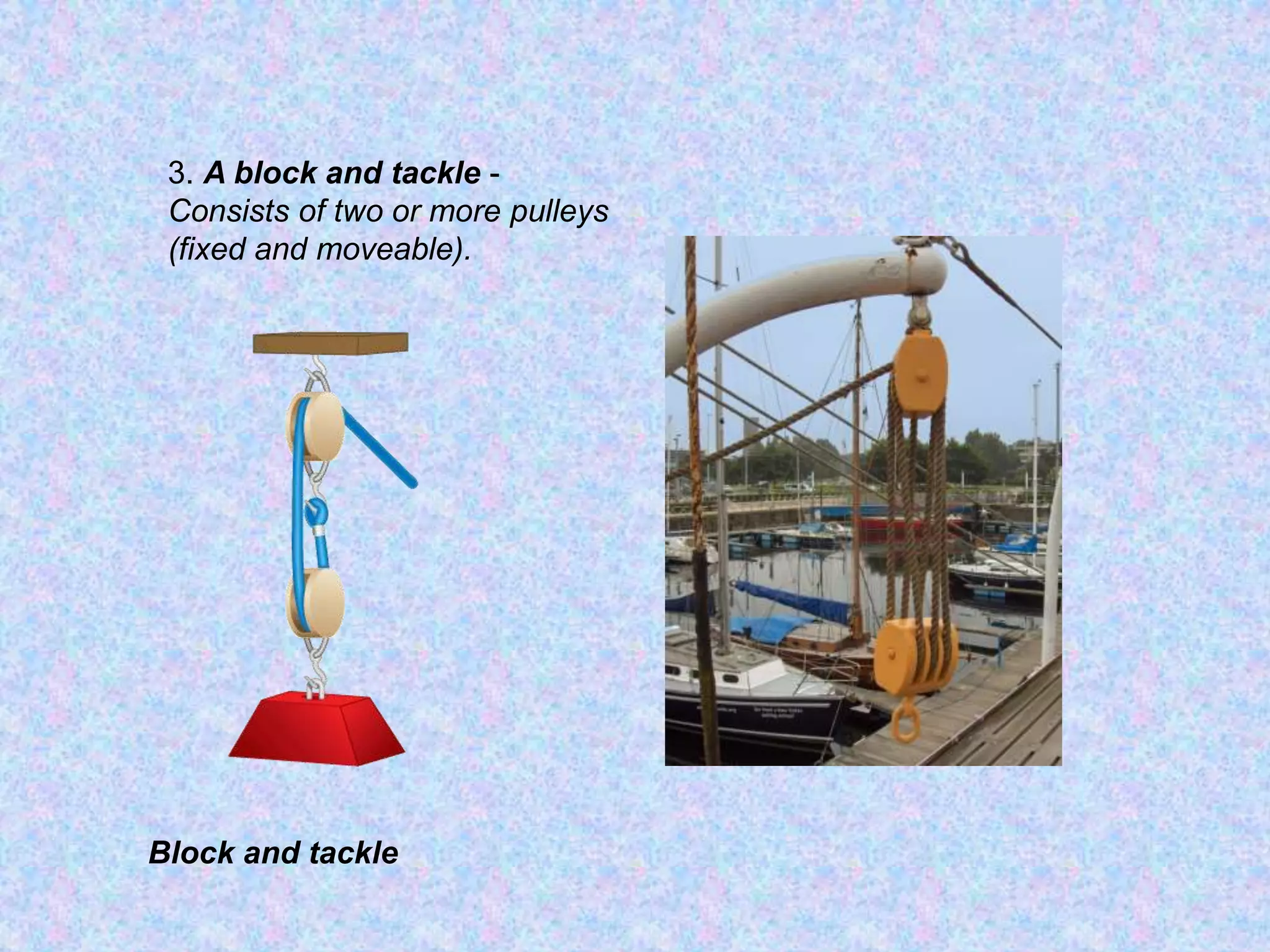
Block and tackle
3.A block and tackle -
Consists of two or more pulleys
(fixed and moveable).
9.
In this simplepulley system,
the force is equal to the load,
so the Mechanical Advantage is 1:1 or 1.
The Pulley Advantage
10 Kg = 100 N
The Mechanical Advantage is calculated like so:
Mechanical Advantage = Load / Effort = 100 N / 100 N
Mechanical Advantage = 1:1 or 1
10.
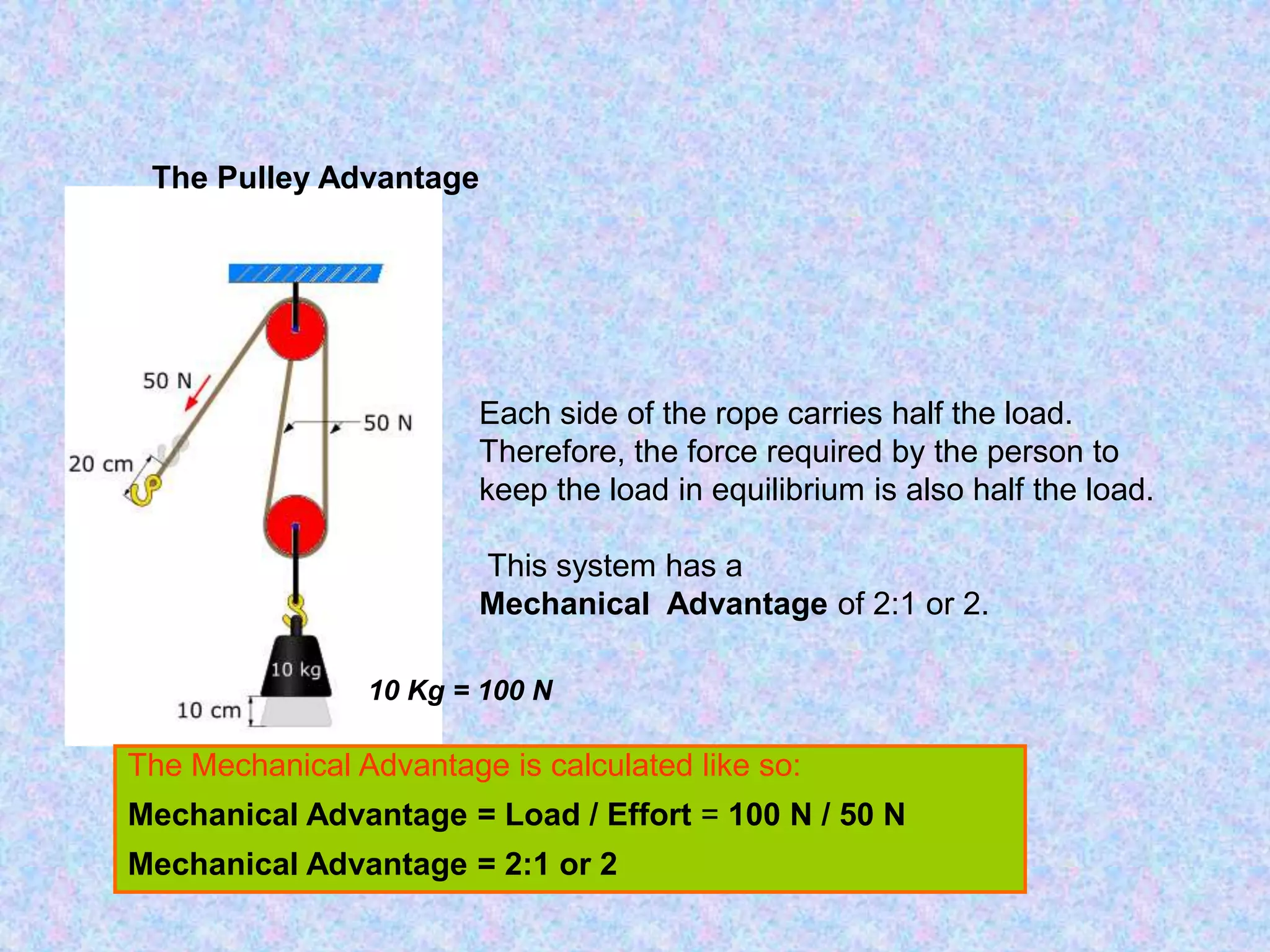
Each side ofthe rope carries half the load.
Therefore, the force required by the person to
keep the load in equilibrium is also half the load.
This system has a
Mechanical Advantage of 2:1 or 2.
The Pulley Advantage
The Mechanical Advantage is calculated like so:
Mechanical Advantage = Load / Effort = 100 N / 50 N
Mechanical Advantage = 2:1 or 2
10 Kg = 100 N
11.
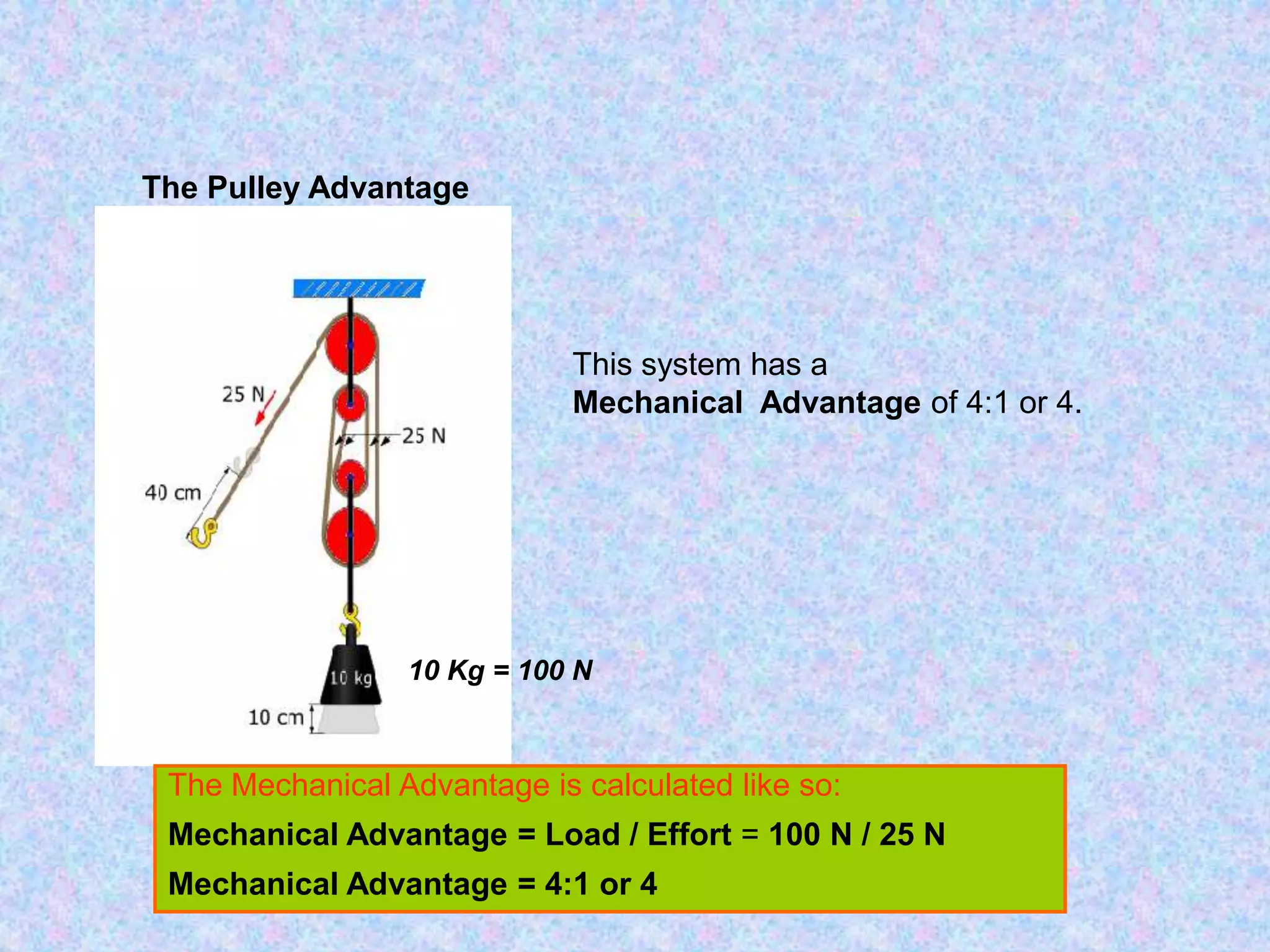
This system hasa
Mechanical Advantage of 4:1 or 4.
The Pulley Advantage
10 Kg = 100 N
The Mechanical Advantage is calculated like so:
Mechanical Advantage = Load / Effort = 100 N / 25 N
Mechanical Advantage = 4:1 or 4
12.
MODELLING
• AIM
Our aimis to lift the 6kg weight by
using 1 kg weight by pulley techniques.
In fact lifting more weight using less
weight
• MATERIALS REQUIRED
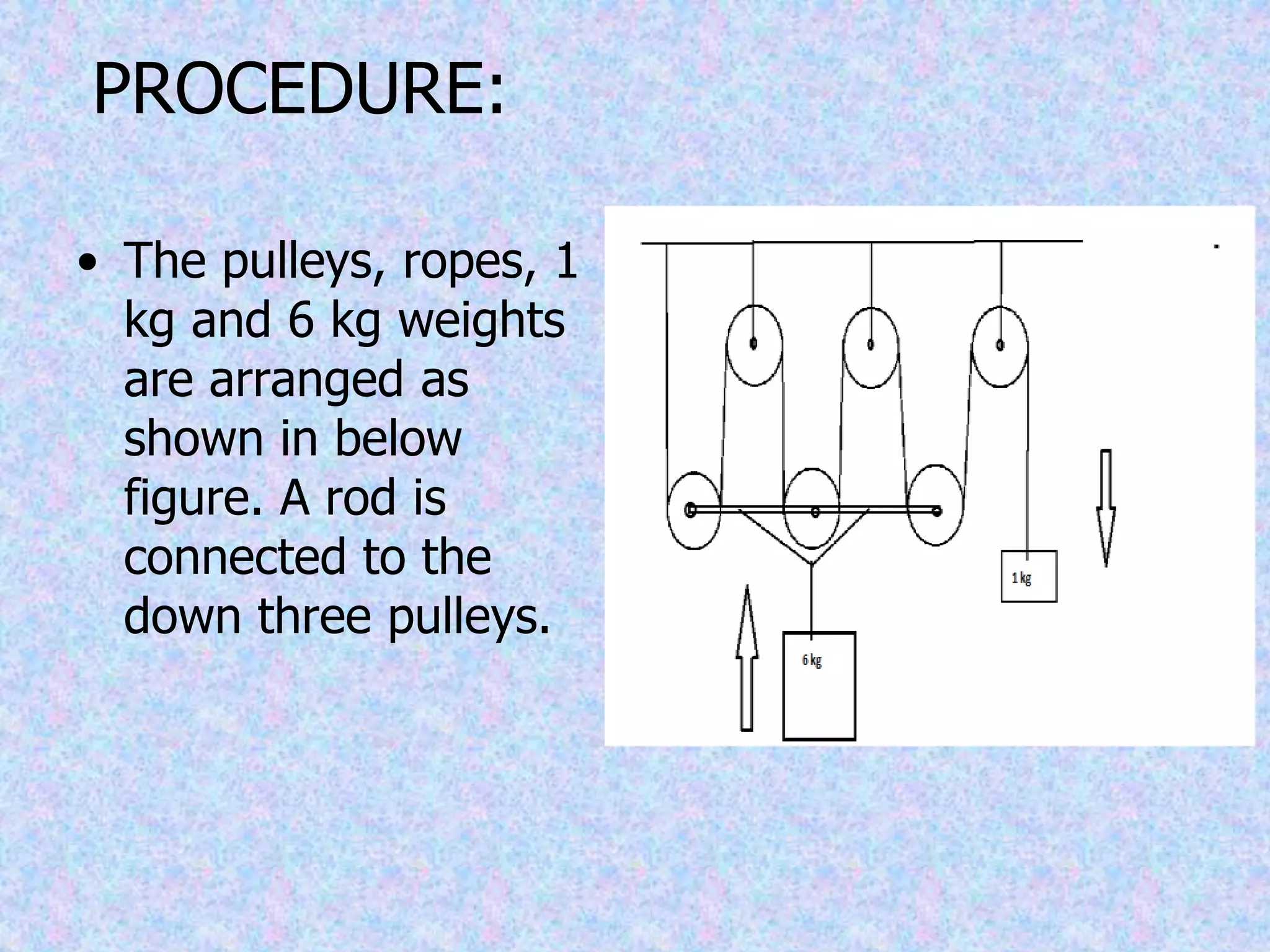
We need 6 pulleys, ropes, 1 kg and 6
kg weights and a rod.
13.
PROCEDURE:
• The pulleys,ropes, 1
kg and 6 kg weights
are arranged as
shown in below
figure. A rod is
connected to the
down three pulleys.
14.
EXPLANATION:
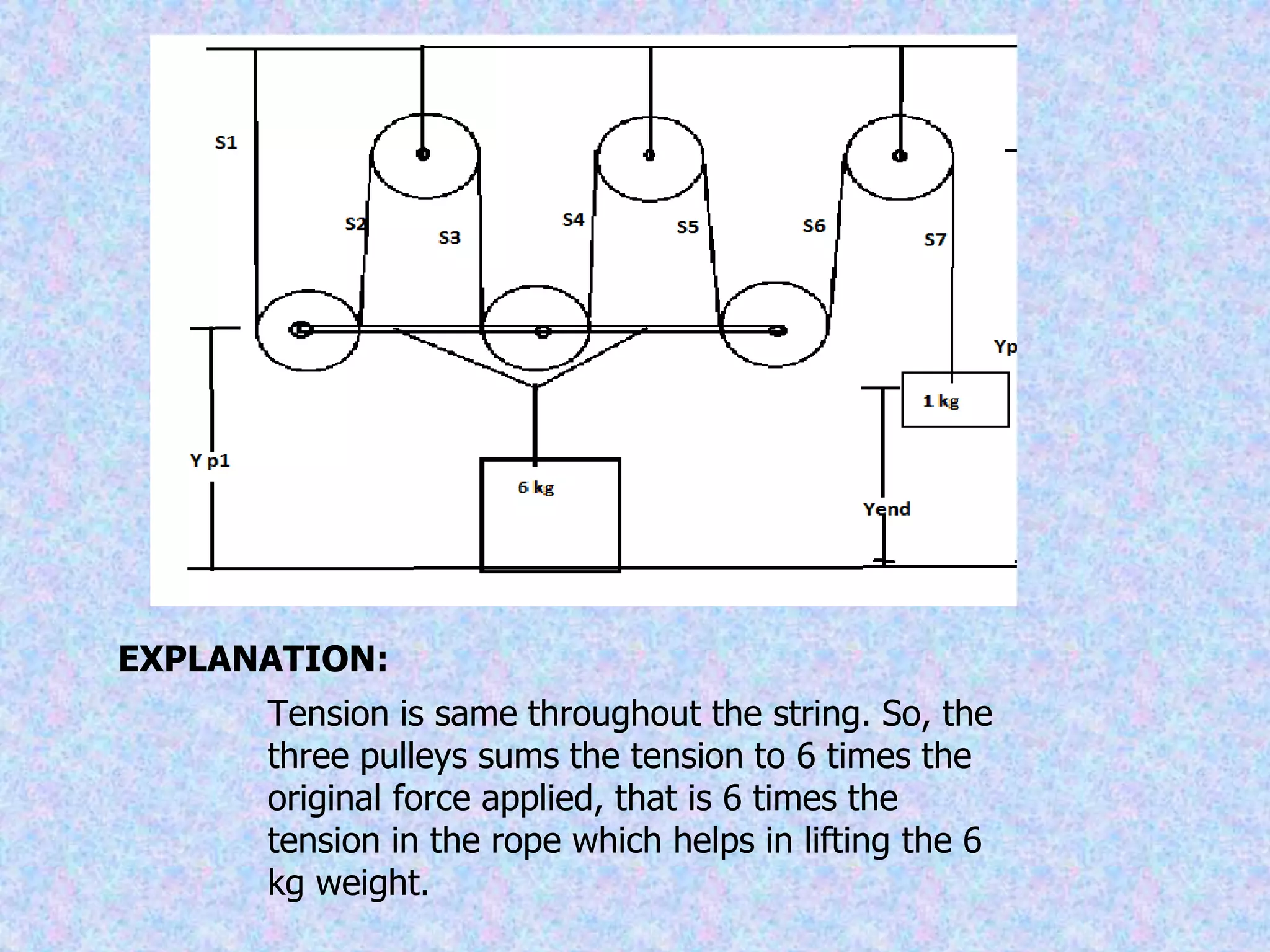
Tension is samethroughout the string. So, the
three pulleys sums the tension to 6 times the
original force applied, that is 6 times the
tension in the rope which helps in lifting the 6
kg weight.
15.
General applications inreal life:
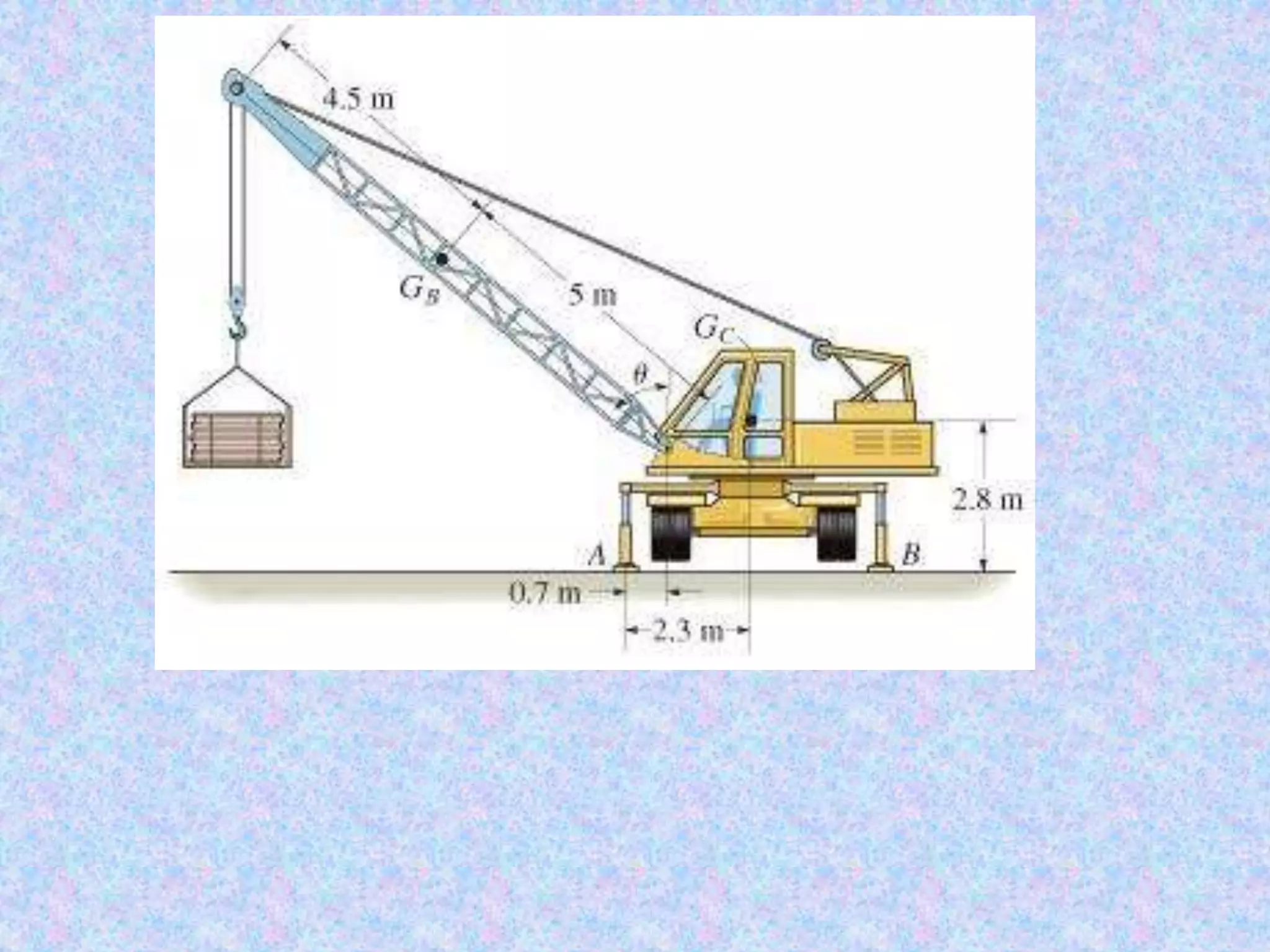
1. In cranes.
2. In factories.
3. Gears in automobiles to change
Directions.
4. In wells
5. In bicycle
applications:
1. Lifting
2. Pulling
3. Moving
4. Change of direction
5. Mechanical advantage
6. Reducing friction
7. Change of direction of effort
18.
RESULT:
As a result,through this project
we explained above we have
successfully lifted 6 kg weight
with 1 kg weight and meanwhile
proved the concept of pulleys
19.
CONCLUSION:
We have explainedthe
application of pulleys in lifting
large weights by means of mini
weights. And this concept is
majorly applicable in cranes.
The pulleys are not only useful
in lifting weights but also in
some important applications like
reversal of gears and reversal of
direction of application of force
and pulleys can also be seen
applicable in ancient times also
that is in wells.