ForcesForces
Learning objectives:
1. To know the units forces
are measured in.
2. To know what equipment is used to measure a
force.
3. To be able to measure the force of objects in the
classroom.
What is a force?What is a force?
Here are some ways of describing forces:
A push
A pull
A stretch
A squeeze
A catch
A twist
We can’t see forces but we can see the effects of a force.
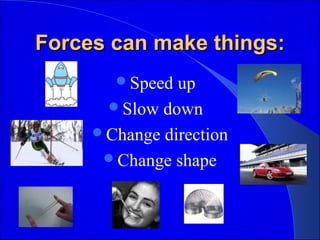
Forces can make things:Forces can make things:
Speed up
Slow down
Change direction
Change shape
Measuring forcesMeasuring forces
Forces are measured in newtons.
We can write this as N.
We use a Newton meter to measure forces.
It is sometimes called a force meter.
Have a look at the NewtonHave a look at the Newton
meter:meter:
What do you notice about this
instrument that measures forces?
What objects would this instrument
not be able to measure the force of
and why?
TodayToday’’s tasks:s tasks:
You are going to complete worksheet 1.
You are going to work in groups and
measure the force of different objects in the
classroom using a Newton meter. You will
record your findings in a table.
We will then discuss our findings.
What did we find out?What did we find out?
What object had the biggest force?
What object had the smallest force?
Challenge: can you find an object that has a
force of exactly 3 N?
Which object has a force greater than 5 N?
Quick quiz!Quick quiz!
1. What is a force?
2. Can you see forces?
3. Can you name any effects that forces
have?
4. What units do we measure forces in?
5. What instrument do we use to measure
force?
6. What is this instrument also known as?
How did you score??!

Measuring forces

  • 1.
    ForcesForces Learning objectives: 1. Toknow the units forces are measured in. 2. To know what equipment is used to measure a force. 3. To be able to measure the force of objects in the classroom.
  • 2.
    What is aforce?What is a force? Here are some ways of describing forces: A push A pull A stretch A squeeze A catch A twist We can’t see forces but we can see the effects of a force.
  • 3.
    Forces can makethings:Forces can make things: Speed up Slow down Change direction Change shape
  • 4.
    Measuring forcesMeasuring forces Forcesare measured in newtons. We can write this as N. We use a Newton meter to measure forces. It is sometimes called a force meter.
  • 5.
    Have a lookat the NewtonHave a look at the Newton meter:meter: What do you notice about this instrument that measures forces? What objects would this instrument not be able to measure the force of and why?
  • 6.
    TodayToday’’s tasks:s tasks: Youare going to complete worksheet 1. You are going to work in groups and measure the force of different objects in the classroom using a Newton meter. You will record your findings in a table. We will then discuss our findings.
  • 7.
    What did wefind out?What did we find out? What object had the biggest force? What object had the smallest force? Challenge: can you find an object that has a force of exactly 3 N? Which object has a force greater than 5 N?
  • 8.
    Quick quiz!Quick quiz! 1.What is a force? 2. Can you see forces? 3. Can you name any effects that forces have? 4. What units do we measure forces in? 5. What instrument do we use to measure force? 6. What is this instrument also known as? How did you score??!