MACHINES
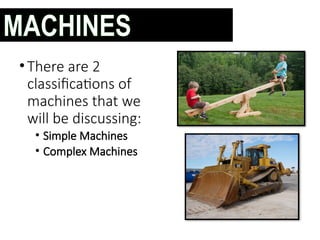
• The purposeof a machine is to
make work easier.
• This is done in 3 ways:
1. Decreasing Effort Force- the
force that YOU must apply
Ex. Using a screwdriver
2. Increasing the distance over
which the force is applied
Ex. Ramp
3. Changing the direction of the
applied force
Ex. Pulley
SIMPLE MACHINES
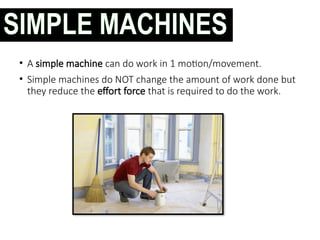
• Asimple machine can do work in 1 motion/movement.
• Simple machines do NOT change the amount of work done but
they reduce the effort force that is required to do the work.
5.
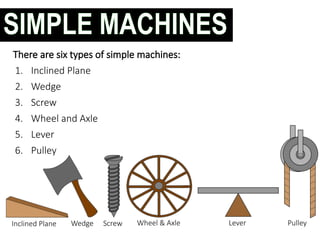
There are sixtypes of simple machines:
1. Inclined Plane
2. Wedge
3. Screw
4. Wheel and Axle
5. Lever
6. Pulley
Inclined Plane Wedge Screw Wheel & Axle Lever Pulley
SIMPLE MACHINES
6.
• An inclinedplane is a device that
increases the distance by which
the effort force is applied
• An inclined plane makes it easier
to raise or lower heavy objects.
• Examples: Slide, Stairs, Ramps
INCLINED PLANE
INCREASES DISTANCE
7.
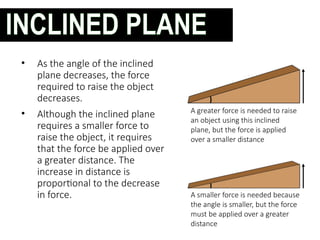
• As theangle of the inclined
plane decreases, the force
required to raise the object
decreases.
• Although the inclined plane
requires a smaller force to
raise the object, it requires
that the force be applied over
a greater distance. The
increase in distance is
proportional to the decrease
in force.
A greater force is needed to raise
an object using this inclined
plane, but the force is applied
over a smaller distance
A smaller force is needed because
the angle is smaller, but the force
must be applied over a greater
distance
INCLINED PLANE
8.
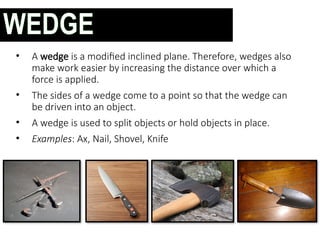
• A wedgeis a modified inclined plane. Therefore, wedges also
make work easier by increasing the distance over which a
force is applied.
• The sides of a wedge come to a point so that the wedge can
be driven into an object.
• A wedge is used to split objects or hold objects in place.
• Examples: Ax, Nail, Shovel, Knife
WEDGE
9.
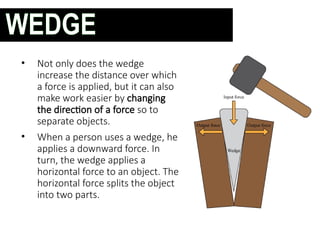
• Not onlydoes the wedge
increase the distance over which
a force is applied, but it can also
make work easier by changing
the direction of a force so to
separate objects.
• When a person uses a wedge, he
applies a downward force. In
turn, the wedge applies a
horizontal force to an object. The
horizontal force splits the object
into two parts.
WEDGE
10.
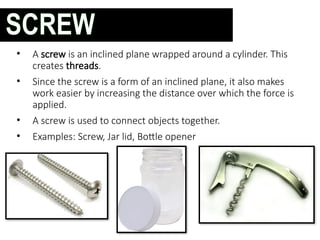
• A screwis an inclined plane wrapped around a cylinder. This
creates threads.
• Since the screw is a form of an inclined plane, it also makes
work easier by increasing the distance over which the force is
applied.
• A screw is used to connect objects together.
• Examples: Screw, Jar lid, Bottle opener
SCREW
11.
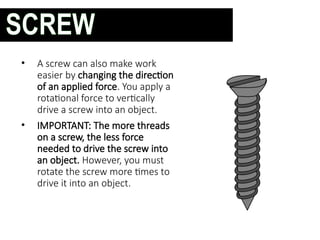
• A screwcan also make work
easier by changing the direction
of an applied force. You apply a
rotational force to vertically
drive a screw into an object.
• IMPORTANT: The more threads
on a screw, the less force
needed to drive the screw into
an object. However, you must
rotate the screw more times to
drive it into an object.
SCREW
12.
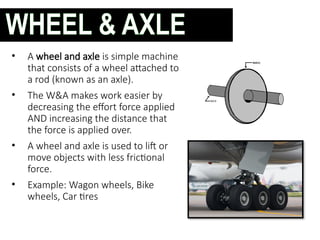
• A wheeland axle is simple machine
that consists of a wheel attached to
a rod (known as an axle).
• The W&A makes work easier by
decreasing the effort force applied
AND increasing the distance that
the force is applied over.
• A wheel and axle is used to lift or
move objects with less frictional
force.
• Example: Wagon wheels, Bike
wheels, Car tires
WHEEL & AXLE
13.
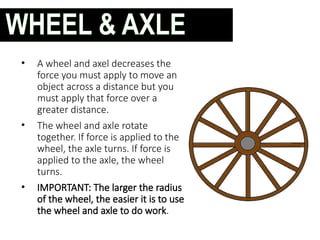
• A wheeland axel decreases the
force you must apply to move an
object across a distance but you
must apply that force over a
greater distance.
• The wheel and axle rotate
together. If force is applied to the
wheel, the axle turns. If force is
applied to the axle, the wheel
turns.
• IMPORTANT: The larger the radius
of the wheel, the easier it is to use
the wheel and axle to do work.
WHEEL & AXLE
14.
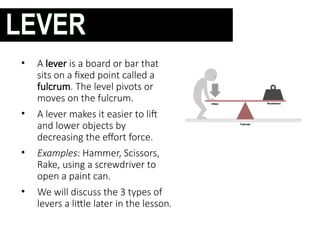
• A leveris a board or bar that
sits on a fixed point called a
fulcrum. The level pivots or
moves on the fulcrum.
• A lever makes it easier to lift
and lower objects by
decreasing the effort force.
• Examples: Hammer, Scissors,
Rake, using a screwdriver to
open a paint can.
• We will discuss the 3 types of
levers a little later in the lesson.
LEVER
15.
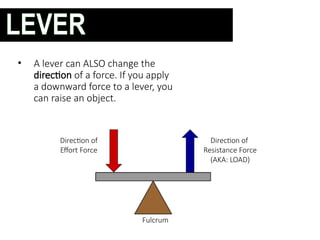
• A levercan ALSO change the
direction of a force. If you apply
a downward force to a lever, you
can raise an object.
Fulcrum
Direction of
Effort Force
Direction of
Resistance Force
(AKA: LOAD)
LEVER
16.
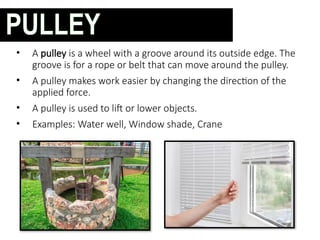
• A pulleyis a wheel with a groove around its outside edge. The
groove is for a rope or belt that can move around the pulley.
• A pulley makes work easier by changing the direction of the
applied force.
• A pulley is used to lift or lower objects.
• Examples: Water well, Window shade, Crane
PULLEY
17.
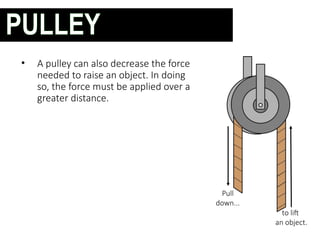
• A pulleycan also decrease the force
needed to raise an object. In doing
so, the force must be applied over a
greater distance.
Pull
down...
to lift
an object.
PULLEY
18.
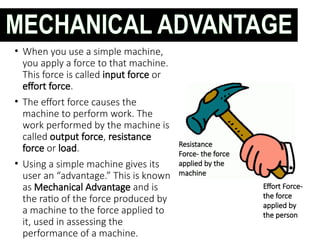
• When youuse a simple machine,
you apply a force to that machine.
This force is called input force or
effort force.
• The effort force causes the
machine to perform work. The
work performed by the machine is
called output force, resistance
force or load.
• Using a simple machine gives its
user an “advantage.” This is known
as Mechanical Advantage and is
the ratio of the force produced by
a machine to the force applied to
it, used in assessing the
performance of a machine.
Effort Force-
the force
applied by
the person
Resistance
Force- the force
applied by the
machine
MECHANICAL ADVANTAGE
19.
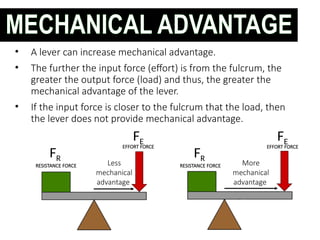
• A levercan increase mechanical advantage.
• The further the input force (effort) is from the fulcrum, the
greater the output force (load) and thus, the greater the
mechanical advantage of the lever.
• If the input force is closer to the fulcrum that the load, then
the lever does not provide mechanical advantage.
More
mechanical
advantage
EFFORT FORCE
RESISTANCE FORCE Less
mechanical
advantage
MECHANICAL ADVANTAGE
FE
FR
EFFORT FORCE
RESISTANCE FORCE
FE
FR
20.
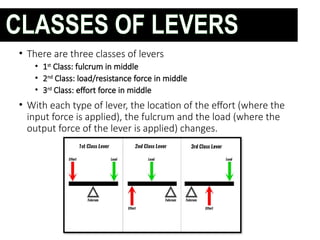
• There arethree classes of levers
• 1st
Class: fulcrum in middle
• 2nd
Class: load/resistance force in middle
• 3rd
Class: effort force in middle
• With each type of lever, the location of the effort (where the
input force is applied), the fulcrum and the load (where the
output force of the lever is applied) changes.
CLASSES OF LEVERS
21.
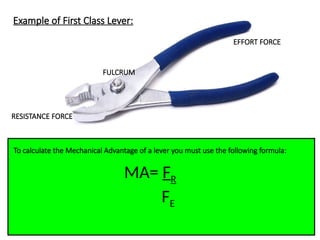
Example of FirstClass Lever:
FULCRUM
EFFORT FORCE
RESISTANCE FORCE
To calculate the Mechanical Advantage of a lever you must use the following formula:
MA= FR
FE
22.
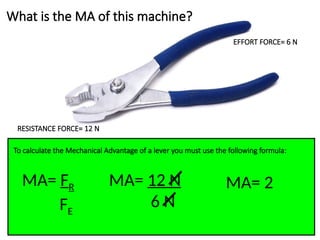
What is theMA of this machine?
EFFORT FORCE= 6 N
RESISTANCE FORCE= 12 N
To calculate the Mechanical Advantage of a lever you must use the following formula:
MA= FR
FE
MA= 12 N
6 N
MA= 2
23.
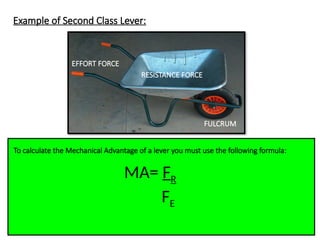
Example of SecondClass Lever:
To calculate the Mechanical Advantage of a lever you must use the following formula:
MA= FR
FE
EFFORT FORCE
RESISTANCE FORCE
FULCRUM
24.
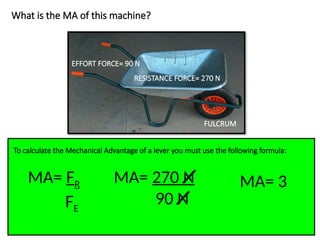
What is theMA of this machine?
To calculate the Mechanical Advantage of a lever you must use the following formula:
MA= FR
FE
EFFORT FORCE= 90 N
RESISTANCE FORCE= 270 N
FULCRUM
MA= 270 N
90 N
MA= 3
25.
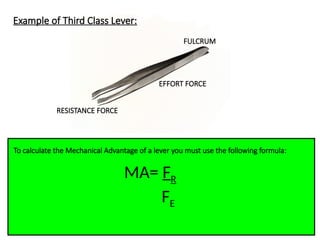
Example of ThirdClass Lever:
FULCRUM
EFFORT FORCE
RESISTANCE FORCE
To calculate the Mechanical Advantage of a lever you must use the following formula:
MA= FR
FE
26.
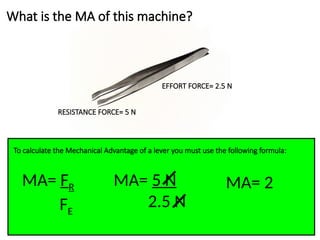
What is theMA of this machine?
EFFORT FORCE= 2.5 N
RESISTANCE FORCE= 5 N
To calculate the Mechanical Advantage of a lever you must use the following formula:
MA= FR
FE
MA= 5 N
2.5 N
MA= 2
27.
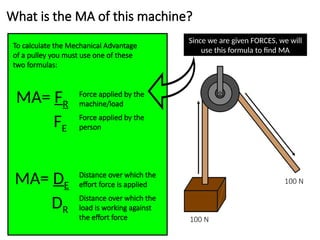
100 N
100 N
Whatis the MA of this machine?
To calculate the Mechanical Advantage
of a pulley you must use one of these
two formulas:
MA= FR
FE
MA= DE
DR
Force applied by the
machine/load
Force applied by the
person
Distance over which the
effort force is applied
Distance over which the
load is working against
the effort force
Since we are given FORCES, we will
use this formula to find MA
28.
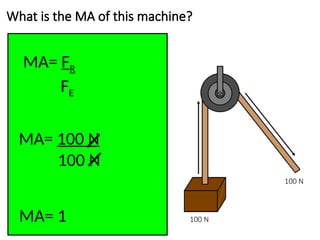
100 N
100 N
Whatis the MA of this machine?
MA= FR
FE
MA= 100 N
100 N
MA= 1
29.
1
0
m
10
m
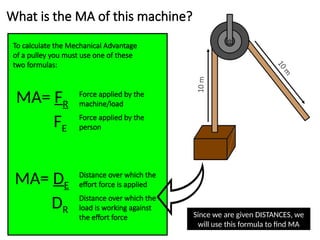
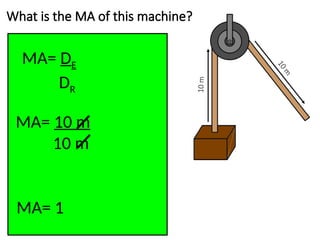
What is theMA of this machine?
To calculate the Mechanical Advantage
of a pulley you must use one of these
two formulas:
MA= FR
FE
MA= DE
DR
Force applied by the
machine/load
Force applied by the
person
Distance over which the
effort force is applied
Distance over which the
load is working against
the effort force Since we are given DISTANCES, we
will use this formula to find MA
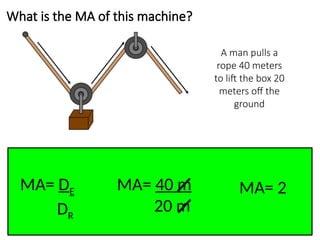
What is theMA of this machine?
MA= DE
DR
MA= 40 m
20 m
MA= 2
A man pulls a
rope 40 meters
to lift the box 20
meters off the
ground
32.
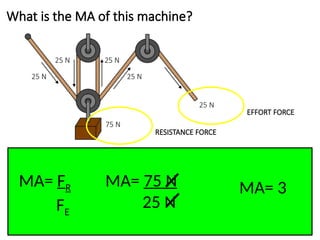
What is theMA of this machine?
MA= 3
75 N
25 N
25 N
25 N
25 N
25 N
EFFORT FORCE
RESISTANCE FORCE
MA= FR
FE
MA= 75 N
25 N
33.
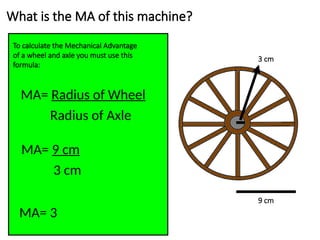
What is theMA of this machine?
To calculate the Mechanical Advantage
of a wheel and axle you must use this
formula:
MA= Radius of Wheel
Radius of Axle
9 cm
3 cm
MA= 9 cm
3 cm
MA= 3
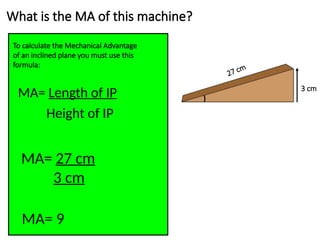
34.
What is theMA of this machine?
To calculate the Mechanical Advantage
of an inclined plane you must use this
formula:
MA= Length of IP
Height of IP
27 cm
3 cm
MA= 27 cm
3 cm
MA= 9
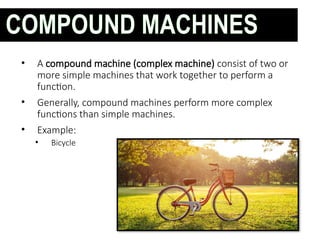
35.
• A compoundmachine (complex machine) consist of two or
more simple machines that work together to perform a
function.
• Generally, compound machines perform more complex
functions than simple machines.
• Example:
• Bicycle
COMPOUND MACHINES

 Most read

 Most read