By the endyou will be able to:
• describe the relationship between energy and work
• explain how the six simple machines operate
• provide reasons why more energy-efficient machines are
needed
• analyze the output of simple machines
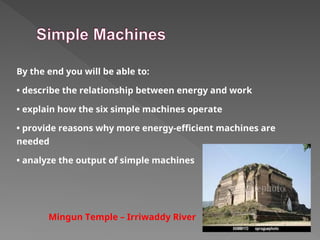
Mingun Temple – Irriwaddy River
3.
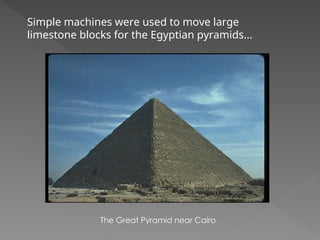
Simple machines wereused to move large
limestone blocks for the Egyptian pyramids...
The Great Pyramid near Cairo
4.
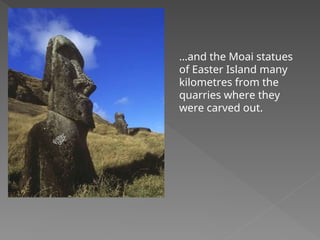
…and the Moaistatues
of Easter Island many
kilometres from the
quarries where they
were carved out.
5.
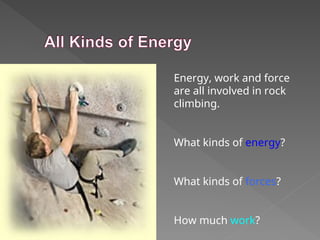
Energy, work andforce
are all involved in rock
climbing.
What kinds of energy?
What kinds of forces?
How much work?
6.
Energy – theability to do work
Work = Force x distance
(or W = F x d)
Force (effort)– a push or a pull
Force is measured in Newtons (N).
Distance is measured in metres (m).
Therefore, energy is the ability to move a mass
using a push or pull.
7.
Work ismeasured in Newton-metres (N•m) or
Joules (J). Energy is also measured in Joules.
Work is only done when both these conditions
exist:
1) a force is applied, and
2) the object moves.
A person coasting on a skateboard or bike is not
doing work; BUT pushing off or pedaling classifies
as work.
A student studying does no work but a student
writing an essay does… as long as the pen keeps
moving.
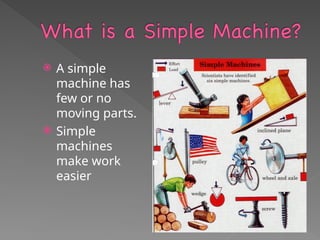
A simple
machinehas
few or no
moving parts.
Simple
machines
make work
easier
10.
Simple machines makework easier to
do. They decrease the effort force.
Simple machines don’t create less
work, they just spread the force applied
over a greater distance.
11.
Types of SimpleMachines
1) wheel and axle
2) pulley
a) moveable
b) fixed
3) inclined plane (ramp)
4) wedge
5) screw
6) lever
a) first class
b) second class
c) third class
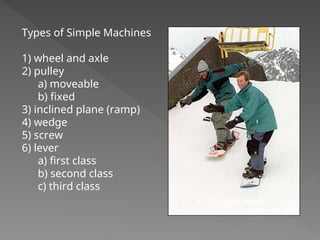
a “declined plane”
12.
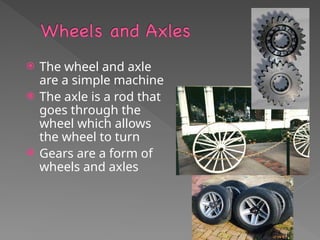
The wheeland axle
are a simple machine
The axle is a rod that
goes through the
wheel which allows
the wheel to turn
Gears are a form of
wheels and axles
13.
Wheel and Axle
–a larger wheel turning a smaller wheel
Examples:
door knob
screwdriver
wrench
bike sprocket
Winch
Turning a large wheel takes less effort than turning a
small wheel. This decreases effort force and multiplies
applied force.
The large wheel moves through a greater distance than
the smaller wheel, spreading effort over a longer
distance.
14.
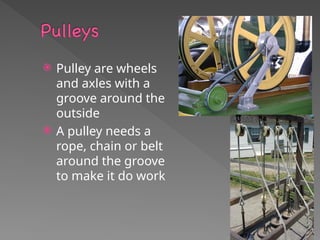
Pulley arewheels
and axles with a
groove around the
outside
A pulley needs a
rope, chain or belt
around the groove
to make it do work
15.
pulley – agrooved wheel
A pulley threaded with a rope is a simple machine.
Effort occurs at one end (pull) while the load
moves at the other end (push).
equilibrium – a system in balance
e.g. when the effort just supports the load
(pull = push)
16.
The number ofwheels on the pulley determines the effort
force that is needed:
1 wheel = 1/1 effort 2 wheels = ½ effort 3 wheels = 1/3
effort
Fixed pulley – effort force equals the load force; the
fulcrum does not move
example: clothesline
The load is still easier to move because pulling down and
inward is easier than pushing up against the force of
gravity.
Moveable pulley – the pulley moves with the load
example: block and tackle
Complex machines are made by combining simple
17.
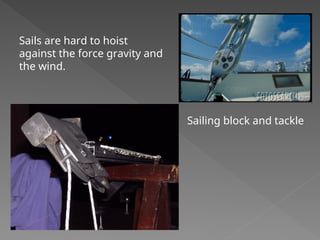
Sailing block andtackle
Sails are hard to hoist
against the force gravity and
the wind.
18.
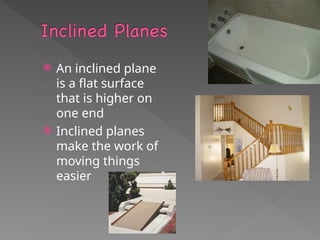
An inclinedplane
is a flat surface
that is higher on
one end
Inclined planes
make the work of
moving things
easier
19.
It isa flat surface whose endpoints are at
different heights.
By moving an object up an inclined plane
rather than completely vertical, the amount
of force required is reduced,
The negative is the increasing distance the
object must travel.
Examples of Inclined Planes
game trail
switchback
exit ramp
ski hill
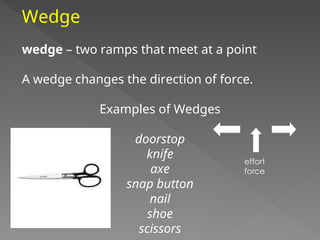
Wedge
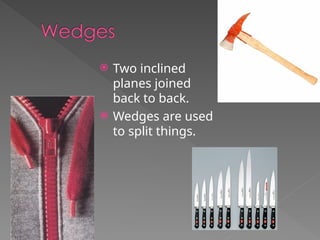
wedge – tworamps that meet at a point
A wedge changes the direction of force.
Examples of Wedges
doorstop
knife
axe
snap button
nail
shoe
scissors
effort
force
22.
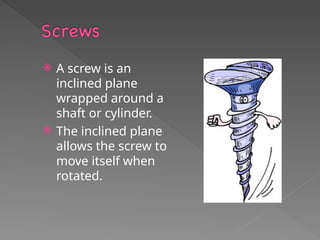
A screwis an
inclined plane
wrapped around a
shaft or cylinder.
The inclined plane
allows the screw to
move itself when
rotated.
23.
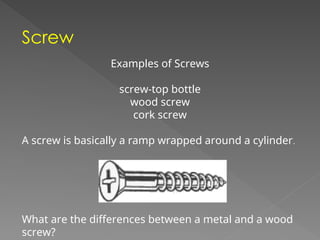
Screw
Examples of Screws
screw-topbottle
wood screw
cork screw
A screw is basically a ramp wrapped around a cylinder.
What are the differences between a metal and a wood
screw?
24.
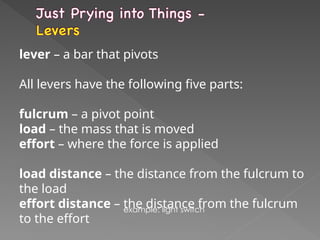
lever – abar that pivots
All levers have the following five parts:
fulcrum – a pivot point
load – the mass that is moved
effort – where the force is applied
load distance – the distance from the fulcrum to
the load
effort distance – the distance from the fulcrum
to the effort
example: light switch
25.
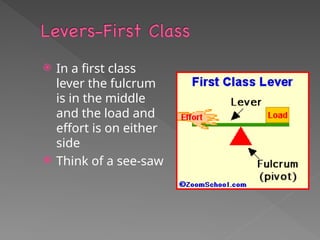
In afirst class
lever the fulcrum
is in the middle
and the load and
effort is on either
side
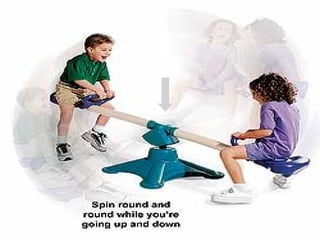
Think of a see-saw
26.
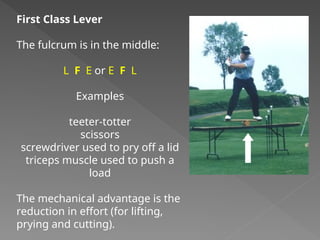
First Class Lever
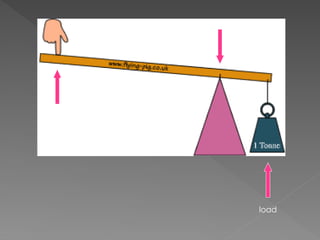
Thefulcrum is in the middle:
L F E or E F L
Examples
teeter-totter
scissors
screwdriver used to pry off a lid
triceps muscle used to push a
load
The mechanical advantage is the
reduction in effort (for lifting,
prying and cutting).
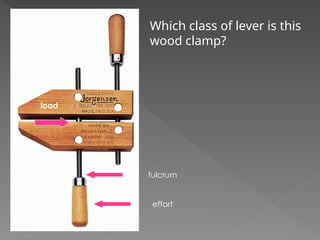
Which class oflever is this
wood clamp?
load
fulcrum
effort
30.
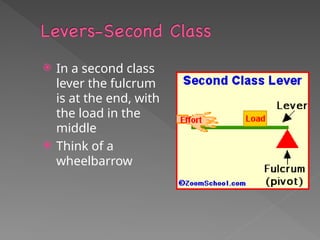
In asecond class
lever the fulcrum
is at the end, with
the load in the
middle
Think of a
wheelbarrow
31.
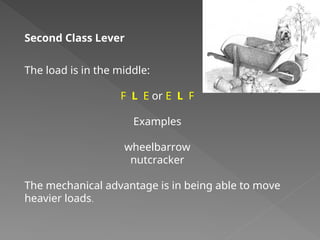
Second Class Lever
Theload is in the middle:
F L E or E L F
Examples
wheelbarrow
nutcracker
The mechanical advantage is in being able to move
heavier loads.
32.
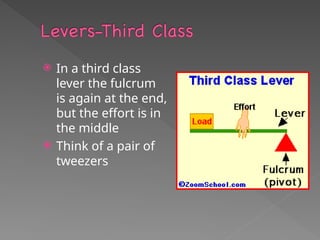
In athird class
lever the fulcrum
is again at the end,
but the effort is in
the middle
Think of a pair of
tweezers
33.
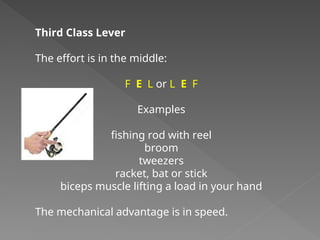
Third Class Lever
Theeffort is in the middle:
F E L or L E F
Examples
fishing rod with reel
broom
tweezers
racket, bat or stick
biceps muscle lifting a load in your hand
The mechanical advantage is in speed.
distance multiplier –a simple machine that moves a
load through a large distance with short effort
distance
e.g. third class lever
Example: hockey stick used for a slap shot
force multiplier – a simple machine that requires a
small effort force to move a massive load
e.g. first and second class lever
Example: crowbar used to open a door
36.
Simple Machinescan
be put together in
different ways to
make complex
machinery
#18 A sloping surface, such as a ramp. An inclined plane can be used to alter the effort and distance involved in doing work, such as lifting loads. The trade-off is that an object must be moved a longer distance than if it was lifted straight up, but less force is needed.
You can use this machine to move an object to a lower or higher place. Inclined planes make the work of moving things easier. You would need less energy and force to move objects with an inclined plane.