Work and machines Making jobs easier
Work Work is done on an object when a force is exerted on an object that causes the object to move some distance. No work without motion No work without force in the same direction
Motion and force Person does not work on weights – weights do not move Person does work on weights – weights moved Summer Olympics 2000 Sydney Australia  By Lou Jones  http://www.pricespower.com Force on weights Force on weights
Direction and force Horse does not work on the rider – force not in same direction Horse does work on the cart - force and motion in the same direction Force on person motion motion Force on cart
Calculating work Work = Force X Distance Force units = Newton, N Distance units = meter, m Work units = Joule, J J = N*m
Making work easier Machines Change the amount of force you exert Change the distance over which you exert force Change the direction in which you exert force Do  change the amount of work done NOT
Total work does not change Work = Force X Distance If a machine allows you to apply a smaller force the distance will increase If a machine reduces the distance the force will increase If a machine allows you to apply a force in a different direction it doesn’t change how much force you have to apply or how far you move it
Mechanical advantage The number of times a force exerted on a machine is multiplied by the machine Mechanical ad. =  Output force Input force If M.A. > 1 machine increases force needed but distance decreases If M.A. < 1 machine reduces force needed but distance increases
Efficiency Efficiency compares the output work to the input work (%) Cannot be greater than 100% Efficiency usually < 100% Friction
Types of simple machines Inclined plane Wedge Screw Lever Wheel and axle pulley Image taken from: http://www.daniel-wright.district103.k12.il.us/ccheifetz/physics.html
Levers A lever is a simple machine that consists of a bar that pivots at a set point, called a fulcrum.  There are 3 classes of levers, which are based on where the input force, output force, and fulcrum are placed in relation to the load.
Lever teacher.scholastic.com/dirtrep/ simple/img/lever.gif
Types of machines – simple & compound. Simple machines do work with one movement.  There are 6 simple machines. A compound machine is made of 2 or more simple machines.
The 3 types of Levers First class lever: the fulcrum (fixed point) is between the input force and the load.
Second class lever. Second class ever: the load is between the fulcrum and the input force.
Third class lever. Third class lever: the input force is between the fulcrum and the load.
Inclined plane teacher.scholastic.com/dirtrep/ simple/img/plane.gif
Inclined plane An inclined plane is a slanted surface used to raise an object. Work is made easier because the effort force moves over a greater distance. Mechanical advantage is equal to the length of the plane divided by its height.
Wedge teacher.scholastic.com/dirtrep/ simple/img/wedge.gif
Wedge A moving inclined plane. Force is multiplied since it is applied to a wide area and exerted over a small area. The “sharper” the wedge the greater the mechanical advantage.
Screw teacher.scholastic.com/dirtrep/ simple/img/screw.gif
A screw An inclined plane wrapped around a cylinder. It multiplies effort force by acting through a long effort distance. The closer the threads on a screw, the greater the mechanical advantage.
Pulley teacher.scholastic.com/dirtrep/ simple/img/pulley.gif                                                           
Pulley A belt, rope, or chain wrapped around a wheel. There are three main types of pulleys: fixed, movable, and block and tackle pulley system.
Fixed Pulley Does not multiply force. Changes the direction of the effort force. Mechanical advantage is equal to one.
Movable pulley Multiplies effort force but cannot change the direction of the effort force. The mechanical advantage is the effort distance divided by the resistance distance.
Pulley system A combination of fixed and movable pulleys. A mechanical advantage is equal to the number of supporting ropes.
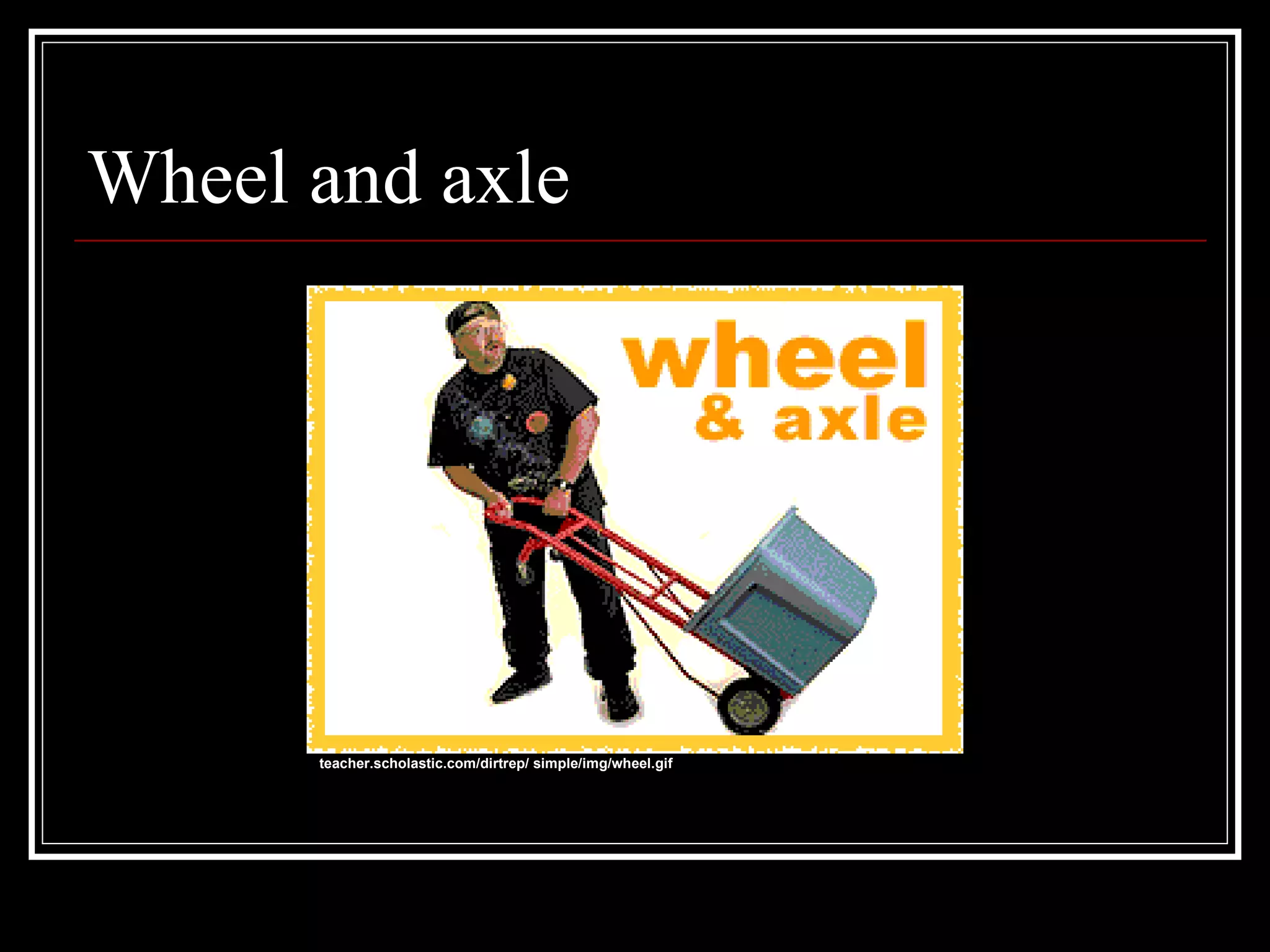
Wheel and axle teacher.scholastic.com/dirtrep/ simple/img/wheel.gif
Wheel and axel A lever that rotates in a circle around an axel. Two wheels of different sizes connected – the axel being the smaller wheel. Effort force to the wheel is multiplied at the axel.
Additional information Do not rely on just this study guide.  Some test and quiz questions will come from the book as well.

Work and simple machines

  • 1.
    Work and machinesMaking jobs easier
  • 2.
    Work Work isdone on an object when a force is exerted on an object that causes the object to move some distance. No work without motion No work without force in the same direction
  • 3.
    Motion and forcePerson does not work on weights – weights do not move Person does work on weights – weights moved Summer Olympics 2000 Sydney Australia By Lou Jones http://www.pricespower.com Force on weights Force on weights
  • 4.
    Direction and forceHorse does not work on the rider – force not in same direction Horse does work on the cart - force and motion in the same direction Force on person motion motion Force on cart
  • 5.
    Calculating work Work= Force X Distance Force units = Newton, N Distance units = meter, m Work units = Joule, J J = N*m
  • 6.
    Making work easierMachines Change the amount of force you exert Change the distance over which you exert force Change the direction in which you exert force Do change the amount of work done NOT
  • 7.
    Total work doesnot change Work = Force X Distance If a machine allows you to apply a smaller force the distance will increase If a machine reduces the distance the force will increase If a machine allows you to apply a force in a different direction it doesn’t change how much force you have to apply or how far you move it
  • 8.
    Mechanical advantage Thenumber of times a force exerted on a machine is multiplied by the machine Mechanical ad. = Output force Input force If M.A. > 1 machine increases force needed but distance decreases If M.A. < 1 machine reduces force needed but distance increases
  • 9.
    Efficiency Efficiency comparesthe output work to the input work (%) Cannot be greater than 100% Efficiency usually < 100% Friction
  • 10.
    Types of simplemachines Inclined plane Wedge Screw Lever Wheel and axle pulley Image taken from: http://www.daniel-wright.district103.k12.il.us/ccheifetz/physics.html
  • 11.
    Levers A leveris a simple machine that consists of a bar that pivots at a set point, called a fulcrum. There are 3 classes of levers, which are based on where the input force, output force, and fulcrum are placed in relation to the load.
  • 12.
  • 13.
    Types of machines– simple & compound. Simple machines do work with one movement. There are 6 simple machines. A compound machine is made of 2 or more simple machines.
  • 14.
    The 3 typesof Levers First class lever: the fulcrum (fixed point) is between the input force and the load.
  • 15.
    Second class lever.Second class ever: the load is between the fulcrum and the input force.
  • 16.
    Third class lever.Third class lever: the input force is between the fulcrum and the load.
  • 17.
  • 18.
    Inclined plane Aninclined plane is a slanted surface used to raise an object. Work is made easier because the effort force moves over a greater distance. Mechanical advantage is equal to the length of the plane divided by its height.
  • 19.
  • 20.
    Wedge A movinginclined plane. Force is multiplied since it is applied to a wide area and exerted over a small area. The “sharper” the wedge the greater the mechanical advantage.
  • 21.
  • 22.
    A screw Aninclined plane wrapped around a cylinder. It multiplies effort force by acting through a long effort distance. The closer the threads on a screw, the greater the mechanical advantage.
  • 23.
    Pulley teacher.scholastic.com/dirtrep/ simple/img/pulley.gif                                                         
  • 24.
    Pulley A belt,rope, or chain wrapped around a wheel. There are three main types of pulleys: fixed, movable, and block and tackle pulley system.
  • 25.
    Fixed Pulley Doesnot multiply force. Changes the direction of the effort force. Mechanical advantage is equal to one.
  • 26.
    Movable pulley Multiplieseffort force but cannot change the direction of the effort force. The mechanical advantage is the effort distance divided by the resistance distance.
  • 27.
    Pulley system Acombination of fixed and movable pulleys. A mechanical advantage is equal to the number of supporting ropes.
  • 28.
    Wheel and axleteacher.scholastic.com/dirtrep/ simple/img/wheel.gif
  • 29.
    Wheel and axelA lever that rotates in a circle around an axel. Two wheels of different sizes connected – the axel being the smaller wheel. Effort force to the wheel is multiplied at the axel.
  • 30.
    Additional information Donot rely on just this study guide. Some test and quiz questions will come from the book as well.