Simple machines


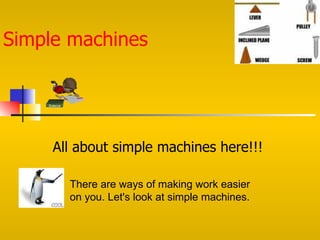
     All about simple machines here!!!

       There are ways of making work easier
       on you. Let's look at simple machines.
Inclined plane
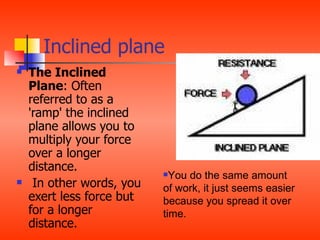
   The Inclined
    Plane: Often
    referred to as a
    'ramp' the inclined
    plane allows you to
    multiply your force
    over a longer
    distance.               You do the same amount
    In other words, you   of work, it just seems easier
    exert less force but   because you spread it over
    for a longer           time.
    distance.
Wedge
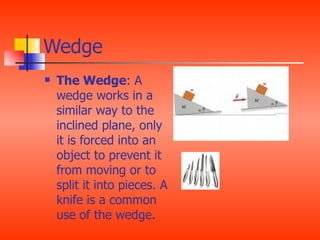
   The Wedge: A
    wedge works in a
    similar way to the
    inclined plane, only
    it is forced into an
    object to prevent it
    from moving or to
    split it into pieces. A
    knife is a common
    use of the wedge.
Screw
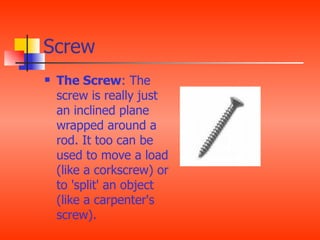
   The Screw: The
    screw is really just
    an inclined plane
    wrapped around a
    rod. It too can be
    used to move a load
    (like a corkscrew) or
    to 'split' an object
    (like a carpenter's
    screw).
Lever

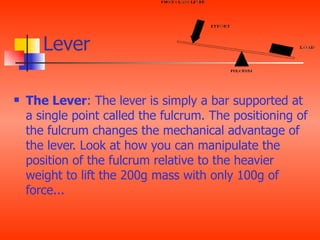
   The Lever: The lever is simply a bar supported at
    a single point called the fulcrum. The positioning of
    the fulcrum changes the mechanical advantage of
    the lever. Look at how you can manipulate the
    position of the fulcrum relative to the heavier
    weight to lift the 200g mass with only 100g of
    force...
Wheel and Axle
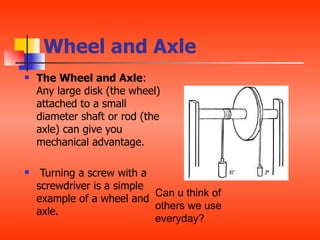
   The Wheel and Axle:
    Any large disk (the wheel)
    attached to a small
    diameter shaft or rod (the
    axle) can give you
    mechanical advantage.

    Turning a screw with a
    screwdriver is a simple
                            Can u think of
    example of a wheel and
                            others we use
    axle.
                            everyday?
First Class Lever


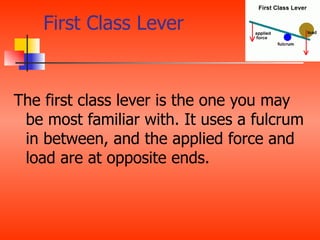
The first class lever is the one you may
 be most familiar with. It uses a fulcrum
 in between, and the applied force and
 load are at opposite ends.
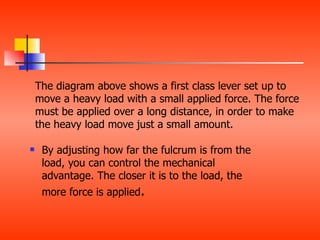
The diagram above shows a first class lever set up to
    move a heavy load with a small applied force. The force
    must be applied over a long distance, in order to make
    the heavy load move just a small amount.

    By adjusting how far the fulcrum is from the
     load, you can control the mechanical
     advantage. The closer it is to the load, the
     more force is applied.
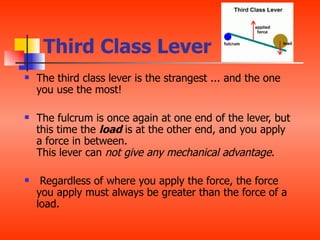
Second Class Lever
   The second class lever is one where the
    fulcrum is at one end, and the applied force
    at the other. The load that is to be moved is
    between them.

    This lever is different in how it works ... it
    causes the load to move in the same
    direction as the force you apply.
   Just as with a first class lever, how close
    the load is to the fulcrum determines by
    how much your force will be multiplied.
    If you want to move a very large load
    with a small applied force, you must put
    the load very close to the fulcrum.
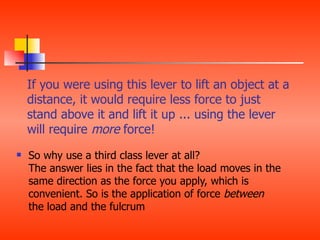
Third Class Lever
   The third class lever is the strangest ... and the one
    you use the most!

   The fulcrum is once again at one end of the lever, but
    this time the load is at the other end, and you apply
    a force in between.
    This lever can not give any mechanical advantage.

    Regardless of where you apply the force, the force
    you apply must always be greater than the force of a
    load.
If you were using this lever to lift an object at a
    distance, it would require less force to just
    stand above it and lift it up ... using the lever
    will require more force!
   So why use a third class lever at all?
    The answer lies in the fact that the load moves in the
    same direction as the force you apply, which is
    convenient. So is the application of force between
    the load and the fulcrum
THE END