Work & Machines Chapter 11
Doing Work Work is exerting a force on an object over a distance in the same direction as the objects motion. An example in when you pick up a box.  The force you exert is in the upward direction and the boxes movement is upward, so that is work.
Work Work depends on force and distance.  Force is always given in Newtons and distance will be given in meters. So if you want to find out how much work you did to lift that box you would use the equation W=F x d. So if the box was 300N and you lifted it 1.5m we would do 300N x 1.5m and get 450 N/m. We don’t use N/m when talking about work.  Its easier to say joule, which is a shorter way of saying N/m.  So our answer is 450 J.
More Work  Is walking up a hill work? Yes, every step you take is the distance that we would use in our formula,  W= F x d What is the force in this example? Your own weight is the force. Which would exert more work: You climbing a mountain or hiking up a mountain trail, given the dis was the same? They both use the same amount of force. H.W. pg 295 ques. 1-4
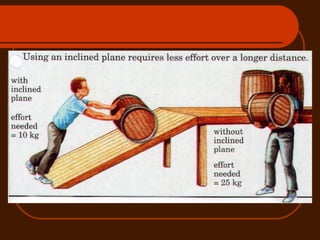
11-2 Simple machines A simple machine is a device the only does work with only one movement. Inclined plane- is a sloped surface that is used to make lifting easier. (a ramp) A screw- is an inclined plane that is wrapped around a rod and are used to hold materials together. A wedge- is an inclined plane that has one or two sloping sides. Like an axe or a scissor. They are used to split materials apart.
 
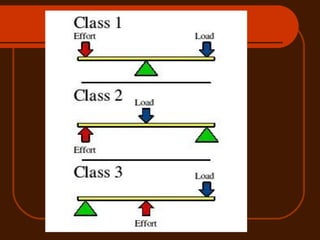
Levers Levers are simple machines which use a bar that is free to move around a pivot point, called a fulcrum. In a lever, the force you use to push down the bar is equal to the work at the other end. First class lever- is one that allows you to produce enough force to move something you wouldn’t normally be able to move. A seesaw is a first class lever, where the middle is the fulcrum and the people are the force.
Levers Second class levers- in a second class lever some of the weight of the object you are lifting is being transferred to the fulcrum so the amount of force you use in increased.  If you lift one end of a canoe and drag it along the floor is an example. The fulcrum is where the canoe is touching the floor. Another example is a wheel barrow.
Levers Third class lever- is one that doesn’t increase your force but does make work easier. Casting a line while fishing is a third class lever.  The fulcrum is your wrist and the bar is the fishing rod. If you move you wrist just a little the other end of the rod moves a lot.  Other ex are brooms & baseball bats.
 
Wheels, axels, and pulleys  Wheel and axel- is a simple machine that uses 2 different sized wheels that are connected and turn together. An ex is a door knob.  The knob is connected to an axel that goes through the door and connected to the latch that opens the door. When you turn the knob it turns the axel, which opens the door.  If you had to turn the axel with your fingers it would be extremely difficult.  The large knob makes it a lot easier.
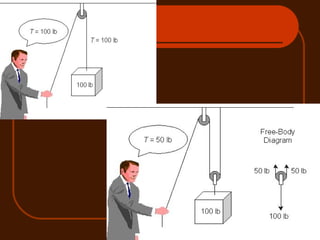
Pulleys A pulley is a surface with a rope or chain going around it.  They allow for very heavy things to be lifter a lot easier. A fixed pulley is one were the pulley does not move but the rope and the thing attached to it do move. In a moveable pulley system, 2 pulleys are used. One of the pulleys is fixed and the other moves to make the lifting even easier.
 
Compound machine These are when 2 or more simple machines are used together. Rowing a boat is a good example.  Your arm, hand and the ore are all levers.  Your elbow and the paddle of the ore are the fulcrums. In a scissor there are 2 levers a fulcrum and 2 wedges. Compound machines do not have to be fancy. How is a can opener is compound machine?

work and machines

  • 1.
    Work & MachinesChapter 11
  • 2.
    Doing Work Workis exerting a force on an object over a distance in the same direction as the objects motion. An example in when you pick up a box. The force you exert is in the upward direction and the boxes movement is upward, so that is work.
  • 3.
    Work Work dependson force and distance. Force is always given in Newtons and distance will be given in meters. So if you want to find out how much work you did to lift that box you would use the equation W=F x d. So if the box was 300N and you lifted it 1.5m we would do 300N x 1.5m and get 450 N/m. We don’t use N/m when talking about work. Its easier to say joule, which is a shorter way of saying N/m. So our answer is 450 J.
  • 4.
    More Work Is walking up a hill work? Yes, every step you take is the distance that we would use in our formula, W= F x d What is the force in this example? Your own weight is the force. Which would exert more work: You climbing a mountain or hiking up a mountain trail, given the dis was the same? They both use the same amount of force. H.W. pg 295 ques. 1-4
  • 5.
    11-2 Simple machinesA simple machine is a device the only does work with only one movement. Inclined plane- is a sloped surface that is used to make lifting easier. (a ramp) A screw- is an inclined plane that is wrapped around a rod and are used to hold materials together. A wedge- is an inclined plane that has one or two sloping sides. Like an axe or a scissor. They are used to split materials apart.
  • 6.
  • 7.
    Levers Levers aresimple machines which use a bar that is free to move around a pivot point, called a fulcrum. In a lever, the force you use to push down the bar is equal to the work at the other end. First class lever- is one that allows you to produce enough force to move something you wouldn’t normally be able to move. A seesaw is a first class lever, where the middle is the fulcrum and the people are the force.
  • 8.
    Levers Second classlevers- in a second class lever some of the weight of the object you are lifting is being transferred to the fulcrum so the amount of force you use in increased. If you lift one end of a canoe and drag it along the floor is an example. The fulcrum is where the canoe is touching the floor. Another example is a wheel barrow.
  • 9.
    Levers Third classlever- is one that doesn’t increase your force but does make work easier. Casting a line while fishing is a third class lever. The fulcrum is your wrist and the bar is the fishing rod. If you move you wrist just a little the other end of the rod moves a lot. Other ex are brooms & baseball bats.
  • 10.
  • 11.
    Wheels, axels, andpulleys Wheel and axel- is a simple machine that uses 2 different sized wheels that are connected and turn together. An ex is a door knob. The knob is connected to an axel that goes through the door and connected to the latch that opens the door. When you turn the knob it turns the axel, which opens the door. If you had to turn the axel with your fingers it would be extremely difficult. The large knob makes it a lot easier.
  • 12.
    Pulleys A pulleyis a surface with a rope or chain going around it. They allow for very heavy things to be lifter a lot easier. A fixed pulley is one were the pulley does not move but the rope and the thing attached to it do move. In a moveable pulley system, 2 pulleys are used. One of the pulleys is fixed and the other moves to make the lifting even easier.
  • 13.
  • 14.
    Compound machine Theseare when 2 or more simple machines are used together. Rowing a boat is a good example. Your arm, hand and the ore are all levers. Your elbow and the paddle of the ore are the fulcrums. In a scissor there are 2 levers a fulcrum and 2 wedges. Compound machines do not have to be fancy. How is a can opener is compound machine?